Gain unified visibility across IT and OT environments, detect and contain threats across converged infrastructure, and proactively reduce risk with a behavioral understanding of your unique operational environment.
OT security capabilities
Secure your critical infrastructure with Adaptive AI
Lorem ipsum dolor sit amet, consectetur adipiscing elit, sed do eiusmod tempor incididunt ut labore et dolore magna aliqua. Ut enim ad minim veniam, quis nostrud exercitation ullamco laboris nisi ut aliquip ex ea commodo consequat. Duis aute irure dolor in reprehenderit in voluptate velit esse cillum dolore eu fugiat nulla pariatur.
- Item A
- Item B
- Item C

The challenge
OT environments no longer operate in isolation
Lorem ipsum dolor sit amet, consectetur adipiscing elit, sed do eiusmod tempor incididunt ut labore et dolore magna aliqua. Ut enim ad minim veniam, quis nostrud exercitation ullamco laboris nisi ut aliquip ex ea commodo consequat. Duis aute irure dolor in reprehenderit in voluptate velit esse cillum dolore eu fugiat nulla pariatur.
- Item A
- Item B
- Item C
$4.56M
82%
of manufacturers experienced a cyber incident targeting OT in 2026
(Manufacturing Business Technology)
IT/OT security
Maintain resilience across your operational environments with visibility, threat detection, and risk management built for modern industrial systems.

Achieve unified visibility of OT & IT devices across every level of the Purdue Model
Lorem ipsum dolor sit amet, consectetur adipiscing elit, sed do eiusmod tempor incididunt ut labore et dolore magna aliqua. Ut enim ad minim veniam, quis nostrud exercitation ullamco laboris nisi ut aliquip ex ea commodo consequat. Duis aute irure dolor in reprehenderit in voluptate velit esse cillum dolore eu fugiat nulla pariatur.
- Item A
- Item B
- Item C
Continuous identification of OT and IT assets
Maintains a live asset inventory, obtained through passive and active scanning, and immediately reveals CVEs and End-Of-Life status.
Real-time monitoring of OT and relevant IT infrastructure
Gives you end-to-end coverage of industrial protocols and devices combined with industry leading analysis of IT activity, giving OT engineers and security operations the confidence to maintain productivity and security at the same time
Truly unify OT and IT to protect business operations
Allows security teams to protect all interconnected devices within a single trusted platform – from specialized OT production assets, to network and cloud connected IT systems


Detect, investigate, and contain threats across critical infrastructure
Lorem ipsum dolor sit amet, consectetur adipiscing elit, sed do eiusmod tempor incididunt ut labore et dolore magna aliqua. Ut enim ad minim veniam, quis nostrud exercitation ullamco laboris nisi ut aliquip ex ea commodo consequat. Duis aute irure dolor in reprehenderit in voluptate velit esse cillum dolore eu fugiat nulla pariatur.
- Item A
- Item B
- Item C
Detect sophisticated threats at scale
Darktrace learns the normal behaviour of your operational environment and detects known, novel, insider, and AI-accelerated threats without relying solely on rules, signatures, or threat intelligence. This enables earlier detection of suspicious activity across industrial networks.
Reduce investigation and triage time
Cyber AI Analyst automatically investigates alerts, correlates related activity across OT and IT environments, and provides incident context that helps analysts understand threats faster and reduce manual workloads.
Contain threats while maintaining operational uptime
Darktrace autonomously responds to threatening activity using customer-specific behavioral context, helping organizations contain threats quickly while minimizing disruption to industrial processes and critical operations.

Prioritize critical infrastructure risks with environmental context
Lorem ipsum dolor sit amet, consectetur adipiscing elit, sed do eiusmod tempor incididunt ut labore et dolore magna aliqua. Ut enim ad minim veniam, quis nostrud exercitation ullamco laboris nisi ut aliquip ex ea commodo consequat. Duis aute irure dolor in reprehenderit in voluptate velit esse cillum dolore eu fugiat nulla pariatur.
- Item A
- Item B
- Item C
Go beyond CVEs for contextual risk analysis
Darktrace evaluates vulnerabilities, assets, identities, communication paths, and operational dependencies together, helping teams understand which exposures create meaningful risk in their specific environment.
Mitigate risks with or without a patch
Operational environments often cannot patch immediately. Darktrace helps organizations understand exposure pathways, prioritize compensating controls, and reduce risk while maintaining operational continuity.
Evaluate resilience against advanced threats
Darktrace uses behavioral and environmental context to help teams understand likely attack paths, validate security posture, and prioritize defensive improvements against sophisticated adversaries targeting critical infrastructure.

Discover the Darktrace difference
Read the solution brief
Analyst recognition
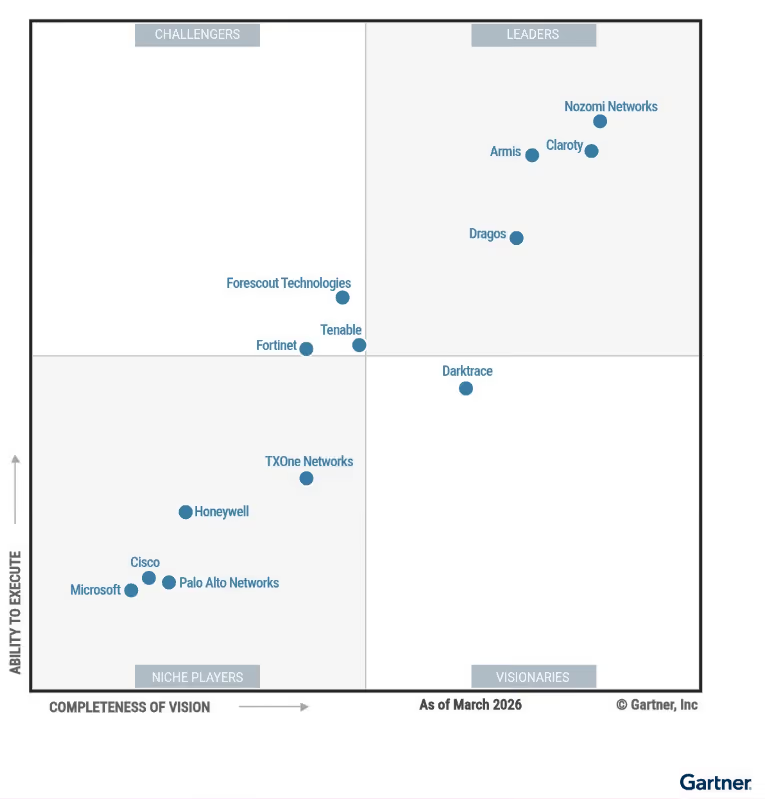
Darktrace named the only Visionary in the 2026 Gartner® Magic Quadrant™ for CPS Protection Platforms
Lorem ipsum dolor sit amet, consectetur adipiscing elit, sed do eiusmod tempor incididunt ut labore et dolore magna aliqua. Ut enim ad minim veniam, quis nostrud exercitation ullamco laboris nisi ut aliquip ex ea commodo consequat. Duis aute irure dolor in reprehenderit in voluptate velit esse cillum dolore eu fugiat nulla pariatur.
- Item A
- Item B
- Item C
Over 150 reviews on Gartner Peer Insights
4.8
on Gartner Peer Insights
Trusted OT security for today's challenges
Adaptive AI continuously learns your operational environment, helping detect known, novel, insider, and cross-domain threats across converged IT and OT infrastructure.
Adaptive AI changes the game
Read more on the challenges of securing high-profile events – including the ‘access paradox’, increasing IT and OT convergence, and the importance of a fast response

The limits of the air gap approach
Air-gapped security measures are not enough for resilience against cyber attacks. Read about how to gain visibility & reduce your cyber vulnerabilities.

How to spot OT insider threats
Read how insider threats pose a security risk specifically to OT systems, what the challenges are dealing with insider threats, and potential solutions for mitigating insider threats.

Managing risk beyond CVE scores
Identifying CVEs in the multitude of complex OT devices is labor-intensive and time-consuming, draining valuable resources. Darktrace can support.

How Conti ransomware took down OT
Read how ransomware can spread throughout converged IT/OT environments, and how Adaptive AI empowers organizations to contain these threats.

How Cyber AI Analyst accelerates reporting
Read how Darktrace helps defenders abide by US federal laws on reporting cybersecurity incidents.

Maps to major frameworks
Lorem ipsum dolor sit amet, consectetur adipiscing elit, sed do eiusmod tempor incididunt ut labore et dolore magna aliqua. Ut enim ad minim veniam, quis nostrud exercitation ullamco laboris nisi ut aliquip ex ea commodo consequat. Duis aute irure dolor in reprehenderit in voluptate velit esse cillum dolore eu fugiat nulla pariatur.
- Item A
- Item B
- Item C
Customer stories
Customer stories






Stronger as part of the Darktrace Behavioral Defense Platform
Lorem ipsum dolor sit amet, consectetur adipiscing elit, sed do eiusmod tempor incididunt ut labore et dolore magna aliqua. Ut enim ad minim veniam, quis nostrud exercitation ullamco laboris nisi ut aliquip ex ea commodo consequat. Duis aute irure dolor in reprehenderit in voluptate velit esse cillum dolore eu fugiat nulla pariatur.
- Item A
- Item B
- Item C

Frequently asked
questions
How does the convergence of IT and OT networks increase the risk of cyberattacks?
Integrating IT and OT benefits operations, but it presents new security challenges. In the past, OT systems were isolated and protected through physical safeguards. Today, the growing need for real-time data and remote access has widened the attack surface and placed OT environments at greater risk.
The expanded attack surface means that if an IT system is compromised, adversaries can exploit that entry point to infiltrate vulnerable OT devices, potentially disrupting mission-critical infrastructure. Many legacy OT systems lack modern security controls, which makes them susceptible to attacks.
The complexity of converged environments complicates effective threat detection. Standard IT security tools struggle to interpret the specialized protocols and operational behaviors found in OT networks due to factors such as heterogeneous technologies and proprietary controls. These environments blend various technologies, legacy OT systems, modern IT infrastructure, and various cloud services. This diversity makes it difficult to apply consistent security policies and maintain unified monitoring across the entire attack surface.
OT technology often uses proprietary communication protocols that traditional IT security tools cannot fully comprehend, making threat detection more challenging. Additionally, merged IT and OT systems create visibility gaps in the network, increasing the difficulty of tracking data flows and monitoring activity. Identification of potential security breaches is also more difficult. The combined volume of data generated by IT and OT systems can overwhelm security teams. Sifting through this data can hinder the identification and prioritization of threats.
The solution is a specialized approach to OT security. This approach should include network segmentation, isolation of critical systems, and intrusion detection systems to successfully identify threats.
Can small and medium-sized enterprises (SMEs) benefit from OT vulnerability management?
Yes, SMEs can greatly benefit from implementing a structured OT vulnerability management program that scales to their size and complexity. SMEs can leverage effective vulnerability management tools to create more efficient processes and procedures aimed at safeguarding their OT systems. With proper OT risk management, SMEs can mitigate risks related to outdated systems, poor patch management, and vulnerabilities specific to their OT environment. Small businesses can adopt scalable OT security tools that address key vulnerabilities, ensuring compliance with security standards and reducing the risk of costly disruptions, even with limited resources.
What are the key differences between security solutions designed for IT and those designed for OT environments?
While IT and OT security share the common goal of asset protection, their underlying priorities and operational constraints require different approaches. IT security prioritizes data protection and system availability, while OT security emphasizes safety and operational continuity.
In IT security, data confidentiality and availability are typically primary goals, and they are achieved through proactive security measures. Common practices include active vulnerability scanning and threat detection. Regular patching cycles are also common. In these environments, scheduled downtime for security maintenance is often acceptable and involves balancing security with system uptime.
The main objectives in OT environments are ensuring the safe and continuous operation of critical infrastructure and industrial processes. This is best achieved through passive network monitoring, anomaly detection, and behavioral analytics designed to minimize operational impact. Unlike IT environments, where scheduled downtime for routine maintenance is common, even brief disruptions in OT environments can significantly impact safety and productivity. OT environments rely on specialized and often proprietary protocols, requiring security tools with deep protocol awareness.
These two environments also differ in their threat landscapes. Adversaries frequently target specific entry points like ICS and SCADA devices, whereas IT systems face attacks targeting data, systems, and users.
Frequent patching, a cornerstone of IT security, can introduce unacceptable risks and operational disruptions in OT environments. Plus, OT system availability for patching typically ranges from impractical to impossible. As a result, OT systems require tailored incident response that acknowledges their unique operational requirements and risk profiles. Specialized solutions that provide nonintrusive monitoring and advanced threat detection are a better approach.
What is an OT attack?
An OT attack targets the control systems and devices that manage critical infrastructure, such as industrial control systems (ICS), SCADA systems, and manufacturing operations. These attacks often exploit legacy protocols, unpatched vulnerabilities, and weak network segmentation, compromising key processes and potentially leading to operational shutdowns, equipment damage, and physical hazards. The effects of such attacks are often severe, leading to costly downtime, environmental damage, and potential threats to human life.
How can organizations detect and respond to insider threats in OT environments?
Effective insider threat management in OT requires a laser focus on user behavior and strict access controls. It also calls for swift responses to minimize the window of opportunity for adversaries or compromised insiders to impact critical operations.
Insider threat detection methods in OT environments include anomaly detection, behavioral analysis, least privilege enforcement, and change management controls. Leverage advanced analytics and machine learning to automatically identify anomalous activity that deviates from established baselines. Prioritize alerts based on severity and potential impact to minimize alert fatigue. Then, ensure timely investigation and response.
Establish behavioral baselines for all users and devices by continuously monitoring access patterns, command usage, data transfers, and network activity. Identify deviations from these established norms because subtle changes can be early indicators of compromise. Also, implement a granular access control model based on the least privilege principle. This model grants users only the minimum necessary privileges to perform their assigned tasks. Review and update access rights as needed based on job roles and responsibilities.
Enforce rigorous change management processes that require multilevel approvals and automated auditing for all modifications to OT systems and configurations. This practice helps to prevent unauthorized changes and maintain system integrity.
Organizations can strengthen their defenses against insider threats and protect the integrity and reliability of their OT environments with automated alerting. Configure systems to automatically generate high-fidelity alerts. These alerts should be enriched with contextual information and routed to the appropriate security personnel for immediate review. Organizations also need to develop and maintain a tailored incident response plan with procedures for insider threat response. Regularly test this plan through simulations and tabletop exercises to ensure its effectiveness.
Swift containment and thorough investigation are also essential. Network segmentation and automated isolation strategies contain affected systems and quickly limit the blast radius of a potential breach by adversaries. This measure helps minimize disruption to critical operations. When incidents occur, conduct forensic investigations to determine the root cause and identify all affected systems and data. Then, implement appropriate remediation measures to prevent future occurrences.
What are the key considerations for securing remote access to OT systems?
Organizations need a comprehensive defense to secure remote access to OT because connecting previously isolated systems introduces inherent security risks. Use a zero trust architecture to minimize the attack surface and maintain operational integrity. This practice is particularly important for remote access, where users are connecting from potentially untrusted devices and networks.
Enforce strict policies for remote access, including multi-factor authentication (MFA), strong authentication methods, guidelines for password management, device security, and acceptable use. Adhere to best practices like role-based access control and give remote users the minimum necessary permissions based on their specific tasks and the systems access needed to complete them. Doing so limits lateral movement and reduces the potential for abuse.
Utilize encrypted communication channels, such as VPNs with strong cipher suites, to protect remote access traffic from eavesdropping and tampering. Monitor and record these sessions to detect and investigate suspicious activity. Proactively address vulnerabilities by conducting regular assessments of remote access infrastructure and promptly remediating any identified weaknesses. Also, analyze this activity for anomalous patterns that could indicate compromised accounts to detect threats in real time.
Is SCADA an OT system?
Yes, SCADA (Supervisory Control and Data Acquisition) is an essential OT system used to control and monitor industrial processes such as manufacturing, energy distribution, and water treatment. SCADA systems are critical to operational control, providing real-time data and remote access to OT assets. However, as these systems become more connected to IT networks, they are increasingly vulnerable to cyber threats, making SCADA security a crucial aspect of OT cybersecurity.