Blog
/
Email
/
April 10, 2023

Detecting Malicious Email Activity & AI Impersonating

Discover how two different phishing attempts from some known and unknown senders used a payroll diversion and credential sealing box link to harm users.
Inside the SOC
Darktrace cyber analysts are world-class experts in threat intelligence, threat hunting and incident response, and provide 24/7 SOC support to thousands of Darktrace customers around the globe. Inside the SOC is exclusively authored by these experts, providing analysis of cyber incidents and threat trends, based on real-world experience in the field.
Written by
Isabelle Cheong
Cyber Security Analyst
Default blog imageDefault blog imageDefault blog imageDefault blog imageDefault blog imageDefault blog image
10
Apr 2023

Social engineering has become widespread in the cyber threat landscape in recent years, and the near-universal use of social media today has allowed attackers to research and target victims more effectively. Social engineering involves manipulating users to carry out actions such as revealing sensitive information like login credentials or credit card details. It can also lead to user account compromises, causing huge disruption to an organization’s digital estate. 

As people use social media platforms not only for personal reasons, but also for business purposes, attackers gain information they can exploit in social engineering attacks. For example, a threat actor may attempt to impersonate a known individual or legitimate service to take advantage of a user’s established trust. This is a highly successful method of social engineering because mimicking known contacts makes it difficult for traditional security tools that rely on deny-lists to detect the attack.

In October 2022, Darktrace identified and responded to two separate malicious email campaigns in which threat actors attempted to impersonate known contacts in an effort to compromise customer devices. As it learns the normal behavior of every user in the email system, Darktrace was able to instantly detect these threats and mitigate them autonomously, preventing significant disruption to the customer networks.

Payroll Diversion Fraud Attempt Impersonating a Former Employee 

While a customer in the Canadian energy sector was trialing Darktrace in October 2022, Darktrace/Email™ identified a suspicious email seemingly sent from an employee within the organization. The email was sent to the Senior Director of Human Resources (HR) with a subject line of “Change in payroll Direct Deposit.” The email requested a change in bank account information for an employee. However, Darktrace recognized that the sender was using a free mail address that contained random letters, indicating it may have been algorithmically generated. Since this incident occurred during a trial, Darktrace/Email was not configured to take action. Otherwise, it would have prevented the email from landing in the inbox. In this case though, the email went through, bypassing all other security tools in place.

Although the email was from an unknown sender, the HR director believed the email could have been legitimate as the employee who appeared to be the sender had left the organization seven days prior and no longer had access to their corporate email account. However, after reviewing it in the Darktrace/Email dashboard, the customer grew suspicious and contacted the former employee directly to verify if the request was legitimate. The former employee validated the suspicions by confirming they had sent no such email.

Further investigation by the customer revealed that the former employee had been vocal about their departure on various social media platforms. This gave threat actors valuable information to believably impersonate the former employee and defraud the organization. 

Such attempts to target organizations’ HR departments and divert payroll are common tactics for cyber-criminals and are often identified by Darktrace/Email across the customer base. Darktrace/Email is able to instantly identify the indicators associated with these spoofing attempts and immediately bring them to the attention of the customer’s security team. 

Using Legitimate File Sharing Service to Share a Phishing Link 

On October 7, 2022, a customer in the Singaporean construction sector was targeted by a phishing campaign attempting to impersonate a law firm known to the organization. Almost 200 employees received an email with the subject line “Accepted: Valuation Agreement.” 
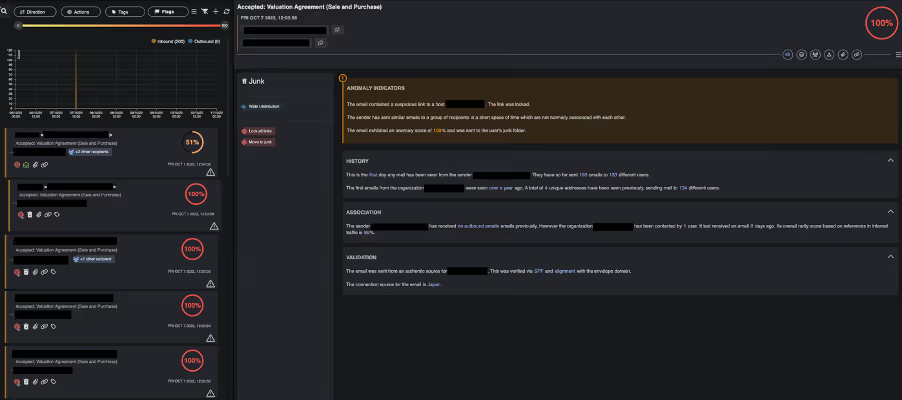
Figure 1: Sample of an UI view of the message held showing anomaly indicators, history, association, and validation.

Four days earlier, Darktrace observed communication between another email address associated with the law firm and an employee of the customer. Darktrace/Email noted that it was the first time this correspondent had sent emails to the customer. 

Figure 2: Metrics showing how well the sender’s domain is known within the digital environment.

The emails contained a highly unusual link to a file sharing service, (hxxps://ssvilvensstokes[.]app[.]box[.]com/notes), hidden behind the text “PREVIEW OR PRINT COPY OF DOCUMENT HERE.” Darktrace analysts investigated this event further and found that around 30 similar URLs had been identified as suspicious using OSINT security tools in October 2022, suggesting the customer was not the only target of this phishing campaign.

Figure 3: Preview of the phishing email’s body.
Figure 4: Darktrace’s evaluation of the link contained in the phishing email.

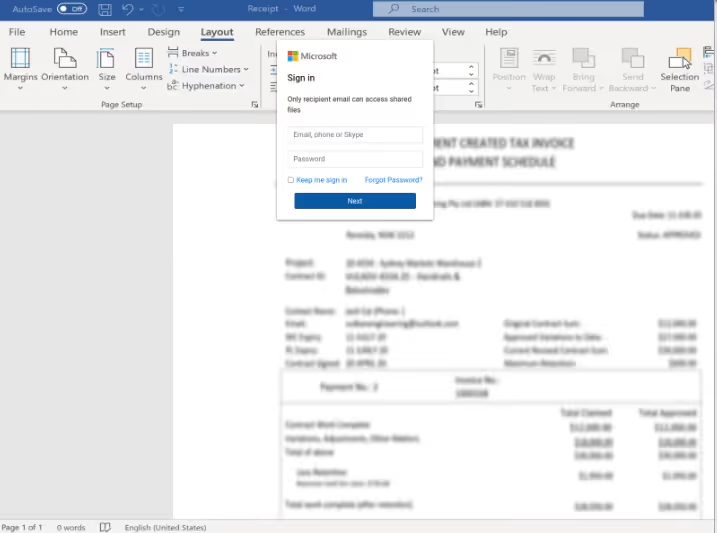
Additional OSINT work revealed that the link directed to a website which appeared to host a PDF file named “Valuation Agreement.” The recipient would then be prompted to follow another link (hulking-citrine-krypton[.]glitch[.]me), again hidden behind the text “OPEN OR ACCESS DOCUMENT HERE” to view the file. Subsequently, the user would be prompted to enter their Microsoft 365 credentials. 

Figure 5: The page displayed when the phishing link was clicked, viewed in a sandbox environment.
Figure 6: Example of a page shown when recipient clicks the second link, accessing “hulking-citrine-krypton[.]glitch[.]me”. 

This page contained the text “This document has been scanned for viruses by Norton Antivirus Security.” This is another example of threat actors’ employing social engineering techniques by impersonating well-known brands, such as established security vendors, to gain the trust of users and increase their likelihood of success.

It is highly probable that a real employee of the law firm had their account hijacked and that a malicious actor was exploiting it to send out these phishing emails en masse as part of a supply chain attack. In such cases, malicious actors rely on their targets’ trust of known contacts to not question departures from their normal conversations. 

Darktrace was able to instantly detect multiple anomalies in these emails, despite the fact that they were seemingly sent by known correspondents. The activity detected automatically triggered model breaches associated with unexpected and visually prominent links. As a result, Darktrace/Email responded by locking the link, stopping users from being able to click it.

Darktrace subsequently identified additional emails from this sender attempting to target other recipients within the company, triggering the model breaches associated with a surge in email sending indicative of a phishing campaign. In response, Darktrace/Email autonomously acted and filed these emails as junk. As more emails were detected across the customer’s environment, the anomaly score of the sender increased and Darktrace ultimately held back over 160 malicious emails, safeguarding recipients from potential account compromise.           

The following Darktrace/Email models were breached throughout the course of this phishing campaign:

  • Unusual/Sender Surge 
  • Unusual/Undisclosed Recipients 
  • Antigena Anomaly 
  • Association/Unlikely Recipient Association 
  • Link/Low Link Association 
  • Link/Visually Prominent Link 
  • Link/Visually Prominent Link Unexpected For Sender 
  • Unusual/New Sender Wide Distribution
  • Unusual/Undisclosed Recipients + New Address Known Domain

Conclusion

Social engineering plays a role in many of the major threats challenging current email cyber security, as attackers can use it to manipulate users into transferring money, revealing credentials, clicking malicious links, and more. 

The above threat stories happened before language generating AI became mainstream with the release of ChatGPT in December 2022. Now, it is even easier for malicious actors to generate sophisticated social engineering emails. By using social media posts as input, social engineering emails written by generative AI can be highly targeted and produced at scale. They often avoid the flags users are trained to look for, like poor grammar and spelling mistakes, and can hide payloads or forgo them entirely.

To mitigate the risk of possible social engineering attempts, it is recommended that organizations implement social media policies that advise employees to be cautious of what they post online and enact procedures to verify if fund transfer requests are legitimate.

Yet these policies are not enough on their own. Darktrace/Email can identify suspicious email traits, whether an email is sent from a known correspondent or an unknown sender. With Self-Learning AI, it knows an organization’s users better than any impersonator could. In this way, Darktrace/Email detects anomalies within emails and neutralizes malicious components at machine-speed, stopping attacks at their earliest stages, before employees fall victim. 

Appendices

List of Indicators of Compromise (IoCs)

Domain:

hxxps://ssvilvensstokes[.]app[.]box[.]com/notes/*?s=* - 1st external link (seen in email)

hxxps://hulking-citrine-krypton[.]glitch[.]me/flk.html - 2nd external link, masked behind “OPEN OR ACCESS DOCUMENT HERE”

Inside the SOC
Darktrace cyber analysts are world-class experts in threat intelligence, threat hunting and incident response, and provide 24/7 SOC support to thousands of Darktrace customers around the globe. Inside the SOC is exclusively authored by these experts, providing analysis of cyber incidents and threat trends, based on real-world experience in the field.
Written by
Isabelle Cheong
Cyber Security Analyst

More in this series

No items found.

Blog

/

/

February 13, 2026

CVE-2026-1731: How Darktrace Sees the BeyondTrust Exploitation Wave Unfolding

Default blog imageDefault blog image

Note: Darktrace's Threat Research team is publishing now to help defenders. We will update continue updating this blog as our investigations unfold.

Background

On February 6, 2026, the Identity & Access Management solution BeyondTrust announced patches for a vulnerability, CVE-2026-1731, which enables unauthenticated remote code execution using specially crafted requests.  This vulnerability affects BeyondTrust Remote Support (RS) and particular older versions of Privileged Remote Access (PRA) [1].

A Proof of Concept (PoC) exploit for this vulnerability was released publicly on February 10, and open-source intelligence (OSINT) reported exploitation attempts within 24 hours [2].

Previous intrusions against Beyond Trust technology have been cited as being affiliated with nation-state attacks, including a 2024 breach targeting the U.S. Treasury Department. This incident led to subsequent emergency directives from  the Cybersecurity and Infrastructure Security Agency (CISA) and later showed attackers had chained previously unknown vulnerabilities to achieve their goals [3].

Additionally, there appears to be infrastructure overlap with React2Shell mass exploitation previously observed by Darktrace, with command-and-control (C2) domain  avg.domaininfo[.]top seen in potential post-exploitation activity for BeyondTrust, as well as in a React2Shell exploitation case involving possible EtherRAT deployment.

Darktrace Detections

Darktrace’s Threat Research team has identified highly anomalous activity across several customers that may relate to exploitation of BeyondTrust since February 10, 2026. Observed activities include:

-              Outbound connections and DNS requests for endpoints associated with Out-of-Band Application Security Testing; these services are commonly abused by threat actors for exploit validation.  Associated Darktrace models include:

o    Compromise / Possible Tunnelling to Bin Services

-              Suspicious executable file downloads. Associated Darktrace models include:

o    Anomalous File / EXE from Rare External Location

-              Outbound beaconing to rare domains. Associated Darktrace models include:

o   Compromise / Agent Beacon (Medium Period)

o   Compromise / Agent Beacon (Long Period)

o   Compromise / Sustained TCP Beaconing Activity To Rare Endpoint

o   Compromise / Beacon to Young Endpoint

o   Anomalous Server Activity / Rare External from Server

o   Compromise / SSL Beaconing to Rare Destination

-              Unusual cryptocurrency mining activity. Associated Darktrace models include:

o   Compromise / Monero Mining

o   Compromise / High Priority Crypto Currency Mining

And model alerts for:

o    Compromise / Rare Domain Pointing to Internal IP

IT Defenders: As part of best practices, we highly recommend employing an automated containment solution in your environment. For Darktrace customers, please ensure that Autonomous Response is configured correctly. More guidance regarding this activity and suggested actions can be found in the Darktrace Customer Portal.  

Appendices

Potential indicators of post-exploitation behavior:

·      217.76.57[.]78 – IP address - Likely C2 server

·      hXXp://217.76.57[.]78:8009/index.js - URL -  Likely payload

·      b6a15e1f2f3e1f651a5ad4a18ce39d411d385ac7  - SHA1 - Likely payload

·      195.154.119[.]194 – IP address – Likely C2 server

·      hXXp://195.154.119[.]194/index.js - URL – Likely payload

·      avg.domaininfo[.]top – Hostname – Likely C2 server

·      104.234.174[.]5 – IP address - Possible C2 server

·      35da45aeca4701764eb49185b11ef23432f7162a – SHA1 – Possible payload

·      hXXp://134.122.13[.]34:8979/c - URL – Possible payload

·      134.122.13[.]34 – IP address – Possible C2 server

·      28df16894a6732919c650cc5a3de94e434a81d80 - SHA1 - Possible payload

References:

1.        https://nvd.nist.gov/vuln/detail/CVE-2026-1731

2.        https://www.securityweek.com/beyondtrust-vulnerability-targeted-by-hackers-within-24-hours-of-poc-release/

3.        https://www.rapid7.com/blog/post/etr-cve-2026-1731-critical-unauthenticated-remote-code-execution-rce-beyondtrust-remote-support-rs-privileged-remote-access-pra/

Continue reading
About the author
Emma Foulger
Global Threat Research Operations Lead

Blog

/

/

February 13, 2026

How AI is redefining cybersecurity and the role of today’s CIO

Default blog imageDefault blog image

Why AI is essential to modern security

As attackers use automation and AI to outpace traditional tools and people, our approach to cybersecurity must fundamentally change. That’s why one of my first priorities as Withum's CIO was to elevate cybersecurity from a technical function to a business enabler.

What used to be “IT’s problem” is now a boardroom conversation – and for good reason. Protecting our data, our people, and our clients directly impacts revenue, reputation and competitive positioning.  

As CIOs / CISOs, our responsibilities aren’t just keeping systems running, but enabling trust, protecting our organization's reputation, and giving the business confidence to move forward even as the digital world becomes less predictable. To pull that off, we need to know the business inside-out, understand risk, and anticipate what's coming next. That's where AI becomes essential.

Staying ahead when you’re a natural target

With more than 3,100 team members and over 1,000 CPAs (Certified Public Accountant), Withum’s operates in an industry that naturally attracts attention from attackers. Firms like ours handle highly sensitive financial and personal information, which puts us squarely in the crosshairs for sophisticated phishing, ransomware, and cloud-based attacks.

We’ve built our security program around resilience, visibility, and scale. By using Darktrace’s AI-powered platform, we can defend against both known and unknown threats, across email and network, without slowing our teams down.

Our focus is always on what we’re protecting: our clients’ information, our intellectual property, and the reputation of the firm. With Darktrace, we’re not just keeping up with the massive volume of AI-powered attacks coming our way, we’re staying ahead. The platform defends our digital ecosystem around the clock, detecting potential threats across petabytes of data and autonomously investigating and responding to tens of thousands of incidents every year.

Catching what traditional tools miss

Beyond the sheer scale of attacks, Darktrace ActiveAI Security PlatformTM is critical for identifying threats that matter to our business. Today’s attackers don’t use generic techniques. They leverage automation and AI to craft highly targeted attacks – impersonating trusted colleagues, mimicking legitimate websites, and weaving in real-world details that make their messages look completely authentic.

The platform, covering our network, endpoints, inboxes, cloud and more is so effective because it continuously learns what’s normal for our business: how our users typically behave, the business- and industry-specific language we use, how systems communicate, and how cloud resources are accessed. It picks up on minute details that would sail right past traditional tools and even highly trained security professionals.

Freeing up our team to do what matters

On average, Darktrace autonomously investigates 88% of all our security events, using AI to connect the dots across email, network, and cloud activity to figure out what matters. That shift has changed how our team works. Instead of spending hours sorting through alerts, we can focus on proactive efforts that actually strengthen our security posture.

For example, we saved 1,850 hours on investigating security issues over a ten-day period. We’ve reinvested the time saved into strengthening policies, refining controls, and supporting broader business initiatives, rather than spending endless hours manually piecing together alerts.

Real confidence, real results

The impact of our AI-driven approach goes well beyond threat detection. Today, we operate from a position of confidence, knowing that threats are identified early, investigated automatically, and communicated clearly across our organization.

That confidence was tested when we withstood a major ransomware attack by a well-known threat group. Not only were we able to contain the incident, but we were able to trace attacker activity and provided evidence to law enforcement. That was an exhilarating experience! My team did an outstanding job, and moments like that reinforce exactly why we invest in the right technology and the right people.

Internally, this capability has strengthened trust at the executive level. We share security reporting regularly with leadership, translating technical activity into business-relevant insights. That transparency reinforces cybersecurity as a shared responsibility, one that directly supports growth, continuity, and reputation.

Culturally, we’ve embedded security awareness into daily operations through mandatory monthly training, executive communication, and real-world industry examples that keep cybersecurity top of mind for every employee.

The only headlines we want are positive ones: Withum expanding services, Withum growing year over year. Security plays a huge role in making sure that’s the story we get to tell.

What’s next

Looking ahead, we’re expanding our use of Darktrace, including new cloud capabilities that extend AI-driven visibility and investigation into our AWS and Azure environments.

As I continue shaping our security team, I look for people with passion, curiosity, and a genuine drive to solve problems. Those qualities matter just as much as formal credentials in my view. Combined with AI, these attributes help us build a resilient, engaged security function with low turnover and high impact.

For fellow technology leaders, my advice is simple: be forward-thinking and embrace change. We must understand the business, the threat landscape, and how technology enables both. By augmenting human expertise rather than replacing it, AI allows us to move upstream by anticipating risk, advising the business, and fostering stronger collaboration across teams.

Continue reading
About the author
Your data. Our AI.
Elevate your network security with Darktrace AI