

Blog
/
Network
/
November 12, 2025

Unmasking Vo1d: Inside Darktrace’s Botnet Detection

Earlier this year, Darktrace investigated the Vo1d malware campaign, tracing its activity from DGA-based DNS beaconing to major cloud infrastructure and ultimately to its C2 server communications. This blog explores how Darktrace detected Vo1d and presents a detailed timeline of Cyber AI Analyst’s investigation.
Inside the SOC
Darktrace cyber analysts are world-class experts in threat intelligence, threat hunting and incident response, and provide 24/7 SOC support to thousands of Darktrace customers around the globe. Inside the SOC is exclusively authored by these experts, providing analysis of cyber incidents and threat trends, based on real-world experience in the field.
Written by
Christina Kreza
Cyber Analyst
Unmasking Vo1d: Inside Darktrace’s Botnet DetectionDefault blog imageDefault blog imageDefault blog imageDefault blog imageDefault blog imageDefault blog image
12
Nov 2025

What is Vo1d APK malware?

Vo1d malware first appeared in the wild in September 2024 and has since evolved into one of the most widespread Android botnets ever observed. This large-scale Android malware primarily targets smart TVs and low-cost Android TV boxes. Initially, Vo1d was identified as a malicious backdoor capable of installing additional third-party software [1]. Its functionality soon expanded beyond the initial infection to include deploying further malicious payloads, running proxy services, and conducting ad fraud operations. By early 2025, it was estimated that Vo1d had infected 1.3 to 1.6 million devices worldwide [2].

From a technical perspective, Vo1d embeds components into system storage to enable itself to download and execute new modules at any time. External researchers further discovered that Vo1d uses Domain Generation Algorithms (DGAs) to create new command-and-control (C2) domains, ensuring that regardless of existing servers being taken down, the malware can quickly reconnect to new ones. Previous published analysis identified dozens of C2 domains and hundreds of DGA seeds, along with new downloader families. Over time, Vo1d has grown increasingly sophisticated with clear signs of stronger obfuscation and encryption methods designed to evade detection [2].

Darktrace’s coverage

Earlier this year, Darktrace observed a surge in Vo1d-related activity across customer environments, with the majority of affected customers based in South Africa. Devices that had been quietly operating as expected began exhibiting unusual network behavior, including excessive DNS lookups. Open-source intelligence (OSINT) has long highlighted South Africa as one of the countries most impacted by Vo1d infections [2].

What makes the recent activity particularly interesting is that the surge observed by Darktrace appears to be concentrated specifically in South African environments. This localized spike suggests that a significant number of devices may have been compromised, potentially due to vulnerable software, outdated firmware, or even preloaded malware. Regions with high prevalence of low-cost, often unpatched devices are especially susceptible, as these everyday consumer electronics can be quietly recruited into the botnet’s network. This specifically appears to be the case with South Africa, where public reporting has documented widespread use of low-cost boxes, such as non-Google-certified Android TV sticks, that frequently ship with outdated firmware [3].

The initial triage highlighted the core mechanism Vo1d uses to remain resilient: its use of DGA. A DGA deterministically creates a large list of pseudo-random domain names on a predictable schedule. This enables the malware to compute hundreds of candidate domains using the same algorithm, instead of using a hard-coded single C2 hostname that defenders could easily block or take down. To ensure reproducible from the infected device’s perspective, Vo1d utilizes DGA seeds. These seeds might be a static string, a numeric value, or a combination of underlying techniques that enable infected devices to generate the same list of candidate domains for a time window, provided the same DGA code, seed, and date are used.

Interestingly, Vo1d’s DGA seeds do not appear to be entirely unpredictable, and the generated domains lack fully random-looking endings. As observed in Figure 1, there is a clear pattern in the names generated. In this case, researchers identified that while the first five characters would change to create the desired list of domain names, the trailing portion remained consistent as part of the seed: 60b33d7929a, which OSINT sources have linked to the Vo1d botnet. [2]. Darktrace’s Threat Research team also identified a potential second DGA seed, with devices in some cases also engaging in activity involving hostnames matching the regular expression /[a-z]{5}fc975904fc9\.(com|top|net). This second seed has not been reported by any OSINT vendors at the time of writing.

Another recurring characteristic observed across multiple cases was the choice of top-level domains (TLDs), which included .com, .net, and .top.
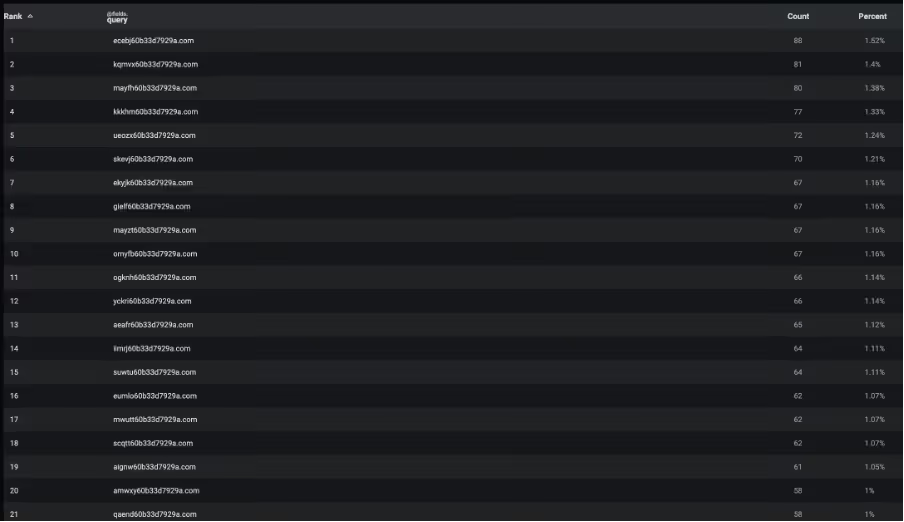
Figure 1: Advanced Search results showing DNS lookups, providing a glimpse on the DGA seed utilized.

The activity was detected by multiple models in Darktrace / NETWORK™, which triggered on devices making an unusually large volume of DNS requests for domains uncommon across the network.

During the network investigation, Darktrace analysts traced Vo1d’s infrastructure and uncovered an interesting pattern related to responder ASNs. A significant number of connections pointed to AS16509 (AMAZON-02). By hosting redirectors or C2 nodes inside major cloud environments, Vo1d is able to gain access to highly available and geographically diverse infrastructure. When one node is taken down or reported, operators can quickly enable a new node under a different IP within the same ASN. Another feature of cloud infrastructure that hardens Vo1d’s resilience is the fact that many organizations allow outbound connections to cloud IP ranges by default, assuming they are legitimate. Despite this, Darktrace was able to identify the rarity of these endpoints, identifying the unusualness of the activity.

Analysts further observed that once a generated domain successfully resolved, infected devices consistently began establishing outbound connections to ephemeral port ranges like TCP ports 55520 and 55521. These destination ports are atypical for standard web or DNS traffic. Even though the choice of high-numbered ports appears random, it is likely far from not accidental. Commonly used ports such as port 80 (HTTP) or 443 (HTTPS) are often subject to more scrutiny and deeper inspection or content filtering, making them riskier for attackers. On the other hand, unregistered ports like 55520 and 55521 are less likely to be blocked, providing a more covert channel that blends with outbound TCP traffic. This tactic helps evade firewall rules that focus on common service ports. Regardless, Darktrace was able to identify external connections on uncommon ports to locations that the network does not normally visit.

The continuation of the described activity was identified by Darktrace’s Cyber AI Analyst, which correlated individual events into a broader interconnected incident. It began with the multiple DNS requests for the algorithmically generated domains, followed by repeated connections to rare endpoints later confirmed as attacker-controlled infrastructure. Cyber AI Analyst’s investigation further enabled it to categorize the events as part of the “established foothold” phase of the attack.
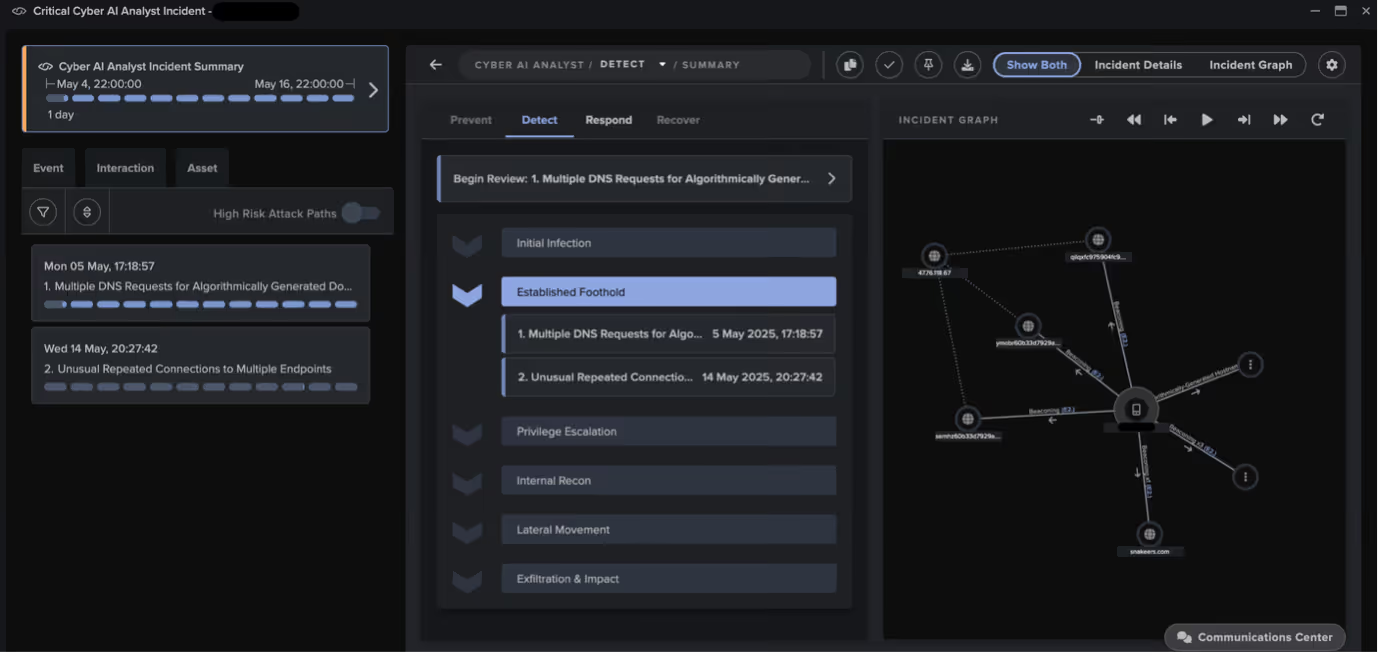
Figure 2: Cyber AI Analyst incident illustrating the transition from DNS requests for DGA domains to connections with resolved attacker-controlled infrastructure.

Conclusion

The observations highlighted in this blog highlight the precision and scale of Vo1d’s operations, ranging from its DGA-generated domains to its covert use of high-numbered ports. The surge in affected South African environments illustrate how regions with many low-cost, often unpatched devices can become major hubs for botnet activity. This serves as a reminder that even everyday consumer electronics can play a role in cybercrime, emphasizing the need for vigilance and proactive security measures.

Credit to Christina Kreza (Cyber Analyst & Team Lead) and Eugene Chua (Principal Cyber Analyst & Team Lead)

Edited by Ryan Traill (Analyst Content Lead)

Appendices

Darktrace Model Detections

  • Anomalous Connection / Devices Beaconing to New Rare IP
  • Anomalous Connection / Multiple Connections to New External TCP Port
  • Anomalous Connection / Multiple Failed Connections to Rare Endpoint
  • Compromise / DGA Beacon
  • Compromise / Domain Fluxing
  • Compromise / Fast Beaconing to DGA
  • Unusual Activity / Unusual External Activity

List of Indicators of Compromise (IoCs)

  • 3.132.75[.]97 – IP address – Likely Vo1d C2 infrastructure
  • g[.]sxim[.]me – Hostname – Likely Vo1d C2 infrastructure
  • snakeers[.]com – Hostname – Likely Vo1d C2 infrastructure

Selected DGA IoCs

  • semhz60b33d7929a[.]com – Hostname – Possible Vo1d C2 DGA endpoint
  • ggqrb60b33d7929a[.]com – Hostname – Possible Vo1d C2 DGA endpoint
  • eusji60b33d7929a[.]com – Hostname – Possible Vo1d C2 DGA endpoint
  • uacfc60b33d7929a[.]com – Hostname – Possible Vo1d C2 DGA endpoint
  • qilqxfc975904fc9[.]top – Hostname – Possible Vo1d C2 DGA endpoint

MITRE ATT&CK Mapping

  • T1071.004 – Command and Control – DNS
  • T1568.002 – Command and Control – Domain Generation Algorithms
  • T1568.001 – Command and Control – Fast Flux DNS
  • T1571 – Command and Control – Non-Standard Port

[1] https://news.drweb.com/show/?lng=en&i=14900

[2] https://blog.xlab.qianxin.com/long-live-the-vo1d_botnet/

[3] https://mybroadband.co.za/news/broadcasting/596007-warning-for-south-africans-using-specific-types-of-tv-sticks.html

The content provided in this blog is published by Darktrace for general informational purposes only and reflects our understanding of cybersecurity topics, trends, incidents, and developments at the time of publication. While we strive to ensure accuracy and relevance, the information is provided “as is” without any representations or warranties, express or implied. Darktrace makes no guarantees regarding the completeness, accuracy, reliability, or timeliness of any information presented and expressly disclaims all warranties.

Nothing in this blog constitutes legal, technical, or professional advice, and readers should consult qualified professionals before acting on any information contained herein. Any references to third-party organizations, technologies, threat actors, or incidents are for informational purposes only and do not imply affiliation, endorsement, or recommendation.

Darktrace, its affiliates, employees, or agents shall not be held liable for any loss, damage, or harm arising from the use of or reliance on the information in this blog.

The cybersecurity landscape evolves rapidly, and blog content may become outdated or superseded. We reserve the right to update, modify, or remove any content.

Inside the SOC
Darktrace cyber analysts are world-class experts in threat intelligence, threat hunting and incident response, and provide 24/7 SOC support to thousands of Darktrace customers around the globe. Inside the SOC is exclusively authored by these experts, providing analysis of cyber incidents and threat trends, based on real-world experience in the field.
Written by
Christina Kreza
Cyber Analyst

More in this series

No items found.

Blog

/

Network

/

March 31, 2026

Phantom Footprints: Tracking GhostSocks Malware

ghostsocks malwareDefault blog imageDefault blog image

Why are attackers using residential proxies?

In today's threat landscape, blending in to normal activity is the key to success for attackers and the growing reliance on residential proxies shows a significant shift in how threat actors are attempting to bypass IP detection tools.

The increasing dependency on residential proxies has exposed how prevalent proxy services are and how reliant a diverse range of threat actors are on them. From cybercriminal groups to state‑sponsored actors, the need to bypass IP detection tools is fundamental to the success of these groups. One malware that has quietly become notorious for its ability to avoid anomaly detection is GhostSocks, a malware that turns compromised devices into residential proxies.

What is GhostSocks?

Originally marketed on the Russian underground forum xss[.]is as a Malware‑as‑a‑Service (MaaS), GhostSocks enables threat actors to turn compromised devices into residential proxies, leveraging the victim's internet bandwidth to route malicious traffic through it.

How does Ghostsocks malware work? 

The malware offers the threat actor a “clean” IP address, making it look like it is coming from a household user. This enables the bypassing of geographic restrictions and IP detection tools, a perfect tool for avoiding anomaly detection. It wasn’t until 2024, when a partnership was announced with the infamous information stealer Lumma Stealer, that GhostSocks surged into widespread adoption and alluded to who may be the author of the proxy malware.

Written in GoLang, GhostSocks utilizes the SOCKS5 proxy protocol, creating a SOCKS5 connection on infected devices. It uses a relay‑based C2 implementation, where an intermediary server sits in between the real command-and-control (C2) server and the infected device.

How does Ghostsocks malware evade detection?

To further increase evasion, the Ghostsocks malware wraps its SOCKS5 tunnels in TLS encryption, allowing its malicious traffic to blend into normal network traffic.

Early variants of GhostSocks do not implement a persistence mechanism; however, later versions achieve persistence via registry run keys, ensuring sustained proxy operational time [1].

While proxying is its primary purpose, GhostSocks also incorporates backdoor functionality, enabling malicious actors to run arbitrary commands and download and deploy additional malicious payloads. This was evident with the well‑known ransomware group Black Basta, which reportedly used GhostSocks as a way of maintaining long‑term access to victims’ networks [1].

Darktrace’s detection of GhostSocks Malware

Darktrace observed a steady increase in GhostSocks activity across its customer base from late 2025, with its Threat Research team identifying multiple incidents involving the malware. In one notable case from December 2025, Darktrace detected GhostSocks operating alongside Lumma Stealer, reinforcing that the partnership between Lumma and GhostSocks remains active despite recent attempts to disrupt Lumma’s infrastructure.

Darktrace’s first detection of GhostSocks‑related activity came when a device on the network of a customer in the education sector began making connections to an endpoint with a suspicious self‑signed certificate that had never been seen on the network before.

The endpoint in question, 159.89.46[.]92 with the hostname retreaw[.]click, has been flagged by multiple open‑source intelligence (OSINT) sources as being associated with Lumma Stealer’s C2 infrastructure [2], indicating its likely role in the delivery of malicious payloads.

Darktrace’s detection of suspicious SSL connections to retreaw[.]click, indicating an attempted link to Lumma C2 infrastructure.
Figure 1: Darktrace’s detection of suspicious SSL connections to retreaw[.]click, indicating an attempted link to Lumma C2 infrastructure.

Less than two minutes later, Darktrace observed the same device downloading the executable (.exe) file “Renewable.exe” from the IP 86.54.24[.]29, which Darktrace recognized as 100% rare for this network.

Darktrace’s detection of a device downloading the unusual executable file “Renewable.exe”.
Figure 2: Darktrace’s detection of a device downloading the unusual executable file “Renewable.exe”.

Both the file MD5 hash and the executable itself have been identified by multiple OSINT vendors as being associated with the GhostSocks malware [3], with the executable likely the backdoor component of the GhostSocks malware, facilitating the distribution of additional malicious payloads [4].

Following this detection, Darktrace’s Autonomous Response capability recommended a blocking action for the device in an early attempt to stop the malicious file download. In this instance, Darktrace was configured in Human Confirmation Mode, meaning the customer’s security team was required to manually apply any mitigative response actions. Had Autonomous Response been fully enabled at the time of the attack, the connections to 86.54.24[.]29 would have been blocked, rendering the malware ineffective at reaching its C2 infrastructure and halting any further malicious communication.

 Darktrace’s Autonomous Response capability suggesting blocking the suspicious connections to the unusual endpoint from which the malicious executable was downloaded.
Figure 3: Darktrace’s Autonomous Response capability suggesting blocking the suspicious connections to the unusual endpoint from which the malicious executable was downloaded.

As the attack was able to progress, two days later the device was detected downloading additional payloads from the endpoint www.lbfs[.]site (23.106.58[.]48), including “Setup.exe”, “,.exe”, and “/vp6c63yoz.exe”.

Darktrace’s detection of a malicious payload being downloaded from the endpoint www.lbfs[.]site.
Figure 4: Darktrace’s detection of a malicious payload being downloaded from the endpoint www.lbfs[.]site.

Once again, Darktrace recognized the anomalous nature of these downloads and suggested that a “group pattern of life” be enforced on the offending device in an attempt to contain the activity. By enforcing a pattern of life on a device, Darktrace restricts its activity to connections and behaviors similar to those performed by peer devices within the same group, while still allowing it to carry out its expected activity, effectively preventing deviations indicative of compromise while minimizing disruption. As mentioned earlier, these mitigative actions required manual implementation, so the activity was able to continue. Darktrace proceeded to suggest further actions to contain subsequent malicious downloads, including an attempt to block all outbound traffic to stop the attack from progressing.

An overview of download activity and the Autonomous Response actions recommended by Darktrace to block the downloads.
Figure 5: An overview of download activity and the Autonomous Response actions recommended by Darktrace to block the downloads.

Around the same time, a third executable download was detected, this time from the hostname hxxp[://]d2ihv8ymzp14lr.cloudfront.net/2021-08-19/udppump[.]exe, along with the file “udppump.exe”.While GhostSocks may have been present only to facilitate the delivery of additional payloads, there is no indication that these CloudFront endpoints or files are functionally linked to GhostSocks. Rather, the evidence points to broader malicious file‑download activity.

Shortly after the multiple executable files had been downloaded, Darktrace observed the device initiating a series of repeated successful connections to several rare external endpoints, behavior consistent with early-stage C2 beaconing activity.

Cyber AI Analyst’s investigation

Darktrace’s detection of additional malicious file downloads from malicious CloudFront endpoints.
Figure 7: Darktrace’s detection of additional malicious file downloads from malicious CloudFront endpoints.

Throughout the course of this attack, Darktrace’s Cyber AI Analyst carried out its own autonomous investigation, piecing together seemingly separate events into one wider incident encompassing the first suspicious downloads beginning on December 4, the unusual connectivity to many suspicious IPs that followed, and the successful beaconing activity observed two days later. By analyzing these events in real-time and viewing them as part of the bigger picture, Cyber AI Analyst was able to construct an in‑depth breakdown of the attack to aid the customer’s investigation and remediation efforts.

Cyber AI Analyst investigation detailing the sequence of events on the compromised device, highlighting its extensive connectivity to rare endpoints, the related malicious file‑download activity, and finally the emergence of C2 beaconing behavior.
Figure 8: Cyber AI Analyst investigation detailing the sequence of events on the compromised device, highlighting its extensive connectivity to rare endpoints, the related malicious file‑download activity, and finally the emergence of C2 beaconing behavior.

Conclusion

The versatility offered by GhostSocks is far from new, but its ability to convert compromised devices into residential proxy nodes, while enabling long‑term, covert network access—illustrates how threat actors continue to maximise the value of their victims’ infrastructure. Its growing popularity, coupled with its ongoing partnership with Lumma, demonstrates that infrastructure takedowns alone are insufficient; as long as threat actors remain committed to maintaining anonymity and can rapidly rebuild their ecosystems, related malware activity is likely to persist in some form.

Credit to Isabel Evans (Cyber Analyst), Gernice Lee (Associate Principal Analyst & Regional Consultancy Lead – APJ)
Edited by Ryan Traill (Content Manager)

Appendices

References

1.    https://bloo.io/research/malware/ghostsocks

2.    https://www.virustotal.com/gui/domain/retreaw.click/community

3.    https://synthient.com/blog/ghostsocks-from-initial-access-to-residential-proxy

4.    https://www.joesandbox.com/analysis/1810568/0/html

5. https://www.virustotal.com/gui/url/fab6525bf6e77249b74736cb74501a9491109dc7950688b3ae898354eb920413

Darktrace Model Detections

Real-time Detection Models

Anomalous Connection / Suspicious Self-Signed SSL

Anomalous Connection / Rare External SSL Self-Signed

Anomalous File / EXE from Rare External Location

Anomalous File / Multiple EXE from Rare External Locations

Compromise / Possible Fast Flux C2 Activity

Compromise / Large Number of Suspicious Successful Connections

Compromise / Large Number of Suspicious Failed Connections

Compromise / Sustained SSL or HTTP Increase

Autonomous Response Models

Antigena / Network / Significant Anomaly / Antigena Significant Anomaly from Client Block

Antigena / Network / External Threat / Antigena Suspicious File Block

Antigena / Network / Significant Anomaly / Antigena Controlled and Model Alert

Antigena / Network / External Threat / Antigena File then New Outbound Block

Antigena / Network / Significant Anomaly / Antigena Alerts Over Time Block

Antigena / Network / External Threat / Antigena Suspicious Activity Block

MITRE ATT&CK Mapping

Tactic – Technique – Sub-Technique

Resource Development – T1588 - Malware

Initial Access - T1189 - Drive-by Compromise

Persistence – T1112 – Modify Registry

Command and Control – T1071 – Application Layer Protocol

Command and Control – T1095 – Non-application Layer Protocol

Command and Control – T1071 – Web Protocols

Command and Control – T1571 – Non-Standard Port

Command and Control – T1102 – One-Way Communication

List of Indicators of Compromise (IoCs)

86.54.24[.]29 - IP - Likely GhostSocks C2

http[://]86.54.24[.]29/Renewable[.]exe - Hostname - GhostSocks Distribution Endpoint

http[://]d2ihv8ymzp14lr.cloudfront[.]net/2021-08-19/udppump[.]exe - CDN - Payload Distribution Endpoint

www.lbfs[.]site - Hostname - Likely C2 Endpoint

retreaw[.]click - Hostname - Lumma C2 Endpoint

alltipi[.]com - Hostname - Possible C2 Endpoint

w2.bruggebogeyed[.]site - Hostname - Possible C2 Endpoint

9b90c62299d4bed2e0752e2e1fc777ac50308534 - SHA1 file hash – Likely GhostSocks payload

3d9d7a7905e46a3e39a45405cb010c1baa735f9e - SHA1 file hash - Likely follow-up payload

10f928e00a1ed0181992a1e4771673566a02f4e3 - SHA1 file hash - Likely follow-up payload

Continue reading
About the author
Isabel Evans
Cyber Analyst

Blog

/

AI

/

March 31, 2026

State of AI Cybersecurity 2026: 92% of security professionals concerned about the impact of AI agents

Default blog imageDefault blog image

The findings in this blog are taken from Darktrace's annual State of AI Cybersecurity Report 2026.

AI is already embedded in day-to-day enterprise activity, with 78% of participants in one recent survey reporting that their organizations are using generative AI in at least one business function. Generative AI now acts as an always-on assistant, researcher, creator, and coach across an expanding array of departments and functions. Autonomous agents are performing multi-step operational workflows from end to end. AI features have been layered on top of every SaaS application. And vibe coding is making it possible for employees without deep technical expertise to build their own AI-powered automations.

According to Gartner, more than 80% of enterprises will have deployed GenAI models, applications, or APIs in production environments by the end of this year, up from less than 5% in 2023. Companies report a 130% increase in spending on AI over the same period, with 72% of business leaders using AI tools at least weekly. The outsized efficiency and productivity gains that were once a future vision are quickly becoming everyday reality.

AI is currently driving business growth and innovation, and organizations risk falling behind peers if they don’t keep up with the pace of adoption, but it is also quietly expanding the enterprise attack surface. The modern CISO is challenged to both enable innovation and protect the business from these emerging threats.

AI agents introduce new risks and vulnerabilities

AI agents are playing growing roles in enterprise production environments. In many cases, these agents act with broad permissions across multiple software systems and platforms. This means they’re granted far-reaching access – to sensitive data, business-critical applications, tokens and APIs, and IT and security tools. With this access comes risk for security leaders – 92% are concerned about the use of AI agents across the workforce and their impact on security.

These agents must be governed as identities, with least-privilege access and ongoing monitoring. They can’t be thought of as invisible aspects of the application estate. Understanding how AI agents behave, and how to manage their permissions, control their behavior, and limit their data access will be a top security priority throughout 2026.

Generative AI prompts: The next frontier

Prompts are how users – both human and agentic – interact with AI systems, and they’re where natural language gets translated into model behavior. Natural language is infinite in its potential combinations and permutations, making this aspect of the attack surface open-ended and far more complex than traditional CVEs. With carefully crafted prompts, bad actors may be able to coax models into disclosing sensitive data, bypassing guardrails, or initiating undesirable actions.

Among security leaders, the biggest worries about AI usage in their environments all involve ways that systems might be manipulated to bypass traditional controls.

  • 61% are most concerned about the exposure of sensitive data
  • 56% are most concerned about potential data security and policy violations
  • 51% are most concerned about the misuse or abuse of AI tools

The more employees rely on AI in their day-to-day workflows, the more critical it becomes for security teams to understand how prompt behavior determines model behavior – and where that behavior could go wrong.

What does “securing AI” mean in practice?

AI adoption opens new security risks that blur the boundaries between traditional security disciplines. A single malicious interaction with an AI model could involve identity misuse, sensitive data exposure, application logic abuse, and supply chain risk – all within a single workflow. Protecting this dynamic and rapidly evolving attack surface requires an approach that spans identity security, cloud security, application security, data security, software development security, and more.

The task for security leaders is to implement the tools, policies, and frameworks to mitigate these novel, expansive, and cross-disciplinary risks.

However, within most enterprises, AI policy creation remains in its infancy. Just 37% of security leaders report that their organization has a formal AI policy, representing a small but worrisome decrease from last year. Conversations about AI abound: in 52% of organizations, there’s discussion about an AI policy. Still, talk is cheap, and leaders will need to take action if they’re to successfully enable secure AI innovation.

To govern and protect their AI systems, organizations must take a multi-pronged approach. This requires building out policies, but it also demands that they are able to:

  • Monitor the prompts driving GenAI assistants and agents in real time. Organizations must be able to inspect prompts, sessions, and responses across enterprise GenAI tools, low- and high-code environments, and SaaS and SASE so that they can detect clever conversational prompt attacks and malicious chaining.
  • Secure all business AI agent identities. Security teams need to identify all the agents acting within their environment and supply chain, map their connections and interactions via MCP and services like Amazon S3, and audit their behavior across the cloud, SaaS environments, and on the network and endpoint devices.
  • Maintain centralized, comprehensive visibility. Understanding intent, assessing risks, and enforcing policies all require that security teams have a single view that spans AI interactions across the entire business.
  • Discover and control shadow AI. Teams need to be able to identify unsanctioned AI activities, distinguish the misuse of legitimate tools from their appropriate use, and apply policies to protect data, while guiding users towards approved solutions.

Scaling AI safely and responsibly

The approach that most cybersecurity vendors have taken – using historical patterns to predict future threats – doesn’t work well for AI systems. Because AI changes its behavior in response to the information it encounters while taking action, previous patterns don’t indicate what it will do next. Looking at past attacks can’t tell you how complex models will behave in your individual business.

Securing AI requires interpreting ambiguous interactions, uncovering subtleties that reveal intent within extended conversations, understanding how access accumulates over time, and recognizing when behavior – both human and machine – begins to drift towards areas of risk. To do this, you need to understand what “normal” looks like in each unique organization: how users, systems, applications, and AI agents behave, how they communicate, and how data flows between them.

Darktrace has spent more than a decade designing AI-powered solutions that can understand and adapt to evolving behavior in complex environments. This technology learns directly from the environment it protects, identifying malicious actions that deviate from normal operations, so that it can stop AI-related threats on the very first encounter.

As AI adoption reshapes enterprise operations, humans and machines will collaborate more and more often. This collaboration might dramatically expand the attack surface, but it also has the potential to be a force multiplier for defenders.

Explore the full State of AI Cybersecurity 2026 report for deeper insights into how security leaders are responding to AI-driven risks.

Learn more about securing AI in your enterprise.

[related-resource]

Continue reading
About the author
The Darktrace Community
Your data. Our AI.
Elevate your network security with Darktrace AI