
Blog
/
OT
/
March 20, 2026

Darktrace Recognized as the Only Visionary in the 2026 Gartner® Magic Quadrant™ for CPS Protection Platforms

Darktrace is proud to announce that Darktrace / OT has been recognized as the only Visionary in the 2026 Gartner® Magic Quadrant™ for CPS Protection Platforms, marking the second consecutive year Darktrace has held this position.
Inside the SOC
Darktrace cyber analysts are world-class experts in threat intelligence, threat hunting and incident response, and provide 24/7 SOC support to thousands of Darktrace customers around the globe. Inside the SOC is exclusively authored by these experts, providing analysis of cyber incidents and threat trends, based on real-world experience in the field.
Written by
Pallavi Singh
Product Marketing Manager, OT Security & Compliance
gartner 2026 cps magic quadrantDefault blog imageDefault blog imageDefault blog imageDefault blog imageDefault blog imageDefault blog image
20
Mar 2026

The Gartner® Magic Quadrant™ for CPS Protection Platforms provides an independent view of the vendors shaping this rapidly evolving market, evaluating how providers are helping organizations address the cybersecurity risks associated with increasingly connected operational technology and cyber-physical environments. Security and risk leaders use this research to better understand vendor positioning and to inform decisions as they modernize their Cyber Physical System (CPS) security strategies. We encourage organizations evaluating CPS security platforms to review the full report to gain a comprehensive view of the market.

Darktrace’s position as the only Visionary for the second consecutive year reflects the strength of our innovation, product execution, and long-term strategy for CPS security.  

Darktrace / OT is built to address the realities of modern industrial defense, securing converged IT, OT, and IoT environments, applying Self-Learning AI to detect known, unknown, and novel threats, accelerating investigations and prioritizing risk based on operational impact. This unique approach supports the flexible deployment models required by complex critical infrastructure organizations.
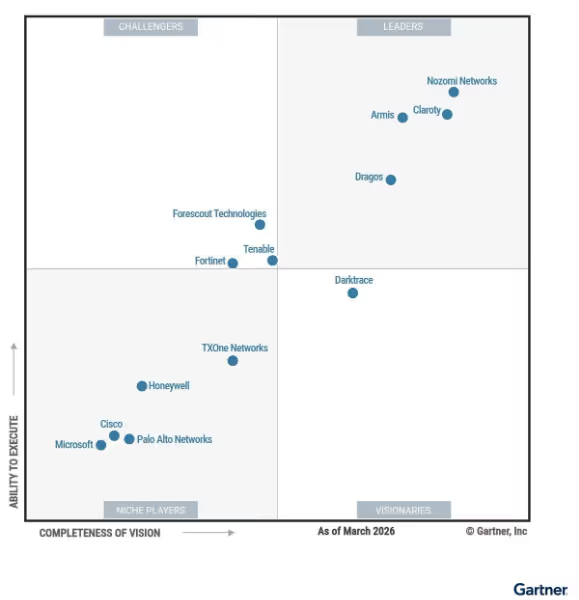
gartner 2026 CPS magic quadrant

Why Darktrace / OT stands apart in CPS security

As industrial environments continue to converge with enterprise infrastructure, security leaders are being asked to reduce cyber risk in systems where uptime, safety, and regulatory requirements limit traditional security approaches. Teams need to understand how risk develops across the environment, investigate threats with greater speed and clarity, and prioritize mitigation based on operational impact.

Darktrace / OT is built for that challenge. It combines cross-domain visibility, detection and investigation with Self-Learning AI, bespoke risk management beyond CVEs, and OT-relevant workflows that support both security outcomes and operational resilience.

Unified visibility across converged CPS environments

As critical infrastructure expands beyond traditional OT networks to include engineering workstations, HMIs, remote access pathways, enterprise systems, and cloud-linked infrastructure, teams need to understand how assets relate, where dependencies exist, and how exposure develops across domains.  

Darktrace / OT provides unified visibility across OT, IT, IoT, and IoMT to help organizations understand cyber risk across connected industrial environments. By bringing telemetry together through capabilities such as Operational Overview, OT workflows, and deep protocol inspection, Darktrace helps engineers and security teams work from shared context and a more operationally relevant understanding of the environment they are defending.

Enhanced threat detection, investigation, and response powered by Self-Learning AI

While signatures can still provide value for known threats, they fail against insider misuse, zero-day exploits, and custom-built malware designed for targeted operations. Darktrace / OT uses Self-Learning AI to detect subtle deviations from normal behavior across industrial environments where threats often appear through abnormal communications, misuse of legitimate access, or suspicious device behavior rather than known malware. To improve incident investigation, Darktrace’s Cyber AI Analyst automatically correlates activity and produces contextual summaries to reduce manual triage effort and help teams move faster from alert to understanding.  

Darktrace / OT further strengthens investigation and response through Expanded telemetry through NEXT for OT, extending visibility into operational endpoints such as engineering workstations and HMIs to support deeper root-cause analysis. Leveraging Self-Learning AI, Darktrace also enables autonomous response that can surgically contain anomalous activity while allowing industrial processes to continue operating normally. Organizations can customize response actions by device, device type, or network segment, with options ranging from fully autonomous enforcement to human confirmation workflows, helping security teams reduce operational disruption while maintaining control over response decisions.

Contextual risk prioritization based on operational relevance

Teams need the right tools to shift from reactive defense to proactively thinking about their security posture. However, most OT teams are stuck using IT-centric tools that don’t speak the language of industrial systems, are consistently overwhelmed with static CVE lists, and these tools offer no understanding of OT-specific protocols.  

Darktrace / OT helps organizations move beyond static vulnerability lists by prioritizing cyber risk based on operational context. By incorporating asset criticality, network relationships, exploitability intelligence, behavioral telemetry, and attack path analysis, the platform helps teams understand which exposures could realistically impact operations. By correlating CVE severity, KEV data, MITRE techniques, and business impact, Darktrace enables more focused remediation decisions that support operational resilience, governance, and compliance initiatives such as IEC-62443.

Built for real-world deployment and enterprise alignment

Darktrace / OT is designed for the realities of industrial environments where flexible deployment across on-premises, hybrid, distributed, air-gapped and operationally sensitive networks is essential. The platform integrates with enterprise security ecosystems including SIEM, SOAR, CMDB, firewall, and governance tools to support broader security workflows. This enables OT security to align with enterprise programs while respecting operational constraints and improving collaboration between security and engineering teams.

Customer validation and platform recognition  

In the last 12 months, Darktrace / OT has received a 4.8/5 rating on Gartner Peer Insights*. which we believe reflects strong customer confidence in the platform across critical infrastructure and industrial environments.  

With this recognition, Darktrace is now positioned across multiple Gartner Magic Quadrants, including Leader positions in Network Detection and Response (NDR) and Email Security Platforms, reflecting the breadth of Darktrace’s ActiveAI Security Platform.
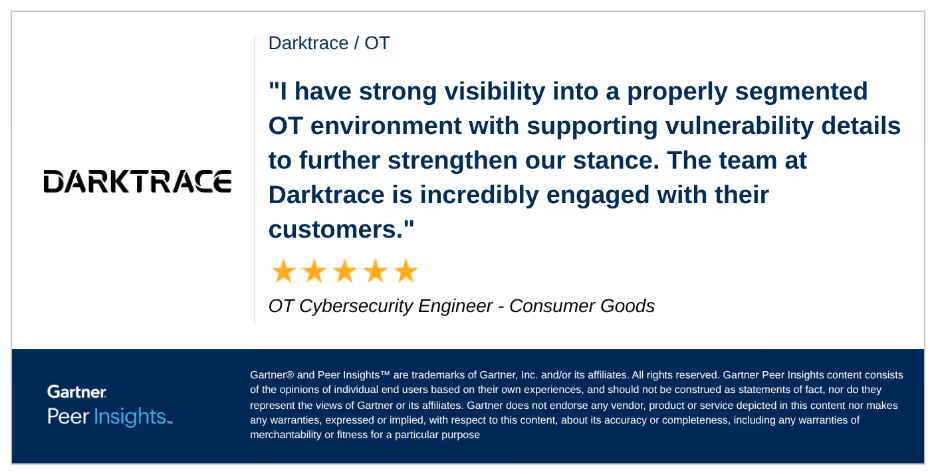
Darktrace / OT customer review

Continuing to advance the future of CPS security

We believe Darktrace’s recognition as the only Visionary for the second consecutive year reflects a clear direction: CPS security platforms need to help customers connect visibility to investigation, investigation to prioritization, and prioritization to real operational outcomes.

That remains our focus for Darktrace / OT.

As industrial environments continue to grow more connected, more complex, and more business-critical, we will continue to invest in the capabilities that help customers reduce uncertainty, strengthen resilience, and secure the systems that keep their operations running.

Gartner, Magic Quadrant for CPS Protection Platforms, Katell Thielemann, Ruggero Contu, Wam Voster, Sumit Rajput, 3 March 2026

Gartner does not endorse any vendor, product or service depicted in its research publications and does not advise technology users to select only those vendors with the highest ratings or other designation. Gartner research publications consist of the opinions of Gartner’s research organization and should not be construed as statements of fact. Gartner disclaims all warranties, expressed or implied, with respect to this research, including any warranties of merchantability or fitness for a particular purpose.

GARTNER is a registered trademark and service mark of Gartner and Magic Quadrant and Peer Insights are a registered trademark, of Gartner, Inc. and/or its affiliates in the U.S. and internationally and are used herein with permission. All rights reserved.

Gartner Peer Insights content consists of the opinions of individual end users based on their own experiences with the vendors listed on the platform, should not be construed as statements of fact, nor do they represent the views of Gartner or its affiliates. Gartner does not endorse any vendor, product or service depicted in this content nor makes any warranties, expressed or implied, with respect to this content, about its accuracy or completeness, including any warranties of merchantability or fitness for a particular purpose.

Inside the SOC
Darktrace cyber analysts are world-class experts in threat intelligence, threat hunting and incident response, and provide 24/7 SOC support to thousands of Darktrace customers around the globe. Inside the SOC is exclusively authored by these experts, providing analysis of cyber incidents and threat trends, based on real-world experience in the field.
Written by
Pallavi Singh
Product Marketing Manager, OT Security & Compliance

More in this series

No items found.

Blog

/

Network

/

April 2, 2026

How Chinese-Nexus Cyber Operations Have Evolved – And What It Means For Cyber Risk and Resilience 

Chinese-Nexus Cyber OperationsDefault blog imageDefault blog image

Cybersecurity has traditionally organized risk around incidents, breaches, campaigns, and threat groups. Those elements still matter—but if we fixate on individual incidents, we risk missing the shaping of the entire ecosystem. Nation‑state–aligned operators are increasingly using cyber operations to establish long-term strategic leverage, not just to execute isolated attacks or short‑term objectives.  

Our latest research, Crimson Echo, shifts the lens accordingly. Instead of dissecting campaigns, malware families, or actor labels as discrete events, the threat research team analyzed Chinese‑nexus activity as a continuum of behaviors over time. That broader view reveals how these operators position themselves within environments: quietly, patiently, and persistently—often preparing the ground long before any recognizable “incident” occurs.  

How Chinese-nexus cyber threats have changed over time

Chinese-nexus cyber activity has evolved in four phases over the past two decades. This ranges from early, high-volume operations in the 1990s and early 2000s to more structured, strategically-aligned activity in the 2010s, and now toward highly adaptive, identity-centric intrusions.  

Today’s phase is defined by scale, operational restraint, and persistence. Attackers are establishing access, evaluating its strategic value, and maintaining it over time. This reflects a broader shift: cyber operations are increasingly integrated into long-term economic and geopolitical strategies. Access to digital environments, specifically those tied to critical national infrastructure, supply chains, and advanced technology, has become a form of strategic leverage for the long-term.  

How Darktrace analysts took a behavioral approach to a complex problem

One of the challenges in analyzing nation-state cyber activity is attribution. Traditional approaches often rely on tracking specific threat groups, malware families, or infrastructure. But these change constantly, and in the case of Chinese-nexus operations, they often overlap.

Crimson Echo is the result of a retrospective analysis of three years of anomalous activity observed across the Darktrace fleet between July 2022 and September 2025. Using behavioral detection, threat hunting, open-source intelligence, and a structured attribution framework (the Darktrace Cybersecurity Attribution Framework), the team identified dozens of medium- to high-confidence cases and analyzed them for recurring operational patterns.  

This long-horizon, behavior-centric approach allows Darktrace to identify consistent patterns in how intrusions unfold, reinforcing that behavioral patterns that matter.  

What the data shows

Several clear trends emerged from the analysis:

  • Targeting is concentrated in strategically important sectors. Across the dataset, 88% of intrusions occurred in organizations classified as critical infrastructure, including transportation, critical manufacturing, telecommunications, government, healthcare, and Information Technology (IT) services.  
  • Strategically important Western economies are a primary focus. The US alone accounted for 22.5% of observed cases, and when combined with major European economies including Germany, Italy, Spain and the UK, over half of all intrusions (55%) were concentrated in these regions.  
  • Nearly 63% of intrusions of intrusions began with the exploitation of internet-facing systems, reinforcing the continued risk posed by externally exposed infrastructure.  

Two models of cyber operations

Across the dataset, Chinese-nexus activity followed two operational models.  

The first is best described as “smash and grab.” These are short-horizon intrusions optimized for speed. Attackers move quickly – often exfiltrating data within 48 hours – and prioritize scale over stealth. The median duration of these compromises is around 10 days. It’s clear they are willing to risk detection for short-term gain.  

The second is “low and slow.” These operations were less prevalent in the dataset, but potentially more consequential. Here, attackers prioritize persistence, establishing durable access through identity systems and legitimate administrative tools, so they can maintain access undetected for months or even years. In one notable case, the actor had fully compromised the environment and established persistence, only to resurface in the environment more than 600 days after. The operational pause underscores both the depth of the intrusion and the actor’s long‑term strategic intent. This suggests that cyber access is a strategic asset to preserve and leverage over time, and we observed these attacks most often inin sectors of the high strategic importance.  

It’s important to note that the same operational ecosystem can employ both models concurrently, selecting the appropriate model based on target value, urgency, intended access. The observation of a “smash and grab” model should not be solely interpreted as a failure of tradecraft, but instead an operational choice likely aligned with objectives. Where “low and slow” operations are optimized for patience, smash and grab is optimized for speed; both seemingly are deliberate operational choices, not necessarily indicators of capability.  

Rethinking cyber risk

For many organizations, cyber risk is still framed as a series of discrete events. Something happens, it is detected and contained, and the organization moves on. But persistent access, particularly in deeply interconnected environments that span cloud, identity-based SaaS and agentic systems, and complex supply chain networks, creates a major ongoing exposure risk. Even in the absence of disruption or data theft, that access can provide insight into operations, dependencies, and strategic decision-making. Cyber risk increasingly resembles long-term competitive intelligence.  

This has impact beyond the Security Operations Center. Organizations need to shift how they think about governance, visibility, and resilience, and treat cyber exposure as a structural business risk instead of an incident response challenge.  

What comes next

The goal of this research is to provide a clearer understanding of how these operations work, so defenders can recognize them earlier and respond more effectively. That includes shifting from tracking indicators to understanding behaviors, treating identity providers as critical infrastructure risks, expanding supplier oversight, investing in rapid containment capabilities, and more.  

Learn more about the findings of Darktrace’s latest research, Crimson Echo: Understanding Chinese-nexus Cyber Operations Through Behavioral Analysis, by downloading the full report and summaries for business leaders, CISOs, and SOC analysts here.  

Continue reading
About the author
Nathaniel Jones
VP, Security & AI Strategy, Field CISO

Blog

/

Proactive Security

/

April 1, 2026

AI-powered security for a rapidly growing grocery enterprise

Default blog imageDefault blog image

Protecting a complex, fast-growing retail organization

For this multi-banner grocery holding organization, cybersecurity is considered an essential business enabler, protecting operations, growth, and customer trust. The organization’s lean IT team manages a highly distributed environment spanning corporate offices, 100+ stores, distribution centers and  thousands of endpoints, users, and third-party connections.

Mergers and acquisitions fueled rapid growth, but they also introduced escalating complexity that constrained visibility into users, endpoints, and security risks inherited across acquired environments.

Closing critical visibility gaps with limited resources

Enterprise-wide visibility is a top priority for the organization, says the  Vice President of Information Technology. “We needed insights beyond the perimeter into how users and devices were behaving across the organization.”

A security breach that occurred before the current IT leadership joined the company reinforced the urgency and elevated cybersecurity to an executive-level priority with a focus on protecting customer trust. The goal was to build a multi-layered security model that could deliver autonomous, enterprise-wide protection without adding headcount.

Managing cyber risk in M&A

Mergers and acquisitions are central to the grocery holding company’s growth strategy. But each transaction introduces new cyber risk, including inherited network architectures, inconsistent tooling, excessive privileges, and remnants of prior security incidents that were never fully remediated.

“Our M&A targets range from small chains with a single IT person and limited cyber tools to large chains with more developed IT teams, toolsets and instrumentation,” explains the VP of IT. “We needed a fast, repeatable, and reliable way to assess cyber risk before transactions closed.”

AI-driven security built for scale, speed, and resilience

Rather than layering additional point tools onto an already complex environment, the retailer adopted the Darktrace ActiveAI Security Platform™ in 2020 as part of a broader modernization effort to improve resilience, close visibility gaps, and establish a security foundation that could scale with growth.

“Darktrace’s AI-driven approach provided the ideal solution to these challenges,” shares the VP of IT. “It has empowered our organization to maintain a robust security strategy, ensuring the protection of our network and the smooth operation of our business.”

Enterprise-wide visibility into traffic  

By monitoring both north-south and east-west traffic and applying Self-Learning AI, Darktrace develops a dynamic understanding of how users and devices normally behave across locations, roles, and systems.

“Modeling normal behavior across the environment enables us to quickly spot behavior that doesn’t fit. Even subtle changes that could signal a threat but appear legitimate at first glance,” explains the VP of IT.

Real-time threat containment, 24/7

Adopting autonomous response has created operational breathing room for the security team, says the company’s Cybersecurity  Engineer.

“Early on, we enabled full Darktrace autonomous mode and we continue to do so today,” shares the IT Security Architect. “Allowing the technology to act first gives us the time we need to investigate incidents during business hours without putting the business at risk.”

Unified, actionable view of security ecosystem

The grocery retailer integrated Darktrace with its existing security ecosystem of firewalls, vulnerability management tools, and endpoint detection and response, and the VP of IT described the adoption process as “exceptionally smooth.”

The team can correlate enterprise-wide security data for a unified and actionable picture of all activity and risk. Using this “single pane of glass” approach, the retailer trains Level 1 and Level 2 operations staff to assist with investigations and user follow-ups, effectively extending the reach of the security function without expanding headcount.

From reactive defense to security at scale

With Darktrace delivering continuous visibility, autonomous containment, and integrated security workflows, the organization has strengthened its cybersecurity posture while improving operational efficiency. The result is a security model that not only reduces risk, but also supports growth, resilience, and informed decision-making at the business level.

Faster detection, faster resolution

With autonomous detection and response, the retailer can immediately contain risk while analysts investigate and validate activity. With this approach, the company can maintain continuous protection even outside business hours and reduce the chance of lateral spread across systems or locations.

Enterprise-grade protection with a lean team

From cloud environments to clients to SaaS collaboration tools, Darktrace provides holistic autonomous AI defense, processing petabytes of the organization’s network traffic and investigating millions of individual events that could be indicative of a wider incident.

Today, Darktrace autonomously conducts the majority of all investigations on behalf of the IT team, escalating only a tiny fraction for analyst review. The impact has been profound, freeing analysts from endless alerts and hours of triage so they can focus on more valuable, proactive, and gratifying work.

“From an operational perspective, Darktrace gives us time back,” says the Cybersecurity Engineer. More importantly, says the VP of IT, “it gives us peace of mind that we’re protected even if we’re not actively monitoring every alert.”

A strategic input for M&A decision-making

One of the most strategic outcomes has been the role of cybersecurity on M&A. 90 days prior to closing a transaction, the security team uses Darktrace alongside other tools to perform a cyber risk assessment of the potential acquisition. “Our approach with Darktrace has consistently identified gaps and exposed risks,” says the VP of IT, including:

  • Remnants of previous incidents that were never fully remediated
  • Network configurations with direct internet exposure
  • Excessive administrative privileges in Active Directory or on critical hosts

While security findings may not alter deal timelines, the VP of IT says they can have enormous business implications. “With early visibility into these risks, we can reduce exposure to inherited cyber threats, strengthen our position during negotiations, and establish clear remediation requirements.”

A security strategy built to evolve with the business

As the holding group expands its cloud footprint, it will extend Darktrace protections into Azure, applying the same AI-driven visibility and autonomous response to cloud workloads. The VP of IT says Darktrace's evolving capabilities will be instrumental in addressing the organization’s future cybersecurity needs and ability to adapt to the dynamic nature of cloud security.

“With Darktrace’s AI-driven approach, we have moved beyond reactive defense, establishing a resilient security foundation for confident expansion and modernization.”

Continue reading
About the author
Your data. Our AI.
Elevate your network security with Darktrace AI