
Blog
/
Network
/
May 21, 2026

Darktrace named a Leader in the 2026 Gartner® Magic Quadrant™ for Network Detection and Response (NDR) For the Second Consecutive Year

Darktrace has been named a Leader in the 2026 Gartner® Magic Quadrant™ for Network Detection and Response (NDR) for the second consecutive year. We believe this reflects continued execution in NDR, ongoing AI innovation, and strong outcomes delivered for customers globally.
Inside the SOC
Darktrace cyber analysts are world-class experts in threat intelligence, threat hunting and incident response, and provide 24/7 SOC support to thousands of Darktrace customers around the globe. Inside the SOC is exclusively authored by these experts, providing analysis of cyber incidents and threat trends, based on real-world experience in the field.
Written by
Mikey Anderson
Senior Product Marketing Manager
garnter ndr magic quadrantDefault blog image
21
May 2026

Continued recognition in NDR  

Darktrace has been recognized as a Leader in the 2026 Gartner® Magic Quadrant™ for Network Detection and Response (NDR), marking the second consecutive year in the Leaders quadrant.

We believe this consistency reflects sustained ability to execute, adapt, and deliver outcomes as the market evolves.

While we are immensely proud to be recognized by industry analysts as a Leader in NDR, that's just part of the story. Darktrace was also Named the Only 2025 Gartner® Peer Insights™ Customers’ Choice for Network Detection and Response based on direct customer feedback and real-world experience.

We believe the combination of these two signals is important. One reflects how the market is evaluated. The other reflects how technology performs in practice.

Why Darktrace continues to be recognized as a leader

We believe our position as a Leader for the second consecutive year reflects a combination of our sustained ability to execute in NDR, continued AI innovation, and proven delivery of security outcomes for customers and partners worldwide.

We also feel that our leadership in the NDR market is a testament to our unique and multi-layered AI approach, for which we were recognized as No.7 on Fast Company’s Most Innovative AI Companies of 2026 list, plus one of the hottest AI cybersecurity companies in CRN's AI 100.

Adapting to complex, real-world environments

Organizations are no longer protecting a single network perimeter. They are securing a mix of users, devices, applications, and data that move across hybrid environments.

Darktrace has focused on maintaining visibility and detection across these conditions, allowing security teams to understand activity as it scales.

Supporting organizations globally, not just technically

Security outcomes are shaped as much by deployment and support as they are by detection capability.

Darktrace continues to invest in regional presence across 29 countries around the world, helping organizations operationalize NDR in ways that align with local requirements, internal processes, and team structures.

Continuing to push AI beyond detection

AI in cybersecurity is often positioned as a way to improve detection accuracy. But the more important shift is how AI can influence decision-making and response.

Darktrace continues to develop models that learn from both live environments and historical incident data, combining real-time behavioral analysis with insights derived from prior attack patterns.

Using technologies such as the Incident Graph and DIGEST (Darktrace Incident Graph Evaluation for Security Threats), activity is not analyzed in isolation. Instead, relationships between users, devices, connections, and events are mapped over time, allowing the system to reconstruct how an incident is unfolding and how similar incidents have progressed in the past.

By evaluating these patterns, Darktrace can assess the likelihood that an incident will escalate, prioritizing the activity that poses the greatest risk and surfacing the most relevant context for investigation.

This shifts security operations from simply identifying anomalies to understanding their trajectory, helping teams anticipate potential impact and respond earlier with greater precision.

Why NDR is shifting from reactive detection to proactive, AI-driven security

Traditional approaches to NDR have been built around reactively identifying threats once they become clearly visible. That model is increasingly difficult to rely on.

Attackers are no longer operating in ways that stand out. They use valid credentials, trusted tools, and low-and-slow techniques that blend into everyday activity. By the time something looks obviously malicious, the impact is often already underway.

This is the core limitation of reactive detection. It depends on recognizing something that already looks like a threat.

As a result, many of the most consequential incidents today fall into a gap.

Insider activity, compromised credentials, and novel attacks rarely trigger traditional alerts because they do not follow known patterns. On the surface, they often appear legitimate, making them difficult to distinguish from normal behavior without deeper context.

This is why we believe this Gartner recognition reflects a broader shift in NDR toward autonomous, proactive and pre‑emptive security operations.

By understanding normal behavior within an environment, it is possible to identify subtle deviations rather than waiting for confirmation of threats as they are taking place.

Darktrace’s Self-Learning AI is designed for behavioral understanding. By continuously learning each organization’s normal patterns, it can detect deviations in real time, enabling a proactive and pre-emptive model of NDR where security teams can respond to early signs of risk as they emerge, reducing the window in which attacks can develop.

In multiple cases, this behavioral approach has led to early threat detection where Darktrace identified completely unknown threats, including pre-CVE zero-day activity. By detecting subtle behavioral changes before vulnerabilities were publicly disclosed or widely understood, organizations can mitigate threats before they do damage.

This shift is subtle but important. Modern NDR solutions must shift from a system that explains what happened to one that helps prevent threats from developing in the first place, and Darktrace is proud to be at the forefront of this shift - helping organizations build and maintain a state of proactive network resilience.

Continuing to innovate at the forefront of NDR

In our view, recognition as a Leader reflects where the market is today. Continuing to innovate defines what comes next.

As businesses evolve, new technologies like AI tools and agents introduce new security risks and challenges; security teams need more than simple detection. They need a complete understanding of risk as it develops, the ability to investigate it in context, and to contain threats at machine speed.  

Darktrace / NETWORK is built to deliver across that full spectrum. Its Self-Learning AI continuously adapts to each organization’s environment, identifying subtle behavioral changes that signal emerging threats. Integrated investigation and autonomous response reduce the time between detection and action, allowing teams to move with greater speed and confidence.

This combination enables organizations to detect and contain known, unknown, and insider threats as they develop, while also strengthening resilience over time.

As a two-time Leader in the Gartner® Magic Quadrant™ for NDR and the only 2025 Gartner® Peer Insights™ Customers’ Choice, we feel Darktrace continues to evolve its platform to meet the demands of modern environments, delivering a more complete and adaptive approach to network security.

‍

[related-resource]

Disclaimer: The 2026 Gartner® Magic Quadrant™ for Network Detection and Response (NDR) ,The 2026 Gartner® Magic Quadrant™ for Network Detection and Response (NDR), Thomas Lintemuth, Charanpal Bhogal, Nahim Fazal, 18 May 2026.

Gartner does not endorse any vendor, product or service depicted in its research publications, and does not advise technology users to select only those vendors with the highest ratings or other designation. Gartner research publications consist of the opinions of Gartner’s research organization and should not be construed as statements of fact. Gartner disclaims all warranties, expressed or implied, with respect to this research, including any warranties of merchantability or fitness for a particular purpose.

GARTNER is a registered trademark and service mark of Gartner, Inc. and/or its affiliates in the U.S. and internationally and is used herein with permission. All rights reserved. Magic Quadrant is a registered trademark of Gartner, Inc. and/or its affiliates and is used herein with permission. All rights reserved.

Download the full report here

Download the 2026 report to learn how we believe Darktrace continues to innovate as a Leader in the NDR market

Inside the SOC
Darktrace cyber analysts are world-class experts in threat intelligence, threat hunting and incident response, and provide 24/7 SOC support to thousands of Darktrace customers around the globe. Inside the SOC is exclusively authored by these experts, providing analysis of cyber incidents and threat trends, based on real-world experience in the field.
Written by
Mikey Anderson
Senior Product Marketing Manager

More in this series

No items found.

Blog

/

AI

/

October 5, 2026

AI-Assisted Attacks Still Leave a Behavioral Trace  

Default blog imageDefault blog image

Key Insights

  • Darktrace identified behavioral indicators associated with two campaigns linked to AI-assisted threat activity, highlighting the growing role of AI in modern cyber-attacks.
  • Observed activity involved suspicious WebDAV file transfers, disguised executable downloads, beaconing to rare infrastructure, unusual process execution, and communications with C2 infrastructure linked to active intrusion campaigns.

Introduction

Just as organizations are incorporating AI into their operations to take advantage of its benefits, threat actors are doing the same, creating new challenges for defenders.

Much of the discussion around AI risk has focused on the expanding attack surface created by AI systems within organizations. These systems are often granted privileged access and heightened permissions to carry out their duties, introducing new security risks and unintended consequences.

At the same time, threat actors are learning to leverage AI to enable malicious activities such as vulnerability discovery, exploit creation, and progressing through the Cyber Kill Chain more quickly. By accelerating development, adaptation, and scaling, AI enables attackers to operate more efficiently while making some capabilities more accessible to less skilled operators.

Whether AI is the target or the enabler, the resulting activity still manifests through networks, identities, endpoints and cloud services. Those interactions create observable signals that defenders can investigate, regardless of how the attack was developed.

AI as part of the attacker’s workflow

Darktrace has previously documented how threat actors are increasingly incorporating AI into offensive operations [1]. Two recent investigations from open-source intelligence (OSINT) illustrate this. In both cases, researchers identified the role of AI within malicious operations. Separately, Darktrace detected activity in customer environments that aligned with the infrastructure and techniques reported in those campaigns. These perspectives provide a view of both attacker workflow and operational consequences.

Although AI played different roles in each campaign, it did not remove the need for the attackers to interact with their targets. Payloads still had to be delivered, processes executed, and command-and-control (C2) connections established, creating behavioral anomalies that Darktrace was able to identify.

‍

Case 1: A Mexican government impersonation campaign with LLM-assisted malware development

Rapid7 reported on a malware delivery operation that used generative AI to assist development, testing, documentation and refinement of attacker infrastructure. Between May and June 2026, Darktrace similarly observed two chains of suspicious activity across customer environments in the Americas that exhibited clear similarities in behavior.

In both cases Darktrace observed:

  • WebDAV communication with onedrive[.]cv·138.124.123[.]87, retrieving a file from the path /Downloads/CURP/
  • Transfer of a masqueraded .scr executable
  • Subsequent communication with google.services[.]ug·77.110.127[.]205 over unusual high ports
  • Additional Darktrace detections correlating the unusual behavior seen spanning payload delivery and C2 communication
  • Darktrace’s Autonomous Response capability alerted across multiple stages of the attack

The infrastructure and behavior observed by Darktrace closely aligned with a campaign reported by Rapid7, in which a WebDAV malware delivery environment was exposed. Rapid7 assessed that threat actors had used generative AI to support the development, testing, documentation and refinement of the operation. The observed activity also aligned with reporting on a campaign in which impersonation of Mexico’s government Unique Population Registry Code (CURP) identity-record service led to delivery of PureRAT, a .NET-based information stealer and remote access trojan (RAT) [2]. The infrastructure overlap and consistent behavioural sequence provides strong alignment and offers a view of how an AI-assisted development pipeline ultimately manifested inside target environments.

Case 2: A suspected China-linked intrusion campaign with AI-assisted automation

In July 2026, Hunt.io published research into a suspected China-based intrusion operation targeting government and financial services organizations [3]. Material recovered from exposed attacker infrastructure by Hunt.io indicated that Claude Code and DeepSeek-v4-pro were being used as active components of the attacker’s workflow. According to the research, the models supported activities including attack reasoning, script generation, execution, exploit adaptation, and phishing-page development.

The investigation identified 192.229.115[.]229 and 192.229.115[.]230 as infrastructure associated with suspected TencShell operations and a possible second C2 framework known as Gshell [3].

Darktrace identified likely related activity within a financial services customer environment involving a newly observed laptop running the Windows 11 Pro operating system. Over a six-day period in July, the device made repeated outbound connections to 192.229.115[.]229 over port 8083.

Darktrace recognized the destination was highly rare for the environment, and the connectivity exhibited beaconing characteristics. During the same timeframe, Darktrace also identified suspicious process behavior associated with process chains involving svchost.exe and cmd.exe. The device repeatedly communicated with infrastructure identified in the Hunt.io research while exhibiting beaconing characteristics and suspicious process activity, strengthening the assessment that the activity likely was associated with the same operation.

Unlike many previous examples of AI-assisted cybercrime, the Hunt.io investigation provided rare visibility into how large language models were being incorporated directly into operational workflows rather than being used solely for content generation. Darktrace, meanwhile, observed how activity associated with that operation ultimately manifested inside a target environment, providing a complementary view of its operational impact.

Operational consequences of AI-assisted attacks

These investigations provide two complementary perspectives on AI-assisted cyber operations. OSINT research revealed how AI was incorporated into attacker workflows, while Darktrace observed the resulting activity within customer environments.

Although AI played different roles in each campaign, it did not remove the need for attackers to interact with their targets, deliver payloads, execute processes, and communicate with C2, all of which generated observable signals.

In these cases, Darktrace identified suspicious file delivery, unusual process behavior, beaconing activity, and communication with rare external infrastructure that aligned with campaigns later linked to AI-assisted operations. While AI may influence how attacks are developed, adapted, and scaled, it does not make them operationally invisible.

For defenders, the broader lesson extends beyond these specific campaigns. As AI becomes increasingly embedded within both enterprise operations and attacker workflows, understanding what a model was asked to do is often less important than understanding the actions it ultimately took and the consequences those actions produced. Whether the actor is human, AI-assisted, or increasingly autonomous, activity still manifests through identities, endpoints, applications, cloud services and network infrastructure.

Credit to Angel Arribas Lopez (Associate Principal Cyber Analyst), Emma Foulger (Global Threat Research Operations Lead), Nathaniel Jones, SVP Global Threat Intelligence
Edited by Ryan Traill (Content Manager)

‍

Appendices

Darktrace Model Detections

Case 1

Anomalous File / Masqueraded File Transfer from New External Endpoint

Anomalous File / Script from Rare External Location

Anomalous File / EXE from Rare External Location

Anomalous File / Script and EXE from Rare External

Anomalous Connection / Multiple Failed Connections to Rare Endpoint

Anomalous Connection / Rare External SSL Self-Signed

Compromise / New or Repeated to Unusual SSL Port

Compromise / Large Number of Suspicious Failed Connections

Device / Initial Attack Chain Activity

Antigena / Network / External Threat::Antigena Suspicious File Block

Antigena / Network / Significant Anomaly::Antigena Enhanced Monitoring from Client Block

Antigena / Network / Significant Anomaly::Antigena Controlled and Model Alert

Antigena / Network / External Threat::Antigena File then New Outbound Block

Antigena / Network / Significant Anomaly::Antigena Significant Anomaly from Client Block

Antigena / Network / Significant Anomaly::Antigena Alerts Over Time Block

Case 2

Anomalous Connection / Multiple Failed Connections to Rare Endpoint

Compromise / High Volume of Connections with Beacon Score

Compromise / Large Number of Suspicious Failed Connections

‍

Indicators of Compromise (IoCs)

‍

Case 1

                                                                                                                                                                                                                                                 
IoCTypeDescription + Confidence
onedrive[.]cvHostnameLikely C2 server
138.124.123[.]87IP AddressPossible C2 server
hXXp://onedrive[.]cv/Downloads/CURP/ReportFinal.%E2%80%AE%E1%BA%9D%D4%81%EF%BD%90.scrURIPossible payload
google.services[.]ugHostnameLikely C2 server
77.110.127[.]205IP AddressLikely C2 server
google.services[.]ug:57666Hostname + PortLikely C2 communication
google.services[.]ug:57888Hostname + PortLikely C2 communication
google.services[.]ug:56001Hostname + PortLikely C2 communication

‍

Case 2

IoC Type Description + Confidence
192.229.115[.]229 IP Address Likely C2 communication
Continue reading
About the author
Angel Arribas Lopez
Associate Principal Cyber Analyst

Blog

/

Network

/

October 5, 2026

A Chain Reaction: Blockchain-Hosted Infostealer Campaign Targets Windows and macOS

Default blog imageDefault blog image

Key Insights

  • Darktrace detected a blockchain-hosted infostealer campaign targeting Windows and macOS devices across multiple customer environments.
  • The campaign combined ClickFix social engineering with trusted services and decentralized blockchain infrastructure to support malware delivery and C2 activity.
  • Compromised devices were observed connecting to rare and unusual external endpoints, including DGA C2 domains, blockchain-related endpoints, and cryptocurrency mining infrastructure.
  • The activity was associated with information-stealing malware strains including Atomic macOS Stealer (AMOS), Lumma, Rhadamanthys, Vidar, and Phexia.
  • Darktrace identified anomalous device behavior, beaconing patterns, rare external connections, cryptomining activity, and suspicious TLS/SSL communications without relying solely on prior knowledge or static indicators of compromise.
  • The campaign highlights how attackers are increasingly using legitimate and decentralized infrastructure to make detection, disruption, and attribution more challenging for defenders.

The Infostealer Ecosystem

The information stealer malware ecosystem continues to grow in value for threat actors across the digital threat landscape. Infostealers are increasingly delivered through Malware-as-a-Service (MaaS) operating models, distributed through affiliate networks, and designed to withstand infrastructure takedowns. This resilience was demonstrated by the recent takedown of Lumma Stealer malicious domains by Microsoft’s Digital Crimes Unit (DCU) [1].

Infostealers are used to gather and exfiltrate sensitive information, including non-human identity (NHI) data, from compromised systems across cloud, Software-as-a-Service (SaaS), Virtual Private Network (VPN), and development environments. They can also support ransomware operations by expanding the credentials and access paths available to threat actors, contributing to the high volume of identity-based attacks observed across the broader threat landscape [2][3].

Darktrace’s Observations of ClickFix and Infostealers

Throughout 2026, Darktrace has observed multiple campaigns using ClickFix social engineering to trick users into carrying out malicious actions and downloading initial payloads, including information stealers. More recently, Darktrace’s Threat Research team identified a specific ClickFix campaign involving a blockchain-hosted infostealer targeting Windows and macOS devices.

Darktrace identified affected customer environments across Europe, the United States, Asia, and the Middle East where blockchain-hosted infostealer malware appears to have been delivered to compromised systems following likely ClickFix-driven initial access. Darktrace investigated the activity and found that decentralized blockchain infrastructure, alongside widely trusted legitimate services, was used to support malware delivery and information theft across Windows and macOS systems.

Following initial access, compromised systems established C2 communication, with C2 configuration and payloads hosted on public blockchain infrastructure. The ultimate objective appears to be credential and cryptocurrency theft through the deployment of information stealers such as Atomic macOS Stealer (AMOS), Lumma, Rhadamanthys, and Vidar [5][6][7].

Darktrace’s Investigation

Affected devices across the Darktrace customer base were observed making outbound connections to rare external endpoints in patterns consistent with beaconing and C2 activity. Darktrace primarily detected devices making repeated connections to algorithmically generated domains (DGA) such as hf98x4d[.]site [8]. In many cases, these domains were linked through open-source intelligence (OSINT) to information-stealing malware families including AMOS and Phexia [5][6][7][8][9].

In multiple cases, devices were also observed connecting to blockchain-related endpoints, such as polygon[.]drpc[.]org, as well as legitimate public services, including GitHub. The use of decentralized blockchain infrastructure and trusted services such as GitHub to facilitate malware distribution and C2 activity can make disruption and attribution significantly more difficult for defenders.

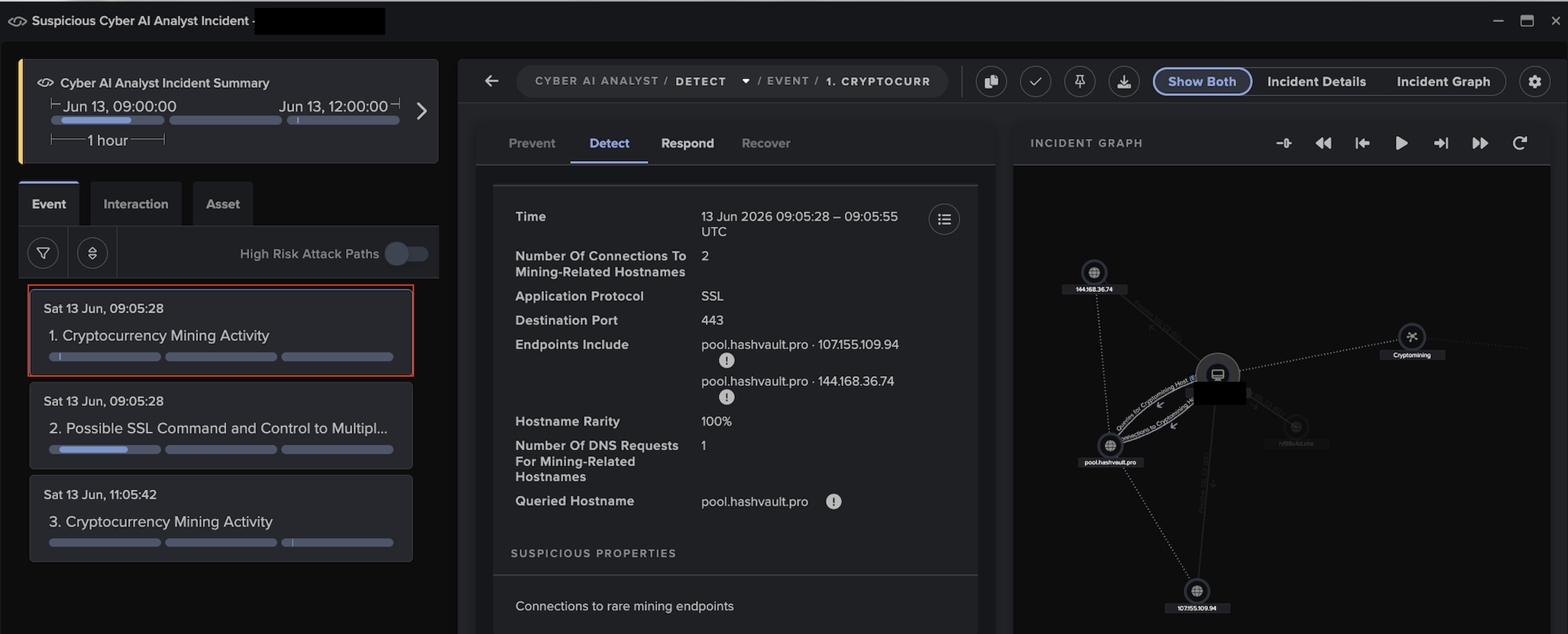
Darktrace also detected a significant proportion of impacted devices making outbound connections to cryptocurrency mining infrastructure associated with the legitimate open-source XMRig mining software and the HashVault mining pool, including pool.hashvault[.]pro and donate[.]ssl[.]xmrig[.]com, which were abused by the attackers, indicating, including pool.hashvault[.]pro and donate[.]ssl[.]xmrig[.]com, indicating active cryptomining on compromised systems.

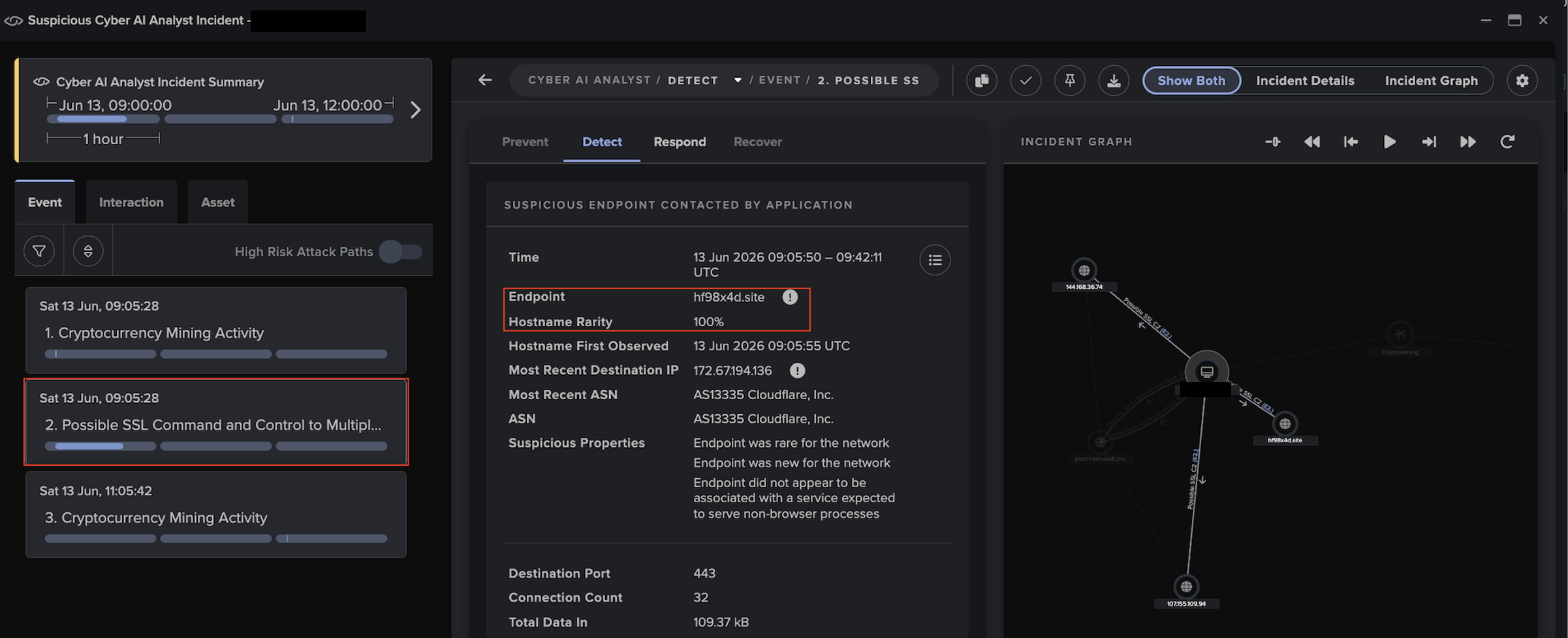
In one case, mining activity was observed before and during connections to the DGA endpoint hf98x4d[.]site. Due to its highly anomalous nature, Darktrace's Real-Time AI Analyst autonomously investigated the activity as it occurred, correlating the two events into a single cryptocurrency mining incident and providing comprehensive visibility into the broader attack.

‍

Figure 1: Real-Time AI Analyst investigation of suspicious SSL and C2 communications with hf98x4d[.]site over port 443.

‍

Figure 2: Real-Time AI Analyst investigation into cryptocurrency mining activity involving pool[.]hashvault[.]pro over SSL on port 443.

‍

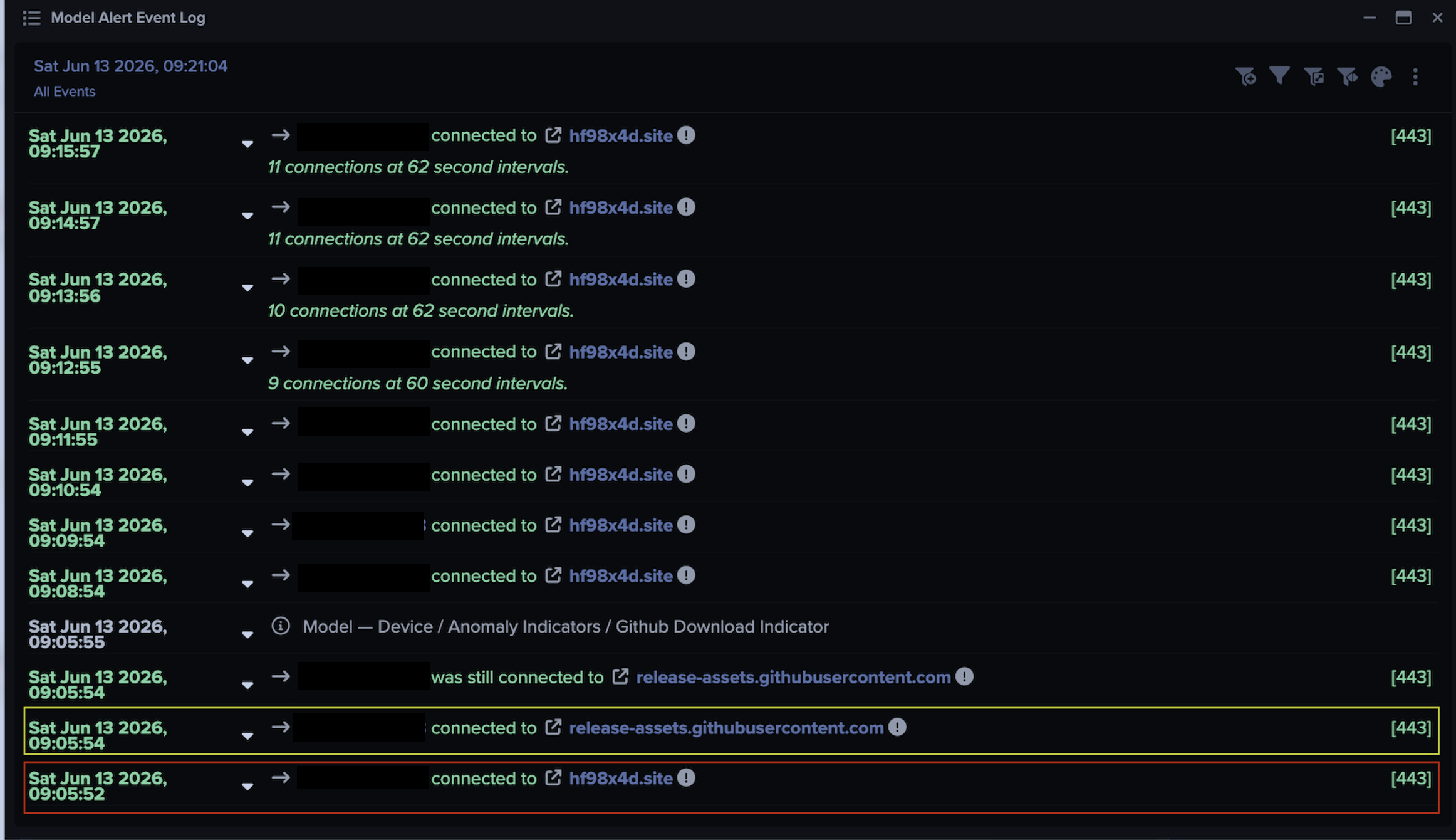
Around the same time, Darktrace identified the same device initiating connections to the GitHub endpoint release-assets[.]githubusercontent[.]com while continuing to make repeated connections to hf98x4d[.]site.

‍

Figure 3: Darktrace's detection of an affected device connecting to a GitHub endpoint between repeated connections to the anomalous external endpoint hf98x4d[.]site.

On the network of another customer, Darktrace observed an affected device making highly unusual outbound connections consistent with beaconing activity. The device initiated multiple connections over port 443 to the external hostname polygon[.]drpc[.]org. According to OSINT, this hostname is a Remote Procedure Call (RPC) endpoint provided by dRPC, a legitimate service enabling decentralized applications (dApps), cryptocurrency wallets, and developer tools to interact with the Polygon blockchain [10].

The same device was later observed making repeated TLS/SSL connections to the previously mentioned DGA C2 domain. In addition, it made outbound connections to the external IP 195.242.214[.]34 over destination port 51820, an endpoint associated with the ProtonVPN service. Collectively, these connections to blockchain-related infrastructure, the DGA C2 domain, and ProtonVPN-associated infrastructure suggested the device had been affected by the campaign.

Conclusion

This campaign demonstrates how attackers can combine ClickFix social engineering with trusted services and decentralized blockchain infrastructure to create a resilient, cross-platform malware delivery chain. By using services such as GitHub alongside blockchain RPC endpoints and rapidly replaceable DGA domains, the activity can blend into legitimate traffic while making infrastructure disruption and attribution more difficult.

For defenders, it’s a reminder that trusted infrastructure does not automatically mean trusted activity. Security teams should look for the behaviors surrounding these connections, including unusual outbound communication, repeated beaconing, unexpected access to blockchain services, suspicious TLS/SSL activity and cryptomining. In this campaign, Darktrace identified and correlated these deviations without depending solely on previously known indicators, providing visibility as affected devices moved between legitimate services, decentralized infrastructure and malicious C2 endpoints

Credit to Nahisha Nobregas (Associate Principal Cyber Analyst), Manoel Kadja (Senior Cyber Analyst)

Edited by Ryan Traill (Content Manager)

Appendices

Darktrace Model Detections

▪ Compromise / Beaconing Activity To External Rare

▪ Compromise / Beacon to Young Endpoint

▪ Compromise / Fast Beaconing to DGA

▪ Compromise / High Volume of Connections with Beacon Score

▪ Compromise / DGA Beacon

▪ Compromise / Slow Beaconing Activity To External Rare

▪ Compromise / Agent Beacon (Long Period)

▪ Compromise / Agent Beacon (Medium Period)

▪ Compromise / Sustained SSL or HTTP Increase

▪ Compromise / Large Number of Suspicious Failed Connections

▪ Compromise / SSL Beaconing to Rare Destination

▪ Compromise / Beacon for 4 Days

▪ Compromise / High Priority Crypto Currency Mining

▪ Compromise / Monero Mining

▪ Device / Long Agent Connection to New Endpoint

▪ Device / New Connections On Suspicious Port

▪ Anomalous Connection / High Volume of Connections to Rare Domain

‍

‍

List of Indicators of Compromise (IoCs)

 
Indicator Description
hf98x4d[.]site C2 Endpoint (Hostname)
sj98xe4[.]xyz C2 Endpoint (Hostname)
citcix6[.]xyz C2 Endpoint (Hostname)
bduwih8[.]pro C2 Endpoint (Hostname)

‍

‍

MITRE ATT&CK Mapping

 
Tactic (ID) Technique
Persistence (T1176) Browser Extensions (T1176.001)
Persistence (T1176) Software Extensions
Command and Control (T1071) Web Protocols (T1071.001)
Command and Control (T1568) Domain Generation Algorithms (T1568.002)
Command and Control (T1071) Application Layer Protocol
Command and Control (T1102) One-Way Communication (T1102.003)
Command and Control (T1571) Non-Standard Port
Command and Control (T1104) Multi-Stage Channels
Command and Control (T1573) Encrypted Channel
Command and Control (T1008) Fallback Channels
Initial Access ICS (T0862) Supply Chain Compromise
Command and Control ICS (T0885) Commonly Used Port
Collection (T1185) Browser Session Hijacking
Impact (T1496) Compute Hijacking (T1496.001)
Impact (T1496) Resource Hijacking
Command and Control (T1071) Publish/Subscribe Protocols (T1071.001)
Lateral Movement (T1210) Exploitation of Remote Services

‍

References:

1.        https://www.microsoft.com/en-us/security/blog/2025/05/21/lumma-stealer-breaking-down-the-delivery-techniques-and-capabilities-of-a-prolific-infostealer/

2.        https://spycloud.com/resource/report/spycloud-annual-identity-exposure-report-2026/

3.        https://www.darktrace.com/blog/why-trust-is-the-new-attack-surface-darktraces-mid-year-threat-update-2026

4.        https://www.darktrace.com/blog/unpacking-clickfix-darktraces-detection-of-a-prolific-social-engineering-tactic

5.        https://abekweng.medium.com/inside-a-blockchain-hosted-malware-campaign-targeting-windows-and-macos-f5bcdeffed66

6.        https://cloud.google.com/blog/topics/threat-intelligence/unc5142-etherhiding-distribute-malware

7.        https://haveibeensquatted.com/blog/from-typosquatting-to-macos-backdoor-clickfix-blockchain-c2

8.        https://www.virustotal.com/gui/domain/hf98x4d.site/community

9.        https://x.com/FABO97662188/status/2074125545026244795

10.  https://www.virustotal.com/gui/url/b0e5c51a411065864119c305fddf218b7c120731f655932cc1c3307ad5b43f94/gti-summary

Continue reading
About the author
Nahisha Nobregas
SOC Analyst
Your data. Our AI.
Elevate your network security with Darktrace AI