
Blog
/
Network
/
May 14, 2026

Chinese APT Campaign Targets Entities with Updated FDMTP Backdoor

Darktrace researchers identified a Twill Typhoon–linked China‑nexus campaign targeting APJ customers. The activity observed includes CDN impersonation, legitimate binaries, and DLL sideloading to deploy a modular .NET RAT.
Inside the SOC
Darktrace cyber analysts are world-class experts in threat intelligence, threat hunting and incident response, and provide 24/7 SOC support to thousands of Darktrace customers around the globe. Inside the SOC is exclusively authored by these experts, providing analysis of cyber incidents and threat trends, based on real-world experience in the field.
Written by
Tara Gould
Malware Research Lead
Written by
Adam Potter
Senior Cyber Analyst
Default blog imageDefault blog imageDefault blog imageDefault blog imageDefault blog imageDefault blog image
14
May 2026

Darktrace have identified activity consistent with Chinese-nexus operations, a Twill Typhoon-linked campaign targeting customer environments, primarily within the Asia-Pacific & Japan (APJ) region

Beginning in late September 2025, multiple affected hosts were observed making requests to domains impersonating content delivery networks (CDNs), including infrastructure masquerading as Yahoo- and Apple-affiliated services. Across these cases, Darktrace identified a consistent behavioral execution pattern: the retrieval of legitimate binaries alongside malicious Dynamic Link Libraries (DLLs), enabling sideloading and execution of a modular .NET-based Remote Access Trojan (RAT) framework.

The activity aligns with patterns described in Darktrace’s previous Chinese-nexus operations report, Crimson Echo. In this case, observed modular intrusion chains built on legitimate software, and staged payload delivery. Threat actors retrieve legitimate binaries alongside configuration files and malicious DLLs to enable sideloading of a .NET-based RAT.

Observed Campaign

Across cases, the same ordered sequence appears: retrieval of a legitimate executable, (2) retrieval of a matching .config file, (3) retrieval of the malicious

DLL, (4) repeated DLL downloads over time, and (5) command-and-control (C2) communication. The .config file retrieves a malicious binary, while the legitimate binary provides a legitimate process to run it in.

Darktrace assesses with moderate confidence that this activity aligns with publicly reported Twill Typhoon tradecraft. The observed use of FDMTP, DLL sideloading, and overlapping infrastructure is consistent with previously observed operations, though not unique to a single actor. While initial access was not directly observed, previous Twill Typhoon campaigns have typically involved spear-phishing.

What Darktrace Observed

Since late September 2025, Darktrace has observed multiple customer environments making HTTP GET requests to infrastructure presenting as “CDN” endpoints for well-known platforms (including Yahoo and Apple lookalikes). Across cases, the affected hosts retrieved legitimate executables, then matching .config files (same base filename), then DLLs intended for sideloading. The sequencing of a legitimate binary + configuration + DLL  has been previously observed in campaigns linked to China-nexus threat actors.

In several cases, affected hosts also issued outbound requests to a /GetCluster endpoint, including the protocol=Dotnet-Tcpdmtp parameter. This activity was repeatedly followed by retrieval of DLL content that was subsequently used for search-order hijacking within legitimate processes.

In the September–October 2025 cases, Darktrace alerting commonly surfaced early-stage registration and C2 setup behaviors, followed by retrieval of a DLL (e.g., Client.dll) from the same external host, sometimes repeatedly over multiple days, consistent with establishing and maintaining the execution chain.

In April 2026, a finance-sector endpoint initiated a series of GET requests to yahoo-cdn[.]it[.]com, first fetching legitimate binaries (including vshost.exe and dfsvc.exe), then repeatedly retrieving associated configuration and DLL components (including dfsvc.exe.config and dnscfg.dll) over an 11-day window. The use of both Visual Studio hosting and OneClick (dfsvc.exe) paths are used to ensure the malware can run in the targeted environment.

Technical Analysis

Initial staging and execution

While the initial access method is unknown, Darktrace security researchers identified multiple archives containing the malware.

A representative example includes a ZIP archive (“test.zip”) containing:

  • A legitimate executable: biz_render.exe (Sogou Pinyin IME)
  • A malicious DLL: browser_host.dll

Contained within the zip archive named “test.zip” is the legitimate binary “biz_render.exe”, a popular Chinese Input Method Editor (IME) Sogou Pinyin.

Alongside the legitimate binary is a malicious DLL named “browser_host.dll”. As the legitimate binary loads a legitimate DLL named “browser_host.dll” via LoadLibraryExW, the malicious DLL has been named the same to sideload the malicious DLL into biz_render.exe. By supplying a malicious DLL with an identical name, the actor hijacks execution flow, enabling the payload to execute within a trusted process.

Figure 1: Biz_render.exe loading browser_host.dll.

The legitimate binary invokes the function GetBrowserManagerInstance from the sideloaded “browser_host.dll”, which then performs XOR-based decryption of embedded strings (key 0x90) to resolve and dynamically load mscoree.dll.

The DLL uses the Windows Common Language Runtime (CLR) to execute managed .NET code inside the process rather than relying solely on native binaries. During execution, the loader loads a payload directly into memory as .NET assemblies, enabling an in-memory execution.

C2 Registration

A GET request is made to:

GET /GetCluster?protocol=DotNet-TcpDmtp&tag={0}&uid={1}

with the custom header:

Verify_Token: Dmtp

This returns Base64-encoded and gzip-compressed IP addresses used for subsequent communication.

Figure 2: Decoded IPs.

Staged payload retrieval

Subsequent activity includes retrieval of multiple components from yahoo-cdn.it[.]com. The following GET requests are made:

/dfsvc.exe

/dnscfg.dll

/dfsvc.exe.config

/vhost.exe

/Microsoft.VisualStudio.HostingProcess.Utilities.Sync.dll

/config.etl

ClickOnce and AppDomain hijacking

Dfsvc.exe is the legitimate Windows ClickOnce Engine, part of the .NET framework used for updating ClickOnce Applications. Accompanying dfsvc.exe is a legitimate dfsvc.exe.config file that is used to store configuration data for the application. However, in this instance the malware has replaced the legitimate dfsvc.exe.config with the one retrieved from the server in: C:\Windows\Microsoft.NET\Framework64\v4.0.30319.

Additionally, vhost.exe the legitimate Visual Studio hosting process is retrieved from the server, along with “Microsoft.VisualStudio.HostingProcess.Utilities.Sync.dll” and “config.etl”. The DLL is used to decrypt the AES encrypted payload in config.etl and load it. The encrypted payload is dnscfg.dll, which can be loaded into vshost instead of dfsvc, and may be used if the environment does not support .NET.

Figure 3: ClickOnce configuration.

The malicious configuration disables logging, forces the application to load dnscfg.dll from the remote server, and uses a custom AppDomainManager to ensure the DLL is executed during initialization of dfsvc.exe. To ensure persistence, a scheduled task is added for %APPDATA%\Local\Microsoft\WindowsApps\dfsvc.exe.

Core payload

The DLL dnscfg.dll is a .NET binary named Client.TcpDmtp.dll. The payload is a heavily obfuscated backdoor that generates its logic at runtime and communicates with the command and control (C2) over custom TCP, DMTP (Duplex Message Transport Protocol) and appears to be an updated version of FDMTP to version 3.2.5.1

Figure 4: InitializeNewDomain.

The payload:

  • Uses cluster-based resolution (GetHostFromCluster)
  • Implements token validation
  • Enters a persistent execution loop (LoopMessage)
  • Supports structured remote tasking over DMTP

Once connected, the malware enters a persistent loop (LoopMessage), enabling it to receive commands from the remote server.
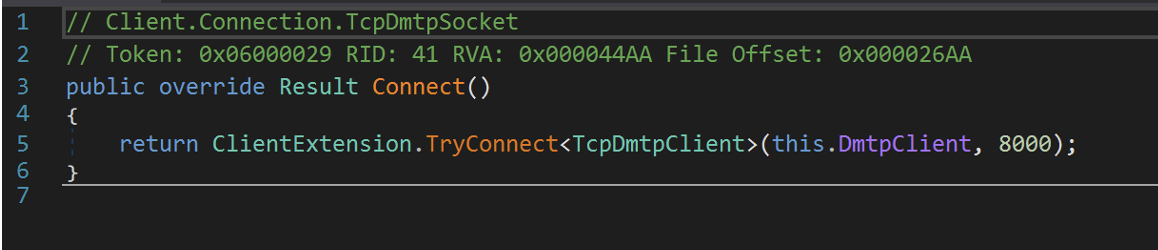
Figure 5: DMTP Connect function.

Rather than referencing values directly, they are retrieved through containers that are resolved at runtime. String values are stored in an encrypted byte array (_0) and decrypted by a custom XOR-based string decryption routine (dcsoft). The lower 16 bits of the provided key are XORed with 0xA61D (42525) to derive the initial XOR key, while subsequent bits define the string length and offset into the encrypted byte array. Each character is reconstructed from two encrypted bytes and XORed with the incrementing key value, producing the plaintext string used by the payload.

Figure 6: Decrypted strings.

Embedded in the resources section are multiple compressed binaries, the majority of which are library files. The only exceptions are client.core.dll and client.dmtpframe.dll.

Figure 7: Resources.

Modular framework and plugins

The payload embeds multiple compressed libraries, notably:

  • client.core.dll
  • client.dmtpframe.dll

Client.core.dll is a core library used for system profiling, C2 communication and plugin execution. The implant has the functionality to retrieve information including antivirus products, domain name, HWID, CLR version, administrator status, hardware details, network details, operating system, and user.

Figure 8: Client.Core.Info functions.

Additionally, the component is responsible for loading plugins, with support for both binary and JSON-based plugin execution. This allows plugins to receive commands and parameters in different formats depending on the task being performed.

The framework handles details such as plugin hashes, method names, task identifiers, caller tracking, and argument processing, allowing plugins to be executed consistently within the environment. In addition to execution management, the library also provides plugins with access to common runtime functionality such as logging, communication, and process handling.

Figure 9: Client.core functions.

client.dmtpframe.dll handles:

  • DMTP communication
  • Heartbeats and reconnection
  • Plugin persistence via registry:

HKCU\Software\Microsoft\IME\{id}

Client.dmtpframe.dll is built on the TouchSocket DMTP networking library and continues to manage the remote plugins. The DLL implements remote communication features including heartbeat maintenance, reconnection handling, RPC-style messaging, SSL support, and token-based verification. The DLL also has the ability to add plugins to the registry under HKCU/Software/Microsoft/IME/{id} for persistence.

Plugins observed

While the full set of plugins remains unknown, researchers were able to identify four plugins, including:

  • Persist.WpTask.dll - used to create, remove and trigger scheduled Windows tasks remotely.
  • Persist.registry.dll - used to manage registry persistence with the ability to create, and delete registry values, along with hidden persistence keys.
  • Persist.extra.dll - used to load and persist the main framework.
  • Assist.dll - used to remotely retrieve files or commands, as well as manipulate system processes.
Figure 10: Plugins stored in IME registry.
Figure 11: Obfuscated script in plugin resources.

Persist.extra.dll is a module that is used to load a script “setup.log” to load and persist the main framework. Stored within the resources section of the binary is an obfuscated script that creates a .NET COM object that is added to the registry key HKCU\Software\Classes\TypeLib\ {9E175B61-F52A-11D8-B9A5-505054503030} \1.0\1\Win64 for persistence. After deobfuscating this script, another DLL is revealed named “WindowsBase.dll”.

Figure 12: Registry entry for script.

The binary checks in with icloud-cdn[.]net every five minutes, retrieves a version string, downloads an encrypted payload named checksum.bin, saves it locally as C:\ProgramData\USOShared\Logs\checksum.etl, decrypts it with AES using the hardcoded key POt_L[Bsh0=+@0a., and loads the decrypted assembly directly from memory via Assembly.Load(byte[]). The version.txt file acts as an update marker so it only re-downloads when the remote version changes, while the mutex prevents duplicate instances.

Figure 13: USOShared/Logs.

Checksum.etl is decrypted with AES and loaded into memory, loading another .NET DLL named “Client.dll”. This binary is the same as “dnscfg.dll” mentioned at the start and allows the threat actors to update the main framework based on the version.

Conclusion

Across cases, Darktrace consistently observed the following sequence:

  • Retrieval of legitimate executables
  • Retrieval of DLLs for sideloading
  • C2 registration via /GetCluster

This approach is consistent with broader China-nexus tradecraft. As outlined in Darktrace’s Crimson Echo report, the stable feature of this activity is behavioral. Infrastructure rotates and payloads can change, but the execution model persists. For defenders, the implication is straightforward: detection anchored to individual indicators will degrade quickly. Detection anchored to a behavioral sequence offer a far more durable approach.

Credit to Tara Gould (Malware Research Lead), Adam Potter (Senior Cyber Analyst), Emma Foulger (Global Threat Research Operations Lead), Nathaniel Jones (VP, Security & AI Strategy)

Edited by Ryan Traill (Content Manager)


Appendices

A detailed list of detection models and triggered indicators is provided alongside IoCs.

Indicators of Compromise (IoCs)

Test.zip - fc3959ebd35286a82c662dc81ca658cb

Dnscfg.dll - b2c8f1402d336963478f4c5bc36c961a

Client.TcpDmtp.dll - c52b4a16d93a44376f0407f1c06e0b

Browser_host.dll - c17f39d25def01d5c87615388925f45a

Client.DmtpFrame.dll - 482cc72e01dfa54f30efe4fefde5422d

Persist.Extra - 162F69FE29EB7DE12B684E979A446131

Persist.Registry - 067FBAD4D6905D6E13FDC19964C1EA52

Assist - 2CD781AB63A00CE5302ED844CFBECC27

Persist.WpTask - DF3437C88866C060B00468055E6FA146

Microsoft.VisualStudio.HostingProcess.Utilities.Sync.dll - c650a624455c5222906b60aac7e57d48

www.icloud-cdn[.]net

www.yahoo-cdn.it[.]com

154.223.58[.]142[AP8] [EF9]

MITRE ATT&CK Techniques

T1106 – Native API

T1053.005 - Scheduled Task

T1546.16 - Component Object Model Hijacking

T1547.001 - Registry Run Keys

T1511.001 - Dynamic Link Library Injection

T1622 – Debugger Evasion

T1140 – Deobfuscate/Decode Files or Information

T1574.001 - Hijack Execution Flow: DLL

T1620 – Reflective Code Loading

T1082 – System Information Discovery

T1007 – System Service Discovery

T1030 – System Owner/User Discovery

T1071.001 - Web Protocols

T1027.007 - Dynamic API Resolution

T1095 – Non-Application Layer Protocol

Darktrace Model Alerts

·      Compromise / Beaconing Activity To External Rare

·      Compromise / HTTP Beaconing to Rare Destination

·      Anomalous File / Script from Rare External Location

·      Compromise / Sustained SSL or HTTP Increase

·      Compromise / Agent Beacon to New Endpoint

·      Anomalous File / EXE from Rare External Location

·      Anomalous File / Multiple EXE from Rare External Locations

·      Compromise / Quick and Regular Windows HTTP Beaconing

·      Compromise / High Volume of Connections with Beacon Score

·      Anomalous File / Anomalous Octet Stream (No User Agent)

·      Compromise / Repeating Connections Over 4 Days

·      Device / Large Number of Model Alerts

·      Anomalous Connection / Multiple Connections to New External TCP Port

·      Compromise / Large Number of Suspicious Failed Connections

·      Anomalous Connection / Multiple Failed Connections to Rare Endpoint

·      Device / Increased External Connectivity

Inside the SOC
Darktrace cyber analysts are world-class experts in threat intelligence, threat hunting and incident response, and provide 24/7 SOC support to thousands of Darktrace customers around the globe. Inside the SOC is exclusively authored by these experts, providing analysis of cyber incidents and threat trends, based on real-world experience in the field.
Written by
Tara Gould
Malware Research Lead
Written by
Adam Potter
Senior Cyber Analyst

More in this series

No items found.

Blog

/

Network

/

May 22, 2026

Darktrace named a Leader in the 2026 Gartner® Magic Quadrant™ for Network Detection and Response (NDR) For the Second Consecutive Year

garnter ndr magic quadrantDefault blog imageDefault blog image

Continued recognition in NDR  

Darktrace has been recognized as a Leader in the 2026 Gartner® Magic Quadrant™ for Network Detection and Response (NDR), marking the second consecutive year in the Leaders quadrant.

We believe this consistency reflects sustained ability to execute, adapt, and deliver outcomes as the market evolves.

While we are immensely proud to be recognized by industry analysts as a Leader in NDR, that's just part of the story. Darktrace was also Named the Only 2025 Gartner® Peer Insights™ Customers’ Choice for Network Detection and Response based on direct customer feedback and real-world experience.

We believe the combination of these two signals is important. One reflects how the market is evaluated. The other reflects how technology performs in practice.

Why Darktrace continues to be recognized as a leader

We believe our position as a Leader for the second consecutive year reflects a combination of our sustained ability to execute in NDR, continued AI innovation, and proven delivery of security outcomes for customers and partners worldwide.

We also feel that our leadership in the NDR market is a testament to our unique and multi-layered AI approach, for which we were recognized as No.7 on Fast Company’s Most Innovative AI Companies of 2026 list, plus one of the hottest AI cybersecurity companies in CRN's AI 100.

Adapting to complex, real-world environments

Organizations are no longer protecting a single network perimeter. They are securing a mix of users, devices, applications, and data that move across hybrid environments.

Darktrace has focused on maintaining visibility and detection across these conditions, allowing security teams to understand activity as it scales.

Supporting organizations globally, not just technically

Security outcomes are shaped as much by deployment and support as they are by detection capability.

Darktrace continues to invest in regional presence across 29 countries around the world, helping organizations operationalize NDR in ways that align with local requirements, internal processes, and team structures.

Continuing to push AI beyond detection

AI in cybersecurity is often positioned as a way to improve detection accuracy. But the more important shift is how AI can influence decision-making and response.

Darktrace continues to develop models that learn from both live environments and historical incident data, combining real-time behavioral analysis with insights derived from prior attack patterns.

Using technologies such as the Incident Graph and DIGEST (Darktrace Incident Graph Evaluation for Security Threats), activity is not analyzed in isolation. Instead, relationships between users, devices, connections, and events are mapped over time, allowing the system to reconstruct how an incident is unfolding and how similar incidents have progressed in the past.

By evaluating these patterns, Darktrace can assess the likelihood that an incident will escalate, prioritizing the activity that poses the greatest risk and surfacing the most relevant context for investigation.

This shifts security operations from simply identifying anomalies to understanding their trajectory, helping teams anticipate potential impact and respond earlier with greater precision.

Why NDR is shifting from reactive detection to proactive, AI-driven security

Traditional approaches to NDR have been built around reactively identifying threats once they become clearly visible. That model is increasingly difficult to rely on.

Attackers are no longer operating in ways that stand out. They use valid credentials, trusted tools, and low-and-slow techniques that blend into everyday activity. By the time something looks obviously malicious, the impact is often already underway.

This is the core limitation of reactive detection. It depends on recognizing something that already looks like a threat.

As a result, many of the most consequential incidents today fall into a gap.

Insider activity, compromised credentials, and novel attacks rarely trigger traditional alerts because they do not follow known patterns. On the surface, they often appear legitimate, making them difficult to distinguish from normal behavior without deeper context.

This is why we believe this Gartner recognition reflects a broader shift in NDR toward autonomous, proactive and pre‑emptive security operations.

By understanding normal behavior within an environment, it is possible to identify subtle deviations rather than waiting for confirmation of threats as they are taking place.

Darktrace’s Self-Learning AI is designed for behavioral understanding. By continuously learning each organization’s normal patterns, it can detect deviations in real time, enabling a proactive and pre-emptive model of NDR where security teams can respond to early signs of risk as they emerge, reducing the window in which attacks can develop.

In multiple cases, this behavioral approach has led to early threat detection where Darktrace identified completely unknown threats, including pre-CVE zero-day activity. By detecting subtle behavioral changes before vulnerabilities were publicly disclosed or widely understood, organizations can mitigate threats before they do damage.

This shift is subtle but important. Modern NDR solutions must shift from a system that explains what happened to one that helps prevent threats from developing in the first place, and Darktrace is proud to be at the forefront of this shift - helping organizations build and maintain a state of proactive network resilience.

Continuing to innovate at the forefront of NDR

In our view, recognition as a Leader reflects where the market is today. Continuing to innovate defines what comes next.

As businesses evolve, new technologies like AI tools and agents introduce new security risks and challenges; security teams need more than simple detection. They need a complete understanding of risk as it develops, the ability to investigate it in context, and to contain threats at machine speed.  

Darktrace / NETWORK is built to deliver across that full spectrum. Its Self-Learning AI continuously adapts to each organization’s environment, identifying subtle behavioral changes that signal emerging threats. Integrated investigation and autonomous response reduce the time between detection and action, allowing teams to move with greater speed and confidence.

This combination enables organizations to detect and contain known, unknown, and insider threats as they develop, while also strengthening resilience over time.

As a two-time Leader in the Gartner® Magic Quadrant™ for NDR and the only 2025 Gartner® Peer Insights™ Customers’ Choice, we feel Darktrace continues to evolve its platform to meet the demands of modern environments, delivering a more complete and adaptive approach to network security.

[related-resource]

Disclaimer: The 2026 Gartner® Magic Quadrant™ for Network Detection and Response (NDR) ,The 2026 Gartner® Magic Quadrant™ for Network Detection and Response (NDR), Thomas Lintemuth, Charanpal Bhogal, Nahim Fazal, 18 May 2026.

Gartner does not endorse any vendor, product or service depicted in its research publications, and does not advise technology users to select only those vendors with the highest ratings or other designation. Gartner research publications consist of the opinions of Gartner’s research organization and should not be construed as statements of fact. Gartner disclaims all warranties, expressed or implied, with respect to this research, including any warranties of merchantability or fitness for a particular purpose.

GARTNER is a registered trademark and service mark of Gartner, Inc. and/or its affiliates in the U.S. and internationally and is used herein with permission. All rights reserved. Magic Quadrant is a registered trademark of Gartner, Inc. and/or its affiliates and is used herein with permission. All rights reserved.

Continue reading
About the author
Mikey Anderson
Product Marketing Manager, Network Detection & Response

Blog

/

AI

/

May 21, 2026

Prompt Security in Enterprise AI: Strengths, Weaknesses, and Common Approaches

prompt securityDefault blog imageDefault blog image

How enterprise AI Agents are changing the risk landscape  

Generative AI Agents are changing the way work gets done inside enterprises, and subsequently how security risks may emerge. Organizations have quickly realized that providing these agents with wider access to tooling, internal information, and granting permissions for the agent to perform autonomous actions can greatly increase the efficiency of employee workflows.

Early deployments of Generative AI systems led many organizations to scope individual components as self-contained applications: a chat interface, a model, and a prompt, with guardrails placed at the boundary. Research from Gartner has shown that while the volume and scope of Agentic AI deployments in enterprise environments is rapidly accelerating, many of the mechanisms required to manage risk, trust, and cost are still maturing.

The issue now resides on whether an agent can be influenced, misdirected, or manipulated in ways that leads to unsafe behavior across a broader system.

Why prompt security matters in enterprise AI

Prompt security matters in enterprise AI because prompts are the primary way users and systems interact with Agentic AI models, making them one of the earliest and most visible indicators of how these systems are being used and where risk may emerge.

For security teams, prompt monitoring is a logical starting point for understanding enterprise AI usage, providing insight into what types of questions are being asked and tasks are being given to AI Agents, how these systems are being guided, and whether interactions align with expected behavior. Complete prompt security takes this one step further, filtering out or blocking sensitive or dangerous content to prevent risks like prompt injection and data leakage.

However, visibility only at the prompt layer can create a false sense of security. Prompts show what was asked, but not always why it was asked, or what downstream actions were triggered by the agent across connected systems, data sources, or applications.

What prompt security reveals  

The primary function of prompt security is to minimize risks associated with generative and agentic AI use, but monitoring and analysis of prompts can also grant insight into use cases for particular agents and model. With comprehensive prompt security, security teams should be able to answer the following questions for each prompt:

  • What task was the user attempting to complete?
  • What data was included in the request, and was any of the data high-risk or confidential?
  • Was the interaction high-risk, potentially malicious, or in violation of company policy?
  • Was the prompt anomalous (in comparison to previous prompts sent to the agent / model)?

Improving visibility at this layer is a necessary first step, allowing organizations to establish a baseline for how AI systems are being used and where potential risks may exist.  

Prompt security alone does not provide a complete view of risk. Further data is needed to understand how the prompt is interpreted, how context is applied, what autonomous actions the agent takes (if any), or what downstream systems are affected. Understanding the outcome of a query is just as important for complete prompt security as understanding the input prompt itself – for example, a perfectly normal, low-risk prompt may inadvertently result in an agent taking a high-risk action.

Comprehensive AI security systems like Darktrace / SECURE AI can monitor and analyze both the prompt submitted to a Generative AI system, as well as the responses and chain-of-thought of the system, providing greater insight into the behavior of the system. Darktrace / SECURE AI builds on the core Darktrace methodology, learning the expected behaviors of your organization and identifying deviations from the expected pattern of life.

How organizations address prompt security today

As prompt-level visibility has become a focus, a range of approaches have emerged to make this activity more observable and controllable. Various monitoring and logging tools aim to capture prompt inputs to be analyzed after the fact.  

Input validation and filtering systems attempt to intervene earlier, inspecting prompts before they reach the model. These controls look for known jailbreak patterns, language indicative of adversarial attacks, or ambiguous instructions which could push the system off course.

Importantly, for a prompt security solution to be accurate and effective, prompts must be continually observed and governed, rather than treated as a point-in-time snapshot.  

Where prompt security breaks down in real environments

In more complex environments, especially those involving multiple agents or extensive tool use, AI security becomes harder to define and control.

Agent-to-Agent communications can be harder to monitor and trace as these happen without direct user interaction. Communication between agents can create routes for potential context leakage between agents, unintentional privilege escalation, or even data leakage from a higher privileged agent to a lower privileged one.

Risk is shaped not just by what is asked, but by the conditions in which that prompt operates and the actions an agent takes. Controls at the orchestration layer are starting to reflect this reality. Techniques such as context isolation, scoped memory, and role-based boundaries aim to limit how far a prompt’s influence can extend.  

Furthermore, Shadow AI usage can be difficult to monitor. AI systems that are deployed outside of formal governance structures and Generative AI systems hosted on unknown endpoints can fly under the radar and can go unseen by monitoring tools, leaving a critical opening where adversarial prompts may go undetected. Darktrace / SECURE AI features comprehensive detection of Shadow AI usage, helping organizations identify potential risk areas.

How prompt security fits in a broader AI risk model

Prompt security is an important starting point, but it is not a complete security strategy. As AI systems become more integrated into enterprise environments, the risks extend to what resources the system can access, how it interprets context, and what actions it is allowed to take across connected tools and workflows.

This creates a gap between visibility and control. Prompt security alone allows security teams to observe prompt activity but falls short of creating a clear understanding of how that activity translates into real-world impact across the organization.

Closing that gap requires a broader approach, one that connects signals across human and AI agent identities, SaaS, cloud, and endpoint environments. It means understanding not just how an AI system is being used, but how that usage interacts with the rest of the digital estate.

Prompt security, in that sense, is less of a standalone solution and more of an entry point into a larger problem: securing AI across the enterprise as a whole.

Explore how Darktrace / SECURE AI brings prompt security to enterprises

Darktrace brings more than a decade of AI expertise, built on an enterprise‑wide platform designed to operate in and understand the behaviors of the complex, ambiguous environments where today’s AI now lives. With Darktrace / SECURE AI, enterprises can safely adopt, manage, monitor, and build AI within their business.  

Learn about Darktrace / SECURE AI here.

Sign up today to stay informed about innovations across securing AI.

[related-resource]

Continue reading
About the author
Jamie Bali
Technical Author (AI) Developer
Your data. Our AI.
Elevate your network security with Darktrace AI