Blog
/
Email
/
December 15, 2025

Beyond MFA: Detecting Adversary-in-the-Middle Attacks and Phishing with Darktrace

During a customer trial of Darktrace / EMAIL and Darktrace / IDENTITY, Darktrace detected an adversary-in-the-middle (AiTM) attack that compromised a user’s Office 365 account via a business email compromise (BEC) phishing email. Following the breach, the compromised account was used to launch both internal and external phishing campaigns.
Inside the SOC
Darktrace cyber analysts are world-class experts in threat intelligence, threat hunting and incident response, and provide 24/7 SOC support to thousands of Darktrace customers around the globe. Inside the SOC is exclusively authored by these experts, providing analysis of cyber incidents and threat trends, based on real-world experience in the field.
Written by
David Ison
Cyber Analyst
Written by
Ryan Traill
Analyst Content Lead
Beyond MFA: Detecting Adversary-in-the-Middle Attacks and Phishing with DarktraceDefault blog imageDefault blog imageDefault blog imageDefault blog imageDefault blog imageDefault blog image
15
Dec 2025

What is an Adversary-in-the-middle (AiTM) attack?

Adversary-in-the-Middle (AiTM) attacks are a sophisticated technique often paired with phishing campaigns to steal user credentials. Unlike traditional phishing, which multi-factor authentication (MFA) increasingly mitigates, AiTM attacks leverage reverse proxy servers to intercept authentication tokens and session cookies. This allows attackers to bypass MFA entirely and hijack active sessions, stealthily maintaining access without repeated logins.

This blog examines a real-world incident detected during a Darktrace customer trial, highlighting how Darktrace / EMAILTM and Darktrace / IDENTITYTM identified the emerging compromise in a customer’s email and software-as-a-service (SaaS) environment, tracked its progression, and could have intervened at critical moments to contain the threat had Darktrace’s Autonomous Response capability been enabled.

What does an AiTM attack look like?

Inbound phishing email

Attacks typically begin with a phishing email, often originating from the compromised account of a known contact like a vendor or business partner. These emails will often contain malicious links or attachments leading to fake login pages designed to spoof legitimate login platforms, like Microsoft 365, designed to harvest user credentials.

Proxy-based credential theft and session hijacking

When a user clicks on a malicious link, they are redirected through an attacker-controlled proxy that impersonates legitimate services.  This proxy forwards login requests to Microsoft, making the login page appear legitimate. After the user successfully completes MFA, the attacker captures credentials and session tokens, enabling full account takeover without the need for reauthentication.

Follow-on attacks

Once inside, attackers will typically establish persistence through the creation of email rules or registering OAuth applications. From there, they often act on their objectives, exfiltrating sensitive data and launching additional business email compromise (BEC) campaigns. These campaigns can include fraudulent payment requests to external contacts or internal phishing designed to compromise more accounts and enable lateral movement across the organization.

Darktrace’s detection of an AiTM attack

At the end of September 2025, Darktrace detected one such example of an AiTM attack on the network of a customer trialling Darktrace / EMAIL and Darktrace / IDENTITY.

In this instance, the first indicator of compromise observed by Darktrace was the creation of a malicious email rule on one of the customer’s Office 365 accounts, suggesting the account had likely already been compromised before Darktrace was deployed for the trial.

Darktrace / IDENTITY observed the account creating a new email rule with a randomly generated name, likely to hide its presence from the legitimate account owner. The rule marked all inbound emails as read and deleted them, while ignoring any existing mail rules on the account. This rule was likely intended to conceal any replies to malicious emails the attacker had sent from the legitimate account owner and to facilitate further phishing attempts.
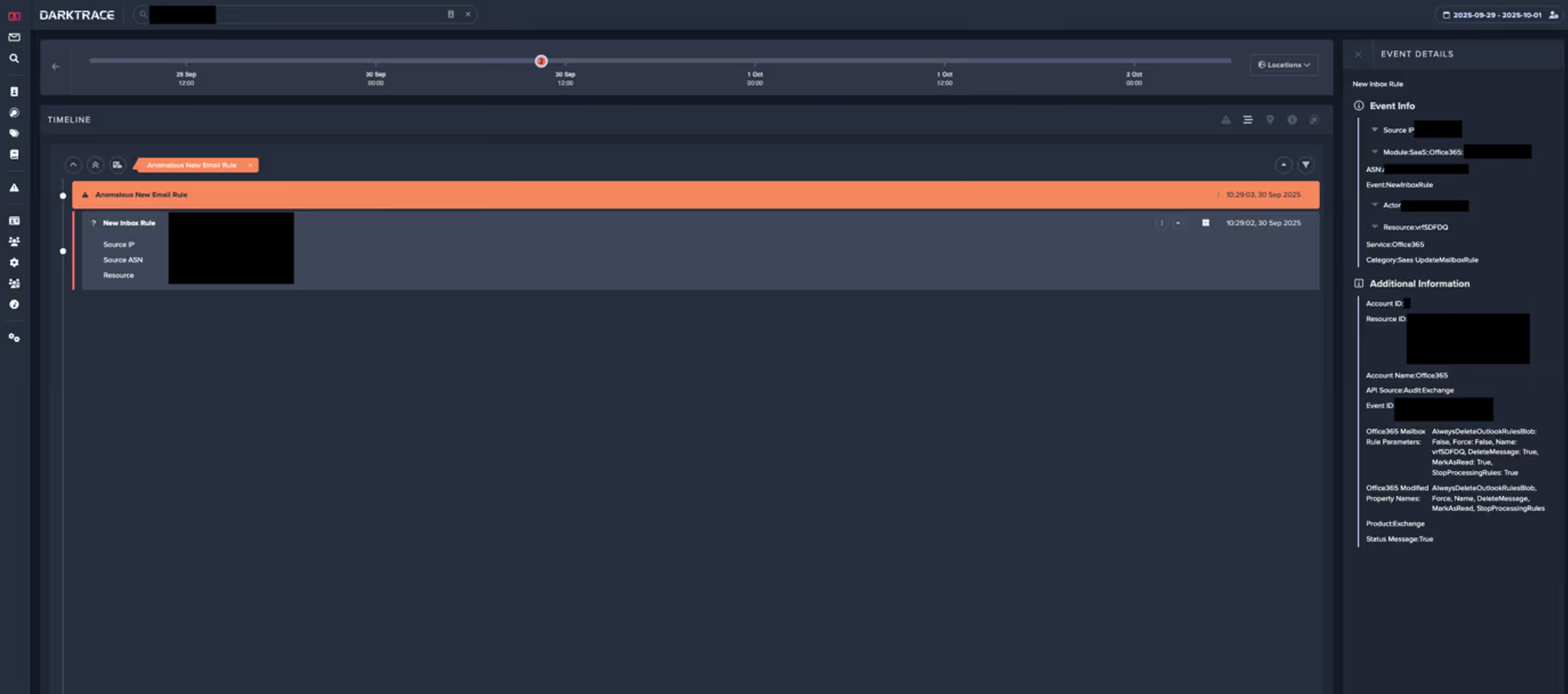
Darktrace’s detection of the anomalous email rule creation.
Figure 1: Darktrace’s detection of the anomalous email rule creation.

Internal and external phishing

Following the creation of the email rule, Darktrace / EMAIL observed a surge of suspicious activity on the user’s account. The account sent emails with subject lines referencing payment information to over 9,000 different external recipients within just one hour. Darktrace also identified that these emails contained a link to an unusual Google Drive endpoint, embedded in the text “download order and invoice”.

Darkrace’s detection of an unusual surge in outbound emails containing suspicious content, shortly following the creation of a new email rule.
Figure 2: Darkrace’s detection of an unusual surge in outbound emails containing suspicious content, shortly following the creation of a new email rule.
Darktrace / EMAIL’s detection of the compromised account sending over 9,000 external phishing emails, containing an unusual Google Drive link.
Figure 3: Darktrace / EMAIL’s detection of the compromised account sending over 9,000 external phishing emails, containing an unusual Google Drive link.

As Darktrace / EMAIL flagged the message with the ‘Compromise Indicators’ tag (Figure 2), it would have been held automatically if the customer had enabled default Data Loss Prevention (DLP) Action Flows in their email environment, preventing any external phishing attempts.
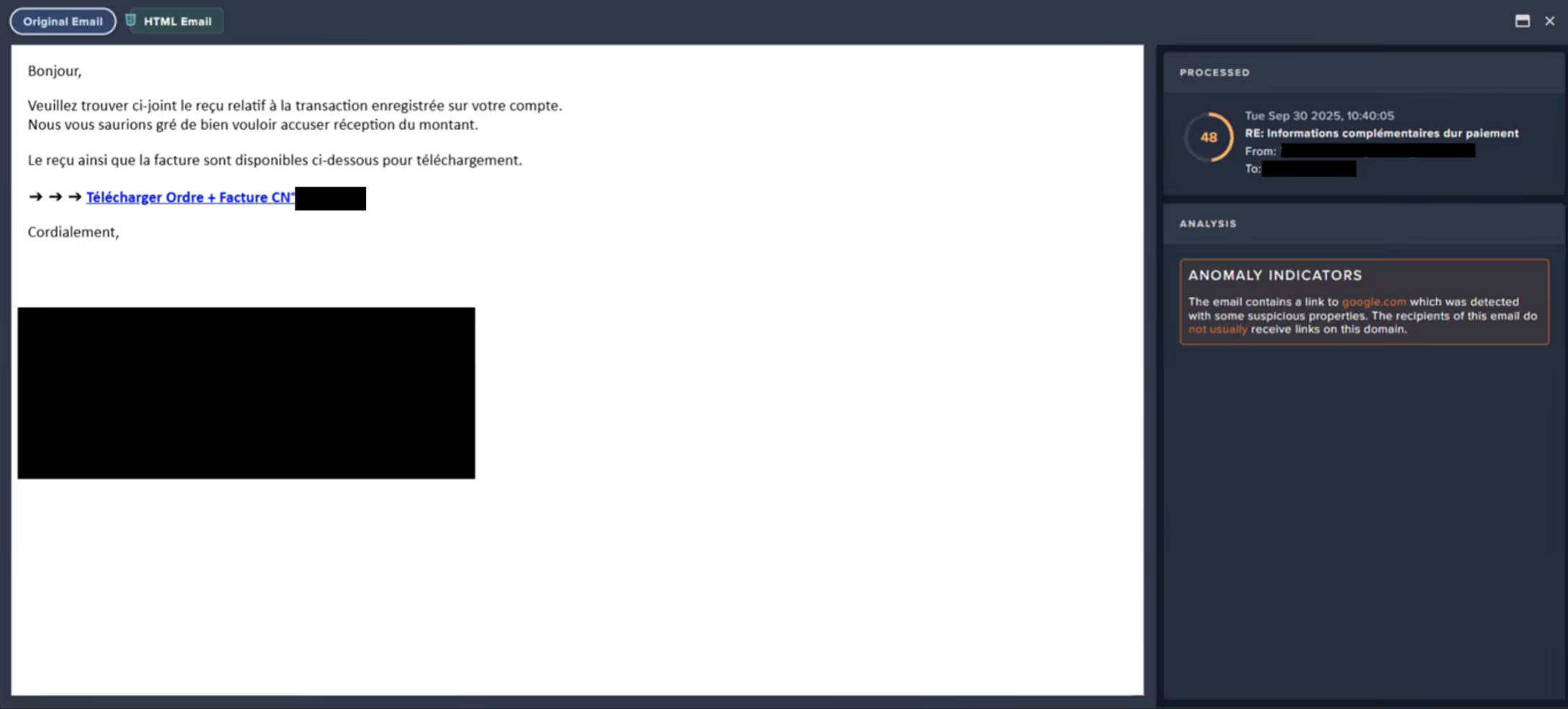
Figure 4: Darktrace / EMAIL’s preview of the email sent by the offending account.

Darktrace analysis revealed that, after clicking the malicious link in the email, recipients would be redirected to a convincing landing page that closely mimicked the customer’s legitimate branding, including authentic imagery and logos, where prompted to download with a PDF named “invoice”.
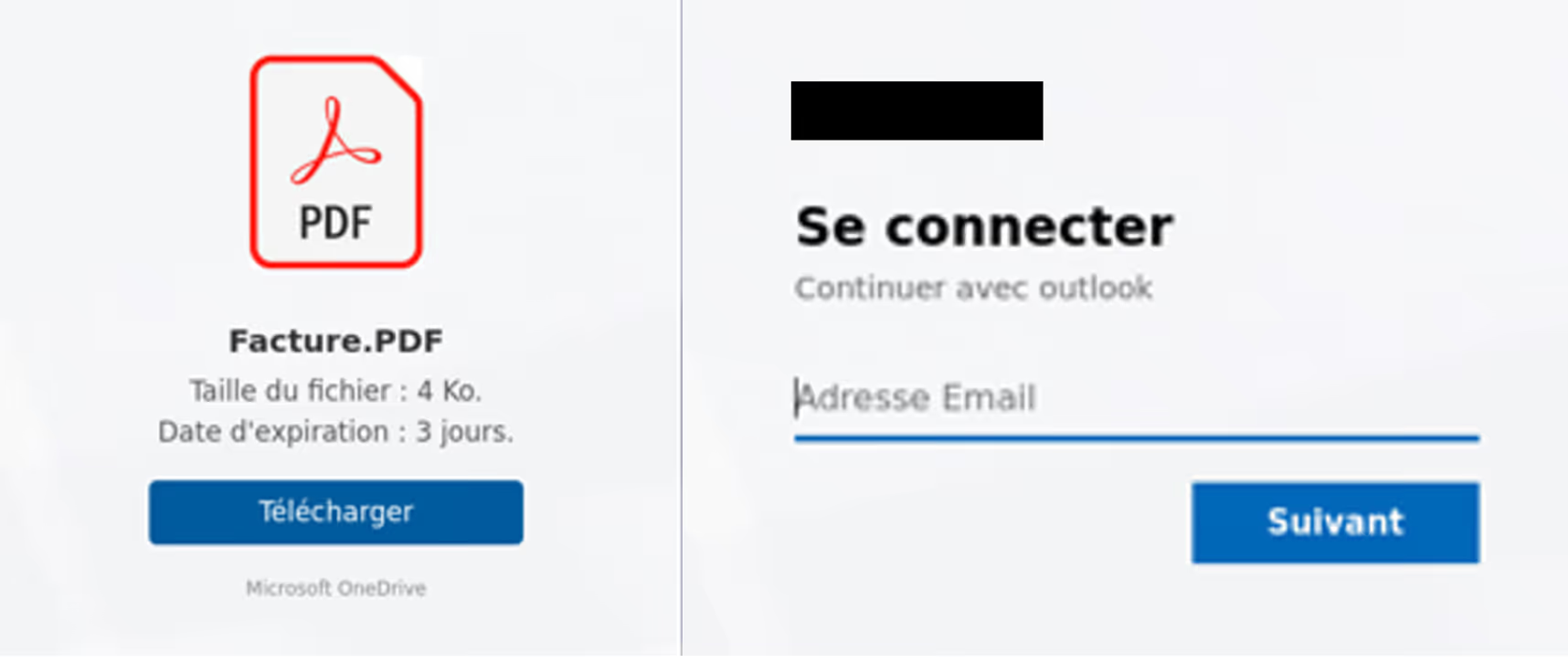
Figure 5: Download and login prompts presented to recipients after following the malicious email link, shown here in safe view.

After clicking the “Download” button, users would be prompted to enter their company credentials on a page that was likely a credential-harvesting tool, designed to steal corporate login details and enable further compromise of SaaS and email accounts.

Darktrace’s Response

In this case, Darktrace’s Autonomous Response was not fully enabled across the customer’s email or SaaS environments, allowing the compromise to progress,  as observed by Darktrace here.

Despite this, Darktrace / EMAIL’s successful detection of the malicious Google Drive link in the internal phishing emails prompted it to suggest ‘Lock Link’, as a recommended action for the customer’s security team to manually apply. This action would have automatically placed the malicious link behind a warning or screening page blocking users from visiting it.

Autonomous Response suggesting locking the malicious Google Drive link sent in internal phishing emails.
Figure 6: Autonomous Response suggesting locking the malicious Google Drive link sent in internal phishing emails.

Furthermore, if active in the customer’s SaaS environment, Darktrace would likely have been able to mitigate the threat even earlier, at the point of the first unusual activity: the creation of a new email rule. Mitigative actions would have included forcing the user to log out, terminating any active sessions, and disabling the account.

Conclusion

AiTM attacks represent a significant evolution in credential theft techniques, enabling attackers to bypass MFA and hijack active sessions through reverse proxy infrastructure. In the real-world case we explored, Darktrace’s AI-driven detection identified multiple stages of the attack, from anomalous email rule creation to suspicious internal email activity, demonstrating how Autonomous Response could have contained the threat before escalation.

MFA is a critical security measure, but it is no longer a silver bullet. Attackers are increasingly targeting session tokens rather than passwords, exploiting trusted SaaS environments and internal communications to remain undetected. Behavioral AI provides a vital layer of defense by spotting subtle anomalies that traditional tools often miss

Security teams must move beyond static defenses and embrace adaptive, AI-driven solutions that can detect and respond in real time. Regularly review SaaS configurations, enforce conditional access policies, and deploy technologies that understand “normal” behavior to stop attackers before they succeed.

Credit to David Ison (Cyber Analyst), Bertille Pierron (Solutions Engineer), Ryan Traill (Analyst Content Lead)

Appendices

Models

SaaS / Anomalous New Email Rule

Tactic – Technique – Sub-Technique  

Phishing - T1566

Adversary-in-the-Middle - T1557

Inside the SOC
Darktrace cyber analysts are world-class experts in threat intelligence, threat hunting and incident response, and provide 24/7 SOC support to thousands of Darktrace customers around the globe. Inside the SOC is exclusively authored by these experts, providing analysis of cyber incidents and threat trends, based on real-world experience in the field.
Written by
David Ison
Cyber Analyst
Written by
Ryan Traill
Analyst Content Lead

More in this series

No items found.

Blog

/

Email

/

April 24, 2026

Email-Borne Cyber Risk: A Core Challenge for the CISO in the Age of Volume and Sophistication

Default blog imageDefault blog image

The challenge for CISOs

Despite continuous advances in security technologies, humans continue to be exploited by attackers. Credential abuse and social actions like phishing are major factors, accounting for around 60% of all breaches. These attacks rely less on technical vulnerabilities and more on exploiting human behavior and organizational processes. 

From my perspective as a former CISO, protecting humans concentrates three of today’s most pressing challenges: the sheer volume of email-based threats, their increasing sophistication, and the limitations of traditional employee awareness programs in moving the needle on risk. 

My personal experience of security awareness training as a CISO

With over 20 years’ experience as an ICT and Cybersecurity leader across various international organizations, I’ve seen security awareness training (SAT) in many guises. And while the cyber landscape is evolving in every direction, the effectiveness of SAT is reaching a plateau.  

Most programs I’ve seen follow a familiar pattern. Training is delivered through a combination of eLearning modules and internal sessions designed to reinforce IT policies. Employees are typically required to complete a slide deck or video, followed by a multiple-choice quiz. Occasional phishing simulations are distributed throughout the year.

The content is often static and unpersonalized, based on known threats that may already be outdated. Every employee regardless of role or risk exposure receives the same training and the same simulated phishing templates, from front-desk staff to the CEO.

The problem with traditional SAT programs

The issue with the approach to SAT outlined above is that the distribution of power is imbalanced. Humans will always be fallible, particularly when faced with increasingly sophisticated attacks. Providing generic, low-context training risks creating false confidence rather than genuine resilience. Let’s look at some of the problems in detail.

Timing and delivery

Employees today operate under constant cognitive load, making lots of rapid decisions every day to reduce their email volumes. Yet if employees are completing training annually, or on an ad hoc basis, it becomes a standalone occurrence rather than a continuous habit.  

As a result, retention is low. Employees often forget the lessons within weeks, a phenomenon known as the ‘Ebbinghaus Forgetting Curve.’

The graph illustrates that when you first learn something, the information disappears at an exponential rate without retention. In fact, according to the curve, you forget 50% of all new information within a day, and 90% of all new information within a week.  

Simultaneously, most training is conducted within a separate interface. Because it takes place away from the actual moment of decision-making, the "teachable moment" is lost. There is a cognitive disconnect between the action (clicking a link in Outlook) and the education (watching a video in a browser). 

People

In the context of professional risk management, the risks faced by different users are different. Static learning such as everyone receiving the same ‘Password Reset’ email doesn’t help users prepare for the specific threats they are likely to face. It also contributes to user fatigue, driven by repetitive training. And if users receive tests at the same time, news spreads among colleagues, hurting the efficacy of the test.  

Staff turnover introduces further risk. In many organizations, new employees gain access to systems before receiving meaningful training, reducing onboarding to little more than policy acknowledgment.

Measuring success

In my experience, solutions are standalone, without any correlation to other tools in the security stack. In some cases, the programs are delivered by HR rather than the security team, creating a complete silo.  

As a result, SAT is often perceived as a compliance exercise rather than a capability building function. The result is that poor-quality training does little to reduce the likelihood of compromise, regardless of completion rates or quiz performance.

What a modern SAT solution should look like

For today’s CISO, email represents the convergence point of high-volume, high-impact, and human-centric threats. Despite significant security investments, it remains one of the most difficult channels to secure effectively. Given these constraints, CISOs must evolve their approach to SAT.

Success lies in a balanced strategy one that combines advanced technology, attack surface reduction, and pragmatic user enablement, without over-relying on human vigilance as the final line of defense.

This means moving beyond traditional SAT toward continuous, contextual awareness, realistic simulations, and tight integration with security outcomes.

Three requirements for a modern SAT solution

  • Invisible protection: The optimum security solution is one that assists users without impeding their experience. The objective is to enhance human capabilities, rather than simply delivering a lecture. 
  • Real-time feedback: Rather than a monthly quiz, the ideal system would provide a prompt or warning when a user is about to engage with something suspicious. 
  • Positive culture: Shifting the focus away from a "gotcha" culture, which is a contributing factor to a resentment, and instead empowers employees to serve as "sensors" for the company. 

Discover how personalized security coaching can strengthen your human layer and make your email defenses more resilient. Explore Darktrace / Adaptive Human Defense.

Continue reading
About the author
Karim Benslimane
VP, Field CISO

Blog

/

Network

/

April 27, 2026

How a Compromised eScan Update Enabled Multi‑Stage Malware and Blockchain C2

multi-stage malwareDefault blog imageDefault blog image

The rise of supply chain attacks

In recent years, the abuse of trusted software has become increasingly common, with supply chain compromises emerging as one of the fastest growing vectors for cyber intrusions. As highlighted in Darktrace’s Annual Threat Report 2026, attackers and state-actors continue to find significant value in gaining access to networks through compromised trusted links, third-party tools, or legitimate software. In January 2026, a supply chain compromise affecting MicroWorld Technologies’ eScan antivirus product was reported, with malicious updates distributed to customers through the legitimate update infrastructure. This, in turn, resulted in a multi‑stage loader malware being deployed on compromised devices [1][2].

An overview of eScan exploitation

According to eScan’s official threat advisory, unauthorized access to a regional update server resulted in an “incorrect file placed in the update distribution path” [3]. Customers associated with the affected update servers who downloaded the update during a two-hour window on January 20 were impacted, with affected Windows devices subsequently have experiencing various errors related to update functions and notifications [3].

While eScan did not specify which regional update servers were affected by the malicious update, all impacted Darktrace customer environments were located in the Europe, Middle East, and Africa (EMEA) region.

External research reported that a malicious 32-bit executable file , “Reload.exe”, was first installed on affected devices, which then dropped the 64-bit downloader, “CONSCTLX.exe”. This downloader establishes persistence by creating scheduled tasks such as “CorelDefrag”, which are responsible for executing PowerShell scripts. Subsequently, it evades detection by tampering with the Windows HOSTS file and eScan registry to prevent future remote updates intended for remediation. Additional payloads are then downloaded from its command-and-control (C2) server [1].

Darktrace’s coverage of eScan exploitation

Initial Access and Blockchain as multi-distributed C2 Infrastructure

On January 20, the same day as the aforementioned two‑hour exploit window, Darktrace observed multiple devices across affected networks downloading .dlz package files from eScan update servers, followed by connections to an anomalous endpoint, vhs.delrosal[.]net, which belongs to the attackers’ C2 infrastructure.

The endpoint contained a self‑signed SSL certificate with the string “O=Internet Widgits Pty Ltd, ST=SomeState, C=AU”, a default placeholder commonly used in SSL/TLS certificates for testing and development environments, as well as in malicious C2 infrastructure [4].

Utilizing a multi‑distributed C2 infrastructure, the attackers also leveraged domains linked with the Solana open‑source blockchain for C2 purposes, namely “.sol”. These domains were human‑readable names that act as aliases for cryptocurrency wallet addresses. As browsers do not natively resolve .sol domains, the Solana Naming System (formerly known as Bonfida, an independent contributor within the Solana ecosystem) provides a proxy service, through endpoints such as sol-domain[.]org, to enable browser access.

Darktrace observed devices connecting to blackice.sol-domain[.]org, indicating that attackers were likely using this proxy to reach a .sol domain for C2 activity. Given this behavior, it is likely that the attackers leveraged .sol domains as a dead drop resolver, a C2 technique in which threat actors host information on a public and legitimate service, such as a blockchain. Additional proxy resolver endpoints, such as sns-resolver.bonfida.workers[.]dev, were also observed.

Solana transactions are transparent, allowing all activity to be viewed publicly. When Darktrace analysts examined the transactions associated with blackice[.]sol, they observed that the earliest records dated November 7, 2025, which coincides with the creation date of the known C2 endpoint vhs[.]delrosal[.]net as shown in WHOIS Lookup information [4][5].

WHOIS Look records of the C2 endpoint vhs[.]delrosal[.]net.
Figure 1: WHOIS Look records of the C2 endpoint vhs[.]delrosal[.]net.
 Earliest observed transaction record for blackice[.]sol on public ledgers.
Figure 2: Earliest observed transaction record for blackice[.]sol on public ledgers.

Subsequent instructions found within the transactions contained strings such as “CNAME= vhs[.]delrosal[.]net”, indicating attempts to direct the device toward the malicious endpoint. A more recent transaction recorded on January 28 included strings such as “hxxps://96.9.125[.]243/i;code=302”, suggesting an effort to change C2 endpoints. Darktrace observed multiple alerts triggered for these endpoints across affected devices.

Similar blockchain‑related endpoints, such as “tumama.hns[.]to”, were also observed in C2 activities. The hns[.]to service allows web browsers to access websites registered on Handshake, a decentralized blockchain‑based framework designed to replace centralized authorities and domain registries for top‑level domains. This shift toward decentralized, blockchain‑based infrastructure likely reflects increased efforts by attackers to evade detection.

In outgoing connections to these malicious endpoints across affected networks, Darktrace / NETWORK recognized that the activity was 100% rare and anomalous for both the devices and the wider networks, likely indicative of malicious beaconing, regardless of the underlying trusted infrastructure. In addition to generating multiple model alerts to capture this malicious activity across affected networks, Darktrace’s Cyber AI Analyst was able to compile these separate events into broader incidents that summarized the entire attack chain, allowing customers’ security teams to investigate and remediate more efficiently. Moreover, in customer environments where Darktrace’s Autonomous Response capability was enabled, Darktrace took swift action to contain the attack by blocking beaconing connections to the malicious endpoints, even when those endpoints were associated with seemingly trustworthy services.

Conclusion

Attacks targeting trusted relationships continue to be a popular strategy among threat actors. Activities linked to trusted or widely deployed software are often unintentionally whitelisted by existing security solutions and gateways. Darktrace observed multiple devices becoming impacted within a very short period, likely because tools such as antivirus software are typically mass‑deployed across numerous endpoints. As a result, a single compromised delivery mechanism can greatly expand the attack surface.

Attackers are also becoming increasingly creative in developing resilient C2 infrastructure and exploiting legitimate services to evade detection. Defenders are therefore encouraged to closely monitor anomalous connections and file downloads. Darktrace’s ability to detect unusual activity amidst ever‑changing tactics and indicators of compromise (IoCs) helps organizations maintain a proactive and resilient defense posture against emerging threats.

Credit to Joanna Ng (Associate Principal Cybersecurity Analyst) and Min Kim (Associate Principal Cybersecurity Analyst) and Tara Gould (Malware Researcher Lead)

Edited by Ryan Traill (Content Manager)

Appendices

Darktrace Model Detections

  • Anomalous File::Zip or Gzip from Rare External Location
  • Anomalous Connection / Suspicious Self-Signed SSL
  • Anomalous Connection / Rare External SSL Self-Signed
  • Anomalous Connection / Suspicious Expired SSL
  • Anomalous Server Activity / Anomalous External Activity from Critical Network Device

List of Indicators of Compromise (IoCs)

  • vhs[.]delrosal[.]net – C2 server
  • tumama[.]hns[.]to – C2 server
  • blackice.sol-domain[.]org – C2 server
  • 96.9.125[.]243 – C2 Server

MITRE ATT&CK Mapping

  • T1071.001 - Command and Control: Web Protocols
  • T1588.001 - Resource Development
  • T1102.001 - Web Service: Dead Drop Resolver
  • T1195 – Supple Chain Compromise

References

[1] https://www.morphisec.com/blog/critical-escan-threat-bulletin/

[2] https://www.bleepingcomputer.com/news/security/escan-confirms-update-server-breached-to-push-malicious-update/

[3] hxxps://download1.mwti.net/documents/Advisory/eScan_Security_Advisory_2026[.]pdf

[4] https://www.virustotal.com/gui/domain/delrosal.net

[5] hxxps://explorer.solana[.]com/address/2wFAbYHNw4ewBHBJzmDgDhCXYoFjJnpbdmeWjZvevaVv

Continue reading
About the author
Joanna Ng
Associate Principal Analyst
Your data. Our AI.
Elevate your network security with Darktrace AI