ブログ
/
/
August 6, 2020

Ransomware-As-A-Service Threat: Eking Targets Government

Discover how Eking ransomware targeted a government organization in APAC. Learn about ransomware as a service & the cyber AI technology that stopped the threat.
Inside the SOC
Darktrace cyber analysts are world-class experts in threat intelligence, threat hunting and incident response, and provide 24/7 SOC support to thousands of Darktrace customers around the globe. Inside the SOC is exclusively authored by these experts, providing analysis of cyber incidents and threat trends, based on real-world experience in the field.
Written by
Max Heinemeyer
Global Field CISO
Default blog imageDefault blog imageDefault blog imageDefault blog imageDefault blog imageDefault blog image
06
Aug 2020

Despite being widely recognized as a serious threat for a number of years, ransomware continues to persist. The total global cost of this threat vector is projected to reach $20 billion by 2021. With this level of financial return for attackers, it is no wonder that they continue to develop new strains of ransomware and advance their techniques to bypass security tools and ensure their campaigns are successful.

In the last few weeks, Darktrace’s AI has detected an attacker abusing off-the-shelf products to deploy ransomware at an African retailer, along with high-profile WastedLocker and Emotet attacks. Here, we look at Eking ransomware – a variant of the Phobos ransomware family – that targeted a government organization in the APAC region.

This attack was likely an example of Ransomware-as-a-Service (RaaS); a particularly concerning threat for security teams as it allows lower-level actors to get hold of sophisticated malware. This blog post breaks down Eking ransomware in detail, showing how Cyber AI enabled the defenders to recognize the anomalous behavior as soon as it occurred and stop the threat from advancing – and causing damage. It also shows how Darktrace’s Cyber AI Analyst autonomously investigated the broader security incident, generating an easy-to-understand and actionable report as the activity unfolded.

An overview of the attack

An internal server was infected with Eking ransomware via an attack vector outside of Darktrace’s visibility, most likely an employee clicking a malicious link within an email. Antigena Email would likely have identified suspicious characteristics of the email and stopped it from reaching employees’ inboxes, preventing the threat at the first hurdle. However, in this instance, the customer had only deployed Cyber AI across their network. This still enabled Darktrace’s Immune System to identify lateral movement and encryption activity indicative of ransomware.

The infected device began engaging in internal reconnaissance activity on a single internal subnet. This included SMB enumeration via the SRVSVC and winreg pipes, as well as extensive scanning over 10 commonly exploited ports. Indicators of Nmap were also detected during this phase of the attack.

About four and a half hours after this scanning concluded, the infected server began encrypting files on a second server. The device transitioned from making just a few internal connections per day to making thousands in less than an hour. This dramatic shift in behavior was immediately detected by Darktrace’s AI as highly threatening and the Cyber AI Analyst began autonomously investigating.

Figure 1: An overview of events

Internal reconnaissance and encryption – sometimes referred to as detonation – took place late at night local time. This may have been strategic on the part of the attackers, as the number of security professionals actively monitoring the network was probably lower, slowing the speed of the organization’s response. Endpoint defenses did not prevent the threat – likely indicating that this was a slightly modified strain of the Eking ransomware that was able to bypass these signature-based tools.

While Darktrace provides complete coverage across email, IoT, and cloud environments, business challenges or segmentation sometimes prevent security teams from obtaining full visibility across their organization. However, even when working with imperfect data and suboptimal coverage, Cyber AI still identified this threat as it emerged.

AI Analyst coverage

When the first model breach occurred, this triggered Darktrace’s Cyber AI Analyst to launch a real-time investigation into the events as they unfolded. Piecing together the lateral movement and the later encryption, the technology recognized that these separate events were part of a wider security narrative. It surfaced an incident summary and several key metrics for the security team to review and action a response.
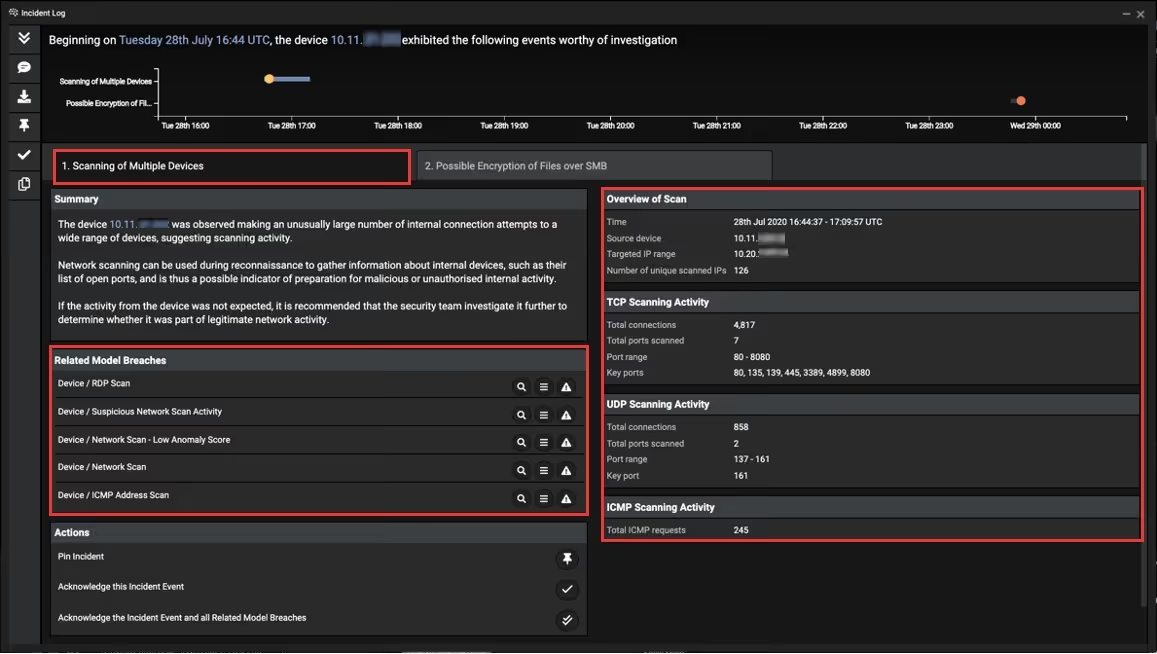
Figure 2: Internal reconnaissance of the subnet over a number of sensitive ports
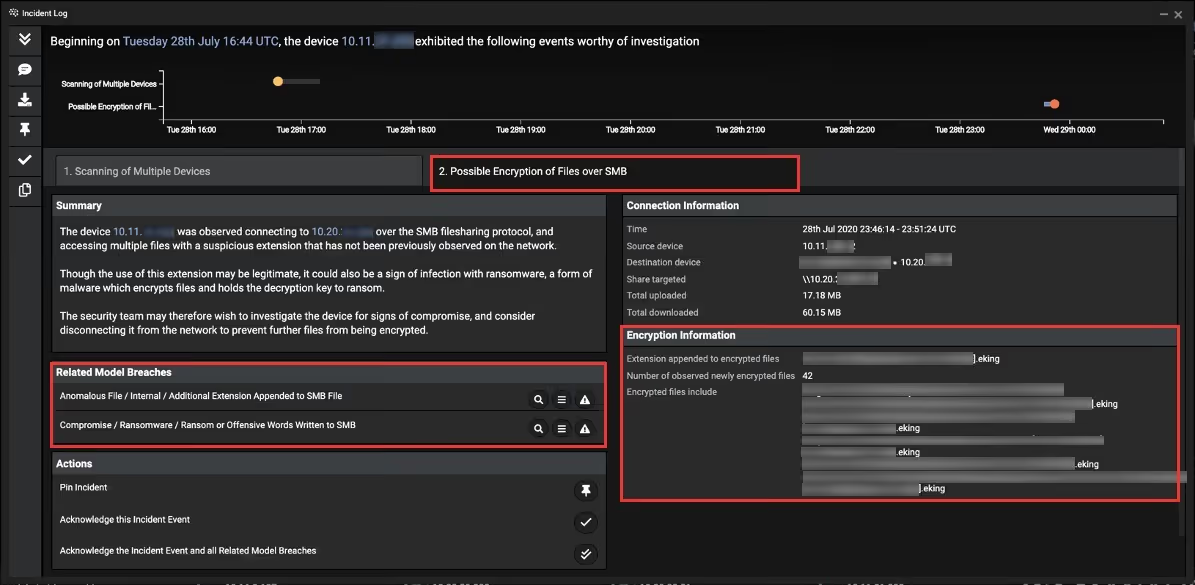
Figure 3: Encryption phase of the attack
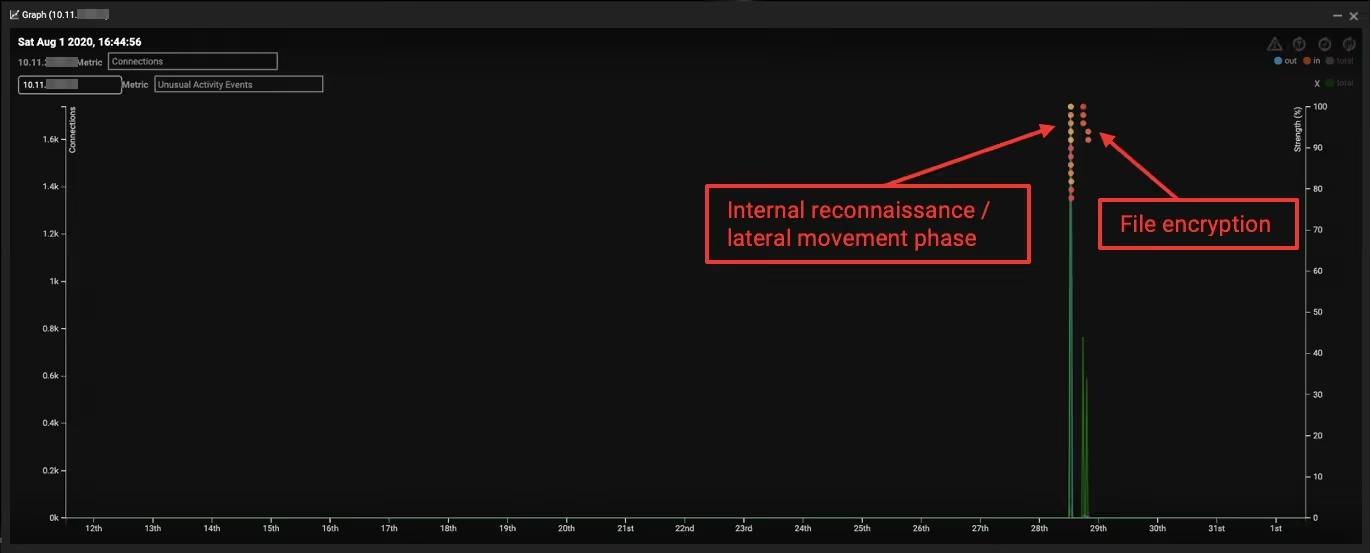
Figure 4: A graph of connections and unusual activity demonstrating how significant of a deviation this activity was from normal device behavior

Off the shelf: The commercialization of cyber-crime

This incident demonstrates how the rise in Ransomware-as-a-Service is allowing lower-level threat actors to access sophisticated strains of ransomware as well as novel variants of well-known attacks. The cyber-crime market is estimated to be worth $1.6 billion, and this figure is only likely to rise as the relatively new ‘industry’ matures. As a result, the potential perpetrators of advanced cyber-attacks like the one detailed above are no longer confined to professional cyber-criminal rings, who have outsourced their tactics, techniques and procedures to a wider range of threat actors willing to pay the right price. As lower-level threat actors get access, more organizations will find themselves targeted by increasingly sophisticated threats.

Just this week, Darktrace observed a high-profile example of RaaS in a Sodinokibi ransomware attack that hit a retail organization in the US. The infected device engaged in anomalous administrative activities before writing an unusual executable file, sharing it with other internal locations and then encrypting multiple files on the network and writing its own ransom note files.

With ransomware attacks continuing to target organizations large and small, security teams are fundamentally changing their approach to cyber defense, turning to artificial intelligence to stop attacks that other tools miss. Without relying on pre-defined rules and signatures, Cyber AI learns a sense of ‘self’ for a unique organization to detect and respond to anomalous activity as soon as it occurs.

Fight back with Autonomous Response

Threat actors know that deploying ransomware at weekends or at night is more likely to succeed because an organization’s response time is typically slower. Darktrace’s Autonomous Response operates around the clock, taking a targeted and proportionate response to contain malicious activity wherever it occurs, whether in the network, email, or in cloud and SaaS applications.

Had Darktrace Antigena been deployed at this government in APAC, it would have taken action at the first stage of the attack – as the initial scanning took place – and prevented the malware from ever reaching the encryption stage. However, in this case, when the security team returned to the office the next morning, they were still able to act faster than they otherwise would have and limit the damage, thanks to the fully-investigated incident and actionable intelligence of the Cyber AI Analyst’s AI-powered investigations.

Thanks to Darktrace analyst Brian Evans for his insights on the above threat find.

Learn more about Autonomous Response

IoCs:

IoCComment.ekingEking encryption extension

Darktrace model detections:

  • Device / ICMP Address Scan
  • Unusual Activity / Unusual Internal Connections
  • Device / Network Scan - Low Anomaly Score
  • Device / Network Scan
  • Anomalous Connection / Unusual Internal Remote Desktop
  • Device / RDP Scan
  • Device / Suspicious Network Scan Activity
  • Anomalous Connection / SMB Enumeration
  • Anomalous Connection / Unusual Admin RDP Session
  • Device / Multiple Lateral Movement Model Breaches
  • Compromise / Ransomware / Suspicious SMB Activity
  • Compromise / Ransomware / Ransom or Offensive Words Written to SMB
  • Anomalous File / Internal / Additional Extension Appended to SMB File

Inside the SOC
Darktrace cyber analysts are world-class experts in threat intelligence, threat hunting and incident response, and provide 24/7 SOC support to thousands of Darktrace customers around the globe. Inside the SOC is exclusively authored by these experts, providing analysis of cyber incidents and threat trends, based on real-world experience in the field.
Written by
Max Heinemeyer
Global Field CISO

More in this series

No items found.

Blog

/

Cloud

/

March 5, 2026

Inside Cloud Compromise: Investigating Attacker Activity with Darktrace / Forensic Acquisition & Investigation

Default blog imageDefault blog image

Investigating Cloud Attacks with Forensic Acquisition & Investigation

Darktrace / Forensic Acquisition & Investigation™ is the industry’s first truly automated forensic solution purpose-built for the cloud. This blog will demonstrate how an investigation can be carried out against a compromised cloud server in minutes, rather than hours or days.

The compromised server investigated in this case originates from Darktrace’s Cloudypots system, a global honeypot network designed to observe adversary activity in real time across a wide range of cloud services. Whenever an attacker successfully compromises one of these honeypots, a forensic copy of the virtual server's disk is preserved for later analysis. Using Forensic Acquisition & Investigation, analysts can then investigate further and obtain detailed insights into the compromise including complete attacker timelines and root cause analysis.

Forensic Acquisition & Investigation supports importing artifacts from a variety of sources, including EC2 instances, ECS, S3 buckets, and more. The Cloudypots system produces a raw disk image whenever an attack is detected and stores it in an S3 bucket. This allows the image to be directly imported into Forensic Acquisition & Investigation using the S3 bucket import option.

As Forensic Acquisition & Investigation runs cloud-natively, no additional configuration is required to add a specific S3 bucket. Analysts can browse and acquire forensic assets from any bucket that the configured IAM role is permitted to access. Operators can also add additional IAM credentials, including those from other cloud providers, to extend access across multiple cloud accounts and environments.

Figure 1: Forensic Acquisition & Investigation import screen.

Forensic Acquisition & Investigation then retrieves a copy of the file and automatically begins running the analysis pipeline on the artifact. This pipeline performs a full forensic analysis of the disk and builds a timeline of the activity that took place on the compromised asset. By leveraging Forensic Acquisition & Investigation’s cloud-native analysis system, this process condenses hour of manual work into just minutes.

Successful import of a forensic artifact and initiation of the analysis pipeline.
Figure 2: Successful import of a forensic artifact and initiation of the analysis pipeline.

Once processing is complete, the preserved artifact is visible in the Evidence tab, along with a summary of key information obtained during analysis, such as the compromised asset’s hostname, operating system, cloud provider, and key event count.

The Evidence overview showing the acquired disk image.
Figure 3: The Evidence overview showing the acquired disk image.

Clicking on the “Key events” field in the listing opens the timeline view, automatically filtered to show system- generated alarms.

The timeline provides a chronological record of every event that occurred on the system, derived from multiple sources, including:

  • Parsed log files such as the systemd journal, audit logs, application specific logs, and others.
  • Parsed history files such as .bash_history, allowing executed commands to be shown on the timeline.
  • File-specific events, such as files being created, accessed, modified, or executables being run, etc.

This approach allows timestamped information and events from multiple sources to be aggregated and parsed into a single, concise view, greatly simplifying the data review process.

Alarms are created for specific timeline events that match either a built-in system rule, curated by Darktrace’s Threat Research team or an operator-defined created at the project level. These alarms help quickly filter out noise and highlight on events of interest, such as the creation of a file containing known malware, access to sensitive files like Amazon Web Service (AWS) credentials, suspicious arguments or commands, and more.

 The timeline view filtered to alarm_severity: “1” OR alarm_severity: “3”, showing only events that matched an alarm rule.
Figure 4: The timeline view filtered to alarm_severity: “1” OR alarm_severity: “3”, showing only events that matched an alarm rule.

In this case, several alarms were generated for suspicious Base64 arguments being passed to Selenium. Examining the event data, it appears the attacker spawned a Selenium Grid session with the following payload:

"request.payload": "[Capabilities {browserName: chrome, goog:chromeOptions: {args: [-cimport base64;exec(base64...], binary: /usr/bin/python3, extensions: []}, pageLoadStrategy: normal}]"

This is a common attack vector for Selenium Grid. The chromeOptions object is intended to specify arguments for how Google Chrome should be launched; however, in this case the attacker has abused the binary field to execute the Python3 binary instead of Chrome. Combined with the option to specify command-line arguments, the attacker can use Python3’s -c option to execute arbitrary Python code, in this instance, decoding and executing a Base64 payload.

Selenium’s logs truncate the Arguments field automatically, so an alternate method is required to retrieve the full payload. To do this, the search bar can be used to find all events that occurred around the same time as this flagged event.

Pivoting off the previous event by filtering the timeline to events within the same window using timestamp: [“2026-02-18T09:09:00Z” TO “2026-02-18T09:12:00Z”].
Figure 5: Pivoting off the previous event by filtering the timeline to events within the same window using timestamp: [“2026-02-18T09:09:00Z” TO “2026-02-18T09:12:00Z”].

Scrolling through the search results, an entry from Java’s systemd journal can be identified. This log contains the full, unaltered payload. GCHQ’s CyberChef can then be used to decode the Base64 data into the attacker’s script, which will ultimately be executed.[NJ9]

Continue reading
About the author
Nathaniel Bill
Malware Research Engineer

Blog

/

Network

/

February 19, 2026

CVE-2026-1731: How Darktrace Sees the BeyondTrust Exploitation Wave Unfolding

Default blog imageDefault blog image

Note: Darktrace's Threat Research team is publishing now to help defenders. We will continue updating this blog as our investigations unfold.

Background

On February 6, 2026, the Identity & Access Management solution BeyondTrust announced patches for a vulnerability, CVE-2026-1731, which enables unauthenticated remote code execution using specially crafted requests.  This vulnerability affects BeyondTrust Remote Support (RS) and particular older versions of Privileged Remote Access (PRA) [1].

A Proof of Concept (PoC) exploit for this vulnerability was released publicly on February 10, and open-source intelligence (OSINT) reported exploitation attempts within 24 hours [2].

Previous intrusions against Beyond Trust technology have been cited as being affiliated with nation-state attacks, including a 2024 breach targeting the U.S. Treasury Department. This incident led to subsequent emergency directives from  the Cybersecurity and Infrastructure Security Agency (CISA) and later showed attackers had chained previously unknown vulnerabilities to achieve their goals [3].

Additionally, there appears to be infrastructure overlap with React2Shell mass exploitation previously observed by Darktrace, with command-and-control (C2) domain  avg.domaininfo[.]top seen in potential post-exploitation activity for BeyondTrust, as well as in a React2Shell exploitation case involving possible EtherRAT deployment.

Darktrace Detections

Darktrace’s Threat Research team has identified highly anomalous activity across several customers that may relate to exploitation of BeyondTrust since February 10, 2026. Observed activities include:

Outbound connections and DNS requests for endpoints associated with Out-of-Band Application Security Testing; these services are commonly abused by threat actors for exploit validation.  Associated Darktrace models include:

  • Compromise / Possible Tunnelling to Bin Services

Suspicious executable file downloads. Associated Darktrace models include:

  • Anomalous File / EXE from Rare External Location

Outbound beaconing to rare domains. Associated Darktrace models include:

  • Compromise / Agent Beacon (Medium Period)
  • Compromise / Agent Beacon (Long Period)
  • Compromise / Sustained TCP Beaconing Activity To Rare Endpoint
  • Compromise / Beacon to Young Endpoint
  • Anomalous Server Activity / Rare External from Server
  • Compromise / SSL Beaconing to Rare Destination

Unusual cryptocurrency mining activity. Associated Darktrace models include:

  • Compromise / Monero Mining
  • Compromise / High Priority Crypto Currency Mining

And model alerts for:

  • Compromise / Rare Domain Pointing to Internal IP

IT Defenders: As part of best practices, we highly recommend employing an automated containment solution in your environment. For Darktrace customers, please ensure that Autonomous Response is configured correctly. More guidance regarding this activity and suggested actions can be found in the Darktrace Customer Portal.  

Appendices

Potential indicators of post-exploitation behavior:

·      217.76.57[.]78 – IP address - Likely C2 server

·      hXXp://217.76.57[.]78:8009/index.js - URL -  Likely payload

·      b6a15e1f2f3e1f651a5ad4a18ce39d411d385ac7  - SHA1 - Likely payload

·      195.154.119[.]194 – IP address – Likely C2 server

·      hXXp://195.154.119[.]194/index.js - URL – Likely payload

·      avg.domaininfo[.]top – Hostname – Likely C2 server

·      104.234.174[.]5 – IP address - Possible C2 server

·      35da45aeca4701764eb49185b11ef23432f7162a – SHA1 – Possible payload

·      hXXp://134.122.13[.]34:8979/c - URL – Possible payload

·      134.122.13[.]34 – IP address – Possible C2 server

·      28df16894a6732919c650cc5a3de94e434a81d80 - SHA1 - Possible payload

References:

1.        https://nvd.nist.gov/vuln/detail/CVE-2026-1731

2.        https://www.securityweek.com/beyondtrust-vulnerability-targeted-by-hackers-within-24-hours-of-poc-release/

3.        https://www.rapid7.com/blog/post/etr-cve-2026-1731-critical-unauthenticated-remote-code-execution-rce-beyondtrust-remote-support-rs-privileged-remote-access-pra/

Continue reading
About the author
Emma Foulger
Global Threat Research Operations Lead
あなたのデータ × DarktraceのAI
唯一無二のDarktrace AIで、ネットワークセキュリティを次の次元へ