
ブログ
/
Email
/
May 1, 2026

How email-delivered prompt injection attacks can target enterprise AI – and why it matters

Prompt injection is a newly emerging threat, with only a handful of confirmed victims so far – targeting how AI systems use data rather than exploiting traditional software vulnerabilities. As agentic AI becomes embedded across enterprise environments, attackers may attempt to manipulate these systems through hidden instructions in everyday email content.
Inside the SOC
Darktrace cyber analysts are world-class experts in threat intelligence, threat hunting and incident response, and provide 24/7 SOC support to thousands of Darktrace customers around the globe. Inside the SOC is exclusively authored by these experts, providing analysis of cyber incidents and threat trends, based on real-world experience in the field.
Written by
Kiri Addison
Senior Director of Product
Default blog image
01
May 2026

What are email-delivered prompt injection attacks?

As organizations rapidly adopt AI assistants to improve productivity, a new class of cyber risk is emerging alongside them: email-delivered AI prompt injection. Unlike traditional attacks that target software vulnerabilities or rely on social engineering, this is the act of embedding malicious or manipulative instructions into content that an AI system will process as part of its normal workflow. Because modern AI tools are designed to ingest and reason over large volumes of data, including emails, documents, and chat histories, they can unintentionally treat hidden attacker-controlled text as legitimate input.  

At Darktrace, our analysis has shown an increase of 90% in the number of customer deployments showing signals associated with potential prompt injection attempts since we began monitoring for this type of activity in late 2025. While it is not always possible to definitively attribute each instance, internal scoring systems designed to identify characteristics consistent with prompt injection have recorded a growing number of high-confidence matches. The upward trend suggests that attackers are actively experimenting with these techniques.

Recent examples of prompt injection attacks

Two early examples of this evolving threat are HashJack and ShadowLeak, which illustrate prompt injection in practice.

HashJack is a novel prompt injection technique discovered in November 2025 that exploits AI-powered web browsers and agentic AI browser assistants. By hiding malicious instructions within the URL fragment (after the # symbol) of a legitimate, trusted website, attackers can trick AI web assistants into performing malicious actions – potentially inserting phishing links, fake contact details, or misleading guidance directly into what appears to be a trusted AI-generated output.

ShadowLeak is a prompt injection method to exfiltrate PII identified in September 2025. This was a flaw in ChatGPT (now patched by OpenAI) which worked via an agent connected to email. If attackers sent the target an email containing a hidden prompt, the agent was tricked into leaking sensitive information to the attacker with no user action or visible UI.

What’s the risk of email-delivered prompt injection attacks?

Enterprise AI assistants often have complete visibility across emails, documents, and internal platforms. This means an attacker does not need to compromise credentials or move laterally through an environment. If successful, they can influence the AI to retrieve relevant information seamlessly, without the labor of compromise and privilege escalation.

The first risk is data exfiltration. In a prompt injection scenario, malicious instructions may be embedded within an ordinary email. As in the ShadowLeak attack, when AI processes that content as part of a legitimate task, it may interpret the hidden text as an instruction. This could result in the AI disclosing sensitive data, summarizing confidential communications, or exposing internal context that would otherwise require significant effort to obtain.

The second risk is agentic workflow poisoning. As AI systems take on more active roles, prompt injection can influence how they behave over time. An attacker could embed instructions that persist across interactions, such as causing the AI to include malicious links in responses or redirect users to untrusted resources. In this way, the attacker inserts themselves into the workflow, effectively acting as a man-in-the-middle within the AI system.

Why can’t other solutions catch email-delivered prompt injection attacks?

AI prompt injection challenges many of the assumptions that traditional email security is built on. It does not fit the usual patterns of phishing, where the goal is to trick a user into clicking a link or opening an attachment.  

Most security solutions are designed to detect signals associated with user engagement: suspicious links, unusual attachments, or social engineering cues. Prompt injection avoids these indicators entirely, meaning there are fewer obvious red flags.

In this case, the intention is actually the opposite of user solicitation. The objective is simply for the email to be delivered and remain in the inbox, appearing benign and unremarkable. The malicious element is not something the recipient is expected to engage with, or even notice.

Detection is further complicated by the nature of the prompts themselves. Unlike known malware signatures or consistent phishing patterns, injected prompts can vary widely in structure and wording. This makes simple pattern-matching approaches, such as regex, unreliable. A broad rule set risks generating large numbers of false positives, while a narrow one is unlikely to capture the diversity of possible injections.

How does Darktrace catch these types of attacks?

The Darktrace approach to email security more generally is to look beyond individual indicators and assess context, which also applies here.  

For example, our prompt density score identifies clusters of prompt-like language within an email rather than just single occurrences. Instead of treating the presence of a phrase as a blocking signal, the focus is on whether there is an unusual concentration of these patterns in a way that suggests injection. Additional weighting can be applied where there are signs of obfuscation. For example, text that is hidden from the user – such as white font or font size zero – but still readable by AI systems can indicate an attempt to conceal malicious prompts.

This is combined with broader behavioral signals. The same communication context used to detect other threats remains relevant, such as whether the content is unusual for the recipient or deviates from normal patterns.

Ask your email provider about email-delivered AI prompt injection

Prompt injection targets not just employees, but the AI systems they rely on, so security approaches need to account for both.

Though there are clear indications of emerging activity, it remains to be seen how popular prompt injection will be with attackers going forward. Still, considering the potential impact of this attack type, it’s worth checking if this risk has been considered by your email security provider.

Questions to ask your email security provider

  • What safeguards are in place to prevent emails from influencing AI‑driven workflows over time?
  • How do you assess email content that’s benign for a human reader, but may carry hidden instructions intended for AI systems?
  • If an email contains no links, no attachments, and no social engineering cues, what signals would your platform use to identify malicious intent?

Visit the Darktrace / EMAIL product hub to discover how we detect and respond to advanced communication threats.  

Learn more about securing AI in your enterprise.

Inside the SOC
Darktrace cyber analysts are world-class experts in threat intelligence, threat hunting and incident response, and provide 24/7 SOC support to thousands of Darktrace customers around the globe. Inside the SOC is exclusively authored by these experts, providing analysis of cyber incidents and threat trends, based on real-world experience in the field.
Written by
Kiri Addison
Senior Director of Product

More in this series

No items found.

Blog

/

AI

/

June 14, 2026

スポーツ産業のサイバーセキュリティ: デジタル化した2026年のスポーツ産業が直面する脅威

Default blog imageDefault blog image

2026年のスポーツイベントを保護する

試合開催日にスタジアムに足を踏み入れるとき、あなたは小さなスマートシティを訪れています。チケット販売、回転ゲート、決済システム、何万ものファンが利用する公共Wi-Fi、CCTV、照明、そしてHVACまでもがすべて、相互に接続されたシステム上で稼働しています。ファンの体験はこれまでになく向上しましたが、この接続への依存は人々が想像するよりもはるかに大きなアタックサーフェスを作り出しています。

私たちの最新の調査結果はそれを裏付けています。ダークトレースが委託して実施した調査によれば、調査対象のプロスポーツ組織の84%は過去1年間に少なくとも1回のサイバーインシデントを経験しており、57%は複数回遭遇していました。試合が行われるライブ時間にすべてがかかっている業界にとって、これらの数字は直接的に運営上のリスクを意味します。

なぜスポーツがサイバー攻撃の標的になるのか

スポーツは非常に目立つターゲットであり、スケジュールが決まっているため、攻撃者は障害が最も影響を与える時期を正確に知っています。また、貴重なデータであるアスリートの医療記録、契約書、スポンサー契約書などが保管されており、これらが漏洩すれば財務上、評判上、規制上のリスクを伴います。同時に、イベントの開催もチケット発行、放送局、クラウドサービス、スタジアム関連テクノロジーなど、多くの第三者に依存しています。それらのシステムとの接続はいずれも侵入点になる可能性があります。注目度、スケジュール、データ、依存関係、これらが組み合わされることにより、小さな足がかりから、影響の大きな、時間的余裕の許されないインシデントに発展する環境が生まれます。

攻撃者はどのようにEメールとアイデンティティを標的にするか

Eメールとアイデンティティは主要な侵入経路です。2025年10月から2026年3月にかけて、Darktrace / EMAIL™は当社の顧客ベースにおいてスポーツ組織を狙った11万6,000通以上のフィッシングEメールを検知しました。また、スポーツ業界の顧客は他の業界の組織よりも19%多くのフィッシングEメールを受け取っています。数字がこれを物語っています:

数値が示すもの

  • フィッシングEメールの21%はVIPを標的
  • 37%は新手のソーシャルエンジニアリングを使用
  • 悪意あるEメールの84%がDMARC認証を通過

これらのEメールの大部分は認証チェックを通過しており、従来のセキュリティ対策がもはや信頼できる防壁ではないことを意味しています。攻撃者はなりすましドメインに頼っているのではなく、正規のインフラストラクチャと信頼されたプラットフォームを利用しています。ここで、動作が大きな意味を持ちます。アカウントが侵害されると、動作は急速に変化します。ログインパターンが変わり、返信を隠すための受信トレイルールが作成され、アカウントが内部偵察やさらなるフィッシングに使用され始めます。これらは大きな騒音を伴う出来事ではありません。それらは通常のワークフローに紛れ込み、多くのケースで見落とされています。

ランサムウェアも同じような経緯で発生しています。あるスポーツ関連の顧客内では、攻撃者は暗号化を開始する前の2週間もの間、静かにデータを外部サーバーに移動していました。身代金要求文が出現するときには、すでにお膳立てができていたというわけです。一貫して見られるシーケンスとして、まずアクセスがあり、次に移動があり、そして最後に障害が発生しています。暗号化の時点で検知されても、既に手遅れです。

AIがスポーツ組織の新たなブラインドスポットとなる理由

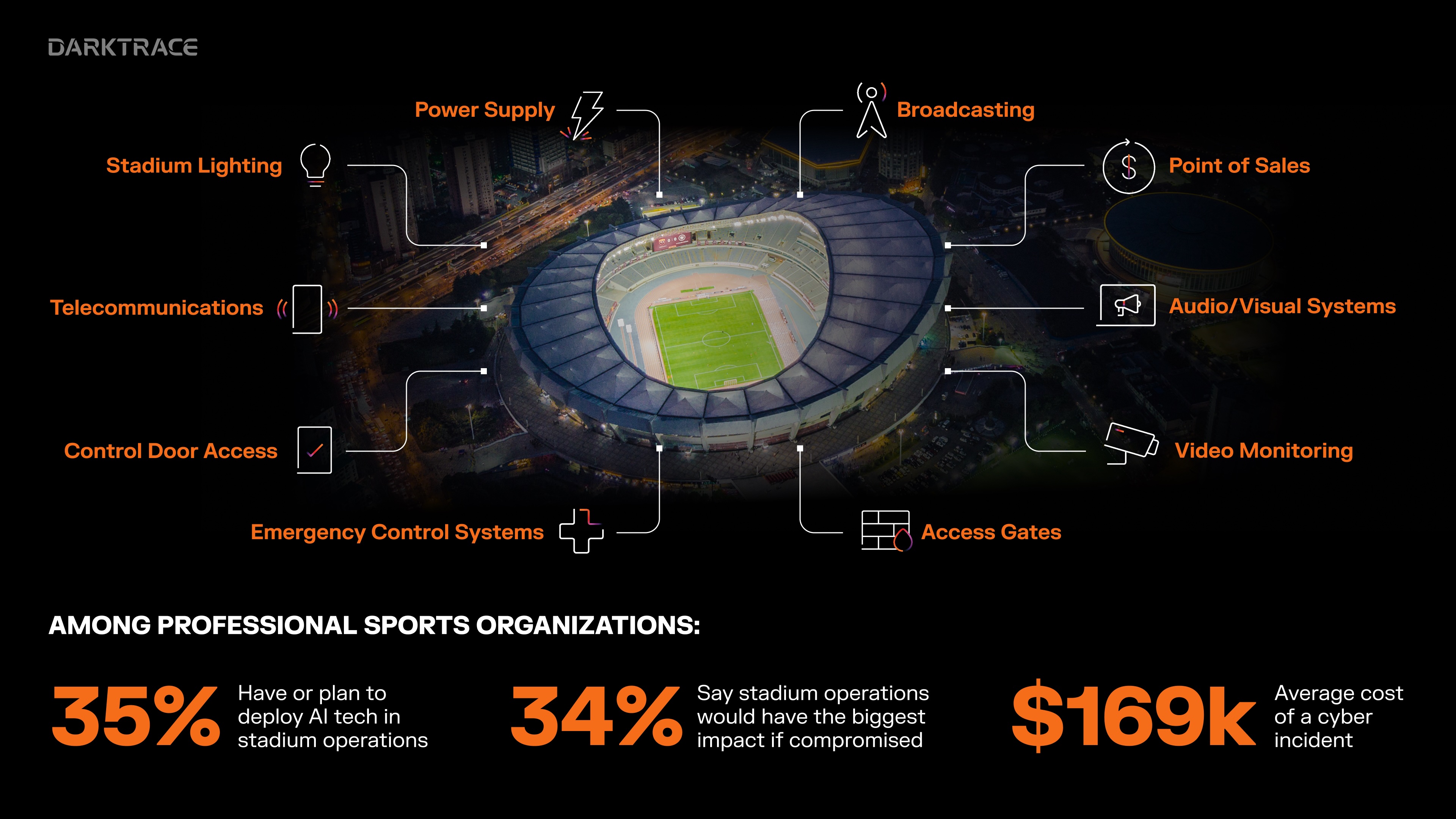
AI導入の増加は潜在的アタックサーフェスを拡大させています。当社が調査を行ったセキュリティプロフェッショナルの72%は、今後1年間でAIがリスク増大につながると予想しています。しかし35%はスタジアムの運営という保護すべき最も重要な機能に既にAIを使用しているか、使用を計画しているのです。プロンプトインジェクションやAI構築リスクに加えて、シャドーAIがより切迫したリスクとなりつつあります。スタッフはすでに、パフォーマンス指標、スカウティングレポート、契約、健康データなどの機密データを、ほとんどまたはまったく管理されていないツールに入力しています。AIのもたらす利点は明らかですが、リスクも同様に明白であり、しかもそれはほとんどの組織が何の可視性やコントロールも持たないうちに発生しています。その一方で、攻撃者は同じAI技術を使ってフィッシングやソーシャルエンジニアリングを拡大しています。その結果はシンプルです-より大きな露出リスクが、より速いスピードで発生しているのです。

サイバーセキュリティプロフェッショナルはどう備えるべきか

大規模なイベントにおいて、効果的なサイバー防御には準備、リアルタイムの可視性が重要です。限られたタイミング、複雑さ、一般の注目、そしてこれらが重なるなかで、動的かつ決定的に対応する能力が必要であることを、ダークトレースの経験は物語っています。

サイバーセキュリティチームにとって戦略的に重要ないくつかの項目があります:

  • コーポレートシステムだけでなく、ITおよびOT全体の動作の可視性を確保すること。
  • アイデンティティをコントロールプレーンとして扱うこと。 この分野でのほとんどの攻撃は、マルウェアではなく認証情報から始まります。ビヘイビア検知を用いた多要素認証(MFA)は、その課題の解決に役立ちます。
  • 自社の環境を管理するのと同じように第三者とAIのアクセスも制御すること。
  • 数分で意思決定を行う、ライブ条件で対応を訓練すること。 検知と対応は、エンジニアにプレッシャーがかかり、時間が制約される非理想的な条件を考慮する必要があります。スポーツにおいて小さな問題を重大インシデントに発展させるのは、このタイミング条件です。平日であれば問題なく対応できる事象も、イベント開催中は重大な事態になりかねません。

2026年、スポーツにおいてサイバーセキュリティのリスクが拡大する理由

FIFAワールドカップ2026は3か国と数十の開催都市にまたがるため、アタックサーフェスは広範であり、スケジュールも厳しいものとなります。

地政学的なシグナリングは脅威プロファイルをさらに深刻化させています。これまでの国際スポーツイベントでは、国家を背後に持つ脅威アクターがサイバー領域を利用してその意思を示し、ナラティブに影響を及ぼし、象徴的な報復を行うことが実証されています。2026年ワールドカップの文脈において、国際スポーツからのロシアの継続的な排除、ウクライナでの現在の紛争、米国のウクライナへの防衛支援、そしてイランの大会参加の可能性は、国家に関係したアクター、そして非伝統的なアフィリエイト達が武力攻撃未満のサイバー攻撃を展開するさらなる動機を与えています。それには新しい技術は必要ありません — ただ適切なタイミングと注目度があればよいのです。

実務においては、結局準備に行きつくことになります。ITとOT全体で正常な状態がどのようなものかを把握し、第三者のアクセスを管理し、動作の変化を識別することです。

スポーツにおいて、障害は徐々に蓄積するのではなく、リアルタイムに、衆人環視の下で発生します。試合開始のホイッスルが鳴るずっと前に、その段取りはすでに完了しているのです。

調査について

調査結果は、スポーツセクターの顧客におけるDarktraceの脅威調査テレメトリー(2025年第4四半期~2026年第1四半期)および2026年5月28日から6月3日にOpinion Mattersが実施した米国、英国、オーストラリア、ドイツの875人のITサイバーセキュリティ専門家を対象とした調査に基づいています。調査手法の詳細、インシデント分析、および戦略的推奨事項については、レポート全文をお読みください。

[related-resource]

Continue reading
About the author
Nathaniel Jones
VP, Security & AI Strategy, Field CISO

Blog

/

OT

/

June 12, 2026

Protecting Stadiums & Events with AI

Default blog imageDefault blog image

Stadium and large public venue operators are confronted with a unique set of cyber security challenges. Often described as a ‘honeypot’ for cyber-criminals, the sports and entertainment industry is an attractive target for threat actors for three main reasons:

  • Modern sports organizations process sensitive and highly valuable data at scale;
  • Sporting events are highly visible and time-critical, operating in front of live audiences with no room for error;
  • Sports organizations rely on sprawling vendor ecosystems and supply chains to deliver broadcast, commerce, fan engagement services, and more.

In a recent Darktrace-commissioned survey, 84% of professional sports organizations reported at least one cyber incident in the past year, and 57% were hit more than once [1]. The potential ramifications of cyber disruption during a large-scale sports event cannot be overstated. A momentary lapse in access to power could bring TV broadcasts to a halt; disruption to access controls could restrict fans from entering the grounds; CCTV outages could increase the risk of criminal behavior and physical injuries. If data is not reliable and stadium machines are outputting the wrong metrics, a venue could become dangerously overcrowded. The barrier between the cyber and physical worlds has long dissolved – cyber-attacks threaten human safety.

In this blog, I explore the key challenges of stadium cyber security and explain the unique capabilities of Self-Learning AI that led me to adopt Darktrace as a head of ICT and cyber security for international venues and events. Over my career I have helped secure football and rugby World Cups, World Athletics Championships and more than 500 events ,and the lessons from each have only sharpened my conviction in this approach.

The access paradox

The biggest challenge lies in the paradox of securing a site where various internal services are provided to a large number of unknown and unmanaged users, suppliers and devices. When it’s game time, or ‘D-Day’, you see a huge influx of thousands of people, each with their own devices, needing to connect to your network and your infrastructure. The floodgates are opened. But certain parts of your digital environment need to remain protected: your sensitive employee and customer data, your critical OT systems. I liken this to opening the door to your home, and letting the entire town come in and wander around. But you still need to secure your master bedroom.

A multitude of different actors must be able to work on-site to provide services or content during the event. Broadcasters, staff and suppliers need to have access to manage the show, and all these people need to access or interact with the IT infrastructure. In many ways, these additional bodies are already inside the perimeter and could host unknown malicious threats.

This year, the paradox is wider than ever. A tournament spread across hundreds of suppliers and vendors means the foothold an attacker needs may already belong to a trusted partner – a single compromised supplier can become the doorway to everything else. And the adversary is no longer working alone: generative AI now lets attackers probe and weaponize vulnerabilities across thousands of software dependencies at a speed no human team could match, turning the access paradox from a manageable risk into a fast-moving target.

Achieving this balance between accessibility and security requires a shift in mindset from perimeter-based security to one that can detect and respond to threats on the inside. The complexities involved requires technology that can identify malicious behavior in real time based on the wider context of an incident. A particular behavior or connection may be benign in one context and yet critically disruptive in another — tools and technology must be able to discern between the two.

This is why I considered Darktrace’s Self-Learning AI a suitable fit: rather than defending at the perimeter, it focuses on detecting and responding to malicious activity already inside. Because it learns the unique ‘patterns of life’ of its surroundings, it can detect subtle deviations that indicate a threat and initiate a targeted response – without relying on pre-programmed rules and playbooks.

IT/OT convergence

The second key challenge is the issue of IT and OT convergence. Typical stadiums and arenas consist of a wide range of Industrial Control Systems (ICS).

This involves a complex and messy array of switches, cables, CCTV cameras, as well as devices and technologies being brought in by the media and the press, and all these IT and OT components are now interconnected, which means these technologies now have Internet Protocol (IP)-based threats to manage. The same challenges that the corporate infrastructure for stadium management faces in cyber security are therefore also now an issue for ICS security.

This challenge cannot be addressed by viewing IT and OT security in isolation — these two environments are linked because of the analogue migration to IP. A unified approach is required to detect and respond to threats that start in IT before moving to industrial systems.

The stakes are physical. CCTV, Access Control, Public Annoucement system, lighting and the giant screens are all now running over IP, and a disruption to any of them can force a venue to halt play on safety grounds. Scale compounds the problem. At the Qatar 2022 World Cup, eight stadiums were purpose-built to a single technical standard, which made the digital environment relatively uniform to defend. The 2026 tournament is the opposite: dozens of host venues across three countries, each with its own operator, its own contractors and its own legacy systems.This creates a far more fragmented and unpredictable estate to secure.

In addition, cyber security technology must be able to deal with complexity. Darktrace’s AI thrives in the most complex environments, with more data points adding more context to inform the AI’s decision making. It covers OT and IT with a single, unified AI engine, that can also detect and respond across cloud infrastructure, SaaS applications, email systems and endpoints. It is ready to adapt to the messy, interconnected systems that make up large stadiums’ digital infrastructure.

The time factor

Finally, the nature of stadium events means that timing is critical and puts enormous pressure on the organizers and operators. ‘D-Day’ cannot be replayed or postponed, and so if cyber disruption occurs during the event, every minute is crucial. You cannot reschedule a World Cup final or move an opening ceremony; the date is fixed, the world is watching, and there is no second take.

There is consequently a strong emphasis on two key metrics

  • Mean Time To Know (MTTK) — how long it takes the security team need to be aware of an incident; and
  • Mean Time To Restore (MTTR) — how quickly a team can act to contain the threat.

It is perhaps more imperative in stadium event management than anywhere else that these two metrics be minimized.

This leads to the third criteria in assessing cyber security technology: does it help with response? And critically, can that response be nuanced and targeted, able to contain that threat without causing further disruption?

To this end, Darktrace’s Autonomous Response takes machine-speed action to contain cyber-attacks, when humans are too slow to react or aren’t around at all. It’s powered by Darktrace’s AI, so it has a nuanced and continuously updating understanding of what’s ‘normal’ across IT and OT systems. This means its response actions are targeted: designed to eliminate the threat, but not at the cost of disruption. Crucially, this enables responses that are surgical rather than blunt. For example, taking an entire server offline to stop a ransomware attack can cause more disruption than the attack itself, so the real value lies in neutralizing the malicious activity precisely — containing the threat without taking down the systems the event and business depends on.

Depending on the nature and severity of the threat, the technology can block specific malicious connections by enforcing the normal ‘pattern of life’ of a device or account. When every second counts, this is the speed and granularity that you need in a cybersecurity technology.

Darktrace can be deployed across every area of the digital enterprise, including network, email, cloud and SaaS environments with the same self-learning approach, stopping anomalous behaviors that point to account takeover and other cloud-based threats. Earlier this year, we announced that Darktrace is also extending its behavioral approach to help businesses deploy and scale AI securely by understanding how these AI systems and agents behave, interact with other systems and humans, and evolve over time. This is critical because 72% of cybersecurity professionals at sports organizations believe AI will increase their cyber risk over the next 12 months [2].

Wherever it is deployed, Darktrace allows the stadium operator to focus on the vital part of the game and offers real-time protection without any modification in the network topology or infrastructure.

An adaptive defense

Cyber-criminals are constantly developing their approach in an attempt to evade security tools trained to look for specific hallmarks of an attack. As they get creative and continuously experiment with new tactics and techniques, the human operators using these tools are forced into a constant state of catch up.

An AI-based approach that learns an organization and its normal behavior patterns from the ground up puts an end to this game of ‘cat and mouse’, shifting the balance in favor of the defenders and allowing them to stay ahead of the threat. This matters more than ever, because adversaries are now using AI to scale their attacks. If you do not have AI working to protect you against malicious AI, you are already at a disadvantage.

With a nuanced understanding of what’s ‘normal’ for the business, unified IT/OT coverage, and an Autonomous Response solution that takes immediate, surgical action, the playing field is leveled, and large stadium and events operators can focus on delivering the best possible experience for attendees, digital viewers, partners and performers.

[related-resource]

References:

[1] [2] Darktrace: Cybersecurity in Global Sport, June 2026. Findings based on survey of 875 IT cybersecurity professionals based in the US, UK, Australia and Germany, working in professional sports organizations (including clubs, societies & sporting bodies) employing 10+ people. The survey was fielded between May 28, 2026 and June 3, 2026 by independent market research agency, Opinion Matters.

Continue reading
About the author
あなたのデータ × DarktraceのAI
唯一無二のDarktrace AIで、ネットワークセキュリティを次の次元へ