Darktrace cyber analysts are world-class experts in threat intelligence, threat hunting and incident response, and provide 24/7 SOC support to thousands of Darktrace customers around the globe. Inside the SOC is exclusively authored by these experts, providing analysis of cyber incidents and threat trends, based on real-world experience in the field.
Written by
Dr. Oakley Cox-Robinson
Senior Director of Product
Share
03
Aug 2023
What is an Insider Threat?
Insider threat refers to cyber threats which originates from within an organization. Insider threats can come in the form of employees, vendors, contractors, or anyone with access to sensitive systems, data, or information. The cyber risk posed by insiders can be grouped into malicious insiders, such as rogue or disgruntled employees, or accidental, such as a well-meaning employee inadvertently leaking data or introducing a security flaw.
Insider threats are a reality for all organizations, across all industry verticals around the world. However, this Darktrace short read will focus on Operational Technology (OT), such as those within Critical Infrastructure, and the impact insiders can have on safety-critical systems, the environment, and human life.
Malicious v Non-Malicious Insider Threat in OT
There are generally two types of insider threats: malicious and non-malicious, or accidental. For organizations managing OT, both types originate from personnel who have legitimate privileged access to OT networks and have insider knowledge of assets, configurations, locations, security controls, or vulnerabilities. Of increasing concern to security teams, these personnel can also include external contractors, such as vendors or consultants, who require high levels of access to perform their role.
The 2001 sewage spill in Maroochy Shire, Australia, was the first high-profile example of a malicious insider manipulating control systems to impact OT. More recently, the 2021 incident at the Oldsmar Water Facility in Florida was the result of poor cyber security practices. While there is much speculation as to the exact cause of the incident, the root cause appears to have been human error which resulted in changes to intended chemical content levels in drinking water.
Insider Threats: Challenges and Solutions
The biggest concern for cyber security managers in Critical Infrastructure and OT networks is the threat posed by those on the inside. Compliance breaches, poor cyber hygiene, and disgruntled or rogue employees all pose a greater everyday threat to these systems than APTs or the latest zero day.
Insider threats are hard to catch. They rarely use attack tools or malware to achieve their goal, rendering signature-based threat detection useless. Instead, they leverage their legitimate access to make changes to native functionality. Rules-based threat detection can be used to prevent certain actions, but playbooks are limited to the imagination of the person implementing them and the time they have to create and maintain them.
Anomaly-Based Threat Detection
Anomaly-based threat detection is uniquely positioned to detect insider threats. Both accidental and malicious disruption may use legitimate privileged access to target Purdue Level 1 and 2 controllers and programmers to alter operations. The actor will alter the routine functionality of the process control environment, which can be detected and alerted by a security tool which understands normal and can spot deviations.
Darktrace/OT vs Insider Threats
Powered by scalable, Self-Learning AI, Darktrace/OT uses anomaly-based detection to detect unpredictable attacks in their earliest stages. By learning the normal ‘patterns of life’ for every device and operator in an industrial environment, Darktrace/OT detects known and unknown threats including zero-day exploits, supply chain attacks, ransomware, pre-existing infections, and insider threat.
Using raw digital data from an OT network to understand the normal pattern of life, Darktrace/OT does not need any data or threat feeds from external sources to perform anomaly-based threat detection. The approach is perfectly suited to spotting and stopping the threat posed by malicious and non-malicious insiders.
Attack Case Study: Spotting Insider Threats with Self-Learning AI
In the real-world example below, Darktrace/OT detected a subtle deviation from normal behavior when a reprogram command was sent by an engineering workstation to a PLC controlling a pump, an action an insider threat with legitimized access to OT systems would take to alter the physical process without any malware involved. In this instance, AI Analyst, Darktrace’s investigation tool that triages events to reveal the full security incident, detected the event as unusual based on multiple metrics including the source of the command, the destination device, the time of the activity, and the command itself.
As a result, AI Analyst created a complete security incident, with a natural language summary, the technical details of the activity, and an investigation process explaining how it came to its conclusion. By leveraging Explainable AI, a security team can quickly triage and escalate Darktrace incidents in real time before it becomes disruptive, and even when performed by a trusted insider.
Figure 1: AI Analyst Incident reporting an unusual reprogram command using the MODBUS protocol. The incident includes a plain English summary, relevant technical information, and the investigation process used by the AI.
Figure 2: The Darktrace Threat Visualizer allows security analysts and OT engineers to visualize and replay incidents in real time.
Credit to Daniel Simonds for his contribution to this blog.
Darktrace cyber analysts are world-class experts in threat intelligence, threat hunting and incident response, and provide 24/7 SOC support to thousands of Darktrace customers around the globe. Inside the SOC is exclusively authored by these experts, providing analysis of cyber incidents and threat trends, based on real-world experience in the field.
Beyond the Fridge: Exposed Industrial Control Systems
Following the cyber attack on supermarket refrigeration systems in France, Darktrace researchers looked at how many industrial devices are sitting exposed on the public internet. From fridge controllers to PLCs and remote gateways, many rely on weak or default credentials.
Botnet Behind the Camera: Mirai Katana Activity on a Video Recording Device
Darktrace identified Mirai Katana botnet activity on a camera device in a sports-sector network, showing how compromised IoT devices can facilitate malware delivery, botnet activity, and data exfiltration from inside trusted environments.
A stadium during a major sporting event is simultaneously a city, a broadcast hub, a transport node, a public safety space, and a national symbol. That makes them attractive not just to criminals, but to politically motivated and state‑aligned threat actors willing to plan years ahead. With the 2026 FIFA World Cup spanning three nations and dozens of host cities, those challenges – and the AI now amplifying them – have never carried higher stakes.
Beyond the Fridge: Exposed Industrial Control Systems
Introduction
In October 2026, hundreds of supermarkets across France were reportedly affected by a cyberattack targeting their refrigeration systems. According to public reports, the attackers gained access to internet-connected controllers and modified their settings, forcing refrigeration units into high and extremely low temperatures and causing significant disruption. Total losses have been reported to reach several million euros.
The incident drew attention to the security of industrial refrigeration systems, particularly older devices with exposed management interfaces and known vulnerabilities.
The exact details of how the attackers gained access have not been confirmed, however it is speculated that the public-facing web server could be accessed with the username “admin” and password being the current date. Researchers from Claroty’s Team82 identified a vulnerability in Danfoss AK-SM 8xxA Series in 2025, “CVE-2025-41450", allowing for administrative access using a time-based “code-of-the-day" for authentication [1].
Default credentials, outdated firmware and publicly accessible administrative interfaces have been an issue for years. And yet these systems continue to appear in internet scans and require little sophistication to gain admin access. A simple search of internet-connected devices shows a range of exposed devices from Programmable Logic Controllers (PLCs) and remote gateways, to, yes, more fridges.
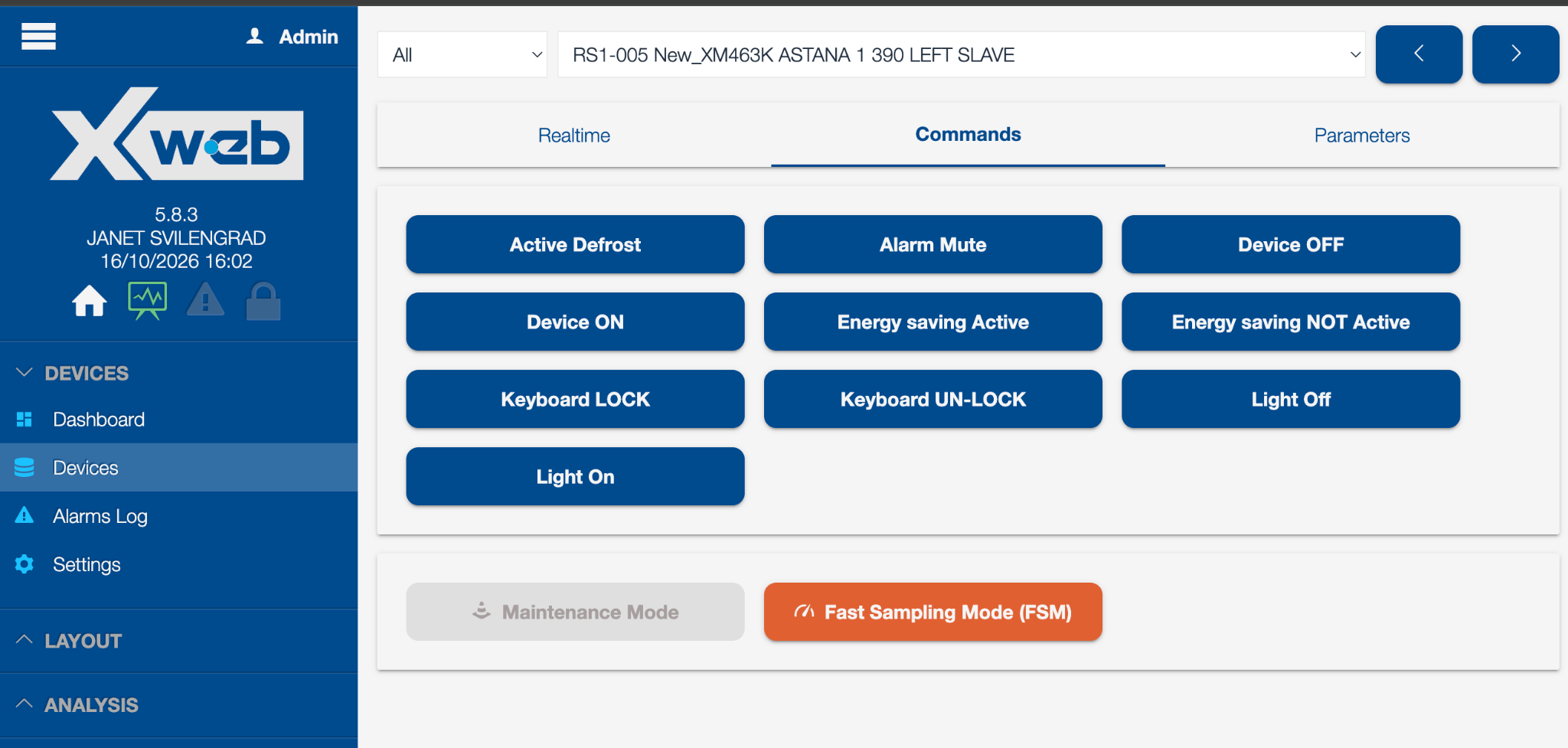
Darktrace malware researchers identified hundreds of IoT and OT devices publicly exposed on the internet, many of which are configured with no authentication, weak credentials, or default credentials. As shown in Figure 1, an exposed Copeland XWEB web interface, used to manage Dixell equipment, including refrigerators, can provide the ability to remotely control connected devices.
Figure 1: Copeland XWEB interface used to control systems including refrigerators and air conditioning.
However, it’s not only fridges; web management interfaces for industrial controls are also publicly accessible, often protected only by weak credentials. Figure 2 shows an example of a publicly exposed WAGO interface. The WAGO management interface is a configuration and administration panel for controllers. Through it, a logged-in user can view device details and diagnostics, manage user accounts and passwords, update firmware, back up or restore the full configuration, set the clock, and manage SD card storage. While it typically doesn’t manage switch outputs or read live process values, someone with access could still disrupt operation by changing network or Modbus settings, loading bad firmware or configurations, or by resetting passwords and enabling insecure services.
Figure 2: WAGO Management interface.
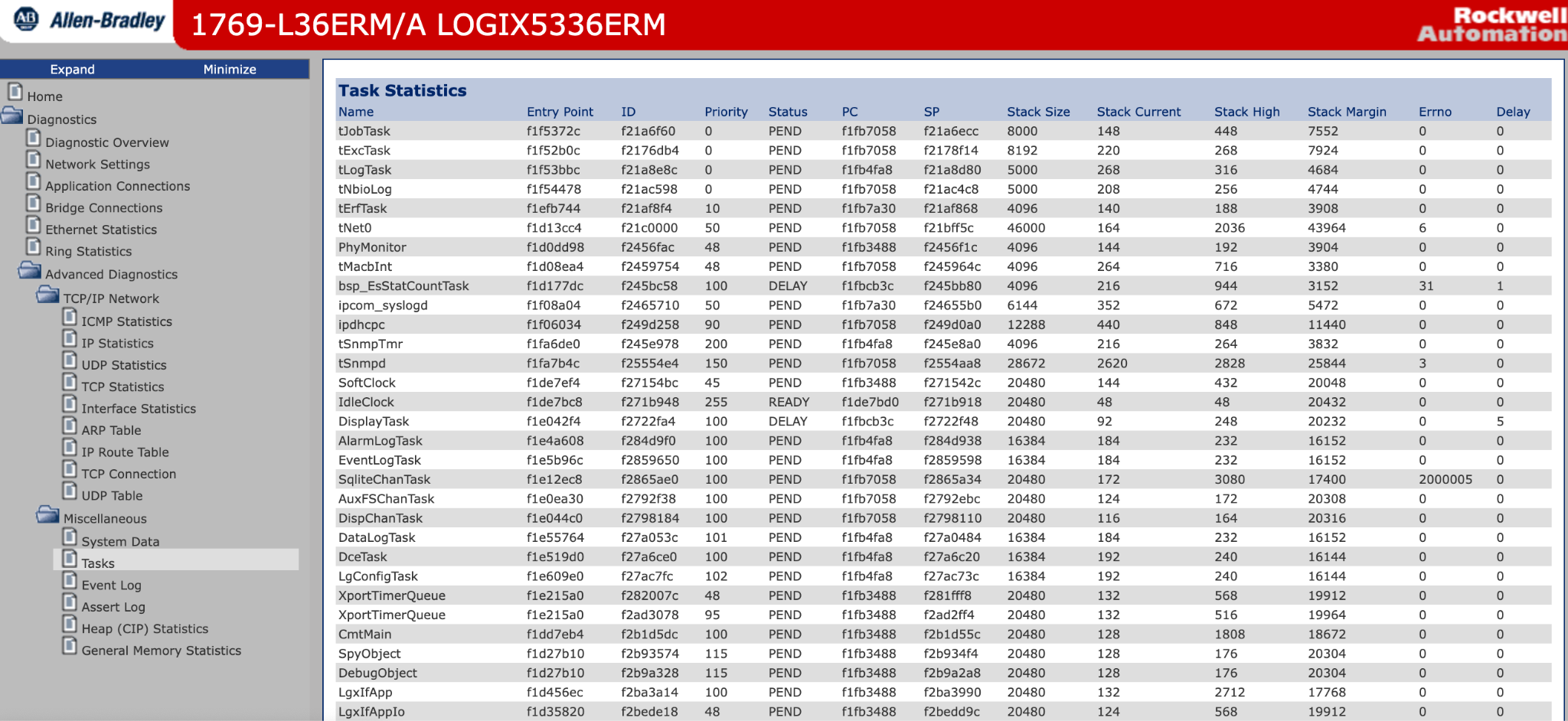
The issue extends beyond management interfaces. During our research, we identified publicly accessible web interfaces belonging to PLCs, including Rockwell Automation Allen-Bradley devices. In each case, the risk arises from how the devices have been deployed and configured, not from a flaw in the vendors’ products.
Figure 3: Web interface for Allen-Bradley CompactLogix controller.
Figure 3 shows the web interface of an Allen-Bradley CompactLogix controller. Unlike the previous examples, this interface provides a view into the controller's operation, including running tasks, network connections, memory usage and diagnostic information. Rockwell Automation's CompactLogix controllers are commonly used to automate industrial processes, from manufacturing and packaging lines to water treatment and material handling systems. Depending on their configuration, these controllers can operate motors, pumps, valves and other physical equipment.
Although in this example the interface shown does not provide direct control over the PLC's logic, it exposes information about the model, firmware, network layout, and connections, which is useful reconnaissance for a bigger attack.
The concern is not necessarily that every exposed interface allows an attacker to immediately manipulate industrial processes. However, these devices are accessible from the public internet in the first place, providing information about systems that may be responsible for controlling physical equipment.
The attacks on refrigeration systems in France highlight the consequences of poorly secured industrial devices. As demonstrated throughout this research, publicly accessible management interfaces are not limited to refrigeration controllers but extend to PLCs and other systems used to manage industrial equipment.
Finding these devices requires little effort. Internet scanners make it possible to identify publicly exposed interfaces quickly, and in some cases these interfaces rely on publicly documented default credentials or have no authentication at all. As attackers increasingly use AI tools, such attacks may be identified and carried out faster and at a greater scale.
The consequences of this access depend on the device and the functionality exposed. While some interfaces provide little more than diagnostic information, others allow users to modify configurations, disrupt communications, or change settings that affect physical equipment. In industrial environments, this can result in operational downtime, damaged equipment and financial losses.
Weak passwords, default credentials and exposed administrative interfaces are not new security issues. Yet their continued presence on internet-connected industrial systems demonstrates how easily preventable weaknesses can leave physical operations vulnerable to attack.
Exposed devices often come from third-party suppliers and contractors, who frequently install refrigeration controllers, gateways and PLCs without the organization ever being aware they are connected to the internet. Asset visibility remains an important foundation, but organizations should assume that some unknown assets and services will exist. Effective security therefore also depends on continuous monitoring, anomaly detection, network segmentation and rapid response, so that risky exposure and unusual activity can be identified and addressed before it becomes disruptive.
Copeland, Dixell, WAGO, Rockwell Automation, Allen-Bradley and CompactLogix are trademarks of their respective owners. Their use here is for identification only and does not imply any affiliation with or endorsement by those owners.
Why Kubernetes Security Needs A Behavioral Approach
Kubernetes has become a foundational technology for modern cloud-native infrastructure. It can orchestrate everything from customer-facing applications to data pipelines and, increasingly, AI workloads. This is due to the highly scalable nature of Kubernetes, making it cost efficient and reliable.
Gartner projects that by 2028, 95% of new AI deployments will run on Kubernetes, up from less than 30% today1. However, the same qualities that make Kubernetes powerful also make it uniquely challenging to secure, leaving many organizations with limited visibility into their clusters. This lack of visibility increases risk - it’s difficult to secure what you can’t see.
However, this risk is often looked at as purely a posture management challenge. While Cloud Security Posture Management (CSPM) solutions can tell you how a cluster should be configured, they don’t tell you what it is doing in real time. This requires runtime behavioral monitoring of clusters to detect active threats.
Yet existing approaches to securing Kubernetes by most Cloud Detection and Response (CDR) and Network Detection and Response (NDR) vendors often have limited coverage or require a third-party integration to forward traffic and metadata. This means that capabilities can be limited and detections can lack the context of the wider environment, which slows down triage, investigation and response.
Why Kubernetes is hard to secure
Traditional security tooling was built for persistent, long-term infrastructure such as servers and virtual machines with fixed identities that last months or years. Some elements of Kubernetes environments can have a much shorter lifespan, breaking many assumptions those tools rely on:
Increased complexity
Kubernetes environments can be complex in comparison to traditional infrastructure, with many different elements to consider such as nodes, clusters, containers, pods and the workloads themselves.
Ephemeral by design
Kubernetes pods can spin up and terminate in seconds. A container that was compromised may no longer exist by the time a deeper investigation is required, leaving no artifact to analyze. This poses a unique challenge for security operations.
Weaker workload boundaries
Kubernetes containers use lightweight, shared-kernel isolation rather than separate virtual machines, improving efficiency but reducing separation between workloads and the host. As a result, a compromised container may have a greater potential impact on the node and neighboring workloads than a compromised virtual machine (VM).2
Recent vulnerabilities have shown that threat actors can escape a container and gain access to the underlying host.3, 4
Everything is API-driven
Dozens or hundreds of microservices communicate over internal APIs, and the Kubernetes control plane itself is an API. This creates a large and dynamic attack surface, making it difficult to distinguish legitimate activity from malicious behavior.
Without identity-aware runtime visibility, threat actors can move laterally between pods and exploit misconfigured role-based access controls (RBAC) with little chance of detection.
Rising to the challenge of securing Kubernetes
With the release of Darktrace 7.2, Darktrace / HYBRID NETWORK can extend behavioral security into Kubernetes, delivering visibility, detection and response capabilities across runtime activity. Darktrace addresses the challenges of securing Kubernetes environments in several ways.
Behavioral detection, not static rules
Many Kubernetes runtime tools rely on predefined rules and signatures - a fixed list of “bad” behaviors to match against. That approach struggles with novel attacks and generates noise at scale. Darktrace takes a different approach: our Adaptive AI builds a Unique Behavioral Profile for each organization from the ground up, learning the normal behavior of every workload, node and identity in your cluster. It then uses this understanding to detect meaningful deviations from expected behavior, which serves as the basis for surfacing suspicious and malicious activity.
A pod reaching out to an unfamiliar destination, an unexpected executable launching inside a workload, or an identity performing an action it has never performed, all surface as anomalies without anyone having to write a rule in advance.
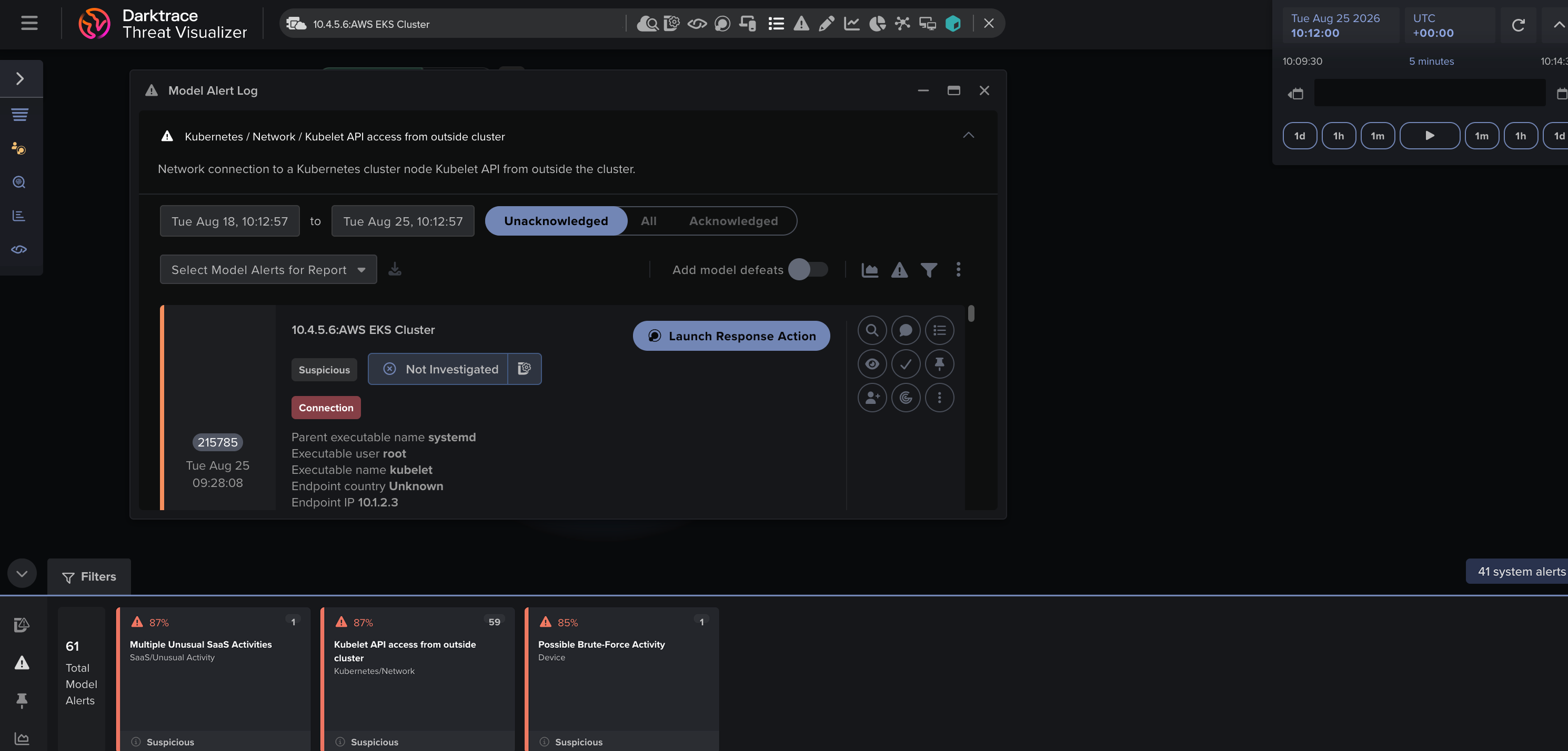
Darktrace surfaces unexpected Kubernetes activity that does not align with an organization’s Unique Behavioral Profile
Visibility across the network, the process, and the control plane
Darktrace monitors Kubernetes at three levels that together provide comprehensive runtime visibility:
Network-layer
Traffic between pods, across nodes and out to the internet. This helps to detect lateral movement and unusual connectivity, whether internal or external.
Process-layer
What is executing inside your containers. If a process reads a sensitive credential file or spawns an unexpected shell inside a production pod, Darktrace can identify that activity and use it as context for further detections.
Controlplane
Activity against the Kubernetes API itself: someone executes a command in a running pod, RBAC changes, or unusual administrative actions. Many high-impact security events involve the control plane, an area that is often less visible to solutions that only analyze or scan network-layer telemetry.
Misconfiguration and vulnerability awareness
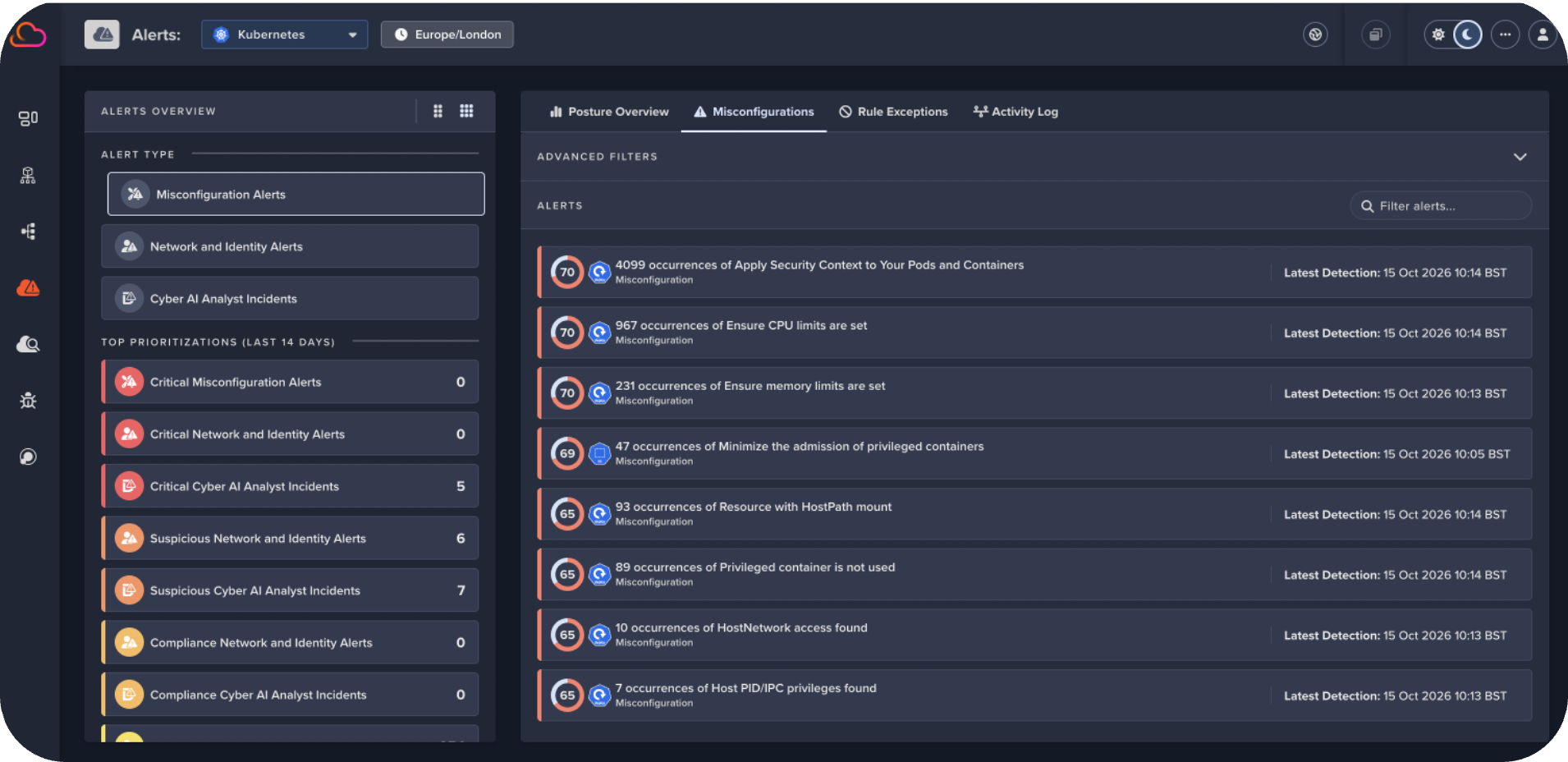
Runtime detection is strongest when combined with posture and exposure management. Darktrace surfaces risky pod configurations, such as privileged containers, host networking, and over-permissive service accounts as workloads are deployed, and links CVEs from images to the workloads running them. Security teams can go beyond simply knowing that a vulnerability exists and see exactly where it is in the cluster. When combined with behavior-based detections, this provides invaluable context that can help prioritize incidents and proactively identify areas that need further attention. For example, anomalous workload behavior on its own might not be very interesting to a security team at first, but if that same workload is known to host sensitive data, is known to have critical vulnerabilities associated with it, or is publicly accessible, then this narrative becomes much more suspicious and demanding of their attention.
Darktrace highlights Kubernetes misconfigurations such as privileged containers, host networking, and missing security controls, helping teams prioritize runtime alerts with valuable exposure and risk context
Response, tailored to Kubernetes
Detection is most effective when paired with response. Darktrace can take precise actions on Kubernetes workloads, including blocking a malicious connection at the pod level, helping to safely contain threats while security teams investigate. Response actions can be taken fully autonomously or via a human-in-the-loop process, which is completely configurable depending on the desired level of autonomy and scope. Darktrace is expanding the number of Kubernetes-native response actions to give customers even more flexibility when containing threats.
Forensics that survive the workload
Because containers are so short-lived, evidence disappears fast and this can make it very difficult to answer questions related to the initial detections. Darktrace solves this with Forensic Acquisition & Investigation capabilities that extend to Kubernetes containers, allowing investigations to be triggered manually by an analyst, or automatically from an alert, preserving evidence before the workload is gone.
For incident responders, this addresses a key challenge in container security: being able to answer “what actually happened?” after an ephemeral workload has vanished.
One platform, not another silo
Kubernetes doesn't exist in isolation, and neither should its security. Darktrace correlates cluster activity with the surrounding cloud environment, including AWS, Azure and GCP identities, network activity and cloud assets, allowing analysts to pivot between a Kubernetes workload and its wider context. A single anomalous action can be traced from the control plane to the pod, and from the pod to the cloud identity behind it, all within a single investigation workflow. This can also include alerts from other areas of hybrid infrastructure or third-party sources where relevant, adding more context to investigations and speeding up workflows for human analysts.
Built to deploy easily
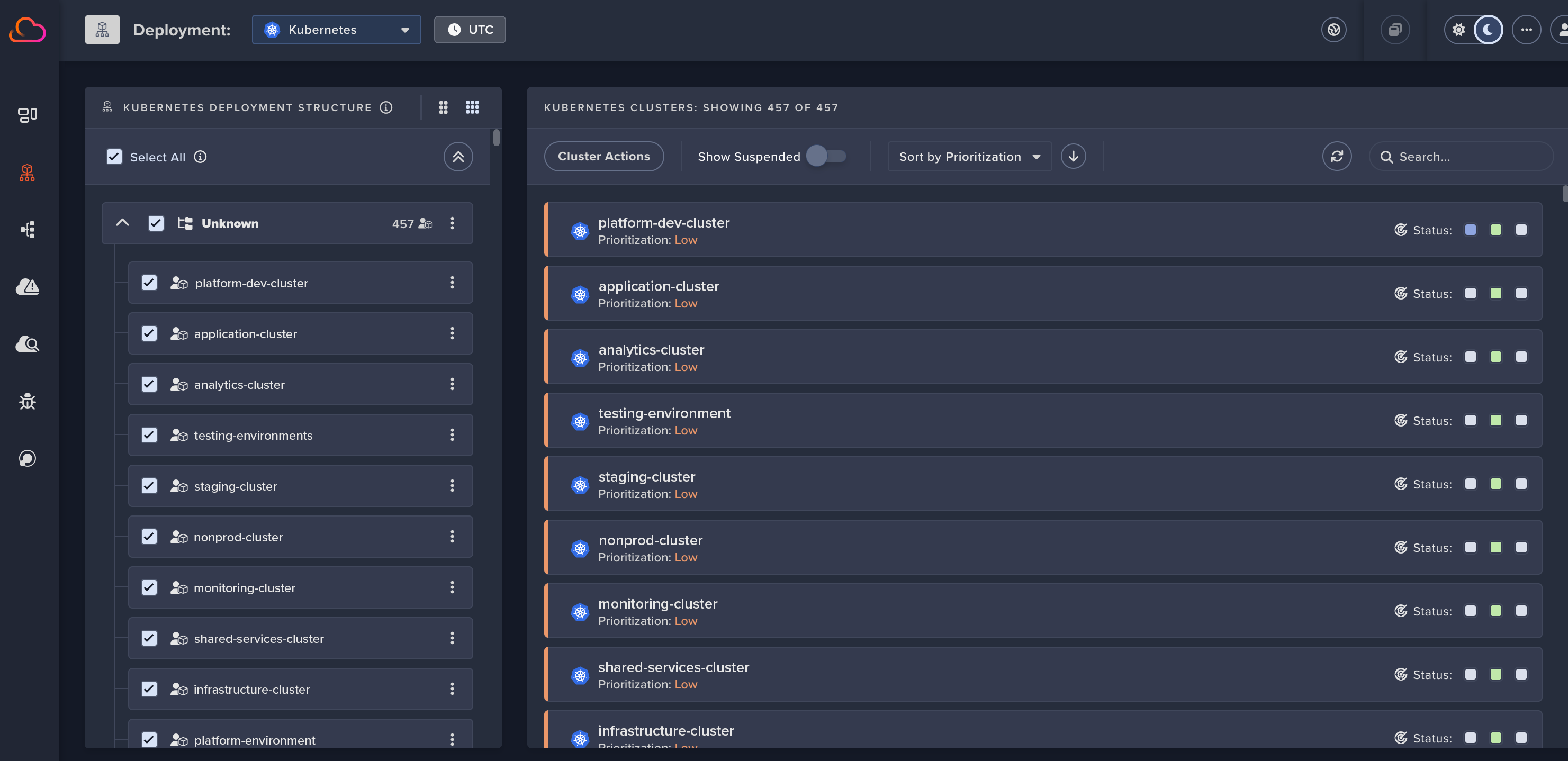
Operational complexity can be a barrier to security adoption. Darktrace / HYBRID NETWORK for Kubernetes installs with a single command, and for teams that manage their infrastructure as code, it supports raw manifests so the deployment can live in a Git repository and be managed through existing GitOps workflows. The same deployment approach works across Kubernetes environments in AWS, Azure, Google Cloud, and on-premises infrastructure. Early adopters of Darktrace’s Kubernetes capabilities have highlighted the simplicity of deployment and time to value.
Darktrace can deploy across your Kubernetes environment and wider hybrid infrastructure, while also providing visibility into Kubernetes deployment structure and status
Next steps
Kubernetes environments are dynamic, ephemeral and API-driven in ways that challenge traditional security tooling. With Kubernetes usage increasing due to widespread AI adoption, it is essential to secure Kubernetes environments as part of securing what AI can do. Darktrace / HYBRID NETWORK addresses these challenges by learning normal behavior in Kubernetes environments across network, process and control-plane layers, identifying meaningful threats and enabling targeted response. Combined with the context of wider hybrid infrastructure and forensic investigation capabilities, Darktrace provides visibility into both emerging threats and active incidents.
To see how Darktrace can help secure your Kubernetes environment and your wider hybrid infrastructure, get in touch to arrange your free trial. Existing customers can contact their Darktrace Account Team for more information about deployment options and licensing.
Sources
[1] Gartner, Container Management research, 2025: "By 2028, 95% of new AI deployments will use Kubernetes, up from less than 30% today." https://www.gartner.com/en/documents/7913109. (quote reproduced under Gartner reprint at https://www.kubermatic.com/magic-quadrant-and-critical-capabilities-for-container-management/)






.jpeg)