Blog
/
/
May 5, 2020

The Ongoing Threat of Dharma Ransomware Attacks

Stay informed about the dangers of Dharma ransomware and its methods of attack, ensuring your defenses are strong against potential intrusions.
Inside the SOC
Darktrace cyber analysts are world-class experts in threat intelligence, threat hunting and incident response, and provide 24/7 SOC support to thousands of Darktrace customers around the globe. Inside the SOC is exclusively authored by these experts, providing analysis of cyber incidents and threat trends, based on real-world experience in the field.
Written by
Max Heinemeyer
Global Field CISO
Default blog imageDefault blog imageDefault blog imageDefault blog imageDefault blog imageDefault blog image
05
May 2020

Executive summary

  • In the past few weeks, Darktrace has observed an increase in attacks against internet-facing systems, such as RDP. The initial intrusions usually take place via existing vulnerabilities or stolen, legitimate credentials. The Dharma ransomware attack described in this blog post is one such example.
  • Old threats can be damaging – Dharma and its variants have been around for four years. This is a classic example of ‘legacy’ ransomware morphing and adapting to bypass traditional defenses.
  • The intrusion shows signs that indicate the threat-actors are aware of – and are actively exploiting – the COVID-19 situation.
  • In the current threat landscape surrounding COVID-19, Darktrace recommends monitoring internet-facing systems and critical servers closely – keeping track of administrative credentials and carefully considering security when rapidly deploying internet-facing infrastructure.

Introduction

In mid-April, Darktrace detected a targeted Dharma ransomware attack on a UK company. The initial point of intrusion was via RDP – this represents a very common attack method of infection that Darktrace has observed in the broader threat landscape over the past few weeks.

This blog post highlights every stage of the attack lifecycle and details the attacker’s techniques, tools and procedures (TTP) – all detected by Darktrace.

Dharma – a varient of the CrySIS malware family – first appeared in 2016 and uses multiple intrusion vectors. It distributes its malware as an attachment in a spam email, by disguising it as an installation file for legitimate software, or by exploiting an open RDP connection through internet-facing servers. When Dharma has finished encrypting files, it drops a ransom note with the contact email address in the encrypted SMB files.

Darktrace had strong, real-time detections of the attack – however the absence of eyes on the user interface prior to the encryption activity, and without Autonomous Response deployed in Active Mode, these alerts were only actioned after the ransomware was unleashed. Fortunately, it was unable to spread within the organization, thanks to human intervention at the peak of the attack. However, Darktrace Antigena in active mode would have significantly slowed down the attack.

Timeline

The timeline below provides a rough overview of the major attack phases over five days of activity.
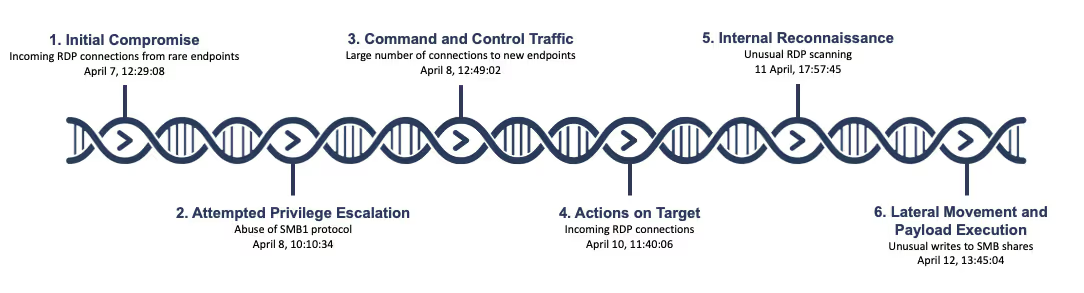
Figure 1: A timeline of the attack

Technical analysis

Darktrace detected that the main device hit by the attack was an internet-facing RDP server (‘RDP server’). Dharma used network-level encryption here: the ransomware activity takes place over the network protocol SMB.

Below is a chronological overview of all Darktrace detections that fired during this attack: Darktrace detected and reported every single unusual or suspicious event occurring on the RDP server.

Figure 2: An overview of Darktrace detections

Initial compromise

On April 7, the RDP server began receiving a large number of incoming connections from rare IP addresses on the internet.

On April 7, the RDP server began receiving a large number of incoming connections from rare IP addresses on the internet. This means a lot of IP addresses on the internet that usually don’t connect to this company started connection attempts over RDP. The top five cookies used to authenticate show that the source IPs were located in Russia, the Netherlands, Korea, the United States, and Germany.

It is highly likely that the RDP credential used in this attack had been compromised prior to the attack – either via common brute-force methods, credential stuffing attacks, or phishing. Indeed, a TTP growing in popularity is to buy RDP credentials on marketplaces and skip to initial access.

Attempted privilege escalation

The following day, the malicious actor abused the SMB version 1 protocol, notorious for always-on null sessions which offer unauthenticated users’ information about the machine – such as password policies, usernames, group names, machine names, user and host SIDs. What followed was very unusual: the server connected externally to a rare IP address located in Morocco.

Next, the attacker attempted a failed SMB session to the external IP over an unusual port. Darktrace detected this activity as highly anomalous, as it had previously learned that SMB is usually not used in this fashion within this organization – and certainly not for external communication over this port.
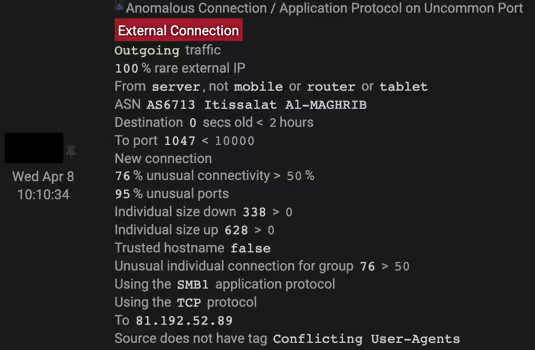
Figure 3: Darktrace detecting the rare external IP address
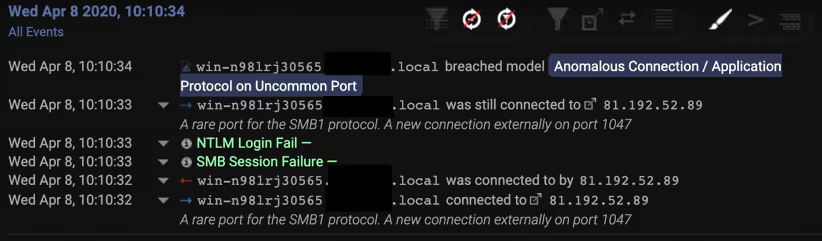
Figure 4: The SMB session failure and the rare connection over port 1047

Command and control traffic

As the entire attack occurred over five days, this aligns with a smash-and-grab approach, rather than a highly covert, low-and-slow operation.

Two hours later, the server initiated a large number of anomalous and rare connections to external destinations located in India, China, and Italy – amongst other destinations the server had never communicated with before. The attacker was now attempting to establish persistence and create stronger channels for command and control (C2). As the entire attack occurred over five days, this aligns with a smash-and-grab approach, rather than a highly covert, low-and-slow operation.

Actions on target

Notwithstanding this approach, the malicious actor remained dormant for two days, biding their time until April 10 — a public holiday in the UK — when security teams would be notably less responsive. This pause in activity provides supporting evidence that the attack was human-driven.
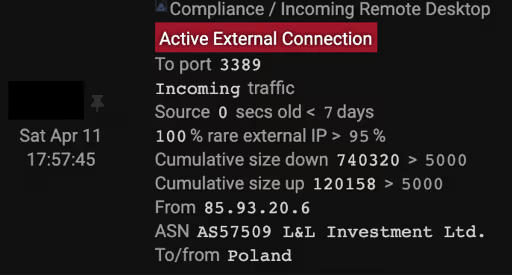
Figure 5: The unusual RDP connections detected by Darktrace

The RDP server then began receiving incoming remote desktop connections from 100% rare IP addresses located in the Netherlands, Latvia, and Poland.

Internal reconnaissance

The IP address 85.93.20[.]6, hosted at the time of investigation in Panama, made two connections to the server, using an administrative credential. On April 12, as other inbound RDP connections scanned the network, the volume of data transferred by the RDP server to this IP address spiked. The RDP server never scans the internal network. Darktrace identified this as highly unusual activity.
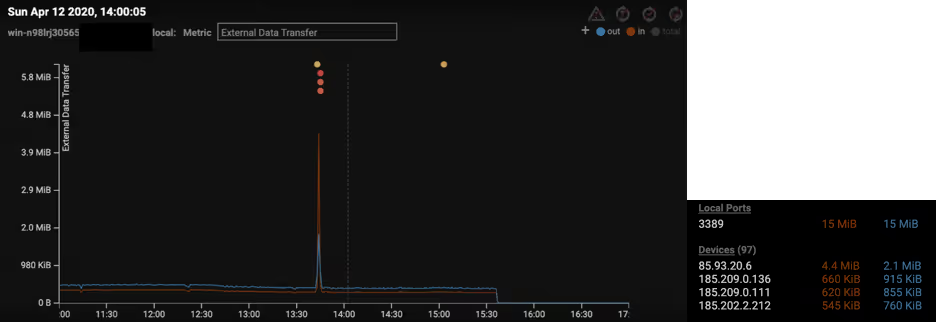
Figure 6: Darktrace detects the anomalous external data transfer

Lateral movement and payload execution

Finally, on April 12, the attackers executed the Dharma payload at 13:45. The RDP server wrote a number of files over the SMB protocol, appended with a file extension containing a throwaway email account possibly evoking the current COVID-19 pandemic, ‘cov2020@aol[.]com’. The use of string ‘…@aol.com].ROGER’ and presence of a file named ‘FILES ENCRYPTED.txt’ resembles previous Dharma compromises.

Parallel to the encryption activity, the ransomware tried to spread and infect other machines by initiating successful SMB authentications using the same administrator credential seen during the internal reconnaissance. However, the destination devices did not encrypt any files themselves.

It was during the encryption activity that the internal IT staff pulled the plug from the compromised RDP server, thus ending the ransomware activity.

Conclusion

This incident supports the idea that ‘legacy’ ransomware may morph to resurrect itself to exploit vulnerabilities in remote working infrastructure during this pandemic.

Dharma executed here a fast-acting, planned, targeted, ransomware attack. The attackers used off-the-shelf tools (RDP, abusing SMB1 protocol) blurring detection and attribution by blending in with typical administrator activity.

Darktrace detected every stage of the attack without having to depend on threat intelligence or rules and signatures, and the internal security team acted on the malicious activity to prevent further damage.

This incident supports the idea that ‘legacy’ ransomware may morph to resurrect itself to exploit vulnerabilities in remote working infrastructure during this pandemic. Poorly-secured public-facing systems have been rushed out and security is neglected as companies prioritize availability – sacrificing security in the process. Financially-motivated actors weaponize these weak points.

The use of the COVID-related email ‘cov2020@aol[.]com’ during the attack indicates that the threat-actor is aware of and abusing the current global pandemic.

Recent attacks, such as APT41’s exploitation of the Zoho Manage Engine vulnerability last March, show that attacks against internet-facing infrastructure are gaining popularity as the initial intrusion vector. Indeed, as many as 85% of ransomware attacks use RDP as an entry vector. Ensuring that backups are isolated, configurations are hardened, and systems are patched is not enough – real-time detection of every anomalous action can help protect potential victims of ransomware.

Technical Details

Some of the detections on the RDP server:

  • Compliance / Internet Facing RDP server – exposure of critical server to Internet
  • Anomalous Connection / Application Protocol on Uncommon Port – external connections using an unusual port to rare endpoints
  • Device / Large Number of Connections to New Endpoints – indicative of peer-to-peer or scanning activity
  • Compliance / Incoming Remote Desktop – device is remotely controlled from an external source, increased rick of bruteforce
  • Compromise / Ransomware / Suspicious SMB Activity – reading and writing similar volumes of data to remote file shares, indicative of files being overwritten and encrypted
  • Anomalous File / Internal / Additional Extension Appended to SMB File – device is renaming network share files with an added extension, seen during ransomware activity

The graph below shows the timeline of Darktrace detections on the RDP server. The attack lifecycle is clearly observable.
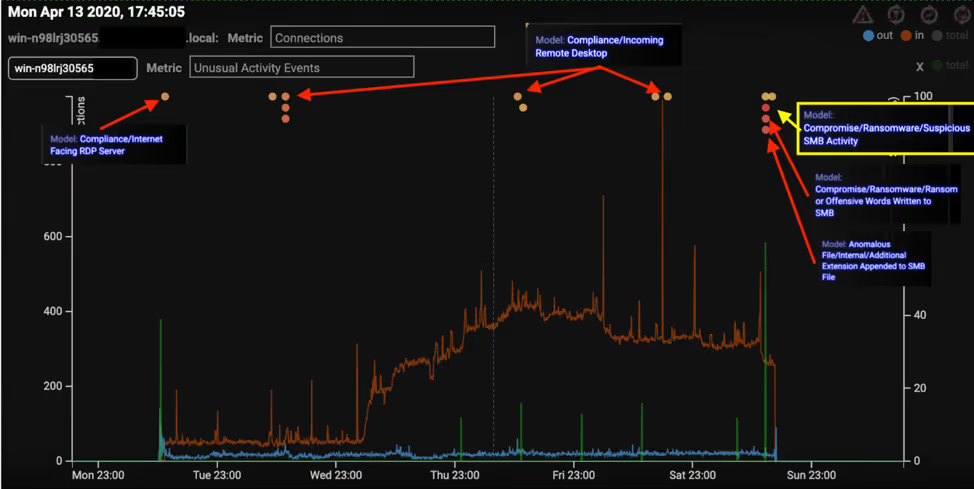
Figure 7: The model breaches occurring over time

Inside the SOC
Darktrace cyber analysts are world-class experts in threat intelligence, threat hunting and incident response, and provide 24/7 SOC support to thousands of Darktrace customers around the globe. Inside the SOC is exclusively authored by these experts, providing analysis of cyber incidents and threat trends, based on real-world experience in the field.
Written by
Max Heinemeyer
Global Field CISO

More in this series

No items found.

Blog

/

/

May 19, 2026

State of AI Cybersecurity 2026: 77% of security stacks include AI, but trust is lagging

Default blog imageDefault blog image

Findings in this blog are taken from Darktrace’s annual State of AI Cybersecurity Report 2026.

AI is a contributing member of nearly every modern cybersecurity team. As we discussed earlier in this blog series, rapid AI adoption is expanding the attack surface in ways that security professionals have never before experienced while also empowering attackers to operate at unprecedented speed and scale. It’s only logical that defenders are harnessing the power of AI to fight back.

After all, AI can help cybersecurity teams spot the subtle signs of novel threats before humans can, investigate events more quickly and thoroughly, and automate response. But although AI has been widely adopted, this technology is also frequently misunderstood, and occasionally viewed with suspicion.

For CISOs, the cybersecurity marketplace can be noisy. Making sense of competing vendors’ claims to distinguish the solutions that truly deliver on AI’s full potential from those that do not isn’t always easy. Without a nuanced understanding of the different types of AI used across the cybersecurity stack, it is difficult to make informed decisions about which vendors to work with or how to gain the most value from their solutions. Many security leaders are turning to Managed Security Service Providers (MSSPs) for guidance and support.

The right kinds of AI in the right places?

Back in 2024, when we first conducted this annual survey, more than a quarter of respondents were only vaguely familiar with generative AI or hadn’t heard of it at all. Today, GenAI plays a role in 77% of security stacks. This percentage marks a rapid increase in both awareness and adoption over a relatively short period of time.

According to security professionals, different types of AI are widely integrated into cybersecurity tooling:

  • 67% report that their organization’s security stack uses supervised machine learning
  • 67% report that theirs uses agentic AI
  • 58% report that theirs uses natural language processing (NLP)
  • 35% report that theirs uses unsupervised machine learning

But their responses suggest that organizations aren’t always using the most valuable types of AI for the most relevant use cases.

Despite all the recent attention AI has gotten, supervised machine learning isn’t new. Cybersecurity vendors have been experimenting with models trained on hand-labeled datasets for over a decade. These systems are fed large numbers of examples of malicious activity – for instance, strains of ransomware – and use these examples to generalize common indicators of maliciousness – such as the TTPs of multiple known ransomware strains – so that the models can identify similar attacks in the future. This approach is more effective than signature-based detection, since it isn’t tied to an individual byte sequence or file hash. However, supervised machine learning models can miss patterns or features outside the training data set. When adversarial behavior shifts, these systems can’t easily pivot.

Unsupervised machine learning, by contrast, can identify key patterns and trends in unlabeled data without human input. This enables it to classify information independently and detect anomalies without needing to be taught about past threats. Unsupervised learning can continuously learn about an environment and adapt in real time.

One key distinction between supervised and unsupervised machine learning is that supervised learning algorithms require periodic updating and re-training, whereas unsupervised machine learning trains itself while it works.

The question of trust

Even as AI moves into the mainstream, security professionals are eyeing it with a mix of enthusiasm and caution. Although 89% say they have good visibility into the reasoning behind AI-generated outputs, 74% are limiting AI’s ability to take autonomous action in their SOC until explainability improves. 86% do not allow AI to take even small remediation actions without human oversight.

This model, commonly known as “human in the loop,” is currently the norm across the industry. It seems like a best-of-both-worlds approach that allows teams to experience the benefits of AI-accelerated response without relinquishing control – or needing to trust an AI system.

Keeping humans somewhat in the loop is essential for getting the best out of AI. Analysts will always need to review alerts, make judgement calls, and set guardrails for AI's behavior. Their input helps AI models better understand what “normal” looks like, improving their accuracy over time.

However, relying on human confirmation has real costs – it delays response, increases the cognitive burden analysts must bear, and creates potential coverage gaps when security teams are overwhelmed or unavailable. The traditional model, in which humans monitor and act on every alert, is no longer workable at scale.

If organizations depend too heavily on in-the-loop humans, they risk recreating the very problem AI is meant to solve: backlogs of alerts waiting for analyst review. Removing the human from the loop can buy back valuable time, which analysts can then invest in building a proactive security posture. They can also focus more closely on the most critical incidents, where human attention is truly needed.

Allowing AI to operate autonomously requires trust in its decision-making. This trust can be built gradually over time, with autonomous operations expanding as trust grows. But it also requires knowledge and understanding of AI — what it is, how it works, and how best to deploy it at enterprise scale.

Looking for help in all the right places

To gain access to these capabilities in a way that’s efficient and scalable, growing numbers of security leaders are looking for outsourced support. In fact, 85% of security professionals prefer to obtain new SOC capabilities in the form of a managed service.

This makes sense: Managed Security Service Providers (MSSPs) can deliver deep, continuously available expertise without the cost and complexity of building an in-house team. Outsourcing also allows organizations to scale security coverage up or down as needs change, stay current with evolving threats and regulatory requirements, and leverage AI-native detection and response without needing to manage the AI tools themselves.

Preferences for MSSP-delivered security operations are particularly strong in the education, energy (87%), and healthcare sectors. This makes sense: all are high-value targets for threat actors, and all tend to have limited cybersecurity budgets, so the need for a partner who can deliver affordable access to expertise at scale is strong. Retailers also voiced a strong preference for MSSP-delivered services. These companies are tasked with managing large volumes of consumer personal and financial data, and with transforming an industry traditionally thought of as a late adopter to a vanguard of cyber defense. Technology companies, too, have a marked preference for SOC capabilities delivered by MSSPs. This may simply be because they understand the complexity of the threat landscape – and the advantages of specialized expertise — so well.

In order to help as many organizations as possible – from major enterprises to small and midmarket companies – benefit from enterprise-grade, AI-native security, Darktrace is making it easier for MSSPs to deliver its technology. The ActiveAI Security Portal introduces an alert dashboard designed to increase the speed and efficiency of alert triage, while a new AI-powered managed email security solution is giving MSSPs an edge in the never-ending fight against advanced phishing attacks – helping partners as well as organizations succeed on the frontlines of cyber defense.

Explore the full State of AI Cybersecurity 2026 report for deeper insights into how security leaders are responding to AI-driven risks.

Learn more about securing AI in your enterprise.

[related-resource]

Continue reading
About the author
The Darktrace Community

Blog

/

Network

/

May 19, 2026

When Open Source Is Weaponized: Analysis of a Trojanized 7 Zip Installer

7 zip installerDefault blog imageDefault blog image

Background of the malicious 7-Zip installer, and assessing its Impact

Early in 2026, external researchers disclosed a malicious distribution campaign leveraging a trojanized installer masquerading itself as a legitimate 7‑Zip utility. Evidence suggests the campaign was active as of January 2026, during which victims were served a fake installer from 7zip[.]com, a highly convincing typo-squatted domain impersonating the official 7‑Zip distribution site (7-zip[.]org).

Initial access is typically achieved through social engineering and search‑engine abuse, including YouTube tutorial content that explicitly referenced the impersonated domain as the download source. Notably, several reports observed the installer delivered a modified but functional build of 7‑Zip (7zfm.exe) to reduce suspicion and preserve expected user behavior.

However, the installer also dropped additional payloads, such as Uphero.exe, hero.exe, and hero.dll, which are not part of the legitimate 7‑Zip software package. Once installed and executed, these payloads allow the attacker to establish persistence and configure the infected host as a proxy node under their control. This facilitates malicious activities such as traffic relaying, anonymizing infrastructure, and the delivery of secondary payloads [1] [2].

Overall, this attack illustrates a proxyware-style attack that abuses implicit trust in widely deployed third‑party tools while exploiting unconventional delivery vectors such as instructional media. By closely imitating legitimate software behavior and branding, the threat actors significantly reduced user suspicion and increased the likelihood of widespread, undetected compromise.

Threat overview

Darktrace observed multiple customers affected by the malicious 7‑Zip installer between January 12 and January 22, impacting organizations across the Americas (AMS), Asia‑Pacific & Japan (APJ), and Europe, the Middle East, and Africa (EMEA) regions. The activity targeted customers across various sectors, including Human health and social work activities, Manufacturing, Education, and Information and communication.

The following use case highlights a device on one customer network making external connections associated with malicious 7-Zip update activity observed between  January 7 and January 18, 2026.  This behavior included connectivity to the malicious domain 7zip[.]com, followed by command-and control (C2) activity involving "smshero"-themed domains, as well as outbound proxy connections over ports 1000 and 1002.  

Initial Connectivity to 'update[.]7zip[.]com':

Initial Beaconing to Young Endpoint alert behavior, involving the known tunnel/proxy endpoint ‘79.127.221[.]47’.
Figure 1: Initial Beaconing to Young Endpoint alert behavior, involving the known tunnel/proxy endpoint ‘79.127.221[.]47’.

Starting on January 7, Darktrace / NETWORK detected the device making repeated beaconing connections to the endpoint 79.127.221[.]47 over the destination port 1000. The use of this port aligns with open-source intelligence (OSINT) reporting that hero[.]exe establishes outbound proxy connections via non-standard ports such as 1000 and 1002 [1].

Darktrace observed TLS beaconing alerts to the known trojanized installer, update[.]7zip[.]com · 98.96.229[.]19, over port 443 on January 7th.
Figure 2: Darktrace observed TLS beaconing alerts to the known trojanized installer, update[.]7zip[.]com · 98.96.229[.]19, over port 443 on January 7th.

Later the same day, the device initiated TLS beaconing to the endpoint update.7zip[.]com. This is more than likely a common source of compromise, where victims unknowingly installed a modified build of the tool alongside additional malicious components. The campaign then progressed into the next attack phase, marked by established connectivity to various C2 domains.

Beaconing Activity to "smshero"-themed domains

Darktrace subsequently observed the same infected device connecting to various C2 domains used to retrieve configuration data. As such, these external hostnames were themed around the string “smshero”, for example ‘smshero[.]co’.

On January 8th, Darktrace observed SSL beaconing to a rare destination which was attributed to a known ‘config/control domain’, nova[.]smshero[.]ai.
Figure 3: On January 8th, Darktrace observed SSL beaconing to a rare destination which was attributed to a known ‘config/control domain’, nova[.]smshero[.]ai.

The following day, on January 8, the device exhibited its first connectivity to a "smshero"-themed endpoint, which has since been identified as being associated with rotating C2 servers [1] [3]. Similar beaconing activity continued over the following days, with Darktrace identifying C2 connectivity to update[.]7zip[.]com over port 443, alongside additional connections to “smshero”‑themed endpoints such as zest.hero-sms[.]ai, flux.smshero[.]cc, and glide.smshero[.]cc between January 9 and January 15.

Darktrace later observed continued beaconing alerts over a 4-day interval to additional rare destinations attributed to a known ‘config/control domain’, zest[.]hero-sms[.]ai & glide[.]smshero[.]cc.
Figure 4: Darktrace later observed continued beaconing alerts over a 4-day interval to additional rare destinations attributed to a known ‘config/control domain’, zest[.]hero-sms[.]ai & glide[.]smshero[.]cc.

Proxied connectivity over destination ports

The primary objective of this campaign is believed to be proxyware, whereby third-party traffic is routed through victim devices to potentially obfuscate malicious activity. Devices were also observed communicating with rare external IPs hosted on Cloudflare and DataCamp Limited ASNs, establishing outbound proxy connections over the non-standard ports 1000 and 1002 [1].

OSINT sources also indicate that connections over these ports leveraged an XOR-encoded protocol (key 0x70) designed to obscure control messages. While the end goal of the campaign remains unclear, residential proxy networks can be abused to evade security rules and facilitate further unauthorized activities, including phishing and malware distribution [1][3].

Specifically, on January 8, Darktrace observed the device engaging in low-and-slow data exfiltration to the IP 79.127.221[.]47, which had first been observed the previous day, over port 1000. Proxyware typically installs an agent that routes third‑party traffic through an end-user’s device, effectively  turning it into a residential proxy exit node. This activity likely represents the system actively communicating outbound data to an entity that controls its behavior.

Figure 5: Darktrace later observed a ‘Low and Slow Exfiltration to IP’ alert, involving the known tunnel/proxy endpoint ‘79.127.221[.]47’.

Similar activity continued between January 10 and January 18, with Darktrace detecting threat actors attempting to exfiltrate significant volumes of data to 79.127.221[.]47 over destination port 1000.

Throughout the course of this incident, Darktrace’s Cyber AI Analyst launched several autonomous investigations, analyzing each anomalous event and ultimately painting a detailed picture of the attack timeline. These investigations correlated multiple incidents based on Darktrace detections observed between January 7 and January 19. Cyber AI Analyst identified anomalous variables such as repeated connections to unusual endpoints involving data uploads and downloads, with particular emphasis on HTTP and SSL connectivity.

Darktrace AI Analyst Coverage, showcasing multiple incident events that occurred on January 7th & 8th, highlighting associated malicious 7-zip behaviors.
Figure 6: Darktrace AI Analyst Coverage, showcasing multiple incident events that occurred on January 7th & 8th, highlighting associated malicious 7-zip behaviors.
Darktrace AI Analyst Endpoint Details from the given ‘Unusual Repeated Connections’ Incident Event, including the known tunnel/proxy endpoint.
Figure 7: Darktrace AI Analyst Endpoint Details from the given ‘Unusual Repeated Connections’ Incident Event, including the known tunnel/proxy endpoint.
 Darktrace AI Analyst Coverage, showcasing additional incident events that occurred on January 12th through 18th, highlighting malicious 7-zip behaviors and SSL connectivity.
Figure 8: Darktrace AI Analyst Coverage, showcasing additional incident events that occurred on January 12th through 18th, highlighting malicious 7-zip behaviors and SSL connectivity.

Darktrace’s Autonomous Response

At several stages throughout the attack, Darktrace implemented Autonomous Response actions to help contain the suspicious activity as soon as it was identified, providing the customer’s security team with additional time to investigate and remediate. Between January 7 and January 18, Darktrace blocked a wide range of malicious activity, including beaconing connections to unusual endpoints, small data exfiltration attempts, and larger egress efforts, ultimately preventing the attacker from progressing through multiple stages of the attack or achieving their objectives.

Darktrace Autonomous Response Action Coverage showcasing connection block connection events including various endpoints that occurred on January 7th.
Figure 9: Darktrace Autonomous Response Action Coverage showcasing connection block connection events including various endpoints that occurred on January 7th.
Darktrace Antigena (Autonomous Response) Model Alert Coverage, showcasing a Antigena Suspicious Activity Block alert occurred on January 10th as a result of the Low and Slow Exfiltration to IP model alert.
Figure 10: Darktrace Antigena (Autonomous Response) Model Alert Coverage, showcasing a Antigena Suspicious Activity Block alert occurred on January 10th as a result of the Low and Slow Exfiltration to IP model alert.
Figure 11: Additional Darktrace Antigena (Autonomous Response) Model Alert Coverage, showcasing a Antigena Large Data Volume Outbound Block alert occurred on January 18th as a result of the Uncommon 1 GiB Outbound model alert.

Conclusion

The malicious 7‑Zip installer underscores how attackers continue to weaponize trust in widely used, legitimate software to gain initial access while evading user suspicion. By exploiting familiar and commonly installed services, this type of attack demonstrates that even routine actions, such as installing compression software, can become high‑risk events when defenses or user awareness are insufficient.

This campaign further emphasizes the urgent need for strict software validation and continuous network monitoring. Modern threats no longer rely solely on obscure tools or overtly malicious behavior. Instead, they increasingly blend seamlessly into everyday operations, making detection more challenging.

In this case, Darktrace / NETWORK was able to identify the anomalous activity and Autonomous Response actions in a timely manner, enabling the customer to be quickly notified and providing crucial additional time to investigate further.

In summary, the abuse of a trojanized 7‑Zip installer highlights a concerning shift in modern threat tactics, where trusted and widely deployed tools can serve as primary delivery mechanisms for system compromise. This reality reinforces that proactive detection, continuous monitoring, and strong security awareness are not optional but essential.

Credit to Justin Torres, Senior Cyber Analyst, David Moreira da Silva, Cyber Analyst, Emma Foulger, Global Threat Research Operations Lead.

Edited by Ryan Traill (Content Manager)

Appendices

References

1. https://www.malwarebytes.com/blog/threat-intel/2026/02/fake-7-zip-downloads-are-turning-home-pcs-into-proxy-nodes

2. https://www.tomshardware.com/tech-industry/cyber-security/unofficial-7-zip-com-website-served-up-malware-for-10-days-files-turned-pcs-into-a-proxy-botnet

3. https://blog.lukeacha.com/2026/01/beware-of-fake-7zip-installer-upstage.html

4. https://www.bleepingcomputer.com/news/security/malicious-7-zip-site-distributes-installer-laced-with-proxy-tool/

5. https://customerportal.darktrace.com/guides/antigena-network-model-actions

Darktrace Model Detections

·      Anomalous Connection / Data Sent to Rare Domain

·      Anomalous Connection / Low and Slow Exfiltration to IP

·      Anomalous Connection / Multiple Failed Connections to Rare Endpoint

·      Anomalous Connection / Uncommon 1 GiB Outbound

·      Anomalous Server Activity / Rare External from Server

·      Compromise / Agent Beacon (Long Period)

·      Compromise / Beacon for 4 Days

·      Compromise / Beacon to Young Endpoint

·      Compromise / Beaconing Activity To External Rare

·      Compromise / High Volume of Connections with Beacon Score

·      Compromise / Large Number of Suspicious Failed Connections

·      Compromise / Large Number of Suspicious Successful Connections

·      Compromise / Repeating Connections Over 4 Days

·      Compromise / SSL Beaconing to Rare Destination

·      Compromise / Suspicious TLS Beaconing To Rare External

·      Device / Large Number of Model Alerts

·      Unusual Activity / Unusual External Activity

Cyber AI Analyst Coverage

·      Unusual Repeated Connections

·      Unusual Repeated Connections to Multiple Endpoints

·      Possible HTTP Command and Control

·      Possible HTTP Command and Control to Multiple Endpoints

·      Suspicious Remote Service Control Activity

·      Possible SSL Command and Control to Multiple Endpoints

Indicators of Compromise

IoC - Type - Description + Confidence

·      7zip[.]com – Hostname – C2 Endpoint

·      flux[.]smshero[.]co - Hostname - C2 Endpoint

·      neo[.]herosms[.]co - Hostname - C2 Endpoint

·      nova[.]smshero[.]ai - Hostname - C2 Endpoint

·      zest[.]hero-sms[.]ai -  Hostname - C2 Endpoint

·      soc[.]hero-sms[.]co - Hostname - C2 Endpoint

·      pulse[.]herosms[.]cc - Hostname - C2 Endpoint

·      glide[.]smshero[.]cc - Hostname - C2 Endpoint

·      prime[.]herosms[.]vip - Hostname - C2 Endpoint

·      172.96.115[.]226 - IP Address - C2 Endpoint

·      79.127.221[.]47:1002 – IP Address/Port - Proxy Endpoint

·      84.17.37[.]1:1002 - IP Address/Port - Proxy Endpoint

MITRE ATT&CK Mapping

Technique Name - Tactic - ID - Sub-Technique of

·      Exfiltration Over C2 Channel - EXFILTRATION - T1041

·      Scheduled Transfer - EXFILTRATION - T1029

·      Automated Exfiltration - EXFILTRATION - T1020

·      Data Transfer Size Limits - EXFILTRATION - T1030

·      External Proxy - COMMAND AND CONTROL - T1090.002 - T1090

·      Non-Application Layer Protocol - COMMAND AND CONTROL - T1095

·      Non-Standard Port - COMMAND AND CONTROL - T1571

·      Exfiltration to Cloud Storage - EXFILTRATION - T1567.002 - T1567

·      Exploit Public-Facing Application - INITIAL ACCESS - T1190

·      Web Protocols - COMMAND AND CONTROL - T1071.001 - T1071

·      Application Layer Protocol - COMMAND AND CONTROL - T1071

·      Man in the Browser - COLLECTION - T1185

·      Browser Extensions - PERSISTENCE - T1176

·      Encrypted Channel - COMMAND AND CONTROL - T1573

·      Fallback Channels - COMMAND AND CONTROL - T1008

·      Multi-Stage Channels - COMMAND AND CONTROL - T1104

·      Supply Chain Compromise - INITIAL ACCESS ICS - T0862

·      Commonly Used Port - COMMAND AND CONTROL ICS - T0885

Continue reading
About the author
Justin Torres
Cyber Analyst
Your data. Our AI.
Elevate your network security with Darktrace AI