Blog
/
/
January 14, 2020

How RESPOND Neutralizes Zero-Day Ransomware Attacks

Discover how Cyber AI is taking back the advantage over cyber security threats. See how Darktrace helps save time, money, resources, and reputation.
Inside the SOC
Darktrace cyber analysts are world-class experts in threat intelligence, threat hunting and incident response, and provide 24/7 SOC support to thousands of Darktrace customers around the globe. Inside the SOC is exclusively authored by these experts, providing analysis of cyber incidents and threat trends, based on real-world experience in the field.
Written by
Max Heinemeyer
Global Field CISO
Default blog imageDefault blog imageDefault blog imageDefault blog imageDefault blog imageDefault blog image
14
Jan 2020

The FBI estimates that, on average, more than 4,000 ransomware attacks have occurred every day since 2016. Operating at machine speeds, ransomware is capable of wreaking havoc on a digital enterprise within mere seconds. And unfortunately, traditional security tools are only programmed to detect known cyber-threats using rules and signatures – leaving them blind to tailored and novel ransomware threats that have never been seen before in the wild.

Because Darktrace’s fundamental approach to cyber defense does not rely on rules and signatures to identify emerging threats, it is in a unique position to neutralize novel attacks. In one recent customer environment, Darktrace RESPOND (formerly known as 'Antigena') stopped a previously-unknown ‘zero-day’ ransomware attack targeting an electronics manufacturer. Even when deployed over a fraction of the digital estate, Darktrace RESPOND was able to neutralize this never-before-seen ransomware strain before it could do any damage.

Imperfect visibility, perfect response

While Darktrace provides 100% coverage of the entire digital infrastructure, from email and cloud to IoT and networks, business challenges sometimes prevent users from obtaining full visibility into their environment. However, even when working with imperfect data and suboptimal coverage, Cyber AI can still identify ongoing threats as they emerge. In the below attack, Darktrace was not covering the initial stages of the attack lifecycle, including the initial infection and command & control establishment – yet the AI was able to autonomously respond within seconds, before the attack escalated into a crisis.

Anatomy of a ransomware attack

In this example, Darktrace’s AI identified patient zero deviating significantly from its typical pattern of internal behavior. This was illustrated by a spike in the pattern of regular connections made by patient zero and a series of high-confidence alerts firing in quick succession. These included:

  1. Compromise / Ransomware / Suspicious SMB Activity — triggers when a device begins making unusual SMB connections across the organization
  2. Antigena Ransomware Block — triggers Antigena to take an action when the behavior is significantly similar to ransomware
  3. Device / Reverse DNS Sweep — triggers when a device makes unusual reverse DNS lookups, a tactic often used during reconnaissance
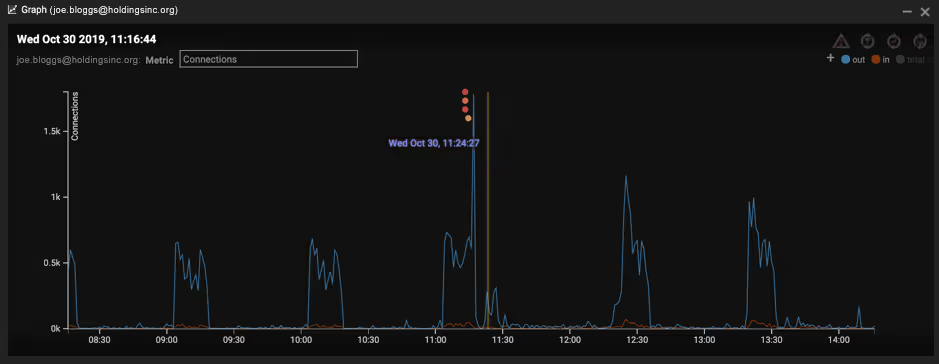
Figure 1: Several Darktrace alerts fire, and a deviation from the regular pattern of life is visible

Indeed, not only was the device observed making an unexpectedly large number of connections, but it was also reading and writing a large number of SMB files and transferring this data internally to a server it did not usually communicate with. The spike in internal connections between patient zero and the server was a strong indicator of malware attempting to move laterally through the network.
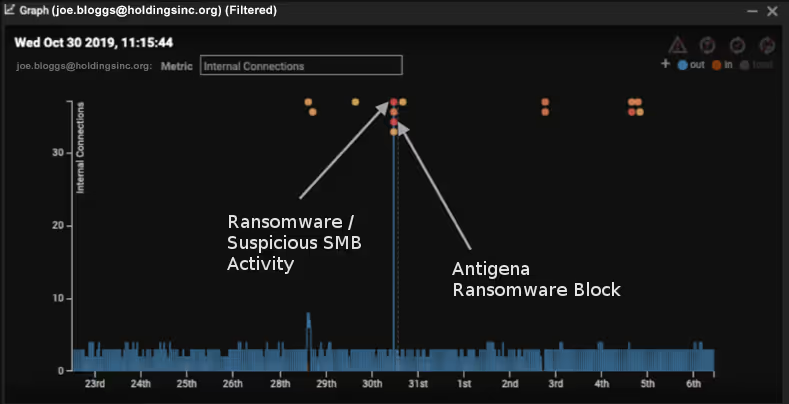
Figure 2: Four model breaches observed on October 30th and a dotted line representing Antigena’s actions

Further investigation into the SMB activity revealed that hundreds of Dropbox-related files were accessed on SMB shares that the device had not previously accessed. Moreover, several of these files started becoming encrypted, appended with a [HELP_DECRYPT] extension.

Figure 3: Darktrace detects SMB activity relating to Dropbox files

Fortunately, Darktrace RESPOND was in Active Mode, and kicked in a second later, enforcing the usual pattern of life by blocking anomalous connections for five minutes, immediately stopping the encryption. By the time Darktrace’s AI took action, only four of these files were successfully encrypted.

Figure 4: Darktrace RESPOND kicks in 1 second after ransomware was detected

Figure 5: More Antigena (RESPOND) alerts and a clear indication of the unusual activity detected

RESPOND then took a second action to stop the ransomware from spreading to other devices. The combination of various anomalous activities was sufficient evidence for Autonomous Response to neutralize the threat: patient zero was quarantined for 24 hours, unable to connect to the server or any other device on the network.
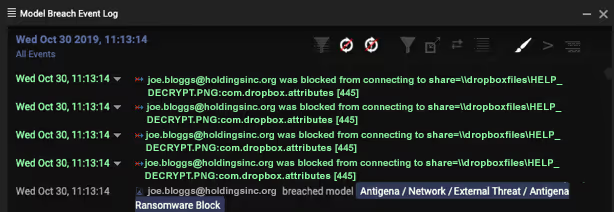
Figure 6: Darktrace stops the infected device from conducting lateral movement & ransom activity

Darktrace RESPOND therefore not only stopped the encryption activity in its tracks, but also prevented the attackers from moving laterally across the network unimpeded – either by scanning, using harvested admin credentials, or performing internal reconnaissance. Autonomous Response initiated a surgical intervention that halted the malware’s spread, all while allowing normal business operations to continue.

No signatures, no problem

Crucially, this strain of ransomware was not associated with any publicly known indicators of compromise such as blacklisted command & control domains or malware file hashes. Darktrace was able to detect this never-before-seen attack based purely on its comprehensive understanding of the normal pattern of life for every device and user within the organization. Once the deviation from this normal behavior was identified, Antigena was able to stop it immediately – without relying on rules, signatures, or historical data. With autonomous response acting decisively and immediately, the security team had enough time to catch up and perform hands-on incident response work.

Darktrace’s AI provides a potent combination: Darktrace DETECT's capacity to reveal deviations in a device’s behavior together with RESPOND acting to block connections and contain the ransomware from spreading across the enterprise. AI-enabled Autonomous Response neutralized the threat by recognizing the lethal recipe of these unusual internal alerts and taking targeted action against the ransomware. This stealthy strain of ransomware is unlikely to have been noticed, let alone stopped, by a security team reliant on legacy tools.

The Return-On-Security-Investment (ROSI) is often discussed when it comes to cyber security expenditure, and this incident provides a great example of the ROSI manifesting itself – recent ransomware attacks usually demand hundreds of thousands of dollars’ worth of ransom payments. Without Darktrace RESPOND containing the threat at an early stage, it is likely that thousands of files would have been encrypted. By relying on Cyber AI, the company was able to take back the advantage over an ever-evolving adversary, saving time, money, resources, and – perhaps most critically – the company’s reputation.

Inside the SOC
Darktrace cyber analysts are world-class experts in threat intelligence, threat hunting and incident response, and provide 24/7 SOC support to thousands of Darktrace customers around the globe. Inside the SOC is exclusively authored by these experts, providing analysis of cyber incidents and threat trends, based on real-world experience in the field.
Written by
Max Heinemeyer
Global Field CISO

More in this series

No items found.

Blog

/

/

Introducing Darktrace / SECURE AI: Complete AI Security Across Your Enterprise

Darktrace Secure AIDefault blog imageDefault blog image

Why securing AI can’t wait

AI is entering the enterprise faster than IT and security teams can keep up, appearing in SaaS tools, embedded in core platforms, and spun up by teams eager to move faster.  

As this adoption accelerates, it introduces unpredictable behaviors and expands the attack surface in ways existing security tools can’t see or control, startup or platform, they all lack one trait. These new types of risks command the attention of security teams and boardrooms, touching everything from business integrity to regulatory exposure.

Securing AI demands a fundamentally different approach, one that understands how AI behaves, how it interacts with data and users, and how risk emerges in real time. That shift is at the core of how organizations should be thinking about securing AI across the enterprise.

What is the current state of securing AI?

In Darktrace’s latest State of AI in Cybersecurity Report research across 1,500 cybersecurity professionals shows that the percentage of organizations without an AI adoption policy grew from 55% last year to 63% this year.

More troubling, the percentage of organizations without any plan to create an AI policy nearly tripled from 3% to 8%. Without clear policies, businesses are effectively accelerating blindfolded.

When we analyzed activity across our own customer base, we saw the same patterns playing out in their environments. Last October alone, we saw a 39% month-over-month increase in anomalous data uploads to generative AI services, with the average upload being 75MB. Given the size and frequency of these uploads, it's almost certain that much of this data should never be leaving the enterprise.

Many security teams still lack visibility into how AI is being used across their business; how it’s behaving, what it’s accessing, and most importantly, whether it’s operating safely. This unsanctioned usage quietly expands, creating pockets of AI activity that fall completely outside established security controls. The result is real organizational exposure with almost no visibility, underscoring just how widespread AI use has already become given the absence of formal policies.

This challenge doesn’t stop internally. Shadow AI extends into third-party tools, vendor platforms, and partner systems, where AI features are embedded without clear oversight.

Meanwhile, attackers are now learning to exploit AI’s unique characteristics, compounding the risks organizations are already struggling to manage.

The leader in AI cybersecurity now secures AI

Darktrace brings more than a decade of behavioral AI expertise built on an enterprise‑wide platform designed to operate in the complex, ambiguous environments where today’s AI now lives.  

Other cybersecurity technologies try to predict each new attack based on historical attacks. The problem is AI operates like humans do. Every action introduces new information that changes how AI behaves, its unpredictable, and historical attack tactics are now only a small part of the equation, forcing vendors to retrofit unproven acquisitions to secure AI.  

Darktrace is fundamentally different. Our Self‑Learning AI learns what “normal” looks like for your unique business: how your users, systems, applications, and now AI agents behave, how they communicate, and how data flows. This allows us to spot even the smallest shifts when something changes in meaningful ways. Long before AI agents were introduced, our technology was already interpreting nuance, detecting drift, uncovering hidden relationships, and making sense of ambiguous activity across networks, cloud, SaaS, email, OT, identities, and endpoints.

As AI introduces new behaviors, unstructured interactions, invisible pathways, and the rise of Shadow AI, these challenges have only intensified. But this is exactly the environment our platform was built for. Securing AI isn’t a new direction for Darktrace — it’s the natural evolution of the behavioral intelligence we’ve delivered to thousands of organizations worldwide.

Introducing Darktrace / SECURE AI – Complete AI security across your enterprise

We are proud to introduce Darktrace / SECURE AI, the newest product in the Darktrace ActiveAI Security Platform designed to secure AI across the whole enterprise.

This marks the next chapter in our mission to secure organizations from cyber threats and emerging risks. By combining full visibility, intelligent behavioral oversight, and real-time control, Darktrace is enabling enterprises to safely adopt, manage, and build AI within their business. This ensures that AI usage, data access, and behavior remain aligned to security baselines, compliance, and business goals.

Darktrace / SECURE AI can bring every AI interaction into a single view, helping teams understand intent, assess risk, protect sensitive data, and enforce policy across both human and AI Agent activity. Now organizations can embrace AI with confidence, with visibility to ensure it is operating safely, responsibly, and in alignment with their security and compliance needs.  

Because securing AI spans multiple areas and layers of complexity, Darktrace / SECURE AI is built around four foundational use cases that ensure your whole enterprise and every AI use affecting your business, whether owned or through third parties, is protected, they are:

  • Monitoring the prompts driving GenAI agents and assistants
  • Securing business AI agent identities in real time
  • Evaluating AI risks in development and deployment
  • Discovering and controlling Shadow AI

Monitoring the prompts driving GenAI agents and assistants

For AI systems, prompts are one of the most active and sensitive points of interaction—spanning human‑AI exchanges where users express intent and AI‑AI interactions where agents generate internal prompts to reason and coordinate. Because prompt language effectively is behavior, and because it relies on natural language rather than a fixed, finite syntax, the attack surface is open‑ended. This makes prompt‑driven risks far more complex than traditional API‑based vulnerabilities tied to CVEs.

Whether an attacker is probing for weaknesses, an employee inadvertently exposes sensitive data, or agents generate their own sub‑tasks to drive complex workflows, security teams must understand how prompt behavior shapes model behavior—and where that behavior can go wrong. Without that behavioral understanding, organizations face heightened risks of exploitation, drift, and cascading failures within their AI systems.

Darktrace / SECURE AI brings together all prompt activity across enterprise AI systems, including Microsoft Copilot and ChatGPT Enterprise, low‑code environments like Microsoft Copilot Studio, SaaS providers like Salesforce and Microsoft 365, and high‑code platforms such as AWS Bedrock and SageMaker, into a single, unified layer of visibility.  

Beyond visibility, Darktrace applies behavioral analytics to understand whether a prompt is unusual or risky in the context of the user, their peers, and the broader organization. Because AI attacks are far more complex and conversational than traditional exploits against fixed APIs – sharing more in common with email and Teams/Slack interactions, —this behavioral understanding is essential. By treating prompts as behavioral signals, Darktrace can detect conversational attacks, malicious chaining, and subtle prompt‑injection attempts, and where integrations allow, intervene in real time to block unsafe prompts or prevent harmful model actions as they occur.

Securing business AI agent identities in real time

As organizations adopt more AI‑driven workflows, we’re seeing a rapid rise in autonomous and semi‑autonomous agents operating across the business. These agents operate within existing identities, with the capability to access systems, read and write data, and trigger actions across cloud platforms, internal infrastructure, applications, APIs, and third‑party services. Some identities are controlled, like users, others like the ones mentioned, can appear anywhere, with organizations having limited visibility into how they’re configured or how their permissions evolve over time.  

Darktrace / SECURE AI gives organizations a real‑time, identity‑centric understanding of what their AI agents are doing, not just what they were designed to do. It automatically discovers live agent identities operating across SaaS, cloud, network, endpoints, OT, and email, including those running inside third‑party environments.  

The platform maps how each agent is configured, what systems it accesses, and how it communicates, including activity such as MCP usage or interactions with storage services where sensitive data may reside.  

By continuously observing agent behavior across all domains, Darktrace / SECURE AI highlights when unnecessary or risky permissions are granted, when activity patterns deviate, or when agents begin chaining together actions in unintended ways. This real‑time audit trail allows organizations to evaluate whether agent actions align with intended operational parameters and catch anomalous or risky behavior early.    

Evaluating AI risks in development and deployment

In the build phase, new identities are created, entitlements accumulate, components are stitched together across SaaS, cloud, and internal environments, and logic starts taking shape through prompts and configurations.  

It’s a highly dynamic and often fragmented process, and even small missteps here, such as a misconfiguration in a created agent identity, can become major security issues once the system is deployed. This is why evaluating AI risk during development and deployment is critical.

Darktrace / SECURE AI brings clarity and control across this entire lifecycle — from the moment an AI system starts taking shape to the moment it goes live. It allows you to gain visibility into created identities and their access across hyperscalers, low‑code SaaS, and internal labs, supported by AI security posture management that surfaces misconfigurations, over‑entitlement, and anomalous building events. Darktrace/ SECURE AI then connects these development insights directly to prompt oversight, connecting how AI is being built to how it will behave once deployed.  The result is a safer, more predictable AI lifecycle where risks are discovered early, guardrails are applied consistently, and innovations move forward with confidence rather than guesswork.

Discovering and controlling Shadow AI

Shadow AI has now appeared across every corner of the enterprise. It’s not just an employee pasting internal data into an external chatbot; it includes unsanctioned agent builders, hidden MCP servers, rogue model deployments, and AI‑driven workflows running on devices or services no one expected to be using AI.  

Darktrace / SECURE AI brings this frontier into view by continuously analyzing interactions across cloud, networks, endpoints, OT, and SASE environments. It surfaces unapproved AI usage wherever it appears and distinguishes legitimate activity in sanctioned tools from misuse or high‑risk behavior. The system identifies hidden AI components and rogue agents, reveals unauthorized deployments and unexpected connections to external AI systems, and highlights risky data flows that deviate from business norms.

When the behavior warrants a response, Darktrace / SECURE AI enables policy enforcement that guides users back toward sanctioned options while containing unsafe or ungoverned adoption. This closes one of the fastest‑expanding security gaps in modern enterprises and significantly reduces the attack surface created by shadow AI.

Conclusion

What’s needed now along with policies and frameworks for AI adoption is the right tooling to detect threats based on AI behavior across shadow use, prompt risks, identity misuse, and AI development.  

Darktrace is uniquely positioned to secure AI, we’ve spent over a decade building AI that learns your business – understanding subtle behavior across the entire enterprise long before AI agents arrived. With over 10,000 customers relying on Darktrace as the last line of defense to capture threats others cannot, Securing AI isn’t a pivot for us, it's not an acquisition; it’s the natural extension of the behavioral expertise and enterprise‑wide intelligence our platform was built on from the start.  

To learn more about how to secure AI at your organization we curated a readiness program that brings together IT and security leaders navigating this responsibility, providing a forum to prepare for high-impact decisions, explore guardrails, and guide the business amid growing uncertainty and pressure.

Sign up for the Secure AI Readiness Program here: This gives you exclusive access to the latest news on the latest AI threats, updates on emerging approaches shaping AI security, and insights into the latest innovations, including Darktrace’s ongoing work in this area.

Ready to talk with a Darktrace expert on securing AI? Register here to receive practical guidance on the AI risks that matter most to your business, paired with clarity on where to focus first across governance, visibility, risk reduction, and long-term readiness.  

Continue reading
About the author
Brittany Woodsmall
Product Marketing Manager, AI

Blog

/

Endpoint

/

February 1, 2026

ClearFake: From Fake CAPTCHAs to Blockchain-Driven Payload Retrieval

fake captcha to blockchain driven palyload retrievalDefault blog imageDefault blog image

What is ClearFake?

As threat actors evolve their techniques to exploit victims and breach target networks, the ClearFake campaign has emerged as a significant illustration of this continued adaptation. ClearFake is a campaign observed using a malicious JavaScript framework deployed on compromised websites, impacting sectors such as e‑commerce, travel, and automotive. First identified in mid‑2023, ClearFake is frequently leveraged to socially engineer victims into installing fake web browser updates.

In ClearFake compromises, victims are steered toward compromised WordPress sites, often positioned by attackers through search engine optimization (SEO) poisoning. Once on the site, users are presented with a fake CAPTCHA. This counterfeit challenge is designed to appear legitimate while enabling the execution of malicious code. When a victim interacts with the CAPTCHA, a PowerShell command containing a download string is retrieved and executed.

Attackers commonly abuse the legitimate Microsoft HTML Application Host (MSHTA) in these operations. Recent campaigns have also incorporated Smart Chain endpoints, such as “bsc-dataseed.binance[.]org,” to obtain configuration code. The primary payload delivered through ClearFake is typically an information stealer, such as Lumma Stealer, enabling credential theft, data exfiltration, and persistent access [1].

Darktrace’s Coverage of ClearFake

Darktrace / ENDPOINT first detected activity likely associated with ClearFake on a single device on over the course of one day on November 18, 2025. The system observed the execution of “mshta.exe,” the legitimate Microsoft HTML Application Host utility. It also noted a repeated process command referencing “weiss.neighb0rrol1[.]ru”, indicating suspicious external activity. Subsequent analysis of this endpoint using open‑source intelligence (OSINT) indicated that it was a malicious, domain generation algorithm (DGA) endpoint [2].

The process line referencing weiss.neighb0rrol1[.]ru, as observed by Darktrace / ENDPOINT.
Figure 1: The process line referencing weiss.neighb0rrol1[.]ru, as observed by Darktrace / ENDPOINT.

This activity indicates that mshta.exe was used to contact a remote server, “weiss.neighb0rrol1[.]ru/rpxacc64mshta,” and execute the associated HTA file to initiate the next stage of the attack. OSINT sources have since heavily flagged this server as potentially malicious [3].

The first argument in this process uses the MSHTA utility to execute the HTA file hosted on the remote server. If successful, MSHTA would then run JavaScript or VBScript to launch PowerShell commands used to retrieve malicious payloads, a technique observed in previous ClearFake campaigns. Darktrace also detected unusual activity involving additional Microsoft executables, including “winlogon.exe,” “userinit.exe,” and “explorer.exe.” Although these binaries are legitimate components of the Windows operating system, threat actors can abuse their normal behavior within the Windows login sequence to gain control over user sessions, similar to the misuse of mshta.exe.

EtherHiding cover

Darktrace also identified additional ClearFake‑related activity, specifically a connection to bsc-testnet.drpc[.]org, a legitimate BNB Smart Chain endpoint. This activity was triggered by injected JavaScript on the compromised site www.allstarsuae[.]com, where the script initiated an eth_call POST request to the Smart Chain endpoint.

Example of a fake CAPTCHA on the compromised site www.allstarsuae[.]com.
Figure 2: Example of a fake CAPTCHA on the compromised site www.allstarsuae[.]com.

EtherHiding is a technique in which threat actors leverage blockchain technology, specifically smart contracts, as part of their malicious infrastructure. Because blockchain is anonymous, decentralized, and highly persistent, it provides threat actors with advantages in evading defensive measures and traditional tracking [4].

In this case, when a user visits a compromised WordPress site, injected base64‑encoded JavaScript retrieved an ABI string, which was then used to load and execute a contract hosted on the BNB Smart Chain.

JavaScript hosted on the compromised site www.allstaruae[.]com.
Figure 3: JavaScript hosted on the compromised site www.allstaruae[.]com.

Conducting malware analysis on this instance, the Base64 decoded into a JavaScript loader. A POST request to bsc-testnet.drpc[.]org was then used to retrieve a hex‑encoded ABI string that loads and executes the contract. The JavaScript also contained hex and Base64‑encoded functions that decoded into additional JavaScript, which attempted to retrieve a payload hosted on GitHub at “github[.]com/PrivateC0de/obf/main/payload.txt.” However, this payload was unavailable at the time of analysis.

Darktrace’s detection of the POST request to bsc-testnet.drpc[.]org.
Figure 4: Darktrace’s detection of the POST request to bsc-testnet.drpc[.]org.
Figure 5: Darktrace’s detection of the executable file and the malicious hostname.

Autonomous Response

As Darktrace’s Autonomous Response capability was enabled on this customer’s network, Darktrace was able to take swift mitigative action to contain the ClearFake‑related activity early, before it could lead to potential payload delivery. The affected device was blocked from making external connections to a number of suspicious endpoints, including 188.114.96[.]6, *.neighb0rrol1[.]ru, and neighb0rrol1[.]ru, ensuring that no further malicious connections could be made and no payloads could be retrieved.

Autonomous Response also acted to prevent the executable mshta.exe from initiating HTA file execution over HTTPS from this endpoint by blocking the attempted connections. Had these files executed successfully, the attack would likely have resulted in the retrieval of an information stealer, such as Lumma Stealer.

Autonomous Response’s intervention against the suspicious connectivity observed.
Figure 6: Autonomous Response’s intervention against the suspicious connectivity observed.

Conclusion

ClearFake continues to be observed across multiple sectors, but Darktrace remains well‑positioned to counter such threats. Because ClearFake’s end goal is often to deliver malware such as information stealers and malware loaders, early disruption is critical to preventing compromise. Users should remain aware of this activity and vigilant regarding fake CAPTCHA pop‑ups. They should also monitor unusual usage of MSHTA and outbound connections to domains that mimic formats such as “bsc-dataseed.binance[.]org” [1].

In this case, Darktrace was able to contain the attack before it could successfully escalate and execute. The attempted execution of HTA files was detected early, allowing Autonomous Response to intervene, stopping the activity from progressing. As soon as the device began communicating with weiss.neighb0rrol1[.]ru, an Autonomous Response inhibitor triggered and interrupted the connections.

As ClearFake continues to rise, users should stay alert to social engineering techniques, including ClickFix, that rely on deceptive security prompts.

Credit to Vivek Rajan (Senior Cyber Analyst) and Tara Gould (Malware Research Lead)

Edited by Ryan Traill (Analyst Content Lead)

Appendices

Darktrace Model Detections

Process / New Executable Launched

Endpoint / Anomalous Use of Scripting Process

Endpoint / New Suspicious Executable Launched

Endpoint / Process Connection::Unusual Connection from New Process

Autonomous Response Models

Antigena / Network::Significant Anomaly::Antigena Significant Anomaly from Client Block

List of Indicators of Compromise (IoCs)

  • weiss.neighb0rrol1[.]ru – URL - Malicious Domain
  • 188.114.96[.]6 – IP – Suspicious Domain
  • *.neighb0rrol1[.]ru – URL – Malicious Domain

MITRE Tactics

Initial Access, Drive-by Compromise, T1189

User Execution, Execution, T1204

Software Deployment Tools, Execution and Lateral Movement, T1072

Command and Scripting Interpreter, T1059

System Binary Proxy Execution: MSHTA, T1218.005

References

1.        https://www.kroll.com/en/publications/cyber/rapid-evolution-of-clearfake-delivery

2.        https://www.virustotal.com/gui/domain/weiss.neighb0rrol1.ru

3.        https://www.virustotal.com/gui/file/1f1aabe87e5e93a8fff769bf3614dd559c51c80fc045e11868f3843d9a004d1e/community

4.        https://www.packetlabs.net/posts/etherhiding-a-new-tactic-for-hiding-malware-on-the-blockchain/

Continue reading
About the author
Vivek Rajan
Cyber Analyst
Your data. Our AI.
Elevate your network security with Darktrace AI