

Blog
/
Network
/
October 23, 2025

Darktrace Redefines NDR: Industry-First Autonomous Threat Investigation from Network to Endpoint with Agentic AI

Darktrace delivers the next evolution of NDR, extending an industry-first bridge across the network and endpoint gap with Self-Learning AI.
Inside the SOC
Darktrace cyber analysts are world-class experts in threat intelligence, threat hunting and incident response, and provide 24/7 SOC support to thousands of Darktrace customers around the globe. Inside the SOC is exclusively authored by these experts, providing analysis of cyber incidents and threat trends, based on real-world experience in the field.
Written by
Mikey Anderson
Product Marketing Manager, Network Detection & Response
autonomous investigations, endpoint, ndr, network detection and responseDefault blog imageDefault blog imageDefault blog imageDefault blog imageDefault blog imageDefault blog image
23
Oct 2025

Darktrace delivers the next evolution of unified and proactive NDR

Darktrace Network Endpoint eXtended Telemetry (NEXT) is revolutionizing NDR with the industry’s first mixed-telemetry agent using Self-Learning AI.  

The combined context of native network and endpoint process data significantly reduces incident triage and investigation times for threats spanning both domains. Our business-centric approach learns what normal looks like for each endpoint, and now uses process context to extend our ability to identify novel threats that existing EDR/XDR tools often  miss.

Summary of what’s new:

  • Native endpoint process telemetry combined with NDR, bridging the EDR gap
  • Self-Learning AI on the endpoint to stop novel threats missed by EDR
  • Sophisticated Agentic AI to automate SecOps investigations across all major IT domains
  • AI-native, real-time threat detection, investigation, and response (TDIR) for cross-domain activity throughout the enterprise

Why is this an important next step in NDR?

Security analysts are buried under a flood of alerts that lack the context needed to separate genuine threats from noise. The root problem is that most security tools only see one slice of the environment. IT and OT networks, endpoints, and cloud systems are monitored in isolation, with little correlation between them.

As a result, investigations are highly manual. Analysts are forced to pivot between siloed point-products, each providing only a fragment of the incident. This slows response, creates blind spots, and limits the team’s ability to understand and contain threats effectively.

In many cases, the high degree of skill it takes to pivot tools and conduct investigations leads even the most experienced analysts closer to burnout, especially when they are already exhausted by the quantity of alerts. Ultimately, the human personnel managing these systems are using their skills to accommodate for the lack of synergy between tools they are using in their security stack, rather than developing the higher-value expertise needed to anticipate, prevent, and respond to emerging threats.

Many organizations have attempted to overcome this challenge by implementing XDR solutions. But, XDR does not cover NDR related use cases. This is especially true in OT/CPS environments where it is not possible to install an agent on devices.

XDR is an Endpoint-focused tool that cannot see the full picture of threats moving laterally across the network, targeting unmanaged devices, or blending into legitimate traffic. While XDR is still a strong tool in the arsenal, attackers are noticing where the gaps are:

  • A CISA Red Team assessment found that one U.S. critical infrastructure organization suffered prolonged compromise because it overly relied on host‑based EDR and lacked sufficient network-layer defenses.  

Bottom line: Without native network detection and response (NDR), critical incidents slip through undetected.

Not all NDR tools are built the same

When it comes to NDR, the details matter. Here are a few reasons why not all NDR solutions are created equal:

  • Most NDR solutions depend on EDR/XDR integrations to ingest endpoint alerts, which are raised based on activity that is already known to be malicious
  • They can’t investigate beyond what the EDR already flags, lacking process-level context in network investigations
  • Almost no NDR solutions have a native endpoint agent to extend NDR visibility to remote worker devices

This reliance on EDR leaves critical gaps in network coverage, since EDRs themselves don’t provide network-level visibility.

The NEXT evolution of NDR

Darktrace Network Endpoint eXtended Telemetry (NEXT) is revolutionizing NDR with the industry’s first mixed-telemetry agent using Self-Learning AI.  

The combined context of native network and endpoint process data significantly reduces incident triage and investigation times for threats spanning both domains, our business-centric approach with new data also extends our ability to identify novel threats that existing EDR/XDR may miss.

Darktrace / ENDPOINT agents are now able to utilize new Network Endpoint eXtended Telemetry (NEXT) capabilities. This combines full network visibility with native endpoint process data, enabling autonomous investigations that trace threats from initial network activity all the way to the root cause at the endpoint, without manual correlation or tool switching. This bridges the gap between NDR and the endpoint, while adding value to existing EDR investments.
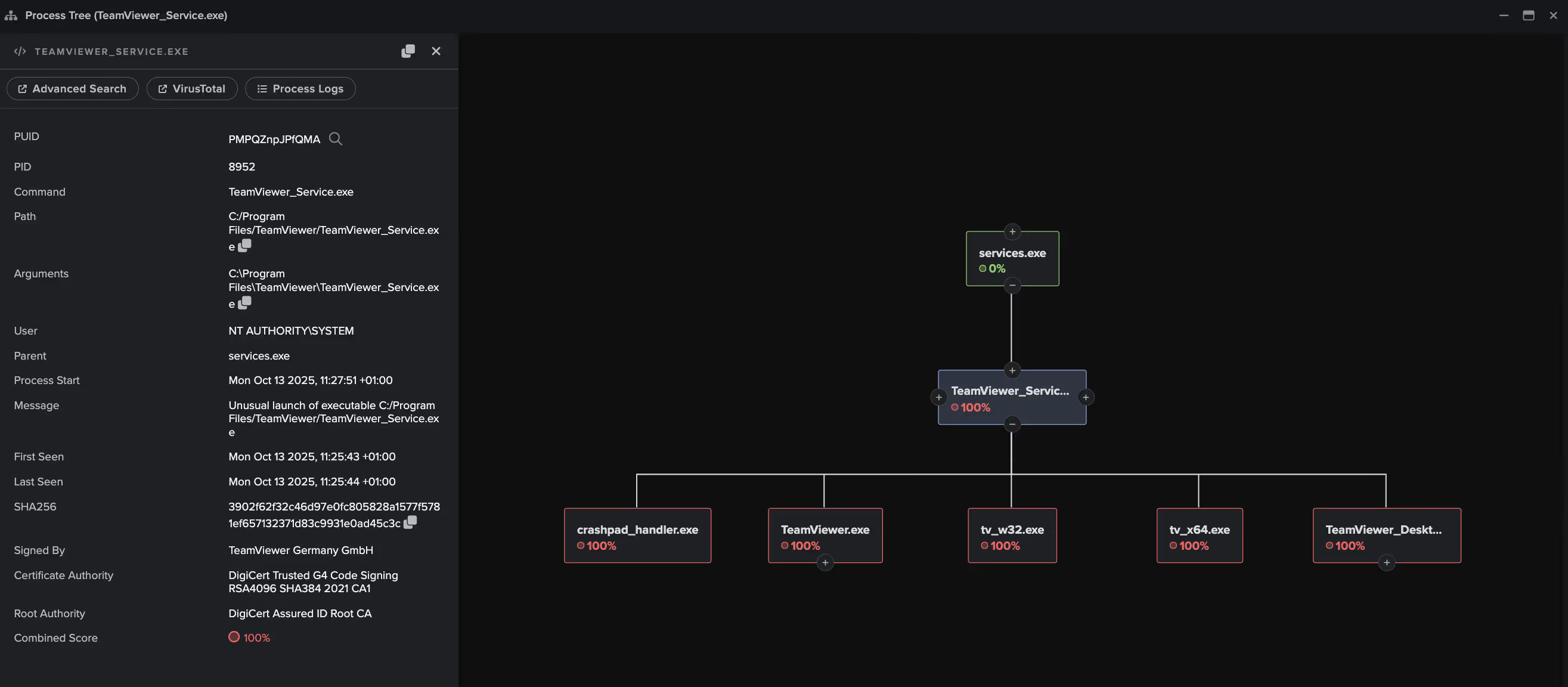
Darktrace natively shows the endpoint process context in relation to network events, complete with parent/child process relationships, adding immediate context to network investigations without needing to pivot to your EDR.
Figure 1: Darktrace natively shows the endpoint process context in relation to network events, complete with parent/child process relationships, adding immediate context to network investigations without needing to pivot to your EDR.

Leveraging this data in investigations

This additional context is then leveraged by Cyber AI Analyst, a sophisticated agentic AI system that autonomously performs end-to-end investigations of all relevant alerts and prioritizes incidents. With the new endpoint process visibility, Cyber AI Analyst now incorporates process context into its decision-making, which improves detection accuracy, filters out benign activity, and enhances incident narratives with process-level insights.

This makes Darktrace the first NDR to natively investigate threats across network and endpoint telemetry with an autonomous, agentic AI analyst. And with our Self-Learning AI, Darktrace continuously evolves by understanding what’s normal for each unique environment, now adding process data to extend visibility and range of detections. This enables Darktrace to detect and contain novel threats, including zero-days, insider threats, and emerging attack techniques, up to 8 days before public disclosure.

This is more than a solution to a visibility problem. It’s a fundamental evolution in how threats are detected, investigated, and stopped. By applying agentic AI, Darktrace empowers security teams to move from reactive alert triage to proactive, autonomous defense, surfacing and blocking threats that others simply can’t see.
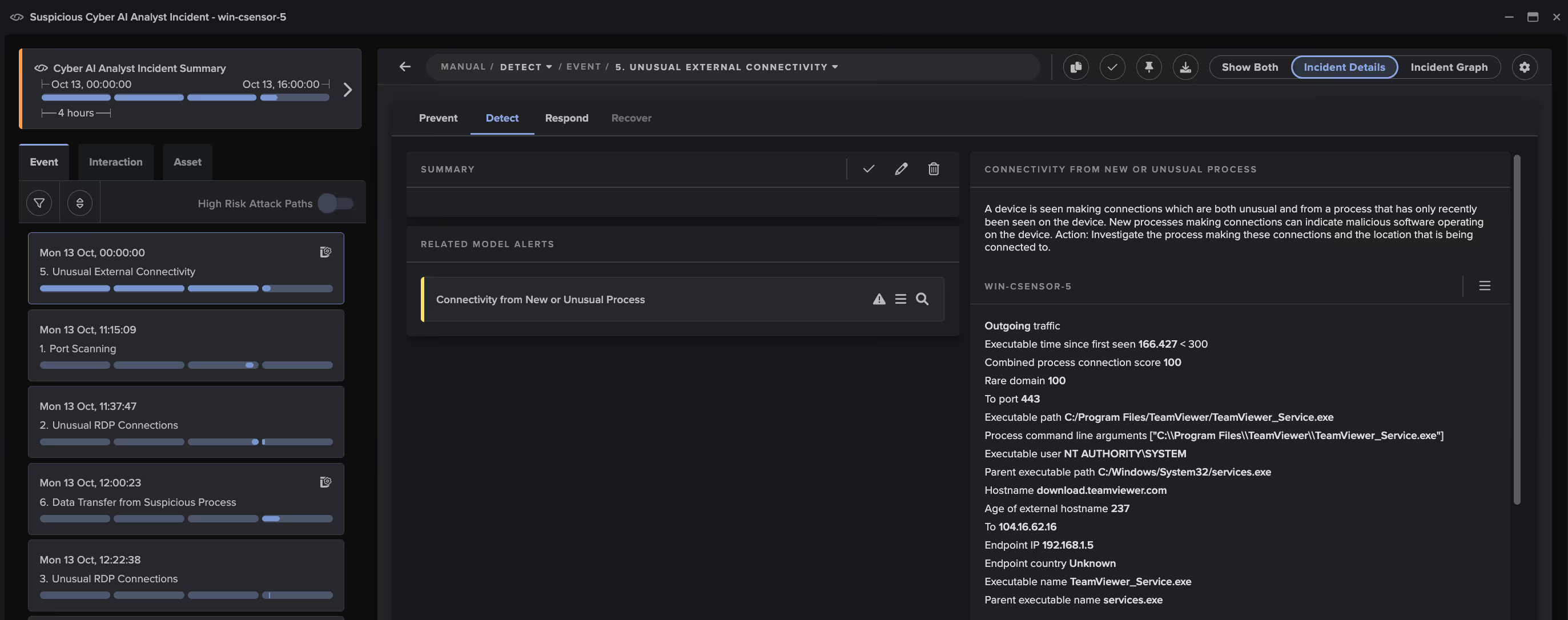
An excerpt from a Darktrace Cyber AI Analyst incident, showing the inclusion of native endpoint process context alongside other network events.
Figure 2: An excerpt from a Darktrace Cyber AI Analyst incident, showing the inclusion of native endpoint process context alongside other network events.

Continued innovation in detection and response

Darktrace also continues to invest in our core NDR capabilities, delivering enhancements and innovations to solve modern network security challenges. In the latest release, Darktrace / NETWORK has been enhanced to increase detection efficacy and performance. This includes increased protocol detection fidelity and new support for custom port mappings, plus expanded visibility into HTTP traffic to support more targeted threat hunting across a wider range of application layer activity. In addition, vSensor performance has been upgraded for tunnel protocols such as Geneve.

We have also released enhancements to Autonomous Response, which is already trusted by thousands of organizations to contain threats at the earliest stages without causing business disruption. This includes enhanced support for highly complex and segmented networks, plus the ability to extend Autonomous Response actions to more areas with additional firewall integration support. This enables faster and more effective response to network threats, and continues Darktrace’s proven ability to contain zero-day threats up to 8 days before public disclosure.

Providing seamless operations with the new Darktrace ActiveAI Security Portal

As part of Darktrace’s commitment to breaking down silos across the cyber defense lifecycle, this release also introduces major platform enhancements that tackle often-overlooked operational gaps specifically around user access, permissions, and integration workflows. With the launch of the new Darktrace ActiveAI Security Portal, organizations can now manage security at scale across diverse environments, making it ideal for large enterprises, MSSPs, and partners overseeing multiple tenants. These updates ensure that visibility, control, and scalability extend beyond detection and response and into how teams manage and interact with the platform itself.

Committed to innovation

These updates are part of the broader Darktrace release, which also included:

1. Major innovations in cloud security with the launch of the industry’s first fully automated cloud forensics solution, reinforcing Darktrace’s leadership in AI-native security.

2. Innovations to our suite of Exposure Management & Attack Surface Management products including:

  • Exploit Prediction Assessment: Continuously validates whether top-priority exposures are actually exploitable in your environment without waiting for patch cycles or formal pen tests.  
  • Deep & Dark Web Monitoring: Extends visibility across millions of sources in the deep and dark web to detect leaked credentials linked to your confirmed domains.
  • Confidence Score: our newly developed AI classification platform will compare newly discovered assets to assets that are known to belong to your organization. The more these newly discovered assets look similar to assets that belong to your organization, the higher the score will be.
  • No-Telemetry Endpoint: Collects installed software data and maps it to known CVEs—without network traffic—providing device-level vulnerability context and operational relevance.
  • Cost-Benefit Analysis for Patching: Calculates ROI by comparing patching effort with potential exploit impact, factoring in headcount time, device count, patch difficulty, and automation availability.

Visit these blogs to learn more about updates:

As attackers exploit gaps between tools, the Darktrace ActiveAI Security Platform delivers unified detection, automated investigation, and autonomous response across cloud, endpoint, email, network, and OT. With full-stack visibility and AI-native workflows, Darktrace empowers security teams to detect, understand, and stop novel threats before they escalate.

Join our Live Launch Event

When? 

December 9, 2025

What will be covered?

Join our live broadcast to experience how Darktrace is eliminating blind spots for detection and response across your complete enterprise with new innovations in Agentic AI across our ActiveAI Security platform. Industry leaders from IDC will join Darktrace customers to discuss challenges in cross-domain security, with a live walkthrough reshaping the future of Network Detection & Response, Endpoint Detection & Response, Email Security, and SecOps in novel threat detection and autonomous investigations.

Inside the SOC
Darktrace cyber analysts are world-class experts in threat intelligence, threat hunting and incident response, and provide 24/7 SOC support to thousands of Darktrace customers around the globe. Inside the SOC is exclusively authored by these experts, providing analysis of cyber incidents and threat trends, based on real-world experience in the field.
Written by
Mikey Anderson
Product Marketing Manager, Network Detection & Response

More in this series

No items found.

Blog

/

Network

/

March 31, 2026

Phantom Footprints: Tracking GhostSocks Malware

ghostsocks malwareDefault blog imageDefault blog image

Why are attackers using residential proxies?

In today's threat landscape, blending in to normal activity is the key to success for attackers and the growing reliance on residential proxies shows a significant shift in how threat actors are attempting to bypass IP detection tools.

The increasing dependency on residential proxies has exposed how prevalent proxy services are and how reliant a diverse range of threat actors are on them. From cybercriminal groups to state‑sponsored actors, the need to bypass IP detection tools is fundamental to the success of these groups. One malware that has quietly become notorious for its ability to avoid anomaly detection is GhostSocks, a malware that turns compromised devices into residential proxies.

What is GhostSocks?

Originally marketed on the Russian underground forum xss[.]is as a Malware‑as‑a‑Service (MaaS), GhostSocks enables threat actors to turn compromised devices into residential proxies, leveraging the victim's internet bandwidth to route malicious traffic through it.

How does Ghostsocks malware work? 

The malware offers the threat actor a “clean” IP address, making it look like it is coming from a household user. This enables the bypassing of geographic restrictions and IP detection tools, a perfect tool for avoiding anomaly detection. It wasn’t until 2024, when a partnership was announced with the infamous information stealer Lumma Stealer, that GhostSocks surged into widespread adoption and alluded to who may be the author of the proxy malware.

Written in GoLang, GhostSocks utilizes the SOCKS5 proxy protocol, creating a SOCKS5 connection on infected devices. It uses a relay‑based C2 implementation, where an intermediary server sits in between the real command-and-control (C2) server and the infected device.

How does Ghostsocks malware evade detection?

To further increase evasion, the Ghostsocks malware wraps its SOCKS5 tunnels in TLS encryption, allowing its malicious traffic to blend into normal network traffic.

Early variants of GhostSocks do not implement a persistence mechanism; however, later versions achieve persistence via registry run keys, ensuring sustained proxy operational time [1].

While proxying is its primary purpose, GhostSocks also incorporates backdoor functionality, enabling malicious actors to run arbitrary commands and download and deploy additional malicious payloads. This was evident with the well‑known ransomware group Black Basta, which reportedly used GhostSocks as a way of maintaining long‑term access to victims’ networks [1].

Darktrace’s detection of GhostSocks Malware

Darktrace observed a steady increase in GhostSocks activity across its customer base from late 2025, with its Threat Research team identifying multiple incidents involving the malware. In one notable case from December 2025, Darktrace detected GhostSocks operating alongside Lumma Stealer, reinforcing that the partnership between Lumma and GhostSocks remains active despite recent attempts to disrupt Lumma’s infrastructure.

Darktrace’s first detection of GhostSocks‑related activity came when a device on the network of a customer in the education sector began making connections to an endpoint with a suspicious self‑signed certificate that had never been seen on the network before.

The endpoint in question, 159.89.46[.]92 with the hostname retreaw[.]click, has been flagged by multiple open‑source intelligence (OSINT) sources as being associated with Lumma Stealer’s C2 infrastructure [2], indicating its likely role in the delivery of malicious payloads.

Darktrace’s detection of suspicious SSL connections to retreaw[.]click, indicating an attempted link to Lumma C2 infrastructure.
Figure 1: Darktrace’s detection of suspicious SSL connections to retreaw[.]click, indicating an attempted link to Lumma C2 infrastructure.

Less than two minutes later, Darktrace observed the same device downloading the executable (.exe) file “Renewable.exe” from the IP 86.54.24[.]29, which Darktrace recognized as 100% rare for this network.

Darktrace’s detection of a device downloading the unusual executable file “Renewable.exe”.
Figure 2: Darktrace’s detection of a device downloading the unusual executable file “Renewable.exe”.

Both the file MD5 hash and the executable itself have been identified by multiple OSINT vendors as being associated with the GhostSocks malware [3], with the executable likely the backdoor component of the GhostSocks malware, facilitating the distribution of additional malicious payloads [4].

Following this detection, Darktrace’s Autonomous Response capability recommended a blocking action for the device in an early attempt to stop the malicious file download. In this instance, Darktrace was configured in Human Confirmation Mode, meaning the customer’s security team was required to manually apply any mitigative response actions. Had Autonomous Response been fully enabled at the time of the attack, the connections to 86.54.24[.]29 would have been blocked, rendering the malware ineffective at reaching its C2 infrastructure and halting any further malicious communication.

 Darktrace’s Autonomous Response capability suggesting blocking the suspicious connections to the unusual endpoint from which the malicious executable was downloaded.
Figure 3: Darktrace’s Autonomous Response capability suggesting blocking the suspicious connections to the unusual endpoint from which the malicious executable was downloaded.

As the attack was able to progress, two days later the device was detected downloading additional payloads from the endpoint www.lbfs[.]site (23.106.58[.]48), including “Setup.exe”, “,.exe”, and “/vp6c63yoz.exe”.

Darktrace’s detection of a malicious payload being downloaded from the endpoint www.lbfs[.]site.
Figure 4: Darktrace’s detection of a malicious payload being downloaded from the endpoint www.lbfs[.]site.

Once again, Darktrace recognized the anomalous nature of these downloads and suggested that a “group pattern of life” be enforced on the offending device in an attempt to contain the activity. By enforcing a pattern of life on a device, Darktrace restricts its activity to connections and behaviors similar to those performed by peer devices within the same group, while still allowing it to carry out its expected activity, effectively preventing deviations indicative of compromise while minimizing disruption. As mentioned earlier, these mitigative actions required manual implementation, so the activity was able to continue. Darktrace proceeded to suggest further actions to contain subsequent malicious downloads, including an attempt to block all outbound traffic to stop the attack from progressing.

An overview of download activity and the Autonomous Response actions recommended by Darktrace to block the downloads.
Figure 5: An overview of download activity and the Autonomous Response actions recommended by Darktrace to block the downloads.

Around the same time, a third executable download was detected, this time from the hostname hxxp[://]d2ihv8ymzp14lr.cloudfront.net/2021-08-19/udppump[.]exe, along with the file “udppump.exe”.While GhostSocks may have been present only to facilitate the delivery of additional payloads, there is no indication that these CloudFront endpoints or files are functionally linked to GhostSocks. Rather, the evidence points to broader malicious file‑download activity.

Shortly after the multiple executable files had been downloaded, Darktrace observed the device initiating a series of repeated successful connections to several rare external endpoints, behavior consistent with early-stage C2 beaconing activity.

Cyber AI Analyst’s investigation

Darktrace’s detection of additional malicious file downloads from malicious CloudFront endpoints.
Figure 7: Darktrace’s detection of additional malicious file downloads from malicious CloudFront endpoints.

Throughout the course of this attack, Darktrace’s Cyber AI Analyst carried out its own autonomous investigation, piecing together seemingly separate events into one wider incident encompassing the first suspicious downloads beginning on December 4, the unusual connectivity to many suspicious IPs that followed, and the successful beaconing activity observed two days later. By analyzing these events in real-time and viewing them as part of the bigger picture, Cyber AI Analyst was able to construct an in‑depth breakdown of the attack to aid the customer’s investigation and remediation efforts.

Cyber AI Analyst investigation detailing the sequence of events on the compromised device, highlighting its extensive connectivity to rare endpoints, the related malicious file‑download activity, and finally the emergence of C2 beaconing behavior.
Figure 8: Cyber AI Analyst investigation detailing the sequence of events on the compromised device, highlighting its extensive connectivity to rare endpoints, the related malicious file‑download activity, and finally the emergence of C2 beaconing behavior.

Conclusion

The versatility offered by GhostSocks is far from new, but its ability to convert compromised devices into residential proxy nodes, while enabling long‑term, covert network access—illustrates how threat actors continue to maximise the value of their victims’ infrastructure. Its growing popularity, coupled with its ongoing partnership with Lumma, demonstrates that infrastructure takedowns alone are insufficient; as long as threat actors remain committed to maintaining anonymity and can rapidly rebuild their ecosystems, related malware activity is likely to persist in some form.

Credit to Isabel Evans (Cyber Analyst), Gernice Lee (Associate Principal Analyst & Regional Consultancy Lead – APJ)
Edited by Ryan Traill (Content Manager)

Appendices

References

1.    https://bloo.io/research/malware/ghostsocks

2.    https://www.virustotal.com/gui/domain/retreaw.click/community

3.    https://synthient.com/blog/ghostsocks-from-initial-access-to-residential-proxy

4.    https://www.joesandbox.com/analysis/1810568/0/html

5. https://www.virustotal.com/gui/url/fab6525bf6e77249b74736cb74501a9491109dc7950688b3ae898354eb920413

Darktrace Model Detections

Real-time Detection Models

Anomalous Connection / Suspicious Self-Signed SSL

Anomalous Connection / Rare External SSL Self-Signed

Anomalous File / EXE from Rare External Location

Anomalous File / Multiple EXE from Rare External Locations

Compromise / Possible Fast Flux C2 Activity

Compromise / Large Number of Suspicious Successful Connections

Compromise / Large Number of Suspicious Failed Connections

Compromise / Sustained SSL or HTTP Increase

Autonomous Response Models

Antigena / Network / Significant Anomaly / Antigena Significant Anomaly from Client Block

Antigena / Network / External Threat / Antigena Suspicious File Block

Antigena / Network / Significant Anomaly / Antigena Controlled and Model Alert

Antigena / Network / External Threat / Antigena File then New Outbound Block

Antigena / Network / Significant Anomaly / Antigena Alerts Over Time Block

Antigena / Network / External Threat / Antigena Suspicious Activity Block

MITRE ATT&CK Mapping

Tactic – Technique – Sub-Technique

Resource Development – T1588 - Malware

Initial Access - T1189 - Drive-by Compromise

Persistence – T1112 – Modify Registry

Command and Control – T1071 – Application Layer Protocol

Command and Control – T1095 – Non-application Layer Protocol

Command and Control – T1071 – Web Protocols

Command and Control – T1571 – Non-Standard Port

Command and Control – T1102 – One-Way Communication

List of Indicators of Compromise (IoCs)

86.54.24[.]29 - IP - Likely GhostSocks C2

http[://]86.54.24[.]29/Renewable[.]exe - Hostname - GhostSocks Distribution Endpoint

http[://]d2ihv8ymzp14lr.cloudfront[.]net/2021-08-19/udppump[.]exe - CDN - Payload Distribution Endpoint

www.lbfs[.]site - Hostname - Likely C2 Endpoint

retreaw[.]click - Hostname - Lumma C2 Endpoint

alltipi[.]com - Hostname - Possible C2 Endpoint

w2.bruggebogeyed[.]site - Hostname - Possible C2 Endpoint

9b90c62299d4bed2e0752e2e1fc777ac50308534 - SHA1 file hash – Likely GhostSocks payload

3d9d7a7905e46a3e39a45405cb010c1baa735f9e - SHA1 file hash - Likely follow-up payload

10f928e00a1ed0181992a1e4771673566a02f4e3 - SHA1 file hash - Likely follow-up payload

Continue reading
About the author
Isabel Evans
Cyber Analyst

Blog

/

AI

/

March 31, 2026

State of AI Cybersecurity 2026: 92% of security professionals concerned about the impact of AI agents

Default blog imageDefault blog image

The findings in this blog are taken from Darktrace's annual State of AI Cybersecurity Report 2026.

AI is already embedded in day-to-day enterprise activity, with 78% of participants in one recent survey reporting that their organizations are using generative AI in at least one business function. Generative AI now acts as an always-on assistant, researcher, creator, and coach across an expanding array of departments and functions. Autonomous agents are performing multi-step operational workflows from end to end. AI features have been layered on top of every SaaS application. And vibe coding is making it possible for employees without deep technical expertise to build their own AI-powered automations.

According to Gartner, more than 80% of enterprises will have deployed GenAI models, applications, or APIs in production environments by the end of this year, up from less than 5% in 2023. Companies report a 130% increase in spending on AI over the same period, with 72% of business leaders using AI tools at least weekly. The outsized efficiency and productivity gains that were once a future vision are quickly becoming everyday reality.

AI is currently driving business growth and innovation, and organizations risk falling behind peers if they don’t keep up with the pace of adoption, but it is also quietly expanding the enterprise attack surface. The modern CISO is challenged to both enable innovation and protect the business from these emerging threats.

AI agents introduce new risks and vulnerabilities

AI agents are playing growing roles in enterprise production environments. In many cases, these agents act with broad permissions across multiple software systems and platforms. This means they’re granted far-reaching access – to sensitive data, business-critical applications, tokens and APIs, and IT and security tools. With this access comes risk for security leaders – 92% are concerned about the use of AI agents across the workforce and their impact on security.

These agents must be governed as identities, with least-privilege access and ongoing monitoring. They can’t be thought of as invisible aspects of the application estate. Understanding how AI agents behave, and how to manage their permissions, control their behavior, and limit their data access will be a top security priority throughout 2026.

Generative AI prompts: The next frontier

Prompts are how users – both human and agentic – interact with AI systems, and they’re where natural language gets translated into model behavior. Natural language is infinite in its potential combinations and permutations, making this aspect of the attack surface open-ended and far more complex than traditional CVEs. With carefully crafted prompts, bad actors may be able to coax models into disclosing sensitive data, bypassing guardrails, or initiating undesirable actions.

Among security leaders, the biggest worries about AI usage in their environments all involve ways that systems might be manipulated to bypass traditional controls.

  • 61% are most concerned about the exposure of sensitive data
  • 56% are most concerned about potential data security and policy violations
  • 51% are most concerned about the misuse or abuse of AI tools

The more employees rely on AI in their day-to-day workflows, the more critical it becomes for security teams to understand how prompt behavior determines model behavior – and where that behavior could go wrong.

What does “securing AI” mean in practice?

AI adoption opens new security risks that blur the boundaries between traditional security disciplines. A single malicious interaction with an AI model could involve identity misuse, sensitive data exposure, application logic abuse, and supply chain risk – all within a single workflow. Protecting this dynamic and rapidly evolving attack surface requires an approach that spans identity security, cloud security, application security, data security, software development security, and more.

The task for security leaders is to implement the tools, policies, and frameworks to mitigate these novel, expansive, and cross-disciplinary risks.

However, within most enterprises, AI policy creation remains in its infancy. Just 37% of security leaders report that their organization has a formal AI policy, representing a small but worrisome decrease from last year. Conversations about AI abound: in 52% of organizations, there’s discussion about an AI policy. Still, talk is cheap, and leaders will need to take action if they’re to successfully enable secure AI innovation.

To govern and protect their AI systems, organizations must take a multi-pronged approach. This requires building out policies, but it also demands that they are able to:

  • Monitor the prompts driving GenAI assistants and agents in real time. Organizations must be able to inspect prompts, sessions, and responses across enterprise GenAI tools, low- and high-code environments, and SaaS and SASE so that they can detect clever conversational prompt attacks and malicious chaining.
  • Secure all business AI agent identities. Security teams need to identify all the agents acting within their environment and supply chain, map their connections and interactions via MCP and services like Amazon S3, and audit their behavior across the cloud, SaaS environments, and on the network and endpoint devices.
  • Maintain centralized, comprehensive visibility. Understanding intent, assessing risks, and enforcing policies all require that security teams have a single view that spans AI interactions across the entire business.
  • Discover and control shadow AI. Teams need to be able to identify unsanctioned AI activities, distinguish the misuse of legitimate tools from their appropriate use, and apply policies to protect data, while guiding users towards approved solutions.

Scaling AI safely and responsibly

The approach that most cybersecurity vendors have taken – using historical patterns to predict future threats – doesn’t work well for AI systems. Because AI changes its behavior in response to the information it encounters while taking action, previous patterns don’t indicate what it will do next. Looking at past attacks can’t tell you how complex models will behave in your individual business.

Securing AI requires interpreting ambiguous interactions, uncovering subtleties that reveal intent within extended conversations, understanding how access accumulates over time, and recognizing when behavior – both human and machine – begins to drift towards areas of risk. To do this, you need to understand what “normal” looks like in each unique organization: how users, systems, applications, and AI agents behave, how they communicate, and how data flows between them.

Darktrace has spent more than a decade designing AI-powered solutions that can understand and adapt to evolving behavior in complex environments. This technology learns directly from the environment it protects, identifying malicious actions that deviate from normal operations, so that it can stop AI-related threats on the very first encounter.

As AI adoption reshapes enterprise operations, humans and machines will collaborate more and more often. This collaboration might dramatically expand the attack surface, but it also has the potential to be a force multiplier for defenders.

Explore the full State of AI Cybersecurity 2026 report for deeper insights into how security leaders are responding to AI-driven risks.

Learn more about securing AI in your enterprise.

[related-resource]

Continue reading
About the author
The Darktrace Community
Your data. Our AI.
Elevate your network security with Darktrace AI