ブログ
/
/
July 27, 2020

US Distributor Hit by LeChiffre Ransomware

Discover how LeChiffre ransomware targeted a US distributor and the measures taken to mitigate the attack, as reported by Darktrace.
Inside the SOC
Darktrace cyber analysts are world-class experts in threat intelligence, threat hunting and incident response, and provide 24/7 SOC support to thousands of Darktrace customers around the globe. Inside the SOC is exclusively authored by these experts, providing analysis of cyber incidents and threat trends, based on real-world experience in the field.
Written by
Max Heinemeyer
Global Field CISO
Default blog image
27
Jul 2020

First observed in 2015, LeChiffre ransomware works by encrypting files and changing their extensions to .lechiffre (translated as ‘cipher’ in French). Unlike other variants of malware, hackers must run LeChiffre manually on a compromised system. Cyber-criminals automatically scan networks in search of poorly secured desktops, and then log in remotely and manually run an instance of the virus.

To profit from the current wave — and success — of ransomware, many low-level threat groups are using mutations of known ransomware. Despite the multiple recovery tools available online, LeChiffre remains a persistent and highly disruptive threat across all industries, with new mutations enabling it to bypass many legacy security solutions.

Recent activity in a Darktrace customer environment

Darktrace recently discovered a resurgence of LeChiffre ransomware whilst deployed in the network of a wholesale distributor in the US.

Over the course of a week, several devices were seen making HTTP requests for Mimikatz Powershell script, then authenticating with administrative credentials for the first time. The infected devices then exhibited network scanning activity on port 445. Shortly after, the devices began writing multiple files (svcctl, PsExec) over SMB to hidden file shares on multiple other devices.

The activity took place early on a Sunday morning, when the security team wasn’t closely monitoring the network and didn’t have eyes on the activity. However, Darktrace’s AI detected the highly suspicious activity in real time, monitoring 19.7k of SMB move successes, with .LEV62C_LeChiffre extension and almost 38.8k of SMB write successes with LEV62C_LeChiffre_ReadMe.txt — the ransom note.

This threatening activity escaped detection from the rest of the organization’s security stack, likely due to the fact that the download of the Mimikatz Powershell script was from a redirected, legitimate domain - githubusercontent[.]com. The use of this legitimate domain allowed it to go unnoticed by firewall and endpoint detection, while this particular variant of the LeChiffre malware was not yet recognized by signature-based tools.

However, with a continuously updating understanding of what constitutes ‘normal’ behavior for every network and device in an organization, Darktrace’s AI quickly detected the unusual activity and flagged it as highly threatening. The Cyber AI Analyst then fully investigated the attack, autonomously connecting the dots and surfacing the five stages of the attack chain ready for incident review. This greatly reduced the incident response time for the security team, who were able to isolate the infected devices and quickly take them offline.

A sample of the AI Analyst report of the SMB file encryption is shown below.
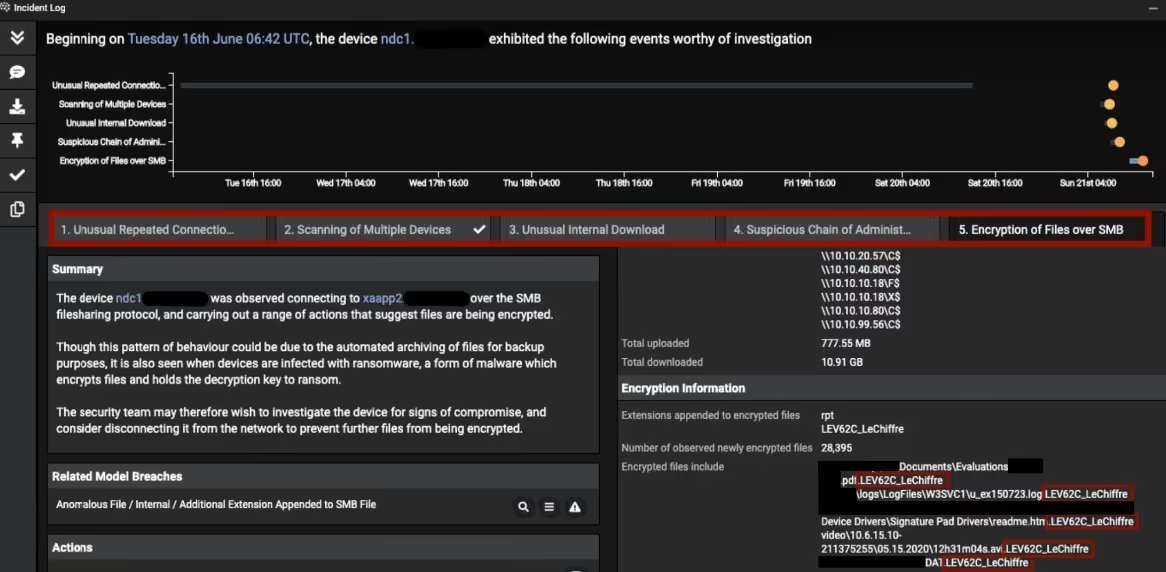
Figure 1: Darktrace’s Cyber AI Analyst autonomously investigates the attack

Overview of infected device
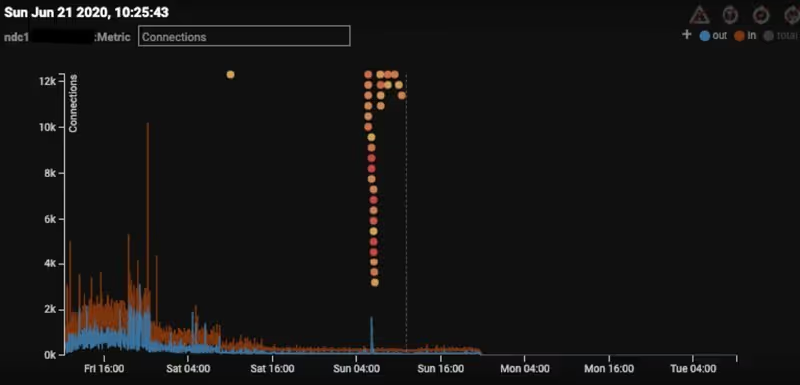
Figure 2: The graph showing the Darktrace detections cluster on June 21
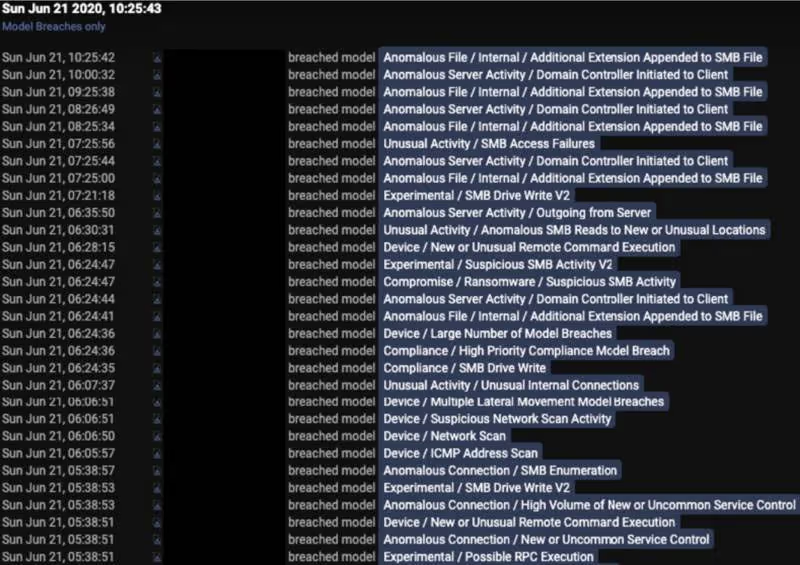
Figure 3: The device event log showing the list of model breaches on June 21

Machine-speed attacks require machine-speed response

This incident happened while the customer was participating in Darktrace’s free 30-day Proof of Value. Had Darktrace’s Autonomous Response technology, Antigena, been enabled, the AI would have responded immediately, taking action when the malware attempted lateral movement to prevent the breach device from carrying out encryption. Even without Antigena, Darktrace’s real-time detection and AI-powered investigation enabled the security team to quickly de-escalate the compromise.

The barrier to entry has been significantly lowered by the commoditization of malware. Many forms of ransomware are easily available to low-level threat actors via Darknet purchases, and minor changes made by cyber-criminals can easily enable the attacks to go undetected by most security tools. Now even low-skilled threat actors have the potential to cause significant damage and evade the traditional security stack.

The events described above demonstrate that ransomware continues to present a very real threat across multiple industries. And with ransomware capable of encrypting files across hundreds of devices in minutes, the need for machine-speed response is more important than ever. Darktrace Antigena enables security teams to get ahead of a threat by autonomously responding to threatening activity, taking devices offline or enforcing their ‘pattern of life’ to keep businesses operational.

Thanks to Darktrace analyst Fiona Goh for her insights on the above threat find.

Learn more about Autonomous Response

IoCs:

IoCCommentLEV62C_LeChiffre_ReadMe.txtRansom note.LEV62C_LeChiffreSuccessful SMB move with LeChiffre encryption extension

Darktrace model detections:

  • Compromise / Ransomware / Suspicious SMB Activity
  • Device / Multiple Lateral Movement Model Breaches
  • Device / Large Number of Model Breaches
  • Anomalous File / Internal / Additional Extension Appended to SMB File
  • Device / New or Unusual Remote Command Execution
  • Anomalous Connection / High Volume of New or Uncommon Service Control
  • Anomalous Connection / SMB Enumeration
  • Device / Suspicious Network Scan Activity
  • Device / Network Scan
  • Compliance / SMB Drive Write
  • Unusual Activity / SMB Access Failures
  • Experimental / Default Credential Usage V3

Inside the SOC
Darktrace cyber analysts are world-class experts in threat intelligence, threat hunting and incident response, and provide 24/7 SOC support to thousands of Darktrace customers around the globe. Inside the SOC is exclusively authored by these experts, providing analysis of cyber incidents and threat trends, based on real-world experience in the field.
Written by
Max Heinemeyer
Global Field CISO

More in this series

No items found.

Blog

/

Proactive Security

/

June 2, 2026

Stopping Stealth Attacks with Precision: How Núclea Prevented a Breach Without Disruption

Default blog imageDefault blog image

Núclea is a Brazilian data and technology company that supports the country’s financial system by delivering digital services exclusively to banks and financial institutions. Operating in an environment where trust, availability, and data integrity are critical, the company faces a threat landscape that has evolved rapidly—particularly with the rise of AI-driven cyberattacks.

Brazil has experienced a wave of successful cyber incidents targeting financial institutions, many of them enabled by insiders or compromised credentials. The result was a noticeable shift in attacker strategy: instead of focusing on end customers, threat actors began targeting the institutions and platforms that underpin the financial ecosystem itself.

“Attacks became far more directed and contextual,” explains Guilherme, who leads incident response within Núclea’s security platform engineering team. “They weren’t noisy or obviously malicious—they were precise, patient, and designed to blend into normal operations.”

That precision was on full display in January 2026, when Núclea faced one of the most convincing phishing attacks the team had seen.

A real attack, built on trust and context

The attack began with a seemingly routine email.

It was sent from a real Brazilian government institution, using legitimate infrastructure and valid credentials that were later confirmed to have been compromised. Núclea had an established, ongoing relationship with this organization, and the email’s language, tone, and subject matter aligned perfectly with the type of communication the recipient team handled every day.

Attached to the email was a PDF document containing content that looked entirely legitimate.

The problem? A single URL embedded inside that PDF.

“The message itself was correct. The sender was real. The context was familiar. Even the document content made sense,” Guilherme explains. “There was just one small element that didn’t belong.”

That small detail was enough to initiate a full attack chain.

What the attackers were trying to do

If clicked, the URL would have downloaded a malicious payload designed to:

  • Collect information about the user and device
  • Identify where the system was located within the financial ecosystem
  • Install remote access tools to maintain control
  • Deploy an infostealer to extract sensitive data
  • Execute anti-forensic scripts to erase traces of the intrusion

In other words, it was a carefully engineered operation designed for persistence and stealth, not immediate disruption.

The attack also employed urgency—a classic social engineering technique. When the link didn’t open as expected, employees requested assistance from the security team, insisting the document was important and needed to be accessed quickly.

This is precisely the kind of scenario where traditional security tools struggle: almost everything about the interaction is legitimate.

Where Darktrace made the difference

Instead of blocking the entire message or relying on known indicators of compromise, Darktrace focused on behavioral context.

Darktrace recognized:

  • That the sending organization was normally trusted
  • That the communication pattern matched historical behavior
  • That the PDF content itself was not suspicious

But it also identified that the URL embedded within the document deviated from established behavioral patterns.

Rather than disrupting business operations, Darktrace took precise action: it rewrote the URL, preventing the malicious download while leaving the rest of the email untouched.

“When we analyzed it afterward, it became clear how dangerous the attack would have been,” says Guilherme. “But it never progressed—because Darktrace acted at exactly the right point.”

Subsequent forensic analysis confirmed the payload’s malicious intent. The attack never succeeded.

Precision over disruption

For Núclea, this incident reinforced a critical lesson: modern attacks don’t always look malicious—they hide within normal activity.

“What stands out to me is the precision,” Guilherme says. “Darktrace doesn’t rely on big, obvious signals. It’s effective in situations that fall outside the standard patterns we all know.”

Building resilience in a high trust ecosystem

For Núclea, cybersecurity is not just a defensive measure—it’s a business enabler.

Availability failures or successful breaches in the financial ecosystem can have immediate, large-scale consequences, from financial loss to reputational damage. Preventing those outcomes protects not just Núclea, but its partners and customers as well.

“Cyber resilience means keeping the business running—even under attack,” Guilherme explains. “And that requires people, processes, and technology working together.”

As AI continues to accelerate both attacks and defenses, the role of security is evolving. Precision, behavioral understanding, and intelligent automation are no longer optional—they’re essential.

“The easy days were yesterday,” Guilherme says. “The challenges ahead are bigger. We need to be prepared—internally and with partners that help us build resilience.”

Continue reading
About the author

Blog

/

AI

/

June 1, 2026

効率化の裏にあるリスク:AI導入が製造現場にもたらす見えない脆弱性

Default blog imageDefault blog image

AIエージェントが製造業に与える影響

製造業界のセキュリティチームやIT担当者は、生産を守り、稼働時間を維持し、重要資産を保護するという絶え間ないプレッシャー下にあります。そしてAIは非常に大きなチャンスとともに、新たなサイバーリスクももたらしています。製造業全体で、AIはワークフローや意思決定に組み込まれつつあり、自律型AIエージェントが従業員やシステムに代わって行動する場面が増えています。

エージェント型システムは独立して行動できるため強力ですが、その同じ自律性がサイバーリスク、運用上のリスクも生み出します。エージェントは広範な権限を持ち、複雑なタスクの実行、意思決定、ツールや外部システムとのやり取りを、ほとんどまたは全く人間の介入なしに行うことができます。

あらかじめ定義されたタスクを実行する従来のAIモデルとは異なり、AIエージェントは高度なテクニックを使用して人間の意思決定プロセスを模倣することにより、新たな課題に動的に適応し、また自らの判断に基づいて意思決定し、アクションを実行します。彼らは業務の上では従業員のように見えますが、人間が持つ判断力、倫理観、または行動の結果に対する恐れが欠けています。これは、サイバー犯罪者によって簡単に操られる可能性があることを意味しており、OTネットワーク全体に埋め込まれたAIエージェントは、データ漏洩をはるかに超える脅威を生み出します。たとえば、BMWでは、AI は溶接プロセスのエラーの発生を識別するのに使われています。同社のスパータンバーグ(米サウスカロライナ州)の工場では、すべてのSUVフレーム上の300-400個のスタッドの溶接をAIが監視し、スタッドの配置間違いや欠陥を検知し直ちに修正します。このAIシステムが破損すれば壊滅的な品質管理問題につながる恐れがあります。

製造全体にエージェント型AIシステムを導入することについて多くのセキュリティチームはさまざまな懸念を示しています。ダークトレースの行ったAIサイバーセキュリティの現状調査では、製造業のセキュリティプロフェッショナルの78%が従業員によるAIエージェントの利用に懸念を抱いており、これは彼らの最も大きな危惧でした。それに続く問題点が従業員によるCopilotやChatGPT等の生成AIツールの使用であり、製造業のセキュリティプロフェッショナルの76%が懸念を抱いていました。これらのツールがますます多くのビジネスデータやプロセスにアクセスし、組織内でより多くの自律性を持つようになるにつれ、エージェントのアクティビティがほとんど可視化されていない現在、セキュリティチームにおいては機密データの露出(60%)や偶発的なポリシーおよび規制違反(59%)への懸念が高まっています。

外部からのAIによる脅威も急激に進化

製造業を変革しているのと同じAIの能力が、サイバー攻撃の形も変貌させています。

AIにより攻撃者は偵察を自動化し、標的をより高度に絞り込み、リアルタイムで適応できるようになっています。かつては人手による作業と時間を要していたことが、今では継続的かつ大規模に実行できるようになりました。そして、製造業はすでにその影響を実感しています。当社が調査した製造業のセキュリティプロフェッショナルの76%は、すでにAIを活用した脅威の影響を受けており、90%がAIによってソーシャルエンジニアリング攻撃の成功率が高まっていると回答しています。

また、攻撃のテクニック自体も進化しています。製造業界全体で、AIを利用した攻撃の経路の多様化に対する懸念が高まっています。特にリアルタイムで進化する適応型マルウェアについて、調査対象の製造業のセキュリティプロフェッショナルの半数近く(49%)が懸念しており、これは全産業の平均よりも9%高い数値です。AIを使った適応型マルウェアに続くその他の懸念には次が含まれます:

  • 自動化された脆弱性スキャンとエクスプロイトチェイニング(48%):Anthropicの新しいMythos AIモデルにより脆弱性探索が深刻化する中で、この問題は一層差し迫ったものとなっています。
  • 超パーソナライズされたフィッシングキャンペーン(46%):フィッシングは依然としてハッカーの主力兵器の1つであり、AIによってフィッシングメールはより説得力が高く検知困難なものとなり、その効果は増幅されました。

これは単に攻撃の量の増加だけでなく、攻撃の展開につれて静的な防御が対応できるよりも速く進化する脅威への変化なのです。

こうした認識が高まっているにもかかわらず、製造業の多くはまだこの変化に対応する準備ができていません。半数以上(51%)がAI駆動の脅威への準備が十分にできていないと回答し、AIの導入を管理する正式なポリシーを持っている組織はわずか37%でした。  

可視性、コンテキスト、およびガードレールを通じてAIのセキュリティを確保

これらの問題に対処するためにAIイノベーションを遅らせる必要はありません。それには、AIと同じスピードと規模で動作できる、これまでとは異なるアプローチのセキュリティが必要です。具体的には、製造業がAIの力を活用する上で、次の3つの優先課題が浮上しています。

可視性はすべての土台  

AIがどこで使用されているか、何にアクセスできるか、そしてITおよびOT環境にわたってどのように動作するかを理解する必要があります。それがなければ、リスクを測定したり管理したりすることはできません。ダークトレースの調査において、製造業のセキュリティプロフェッショナルの91%が、AIを信頼する前に、それがどのように意思決定を行うかを理解する必要があると回答したのは当然のことです。OT環境においてこのことはさらに重要です。稼働の中断は安全や環境、財務、および評判に大きな影響を及ぼすからです。

可視性をアクションにつなげるにはコンテキストが必要  

AIによって形作られる環境において、正常とされる挙動は絶えず変化します。つまり、脅威を検知するにはビヘイビアベースのアプローチが必要なのです。組織全体で生活パターンを理解し、わずかな逸脱をリアルタイムに検知すること- これは従来のセキュリティとリスク管理に対するアプローチからの根本的な変化です。

エージェントからの露出を防ぐガードレール  

AIシステムがより大きな責任を担うようになるなかで、組織はAIが何をできるか、そしていつ独立して行動できるかについて、明確な境界を設ける必要があります。これらのコントロールは何かがあってから適用されるのではなく、システム自体に組み込んでおかなければなりません。  

製造業のITおよびOT環境におけるAIエージェントのセキュリティ

エージェント型AIの出現は製造業を変革し、次世代のオペレーションを支える一方で、脅威ランドスケープも一変させています。これは単なる脅威の増加ではなく、自律型システムへの移行、挙動の絶え間ない変化、そしてマシンスピードで進行するリスクです。AIを活用しつつリスクを管理するという課題に取り組む組織にとって、可視性、コンテキスト、ガードレールはセキュリティの基盤となります。

Darktraceはこの基盤を実現することにより、製造業の安全なAIアプローチ構築を支援します。ITおよびOT環境全体を可視化し、異常なアクティビティに対するリアルタイムの検知および対応を提供することにより、従業員が使用するプロンプトや構築するエージェントから、それらのエージェントの環境全体での動作に至るまで、AIアクティビティの理解を可能にします。これにより、AIの導入を拡大する製造業はコントロールを犠牲にすることなくイノベーションの基盤を構築することができます。

Continue reading
About the author
Dr. Oakley Cox-Robinson
Senior Director of Product
あなたのデータ × DarktraceのAI
唯一無二のDarktrace AIで、ネットワークセキュリティを次の次元へ