Blog
/
/
July 8, 2021

Minimizing the REvil Impact Delivered via Kaseya Servers

Ransomware group REvil recently infiltrated Managed Service Providers for 1,500+ companies. See how Darktrace's autonomous response protected customer data.
Inside the SOC
Darktrace cyber analysts are world-class experts in threat intelligence, threat hunting and incident response, and provide 24/7 SOC support to thousands of Darktrace customers around the globe. Inside the SOC is exclusively authored by these experts, providing analysis of cyber incidents and threat trends, based on real-world experience in the field.
Written by
Max Heinemeyer
Global Field CISO
Default blog imageDefault blog imageDefault blog imageDefault blog imageDefault blog imageDefault blog image
08
Jul 2021

As the USA prepared for a holiday weekend ahead of the Fourth of July, the ransomware group REvil were leveraging a vulnerability in Kaseya software to attack Managed Service Providers (MSPs) and their downstream customers. At least 1,500 companies appear to have been affected, even ones with no direct relationship to Kaseya.

At the time of writing, it appears that a zero-day vulnerability was used to gain access to the Kaseya VSA servers, before deploying ransomware on the endpoints managed by those VSA servers. This modus operandi vastly differs from previous ransomware campaigns which have traditionally been human-operated, direct intrusions.

The analysis below offers Darktrace’s insights into the campaign by looking at a real-life example. It highlights how Self-Learning AI detected the ransomware attack, and how Antigena protected customer data on the network from being encrypted.

Dissecting REvil ransomware from the network perspective

Antigena detected the first signs of ransomware on the network as soon as encryption had begun. The graphic below illustrates the start of the ransomware encryption over SMB shares. When the graphic was taken, the attack was happening live and had never been seen before. As it was a novel threat, Darktrace stopped the network encryption without any static signatures or rules.

Figure 1: Darktrace detects encryption from the infected device

The ransomware began to take action at 11:08:32, shown by the ‘SMB Delete Success’ from the infected laptop to an SMB server. While the laptop sometimes reads files on that SMB server, it never deletes these types of files on this particular file share, so Darktrace detected this activity as new and unusual.

Simultaneously, the infected laptop created the ransom note ‘943860t-readme.txt’. Again, the ‘SMB Write Success’ to the SMB server was new activity – and crucially, Darktrace did not look for a static string or a known ransom note. Instead – by previously learning the ‘normal’ behavior of every entity, peer group, and the overall enterprise – it identified that the activity was unusual and new for this organization and device.

By detecting and correlating these subtle anomalies, Darktrace identified this as the earliest stages of ransomware encryption on the network and Antigena took immediate action.

Figure 2: Snapshot of Antigena’s actions

Antigena took two precise steps:

  1. Enforce ‘pattern of life’ for five minutes: This prevented the infected laptop from making any connections that were new or unusual. In this case, it prevented any further new SMB encryption activity.
  2. Quarantine device for 24 hours: Usually, Antigena would not take such drastic action, but it was clear that this activity closely resembled ransomware behavior, so Antigena decided to quarantine the device on the network completely to prevent it from doing any further damage.

For several minutes, the infected laptop kept trying to connect to other internal devices via SMB to continue the encryption activity. It was blocked by Antigena at every stage, limiting the spread of the attack and mitigating any damage posed via the network encryption.

Figure 3: End of the attack

On a technical level, Antigena delivered the blocking mechanisms via integrations with native security controls such as existing firewalls, or by taking action itself to disrupt the connections.

The below graphic shows the ‘pattern of life’ for all network connections for the infected laptop. The three red dots represent Darktrace’s detections and pinpoint the exact moment in time when REvil ransomware was installed on the laptop. The graphic also shows an abrupt stop to all network communication as Antigena quarantined the device.
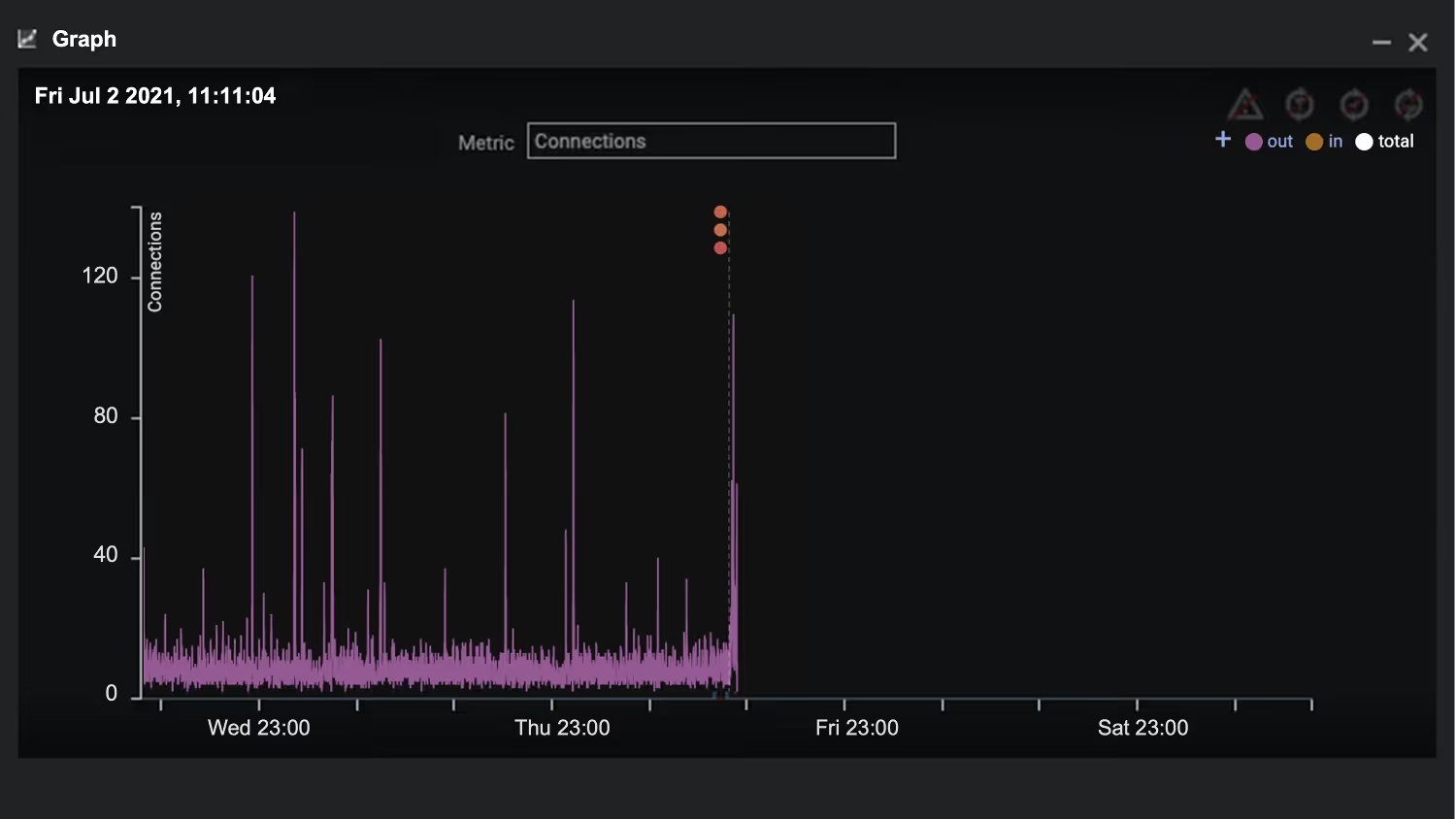
Figure 4: Network connections from the compromised laptop

Attacks will always get in

During the incident, part of the encryption happened locally on the endpoint device, which Darktrace had no visibility over. Furthermore, the Internet-facing Kaseya VSA server that was initially compromised was not visible to Darktrace in this case.

Nevertheless, Self-Learning AI detected the infection as soon as it reached the network. This shows the importance of being able to defend against active ransomware within the enterprise. Organizations cannot rely solely on a single layer of defense to keep threats out. An attacker will always – eventually – breach your environment. Defense therefore needs to change its approach towards detecting and mitigating damage once an adversary is inside.

Many cyber-attacks succeed in bypassing endpoint controls and begin to spread aggressively in corporate environments. Autonomous Response can provide resilience in such cases, even for novel campaigns and new strains of malware.

Thanks to Self-Learning AI, ransomware from the REvil attack could not perform any encryption over the network, and files available on that network were saved. This included the organization’s critical file servers which did not have Kaseya installed and thus did not receive the initial payload via the malicious update directly. By interrupting the attack as it happened, Antigena prevented thousands of files on network shares from being encrypted.

Further observations

Data exfiltration

In contrast to other REvil intrusions Darktrace has caught in the past, no data exfiltration has been observed. This is interesting as it differs from the general trend this last year where cyber-criminal groups generally focus more on the exfiltration of data to hold their victims to ransom, in response to companies becoming better with backups.

Bitcoin

REvil has demanded a total payment of $70 million in Bitcoin. For a group that tries to maximize their profits, this seems odd for two reasons:

  1. How do they expect a single entity to collect $70 million from potentially thousands of affected organizations? They must be aware of the massive logistical challenges behind this, even if they do expect Kaseya to act as a focal point for collecting the money.
  2. Since DarkSide lost access to most of the Colonial Pipeline ransom, ransomware groups have shifted to demanding payments in Monero rather than Bitcoin. Monero appears to be more difficult to track for law enforcement agencies. The fact REvil are using Bitcoin, a more traceable cryptocurrency, appears counter-productive to their usual goal of maximizing profits.

Ransomware-as-a-Service (RaaS)

Darktrace also noticed that other, more traditional ‘big game hunting’ REvil ransomware operations took place over the same weekend. This is not surprising as REvil is running a RaaS model, so it is likely some affiliate groups continued their regular big game hunting attacks while the Kaseya supply chain attack was underway.

Unpredictable is not undefendable

The weekend of the Fourth of July experienced major supply chain attacks against Kaseya and separately, against California-based distributor Synnex. Threats are coming from every direction – leveraging zero-days, social engineering tactics, and other advanced tools.

The case study above demonstrates how self-learning technology detects such attacks and minimizes the damage. It functions as a crucial part of defense-in-depth when other layers – such as endpoint protection, threat intelligence or known signatures and rules – fail to detect unknown threats.

The attack happened in milliseconds, faster than any human security team could react. Autonomous Response has proven invaluable in outpacing this new generation of machine-speed threats. It keeps thousands of organizations safe around the world, around the clock, stopping an attack every second.

Darktrace model detections

  • Compromise / Ransomware / Suspicious SMB Activity
  • Compromise / Ransomware / Suspicious SMB File Extension
  • Compromise / Ransomware / Ransom or Offensive Words Written to SMB
  • Compromise / Ransomware / Ransom or Offensive Words Read from SMB
Inside the SOC
Darktrace cyber analysts are world-class experts in threat intelligence, threat hunting and incident response, and provide 24/7 SOC support to thousands of Darktrace customers around the globe. Inside the SOC is exclusively authored by these experts, providing analysis of cyber incidents and threat trends, based on real-world experience in the field.
Written by
Max Heinemeyer
Global Field CISO

More in this series

No items found.

Blog

/

/

December 2, 2025

Protecting the Experience: How a global hospitality brand stays resilient with Darktrace

Default blog imageDefault blog image

For the Global Chief Technology Officer (CTO) of a leading experiential leisure provider, security is mission critical to protecting a business built on reputation, digital innovation, and guest experience. The company operates large-scale immersive venues across the UK and US, blending activity-driven hospitality with premium dining and vibrant spaces designed for hundreds of guests. With a lean, centrally managed IT team responsible for securing locations worldwide, the challenge is balancing robust cybersecurity with operational efficiency and customer experience.

Brand buzz attracts attention – and attacks

Mid-sized, fast-growing hospitality organizations face a unique risk profile. When systems go down in a venue, the impact is immediate: hundreds of disrupted guest experiences, lost revenue during peak hours, and potential long-term reputation damage. Each time the organization opened a new venue, the surge of marketing buzz attracted attention in local markets and waves of sophisticated cyberattacks, including:

Phishing campaigns leveraging brand momentum to lure employees into clicking on malicious links.

AI-enhanced impersonation using advanced techniques to create AI-generated video calls and deep-researched, contextualized emails  

Fake domains targeting leadership with AI-generated messages that contained insider context gleaned from public information.

“Our endpoint security and antivirus tools were powerless against these sophisticated AI-powered campaigns. We didn’t want to manage incidents anymore. We wanted to prevent them from ever happening.”  - Global CTO

Proactive, preventative security with Darktrace AI

The company’s cybersecurity vision was clear: “Proactive, preventative – that was our mandate,” said the CTO. With a lean and busy IT group, the business evaluated several security solutions using deep-dive workshops. Darktrace proved the best fit for supporting the organization’s proactive mindset, offering:

  • Autonomy without added headcount: Darktrace provided powerful AI-driven detection and autonomous response functions with minimal manual oversight required.
  • Modular adoption: The company could start with core email and network protection and expand into cloud and endpoint coverage, aligning spend with growth.
  • Partnership and responsiveness: “We wanted people we trust, respect, and know will show up when we need them. Darktrace did just that,” said the CTO.
  • Affordability at scale: Darktrace offered reasonable upfront costs plus predictable, sustainable economics as the company and IT infrastructure expanded.  

“The combination of AI capabilities, a scalable model, and a strong engagement team tipped the balance in Darktrace’s favor, and we have not been disappointed,” said the CTO.

Phased deployment builds trust

To minimize disruption to critical hospitality systems like global Point of Sales (POS) terminals and Audio-Visual (AV) infrastructure, deployment was phased:

  1. Observation and human-led response: Initially, Darktrace was deployed in detection-only mode. Alerts were manually reviewed.
  2. Incremental autonomous response: Darktrace Autonomous Response was enabled on select models, taking action on low-risk scenarios. Higher-risk subnets and devices remained under human control.
  3. Full autonomous coverage: With tuning and reinforcement, autonomous response was expanded across domains, trusted to take decisive action in real time. Analysts retained the ability to review and contextualize incidents.

“Darktrace managed the rollout through detailed, professional, and responsive project management – ensuring a smooth, successful adoption and creating a standardized cybersecurity playbook for future venue launches,” said the CTO.  

AI delivers the outcomes that matter  

Measurable efficiency replaces endless alerts

Darktrace autonomous response significantly decreased false alerts and noise. “If it’s quiet, we’re confident there isn’t a problem,” said the CTO. Within six months, Darktrace conducted 3,599 total investigations, detected and contained 320 incidents indicative of an attack, resolved 91% of those events autonomously, and escalated only 9% to human analysts. The efficiency gains were enormous, saving analysts 740 hours on investigations within a single month.  

Precision AI turns inbox chaos into calm

Darktrace Self-Learning AI modeled sender/recipient norms, content/linguistic baselines, and communication patterns unique to the organization’s launch cadence, resulting in:

  • Automated holds and neutralizations of anomalous executive-style messages
  • Rapid detection of novel templates and tone shifts that deviated from the organization’s lived email graph, even when indicators were not yet on any feed
  • Downstream reduction in help-desk escalations tied to suspicious email

Full visibility fuels real-time response

Darktrace gives IT direct visibility without extra licensing, and it surfaces ground truth across every venue, including:

  • Device geolocation and placement drift: Darktrace exposed devices and users operating outside approved zones, prompting new segmentation and access-control policies.
  • Guest Wi-Fi realities: Darktrace AI uncovered high-risk activity on guest networks, like crypto-mining and dark-web traffic, driving stricter VLAN separation and access hygiene.
  • Lateral-movement containment: Autonomous response fenced suspicious activity in real time, buying time for human investigation while keeping POS and AV systems unaffected.

Smarter endpoints for a smarter network

Endpoints once relied on static agents effective only against known signatures. Darktrace’s behavioral models now detect subtle anomalies at the endpoint process level that EDRs often miss, such as misuse of legitimate applications (commonly used in living-off-the-land attacks), unapproved application usage and policy violations. This increases the accuracy and fidelity of network-based investigations by adding endpoint process context alongside existing EDR alerts.

Autonomous response for continuous compliance

Across PCI, GDPR, and cross-border privacy obligations, Darktrace’s native evidencing is helping the team demonstrate control rather than merely assert it:

  • Asset and flow awareness: Knowing “what is where” and “who talks to what” underpins PCI scoping and data-flow diagrams.
  • Layered safeguards: Showing autonomous prevention, network segmentation, and rapid containment supports risk registers and control attestations.
  • Audit-ready artifacts: Investigations and autonomous actions produce artifacts that “tick the box” without additional tooling.  

Defining the next era of resilience with AI

With rapid global expansion underway, the company is using its cybersecurity playbook to streamline and secure future venue launches. In the near term, IT is focused on strengthening prevention, using Darktrace insights to guide new policy updates and infrastructure changes like imposing stricter guest-network posture and refining venue device baselines.

For tech leaders charting their path to proactive cyber defense, the CTO stresses success won’t come from sidestepping AI, but from turning it into a core capability.

“AI isn’t optional – it’s operational. The real risk to your business is trying to out-scale automated adversaries with human speed alone. When applied to the right use case, AI becomes a catalyst for efficiency, resilience, and business growth.” - Global CTO
Continue reading
About the author
The Darktrace Community

Blog

/

Email

/

December 2, 2025

From Amazon to Louis Vuitton: How Darktrace Detects Black Friday Phishing Attacks

Default blog imageDefault blog image

Why Black Friday Drives a Surge in Phishing Attacks

In recent years, Black Friday has shifted from a single day of online retail sales and discounts to an extended ‘Black Friday Week’, often preceded by weeks of online hype. During this period, consumers are inundated with promotional emails and marketing campaigns as legitimate retailers compete for attention.

Unsurprisingly, this surge in legitimate communications creates an ideal environment for threat actors to launch targeted phishing campaigns designed to mimic legitimate retail emails. These campaigns often employ social engineering techniques that exploit urgency, exclusivity, and consumer trust in well-known brands, tactics designed to entice recipients into opening emails and clicking on malicious links.

Additionally, given the seasonal nature of Black Friday and the ever-changing habits of consumers, attackers adopt new tactics and register fresh domains each year, rather than reusing domains previously flagged as spam or phishing endpoints. While this may pose a challenge for traditional email security tools, it presents no such difficulty for Darktrace / EMAIL and its anomaly-based approach.

In the days and weeks leading up to ‘Black Friday’, Darktrace observed a spike in sophisticated phishing campaigns targeting consumers, demonstrating how attackers combine phycological manipulation with technical evasion to bypass basic security checks during this high-traffic period. This blog showcases several notable examples of highly convincing phishing emails detected and contained by Darktrace / EMAIL in mid to late November 2025.

Darktrace’s Black Friday Detections

Brand Impersonation: Deal Watchdogs’ Amazon Deals

The impersonation major online retailers has become a common tactic in retail-focused attacks, none more so than Amazon, which ranked as the fourth most impersonated brand in 2024, only behind Microsoft, Apple, Google, and Facebook [1]. Darktrace’s own research found Amazon to be the most mimicked brand, making up 80% of phishing attacks in its analysis of global consumer brands.

When faced with an email that appears to come from a trusted sender like Amazon, recipients are far more likely to engage, increasing the success rate of these phishing campaigns.

In one case observed on November 16, Darktrace detected an email with the subject line “NOW LIVE: Amazon’s Best Early Black Friday Deals on Gadgets Under $60”. The email was sent to a customer by the sender ‘Deal Watchdogs’, in what appeared to be an attempt to masquerade as a legitimate discount-finding platform. No evidence indicated that the company was legitimate. In fact, the threat actor made no attempt to create a convincing name, and the domain appeared to be generated by a domain generation algorithm (DGA), as shown in Figure 2.

Although the email was sent by ‘Deal Watchdogs’, it attempted to impersonate Amazon by featuring realistic branding, including the Amazon logo and a shade of orange similar to that used by them for the ‘CLICK HERE’ button and headline text.

Figure 1: The contents of the email observed by Darktrace, featuring authentic-looking Amazon branding.

Darktrace identified that the email, marked as urgent by the sender, contained a suspicious link to a Google storage endpoint (storage.googleapis[.]com), which had been hidden by the text “CLICK HERE”. If clicked, the link could have led to a credential harvester or served as a delivery vector for a malicious payload hosted on the Google storage platform.

Fortunately, Darktrace immediately identified the suspicious nature of this email and held it before delivery, preventing recipients from ever receiving or interacting with the malicious content.

Figure 2: Darktrace / EMAIL’s detection of the malicious phishing email sent to a customer.

Around the same time, Darktrace detected a similar email attempting to spoof Amazon on another customer’s network with the subject line “Our 10 Favorite Deals on Amazon That Started Today”, also sent by ‘Deal Watchdogs,’ suggesting a broader campaign.

Analysis revealed that this email originated from the domain petplatz[.]com, a fake marketing domain previously linked to spam activity according to open-source intelligence (OSINT) [2].

Brand Impersonation: Louis Vuitton

A few days later, on November 20, Darktrace / EMAIL detected a phishing email attempting to impersonate the luxury fashion brand Louis Vuitton. At first glance, the email, sent under the name ‘Louis Vuitton’ and titled “[Black Friday 2025] Discover Your New Favorite Louis Vuitton Bag – Elegance Starts Here”, appeared to be a legitimate Black Friday promotion. However, Darktrace’s analysis uncovered several red flags indicating a elaborate brand impersonation attempt.

The email was not sent by Louis Vuitton but by rskkqxyu@bookaaatop[.]ru, a Russia-based domain never before observed on the customer’s network. Darktrace flagged this as suspicious, noting that .ru domains were highly unusual for this recipient’s environment, further reinforcing the likelihood of malicious intent. Subsequent analysis revealed that the domain had only recently registered and was flagged as malicious by multiple OSINT sources [3].

Figure 3: Darktrace / EMAIL’s detection of the malicious email attempting to spoofLouis Vuitton, originating from a suspicious Russia-based domain.

Darktrace further noted that the email contained a highly suspicious link hidden behind the text “View Collection” and “Unsubscribe,” ensuring that any interaction, whether visiting the supposed ‘handbag store’ or attempting to opt out of marketing emails, would direct recipients to the same endpoint. The link resolved to xn--80aaae9btead2a[.]xn--p1ai (топааабоок[.]рф), a domain confirmed as malicious by multiple OSINT sources [4]. At the time of analysis, the domain was inaccessible, likely due to takedown efforts or the short-lived nature of the campaign.

Darktrace / EMAIL blocked this email before it reached customer inboxes, preventing recipients from interacting with the malicious content and averting any disruption.

Figure 4: The suspicious domain linked in the Louis Vuitton phishing email, now defunct.

Too good to be true?

Aside from spoofing well-known brands, threat actors frequently lure consumers with “too good to be true” luxury offers, a trend Darktrace observed in multiple cases throughout November.

In one instance, Darktrace identified an email with the subject line “[Black Friday 2025] Luxury Watches Starting at $250.” Emails contained a malicious phishing link, hidden behind text like “Rolex Starting from $250”, “Shop Now”, and “Unsubscribe”.

Figure 5: Example of a phishing email detected by Darktrace, containing malicious links concealed behind seemingly innocuous text.

Similarly to the Louis Vuitton email campaign described above, this malicious link led to a .ru domain (hxxps://x.wwwtopsalebooks[.]ru/.../d65fg4er[.]html), which had been flagged as malicious by multiple sources [5].

Figure 6: Darktrace / EMAIL’s detection of a malicious email promoting a fake luxury watch store, which was successfully held from recipient inboxes.

If accessed, this domain would redirect users to luxy-rox[.]com, a recently created domain (15 days old at the time of writing) that has also been flagged as malicious by OSINT sources [6]. When visited, the redirect domain displayed a convincing storefront advertising high-end watches at heavily discounted prices.

Figure 7: The fake storefront presented upon visiting the redirectdomain, luxy-rox[.]com.

Although the true intent of this domain could not be confirmed, it was likely a scam site or a credential-harvesting operation, as users were required to create an account to complete a purchase. As of the time or writing, the domain in no longer accessible .

This email illustrates a layered evasion tactic: attackers employed multiple domains, rapid domain registration, and concealed redirects to bypass detection. By leveraging luxury branding and urgency-driven discounts, the campaign sought to exploit seasonal shopping behaviors and entice victims into clicking.

Staying Protected During Seasonal Retail Scams

The investigation into these Black Friday-themed phishing emails highlights a clear trend: attackers are exploiting seasonal shopping events with highly convincing campaigns. Common tactics observed include brand impersonation (Amazon, Louis Vuitton, luxury watch brands), urgency-driven subject lines, and hidden malicious links often hosted on newly registered domains or cloud services.

These campaigns frequently use redirect chains, short-lived infrastructure, and psychological hooks like exclusivity and luxury appeal to bypass user scepticism and security filters. Organizations should remain vigilant during retail-heavy periods, reinforcing user awareness training, link inspection practices, and anomaly-based detection to mitigate these evolving threats.

Credit to Ryan Traill (Analyst Content Lead) and Owen Finn (Cyber Analyst)

Appendices

References

1.        https://keepnetlabs.com/blog/top-5-most-spoofed-brands-in-2024

2.        https://www.virustotal.com/gui/domain/petplatz.com

3.        https://www.virustotal.com/gui/domain/bookaaatop.ru

4.        https://www.virustotal.com/gui/domain/xn--80aaae9btead2a.xn--p1ai

5.        https://www.virustotal.com/gui/url/e2b868a74531cd779d8f4a0e1e610ec7f4efae7c29d8b8ab32c7a6740d770897?nocache=1

6.        https://www.virustotal.com/gui/domain/luxy-rox.com

Indicators of Compromise (IoCs)

IoC – Type – Description + Confidence

petplatz[.]com – Hostname – Spam domain

bookaaatop[.]ru – Hostname – Malicious Domain

xn--80aaae9btead2a[.]xn--p1ai (топааабоок[.]рф) – Hostname - Malicious Domain

hxxps://x.wwwtopsalebooks[.]ru/.../d65fg4er[.]html) – URL – Malicious Domain

luxy-rox[.]com – Hostname -  Malicious Domain

MITRE ATT&CK Mapping  

Tactic – Technique – Sub-Technique  

Initial Access - Phishing – (T1566)  

Continue reading
About the author
Ryan Traill
Analyst Content Lead
Your data. Our AI.
Elevate your network security with Darktrace AI