ブログ
/
AI
/
August 9, 2022

Cyber Tactics in the Russo-Ukrainian Conflict

The conflict between Russia and Ukraine has led to fears of a full-scale cyberwar. Learn the cyber attack tactics used, hacking groups involved, and more!
Inside the SOC
Darktrace cyber analysts are world-class experts in threat intelligence, threat hunting and incident response, and provide 24/7 SOC support to thousands of Darktrace customers around the globe. Inside the SOC is exclusively authored by these experts, providing analysis of cyber incidents and threat trends, based on real-world experience in the field.
Written by
Rosa Jong
OSINT Analyst
Written by
Taisiia Garkava
Security Analyst
Default blog imageDefault blog imageDefault blog imageDefault blog imageDefault blog imageDefault blog image
09
Aug 2022

Introduction

Since the beginning of the Russian invasion of Ukraine in February 2022, cyber communities around the world have been witnessing what can be called a ‘renaissance of cyberwarfare' [1]. Rather than being financially motivated, threat actors are being guided by political convictions to defend allies or attack their enemies. This blog reviews some of the main threat actors involved in this conflict and their ongoing tactics, and advises on how organizations can best protect themselves. Darktrace’s preliminary assessments predicted that attacks would be observed globally with a focus on pro-Ukrainian nations such as North Atlantic Treaty Organization (NATO) members and that identified Advanced Persistent Threat (APT) groups would develop new and complex malware deployed through increasingly sophisticated attack vectors. This blog will show that many of these assessments had unexpected outcomes.

Context for Conflict 

Cyber confrontation between Russia and Ukraine dates back to 2013, when Viktor Yanukovych, (former President of Ukraine) rejected an EU trade pact in favour of an agreement with Russia. This sparked mass protests leading to his overthrow, and shortly after, Russian troops annexed Crimea and initiated the beginning of Russian-Ukrainian ground and cyber warfare. Since then, Russian threat actors have been periodically targeting Ukrainian infrastructure. One of the most notable examples of this, an attack against their national power grid in December 2015, resulted in power outages for approximately 255,000 people in Ukraine and was later attributed to the Russian hacking group Sandworm [2 & 3]. 

Another well-known attack in June 2017 overwhelmed the websites of hundreds of Ukrainian organizations using the infamous NotPetya malware. This attack is still considered the most damaging cyberattack in history, with more than €10 billion euros in financial damage [4]. In February 2022, countries witnessed the next stage of cyberwar against Ukraine with both new and familiar actors deploying various techniques to target their rival’s critical infrastructure. 

Tactic 1: Ransomware

Although some sources suggest US ransomware incidents and expectations of ransom may have declined during the conflict, ransomware still remained a significant tactic deployed globally across this period [5] [6] [7]. A Ukrainian hacking group, Network Battalion 65 (NB65), used ransomware to attack the Russian state-owned television and radio broadcasting network VGTRK. NB65 managed to steal 900,000 emails and 4000 files, and later demanded a ransom which they promised to donate to the Ukrainian army. This attack was unique because the group used the previously leaked source code of Conti, another infamous hacker group that had pledged its support to the Russian government earlier in the conflict. NB65 modified the leaked code to make unique ransomware for each of its targets [5]. 

Against expectations, Darktrace’s customer base appeared to deviate from these ransom trends. Analysts have seen relatively unsophisticated ransomware attacks during the conflict period, with limited evidence to suggest they were connected to any APT activity. Between November 2021 and June 2022, there were 51 confirmed ransomware compromises across the Darktrace customer base. This represents an increase of 43.16% compared to the same period the year before, accounting for relative customer growth. Whilst this suggests an overall growth in ransom cases, many of these confirmed incidents were unattributed and did not appear to be targeting any particular verticals or regions. While there was an increase in the energy sector, this could not be explicitly linked to the conflict. 

The Darktrace DETECT family has a variety of models related to ransomware visibility:

Darktrace Detections for T1486 (Data Encrypted for Impact):

- Compromise / Ransomware / Ransom or Offensive Words Written to SMB

- Compromise / Ransomware / Suspicious SMB Activity

- Anomalous Connection / Sustained MIME Type Conversion

- Unusual Activity / Sustained Anomalous SMB Activity

- Compromise / Ransomware / Suspicious SMB File Extension

- Unusual Activity / Anomalous SMB Read & Write

- Unusual Activity / Anomalous SMB Read & Write from New Device

- SaaS / Resource / SaaS Resources with Additional Extensions

- Compromise / Ransomware / Possible Ransom Note Read

- [If RESPOND is enabled] Antigena / Network / External Threat / Antigena Ransomware Block

Tactic 2: Wipers

One of the largest groups of executables seen during the conflict were wipers. On the eve of the invasion, Ukrainian organizations were targeted by a new wiper malware given the name “HermeticWiper”. Hermetic refers to the name of the Cyprian company “Hermetica Digital Ltd.” which was used by attackers to request a code signing certificate [6]. Such a digital certificate is used to verify the ownership of the code and that it has not been altered. The 24-year-old owner of Hermetica Digital says he had no idea that his company was abused to retrieve a code signing certificate [7]. 

HermeticWiper consists of three components: a worm, decoy ransomware and the wiper malware. The custom worm designed for HermeticWiper was used to spread the malware across the network of its infected machines. ESET researchers discovered that the decoy ransomware and the wiper were released at the same time [8]. The decoy ransomware was used to make it look like the machine was hit by ransomware, when in reality the wiper was already permanently wiping data from the machines. In the attack’s initial stage, it bypasses Windows security features designed to prevent overwriting boot records by installing a separate driver. After wiping data from the machine, HermeticWiper prevents that data from being re-fragmented and overwrites the files to fragment it further. This is done to make it more challenging to reconstruct data for post-compromise forensics [9]. Overall, the function and purpose of HermeticWiper seems similar to that of NotPetya ransomware. 

HermeticWiper is not the only conflict-associated wiper malware which has been observed. In January 2022, Microsoft warned Ukrainian customers that they detected wiper intrusion activity against several European organizations. One example of this was the MBR (Master Boot Record) wiper. This type of wiper overwrites the MBR, the disk sector that instructs a computer on how to load its operating system, with a ransomware note. In reality, the note is a misdirection and the malware destroys the MBR and targeted files [10].  

One of the most notable groups that used wiper malware was Sandworm. Sandworm is an APT attributed to Russia’s foreign military intelligence agency, GRU. The group has been active since 2009 and has used a variety of TTPs within their attacks. They have a history of targeting Ukraine including attacks in 2015 on Ukraine’s energy distribution companies and in 2017 when they used the aforementioned NotPetya malware against several Ukrainian organizations [11]. Another Russian (or pro-Russian) group using wiper malware to target Ukraine is DEV-0586. This group targeted various Ukrainian organizations in January 2022 with Whispergate wiper malware. This type of wiper malware presents itself as ransomware by displaying a file instructing the victim to pay Bitcoin to have their files decrypted [12].  

Darktrace did not observe any confirmed cases of HermeticWiper nor other conflict-associated wipers (e.g IsaacWiper and CaddyWiper) within the customer base over this period. Despite this, Darktrace DETECT has a variety of models related to wipers and data destruction:

Darktrace Detections for T1485 (Data Destruction)- this is the main technique exploited during wiper attacks

- Unusual Activity / Anomalous SMB Delete Volume

- IaaS / Unusual Activity / Anomalous AWS Resources Deleted

- IaaS / Storage / S3 Bucket Delete

- SaaS / Resource / Mass Email Deletes from Rare Location

- SaaS / Resource / Anomalous SaaS Resources Deleted

- SaaS / Resource / Resource Permanent Delete

- [If RESPOND is enabled] Antigena / Network / Manual / Enforce Pattern of Life

- [If RESPOND is enabled] Antigena / SaaS / Antigena Unusual Activity Block

Tactic 3: Spear-Phishing

Another strategy that some threat actors employ is spear-phishing. Targeting can be done using email, social media, messaging, or other platforms.

The hacking group Armageddon (also known as Gamaredon) has been responsible for several spear-phishing attacks during the crisis, primarily targeting individuals involved in the Ukrainian Government [13]. Since the beginning of the war, the group has been sending out a large volume of emails containing an HTML file which, if opened, downloads and launches a RAR payload. Those who click the attached link download an HTA with a PowerShell script which obtains the final Armageddon payload. Using the same strategy, the group is also targeting governmental agencies in the European Union [14]. With high-value targets, the need to improve teaching around phishing identification to minimize the chance of being caught in an attacker's net is higher than ever. 

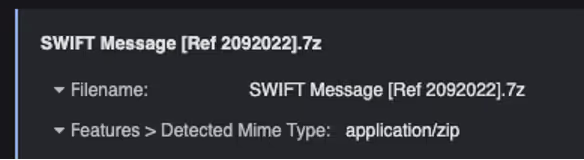
In comparison to the wider trends, Darktrace analysts again saw little-to-no evidence of conflict-associated phishing campaigns affecting customers. Those phishing attempts which did target customers were largely not conflict-related. In some cases, the conflict was used opportunistically, such as when one customer was targeted with a phishing email referencing Russian bank exclusions from the SWIFT payment system (Figures 1 and 2). The email was identified by Darktrace/Email as a probable attempt at financial extortion and inducement - in this case the company received a spoofed email from a major bank’s remittance department.  
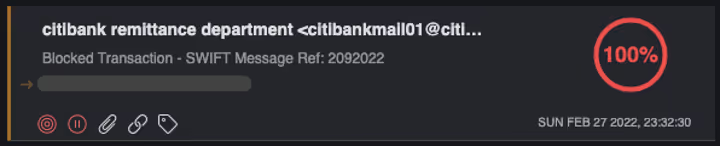
Figure 1- Screencap of targeted phishing email sent to Darktrace customer
Figure 2- Attached file contains soliciting reference to SWIFT, a money payment system which select Russian banks were removed from because of the conflict [15]

 Although the conflict was used as a reference in some examples, in most of Darktrace’s observed phishing cases during the conflict period there was little-to-no evidence to suggest that the company being targeted nor the threat actor behind the phishing attempt was associated with or attributable to the Russia-Ukraine conflict.

However, Darktrace/Email has several model categories which pick up phishing related threats:

Sample of Darktrace for Email Detections for T1566 (Phishing)- this is the overarching technique exploited during spear-phishing events

Model Categories:

- Inducement

- Internal / External User Spoofing

- Internal / External Domain Spoofing

- Fake Support

- Link to Rare Domains

- Link to File Storage

- Redirect Links

- Anomalous / Malicious Attachments

- Compromised Known Sender

Specific models can be located on the Email Console


Tactic 4: Distributed-Denial-of-Service (DDoS)

Another tactic employed by both pro-Russian and pro-Ukrainian threat actors was DDoS (Distributed Denial of Service) attacks. Both pro-Russia and pro-Ukraine actors were seen targeting critical infrastructure, information resources, and governmental platforms with mass DDoS attacks. The Ukrainian Minister of Digital Transformation, Mykhailo Fedorov, called on an IT Army of underground Ukrainian hackers and volunteers to protect Ukraine's critical infrastructure and conduct DDoS attacks against Russia [16]. As of 1 August 2022, more than two hundred thousand people are subscribed to the group's official Telegram channel, where potential DDoS targets are announced [17].

Darktrace observed similar pro-Ukraine DDoS behaviors within a variety of customer environments. These DDoS campaigns appeared to involve low-volume individual support combined with crowd-sourced DDoS activity. They were hosted on a range of public-sourced DDoS sites and seemed to share sentiments of groups such as the IT Army of Ukraine (Figure 3).
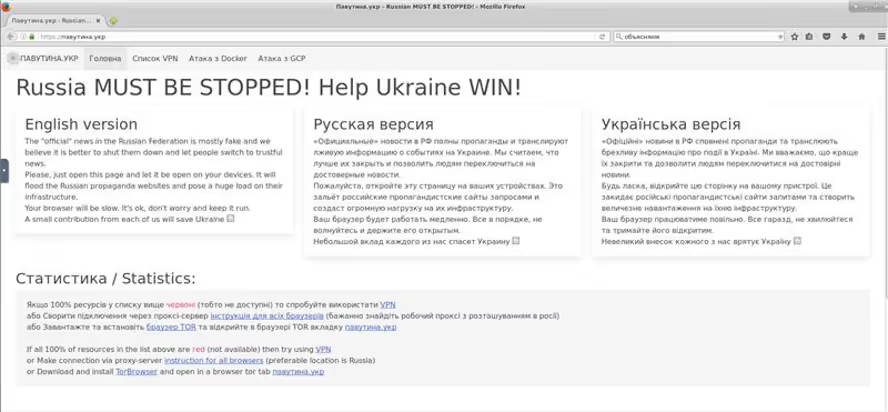
Figure 3- Example DDoS outsource domain with unusual TLD 

From the Russian side, one of the prominent newly emerged groups, Killnet, is striking back, launching several massive DDoS attacks against the critical infrastructure of countries that provide weaponry to Ukraine [18 & 19]. Today, the number of supporters of Killnet has grown to eighty-four thousand on their Telegram channel. The group has already launched a number of mass attacks on several NATO states, including Germany, Poland, Italy, Lithuania and Norway. This shows the conflict has attracted new and fast-growing groups with large backing and the capacity to undertake widespread attacks. 

DETECT has several models to identify anomalous DoS/DDoS activity:

Darktrace Detection for T1498 (Network Denial of Service)- this is the main technique exploited during DDoS attacks

- Device / Anomaly Indicators / Denial of Service Activity Indicator

- Anomalous Server Activity / Possible Denial of Service Activity

- [If RESPOND is enabled] Antigena / Network / External Threat / Antigena Suspicious Activity Block

What did Darktrace observe?

Darktrace’s cross-fleet detections were largely contrary to expectations. Analysts did not see large-scale complex conflict-linked attacks utilizing either conflict-associated ransomware, malware, or other TTPs. Instead, cyber incidents observed were largely opportunistic, using malware that could be purchased through Malware-as-a-Service models and other widely available toolkits, (rather than APT or conflict-attributable attacks). Overall, this is not to say there have been no repercussions from the conflict or that opportunistic attacks will cease, but evidence suggests that there were fewer wider cyber consequences beyond the initial APT-based attacks seen in the public forum. 

Another trend expected since the beginning of the conflict was targeted responses to sanction announcements focusing on NATO businesses and governments. Analysts, however, saw the limited reactive actions, with little-to-no direct impact from sanction announcements. Although cyber-attacks on some NATO organizations did take place, they were not as widespread or impactful as expected. Lastly, it was thought that exposure to new and sophisticated exploits would increase and be used to weaken NATO nations - especially corporations in critical industries. However, analysts observed relatively common exploits deployed indiscriminately and opportunistically. Overall, with the wider industry expecting chaos, Darktrace analysts did not see the crisis taken advantage of to target wider businesses outside of Ukraine. Based on this comparison between expectations and reality, the conflict has demonstrated the danger of  falling prey to confirmation bias and the need to remain vigilant and expect the unexpected. It may be possible to say that cyberwar is ‘cold’ right now, however the element of surprise is always present, and it is better to be prepared to protect yourself and your organization.    

What to Expect from the Future

As cyberattacks continue to become less monetarily and physically costly, it is to be expected that they will increase in frequency. Even after a political ceasefire is established, hacking groups can harbour resentment and continue their attacks, though possibly on a smaller scale.  

Additionally, the longer this conflict continues, the more sophisticated hacking groups’s attacks may become. In one of their publications, Killnet shared with subscribers that they had created ‘network weaponry’ powerful enough to simultaneously take down five European countries (Figure 4) [20]. Whether or not this claim is true, it is vital to be prepared. The European Union and the United States have supported Ukraine since the start of the invasion, and the EU has also stated that it is considering providing further assistance to help Ukraine in cyberspace [21].
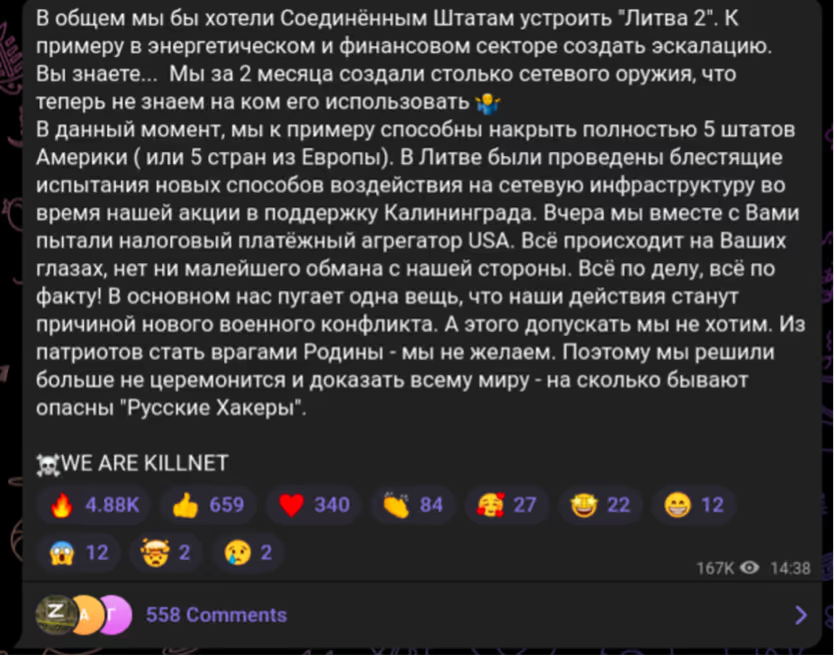
Figure 4- Snapshot of Killnet Telegram announcement

How to Protect Against these Attacks

In the face of wider conflict and cybersecurity tensions, it is crucial that organizations evaluate their security stack and practise the following: 

·       Know what your critical assets are and what software is running on them. 

·       Keep your software up to date. Prioritize patching critical and high vulnerabilities that allow remote code execution. 

·       Enforce Multifactor Authentication (MFA) to the greatest extent possible. 

·       Require the use of a password manager to generate strong and unique passwords for each separate account. 

·       Backup all the essential files on the cloud and external drives and regularly maintain them. 

·       Train your employees to recognize phishing emails, suspicious websites, infected links or other abnormalities to prevent successful compromise of email accounts. 

In order to prevent an organization from suffering damage due to one of the attacks mentioned above, a full-circle approach is needed. This defence starts with a thorough understanding of the attack surface to provide timely mitigation. This can be supported by Darktrace products: 

·       As shown throughout this blog, Darktrace DETECT and Darktrace/Email have several models relating to conflict-associated TTPs and attacks. These help to quickly alert security teams and provide visibility of anomalous behaviors.

·       Darktrace PREVENT/ASM helps to identify vulnerable external-facing assets. By patching and securing these devices, the risk of exploit is drastically reduced.

·       Darktrace RESPOND and RESPOND/Email can make targeted actions to a range of threats such as blocking incoming DDoS connections or locking malicious email links.

Thanks to the Darktrace Threat Intelligence Unit for their contributions to this blog.

Appendices 

Reference List

[1] https://www.atlanticcouncil.org/blogs/ukrainealert/vladimir-putins-ukraine-invasion-is-the-worlds-first-full-scale-cyberwar/ 

[2] https://www.reuters.com/article/us-ukraine-cybersecurity-idUSKCN0VY30K

[3] https://www.reuters.com/article/us-ukraine-cybersecurity-sandworm-idUSKBN0UM00N20160108

[4 & 11] https://www.wired.com/story/notpetya-cyberattack-ukraine-russia-code-crashed-the-world/ 

[5] https://www.scmagazine.com/analysis/ransomware/despite-hopes-for-decline-ransomware-attacks-increased-during-russia-ukraine-conflict

[6] https://ransomware.org/blog/has-the-ukraine-conflict-disrupted-ransomware-attacks/

[7] https://www.cfr.org/blog/financial-incentives-may-explain-perceived-lack-ransomware-russias-latest-assault-ukraine

[8] https://www.bleepingcomputer.com/news/security/hackers-use-contis-leaked-ransomware-to-attack-russian-companies/ 

[9] https://voi.id/en/technology/138937/hermetica-owner-from-cyprus-didnt-know-his-server-was-used-in-malicious-malware-attack-in-ukraine 

[10] https://www.reuters.com/article/ukraine-crisis-cyber-cyprus-idCAKBN2KT2QI 

[11] https://www.eset.com/int/about/newsroom/press-releases/research/eset-research-ukraine-hit-by-destructive-attacks-before-and-during-the-russian-invasion-with-hermet/ 

[12] https://blog.malwarebytes.com/threat-intelligence/2022/03/hermeticwiper-a-detailed-analysis-of-the-destructive-malware-that-targeted-ukraine/ 

[13] https://www.microsoft.com/security/blog/2022/01/15/destructive-malware-targeting-ukrainian-organizations/ 

[15] https://www.cisa.gov/uscert/ncas/alerts/aa22-057a 

[16] https://attack.mitre.org/groups/G0047/ 

[17] https://cyware.com/news/ukraine-cert-warns-of-increasing-attacks-by-armageddon-group-850081f8 

[18] https://www.bbc.co.uk/news/business-60521822

[19] https://foreignpolicy.com/2022/04/11/russia-cyberwarfare-us-ukraine-volunteer-hackers-it-army/

[20] https://t.me/itarmyofukraine2022

[21] https://www.csoonline.com/article/3664859/russian-ddos-attack-on-lithuania-was-planned-on-telegram-flashpoint-says.html

[19 & 20] https://flashpoint.io/blog/killnet-kaliningrad-and-lithuanias-transport-standoff-with-russia/ 

[21] https://presidence-francaise.consilium.europa.eu/en/news/member-states-united-in-supporting-ukraine-and-strengthening-the-eu-s-telecommunications-and-cybersecurity-resilience/ 

Inside the SOC
Darktrace cyber analysts are world-class experts in threat intelligence, threat hunting and incident response, and provide 24/7 SOC support to thousands of Darktrace customers around the globe. Inside the SOC is exclusively authored by these experts, providing analysis of cyber incidents and threat trends, based on real-world experience in the field.
Written by
Rosa Jong
OSINT Analyst
Written by
Taisiia Garkava
Security Analyst

More in this series

No items found.

Blog

/

AI

/

December 5, 2025

Simplifying Cross Domain Investigations

Default blog imageDefault blog image

Cross-domain gaps mean cross-domain attacks  

Organizations are built on increasingly complex digital estates. Nowadays, the average IT ecosystem spans across a large web of interconnected domains like identity, network, cloud, and email.  

While these domain-specific technologies may boost business efficiency and scalability, they also provide blind spots where attackers can shelter undetected. Threat actors can slip past defenses because security teams often use different detection tools in each realm of their digital infrastructure. Adversaries will purposefully execute different stages of an attack across different domains, ensuring no single tool picks up too many traces of their malicious activity. Identifying and investigating this type of threat, known as a cross-domain attack, requires mastery in event correlation.  

For example, one isolated network scan detected on your network may seem harmless at first glance. Only when it is stitched together with a rare O365 login, a new email rule and anomalous remote connections to an S3 bucket in AWS does it begin to manifest as an actual intrusion.  

However, there are a whole host of other challenges that arise with detecting this type of attack. Accessing those alerts in the respective on-premise network, SaaS and IaaS environments, understanding them and identifying which ones are related to each other takes significant experience, skill and time. And time favours no one but the threat actor.  

Anatomy of a cross domain attack
Figure 1: Anatomy of a cross domain attack

Diverse domains and empty grocery shelves

In April 2025, the UK faced a throwback to pandemic-era shortages when the supermarket giant Marks & Spencer (M&S) was crippled by a cyberattack, leaving empty shelves across its stores and massive disruptions to its online service.  

The threat actors, a group called Scattered Spider, exploited multiple layers of the organization’s digital infrastructure. Notably, the group were able to bypass the perimeter not by exploiting a technical vulnerability, but an identity. They used social engineering tactics to impersonate an M&S employee and successfully request a password reset.  

Once authenticated on the network, they accessed the Windows domain controller and exfiltrated the NTDS.dit file – a critical file containing hashed passwords for all users in the domain. After cracking those hashes offline, they returned to the network with escalated privileges and set their sights on the M&S cloud infrastructure. They then launched the encryption payload on the company’s ESXi virtual machines.

To wrap up, the threat actors used a compromised employee’s email account to send an “abuse-filled” email to the M&S CEO, bragging about the hack and demanding payment. This was possibly more of a psychological attack on the CEO than a technically integral part of the cyber kill chain. However, it revealed yet another one of M&S’s domains had been compromised.  

In summary, the group’s attack spanned four different domains:

Identity: Social engineering user impersonation

Network: Exfiltration of NTDS.dit file

Cloud: Ransomware deployed on ESXI VMs

Email: Compromise of user account to contact the CEO

Adept at exploiting nuance

This year alone, several high-profile cyber-attacks have been attributed to the same group, Scattered Spider, including the hacks on Victoria’s Secret, Adidas, Hawaiian Airlines, WestJet, the Co-op and Harrods. It begs the question, what has made this group so successful?

In the M&S attack, they showcased their advanced proficiency in social engineering, which they use to bypass identity controls and gain initial access. They demonstrated deep knowledge of cloud environments by deploying ransomware onto virtualised infrastructure. However, this does not exemplify a cookie-cutter template of attack methods that brings them success every time.

According to CISA, Scattered Spider typically use a remarkable variety of TTPs (tactics, techniques and procedures) across multiple domains to carry out their campaigns. From leveraging legitimate remote access tools in the network, to manipulating AWS EC2 cloud instances or spoofing email domains, the list of TTPs used by the group is eye-wateringly long. Additionally, the group reportedly evades detection by “frequently modifying their TTPs”.  

If only they had better intentions. Any security director would be proud of a red team who not only has this depth and breadth of domain-centric knowledge but is also consistently upskilling.  

Yet, staying ahead of adversaries who seamlessly move across domains and fluently exploit every system they encounter is just one of many hurdles security teams face when investigating cross-domain attacks.  

Resource-heavy investigations

There was a significant delay in time to detection of the M&S intrusion. News outlet BleepingComputer reported that attackers infiltrated the M&S network as early as February 2025. They maintained persistence for weeks before launching the attack in late April 2025, indicating that early signs of compromise were missed or not correlated across domains.

While it’s unclear exactly why M&S missed the initial intrusion, one can speculate about the unique challenges investigating cross-domain attacks present.  

Challenges of cross-domain investigation

First and foremost, correlation work is arduous because the string of malicious behaviour doesn’t always stem from the same device.  

A hypothetical attack could begin with an O365 credential creating a new email rule. Weeks later, that same credential authenticates anomalously on two different devices. One device downloads an .exe file from a strange website, while the other starts beaconing every minute to a rare external IP address that no one else in the organisation has ever connected to. A month later, a third device downloads 1.3 GiB of data from a recently spun up S3 bucket and gradually transfers a similar amount of data to that same rare IP.

Amid a sea of alerts and false positives, connecting the dots of a malicious attack like this takes time and meticulous correlation. Factor in the nuanced telemetry data related to each domain and things get even more complex.  

An analyst who specialises in network security may not understand the unique logging formats or API calls in the cloud environment. Perhaps they are proficient in protecting the Windows Active Directory but are unfamiliar with cloud IAM.  

Cloud is also an inherently more difficult domain to investigate. With 89% of organizations now operating in multi-cloud environments time must be spent collecting logs, snapshots and access records. Coupled with the threat of an ephemeral asset disappearing, the risk of missing a threat is high. These are some of the reasons why research shows that 65% of organisations spend 3-5 extra days investigating cloud incidents.  

Helpdesk teams handling user requests over the phone require a different set of skills altogether. Imagine a threat actor posing as an employee and articulately requesting an urgent password reset or a temporary MFA deactivation. The junior Helpdesk agent— unfamiliar with the exception criteria, eager to help and feeling pressure from the persuasive manipulator at the end of the phoneline—could easily fall victim to this type of social engineering.  

Empowering analysts through intelligent automation

Even the most skilled analysts can’t manually piece together every strand of malicious activity stretching across domains. But skill alone isn’t enough. The biggest hurdle in investigating these attacks often comes down to whether the team have the time, context, and connected visibility needed to see the full picture.

Many organizations attempt to bridge the gap by stitching together a patchwork of security tools. One platform for email, another for endpoint, another for cloud, and so on. But this fragmentation reinforces the very silos that cross-domain attacks exploit. Logs must be exported, normalized, and parsed across tools a process that is not only error-prone but slow. By the time indicators are correlated, the intrusion has often already deepened.

That’s why automation and AI are becoming indispensable. The future of cross-domain investigation lies in systems that can:

  • Automatically correlate activity across domains and data sources, turning disjointed alerts into a single, interpretable incident.
  • Generate and test hypotheses autonomously, identifying likely chains of malicious behaviour without waiting for human triage.
  • Explain findings in human terms, reducing the knowledge gap between junior and senior analysts.
  • Operate within and across hybrid environments, from on-premise networks to SaaS, IaaS, and identity systems.

This is where Darktrace transforms alerting and investigations. Darktrace’s Cyber AI Analyst automates the process of correlation, hypothesis testing, and narrative building, not just within one domain, but across many. An anomalous O365 login, a new S3 bucket, and a suspicious beaconing host are stitched together automatically, surfacing the story behind the alerts rather than leaving it buried in telemetry.

How threat activity is correlated in Cyber AI Analyst
Figure 2: How threat activity is correlated in Cyber AI Analyst

By analyzing events from disparate tools and sources, AI Analyst constructs a unified timeline of activity showing what happened, how it spread, and where to focus next. For analysts, it means investigation time is measured in minutes, not days. For security leaders, it means every member of the SOC, regardless of experience, can contribute meaningfully to a cross-domain response.

Figure 3: Correlation showcasing cross domains (SaaS and IaaS) in Cyber AI Analyst

Until now, forensic investigations were slow, manual, and reserved for only the largest organizations with specialized DFIR expertise. Darktrace / Forensic Acquisition & Investigation changes that by leveraging the scale and elasticity of the cloud itself to automate the entire investigation process. From capturing full disk and memory at detection to reconstructing attacker timelines in minutes, the solution turns fragmented workflows into streamlined investigations available to every team.

What once took days now takes minutes. Now, forensic investigations in the cloud are faster, more scalable, and finally accessible to every security team, no matter their size or expertise.

Continue reading
About the author
Benjamin Druttman
Cyber Security AI Technical Instructor

Blog

/

Network

/

December 5, 2025

Atomic Stealer: Darktrace’s Investigation of a Growing macOS Threat

Default blog imageDefault blog image

The Rise of Infostealers Targeting Apple Users

In a threat landscape historically dominated by Windows-based threats, the growing prevalence of macOS information stealers targeting Apple users is becoming an increasing concern for organizations. Infostealers are a type of malware designed to steal sensitive data from target devices, often enabling attackers to extract credentials and financial data for resale or further exploitation. Recent research identified infostealers as the largest category of new macOS malware, with an alarming 101% increase in the last two quarters of 2024 [1].

What is Atomic Stealer?

Among the most notorious is Atomic macOS Stealer (or AMOS), first observed in 2023. Known for its sophisticated build, Atomic Stealer can exfiltrate a wide range of sensitive information including keychain passwords, cookies, browser data and cryptocurrency wallets.

Originally marketed on Telegram as a Malware-as-a-Service (MaaS), Atomic Stealer has become a popular malware due to its ability to target macOS. Like other MaaS offerings, it includes services like a web panel for managing victims, with reports indicating a monthly subscription cost between $1,000 and $3,000 [2]. Although Atomic Stealer’s original intent was as a standalone MaaS product, its unique capability to target macOS has led to new variants emerging at an unprecedented rate

Even more concerning, the most recent variant has now added a backdoor for persistent access [3]. This backdoor presents a significant threat, as Atomic Stealer campaigns are believed to have reached an around 120 countries. The addition of a backdoor elevates Atomic Stealer to the rare category of backdoor deployments potentially at a global scale, something only previously attributed to nation-state threat actors [4].

This level of sophistication is also evident in the wide range of distribution methods observed since its first appearance; including fake application installers, malvertising and terminal command execution via the ClickFix technique. The ClickFix technique is particularly noteworthy: once the malware is downloaded onto the device, users are presented with what appears to be a legitimate macOS installation prompt. In reality, however, the user unknowingly initiates the execution of the Atomic Stealer malware.

This blog will focus on activity observed across multiple Darktrace customer environments where Atomic Stealer was detected, along with several indicators of compromise (IoCs). These included devices that successfully connected to endpoints associated with Atomic Stealer, those that attempted but failed to establish connections, and instances suggesting potential data exfiltration activity.

Darktrace’s Coverage of Atomic Stealer

As this evolving threat began to spread across the internet in June 2025, Darktrace observed a surge in Atomic Stealer activity, impacting numerous customers in 24 different countries worldwide. Initially, most of the cases detected in 2025 affected Darktrace customers within the Europe, Middle East, and Africa (EMEA) region. However, later in the year, Darktrace began to observe a more even distribution of cases across EMEA, the Americas (AMS), and Asia Pacific (APAC). While multiple sectors were impacted by Atomic Stealer, Darktrace customers in the education sector were the most affected, particularly during September and October, coinciding with the return to school and universities after summer closures. This spike likely reflects increased device usage as students returned and reconnected potentially compromised devices to school and campus environments.

Starting from June, Darktrace detected multiple events of suspicious HTTP activity to external connections to IPs in the range 45.94.47.0/24. Investigation by Darktrace’s Threat Research team revealed several distinct patterns ; HTTP POST requests to the URI “/contact”, identical cURL User Agents and HTTP requests to “/api/tasks/[base64 string]” URIs.

Within one observed customer’s environment in July, Darktrace detected two devices making repeated initiated HTTP connections over port 80 to IPs within the same range. The first, Device A, was observed making GET requests to the IP 45.94.47[.]158 (AS60781 LeaseWeb Netherlands B.V.), targeting the URI “/api/tasks/[base64string]” using the “curl/8.7.2” user agent. This pattern suggested beaconing activity and triggered the ‘Beaconing Activity to External Rare' model alert in Darktrace / NETWORK, with Device A’s Model Event Log showing repeated connections. The IP associated with this endpoint has since been flagged by multiple open-source intelligence (OSINT) vendors as being associated with Atomic Stealer [5].

Darktrace’s detection of Device A showing repeated connections to the suspicious IP address over port 80, indicative of beaconing behavior.
Figure 1: Darktrace’s detection of Device A showing repeated connections to the suspicious IP address over port 80, indicative of beaconing behavior.

Darktrace’s Cyber AI Analyst subsequently launched an investigation into the activity, uncovering that the GET requests resulted in a ‘503 Service Unavailable’ response, likely indicating that the server was temporarily unable to process the requests.

Cyber AI Analyst Incident showing the 503 Status Code, indicating that the server was temporarily unavailable.
Figure 2: Cyber AI Analyst Incident showing the 503 Status Code, indicating that the server was temporarily unavailable.

This unusual activity prompted Darktrace’s Autonomous Response capability to recommend several blocking actions for the device in an attempt to stop the malicious activity. However, as the customer’s Autonomous Response configuration was set to Human Confirmation Mode, Darktrace was unable to automatically apply these actions. Had Autonomous Response been fully enabled, these connections would have been blocked, likely rendering the malware ineffective at reaching its malicious command-and-control (C2) infrastructure.

Autonomous Response’s suggested actions to block suspicious connectivity on Device A in the first customer environment.
Figure 3: Autonomous Response’s suggested actions to block suspicious connectivity on Device A in the first customer environment.

In another customer environment in August, Darktrace detected similar IoCs, noting a device establishing a connection to the external endpoint 45.94.47[.]149 (ASN: AS57043 Hostkey B.V.). Shortly after the initial connections, the device was observed making repeated requests to the same destination IP, targeting the URI /api/tasks/[base64string] with the user agent curl/8.7.1, again suggesting beaconing activity. Further analysis of this endpoint after the fact revealed links to Atomic Stealer in OSINT reporting [6].

Cyber AI Analyst investigation finding a suspicious URI and user agent for the offending device within the second customer environment.
Figure 4:  Cyber AI Analyst investigation finding a suspicious URI and user agent for the offending device within the second customer environment.

As with the customer in the first case, had Darktrace’s Autonomous Response been properly configured on the customer’s network, it would have been able to block connectivity with 45.94.47[.]149. Instead, Darktrace suggested recommended actions that the customer’s security team could manually apply to help contain the attack.

Autonomous Response’s suggested actions to block suspicious connectivity to IP 45.94.47[.]149 for the device within the second customer environment.
Figure 5: Autonomous Response’s suggested actions to block suspicious connectivity to IP 45.94.47[.]149 for the device within the second customer environment.

In the most recent case observed by Darktrace in October, multiple instances of Atomic Stealer activity were seen across one customer’s environment, with two devices communicating with Atomic Stealer C2 infrastructure. During this incident, one device was observed making an HTTP GET request to the IP 45.94.47[.]149 (ASN: AS60781 LeaseWeb Netherlands B.V.). These connections targeted the URI /api/tasks/[base64string, using the user agent curl/8.7.1.  

Shortly afterward, the device began making repeated connections over port 80 to the same external IP, 45.94.47[.]149. This activity continued for several days until Darktrace detected the device making an HTTP POST request to a new IP, 45.94.47[.]211 (ASN: AS57043 Hostkey B.V.), this time targeting the URI /contact, again using the curl/8.7.1 user agent. Similar to the other IPs observed in beaconing activity, OSINT reporting later linked this one to information stealer C2 infrastructure [7].

Darktrace’s detection of suspicious beaconing connectivity with the suspicious IP 45.94.47.211.
Figure 6: Darktrace’s detection of suspicious beaconing connectivity with the suspicious IP 45.94.47.211.

Further investigation into this customer’s network revealed that similar activity had been occurring as far back as August, when Darktrace detected data exfiltration on a second device. Cyber AI Analyst identified this device making a single HTTP POST connection to the external IP 45.94.47[.]144, another IP with malicious links [8], using the user agent curl/8.7.1 and targeting the URI /contact.

Cyber AI Analyst investigation finding a successful POST request to 45.94.47[.]144 for the device within the third customer environment.
Figure 7:  Cyber AI Analyst investigation finding a successful POST request to 45.94.47[.]144 for the device within the third customer environment.

A deeper investigation into the technical details within the POST request revealed the presence of a file named “out.zip”, suggesting potential data exfiltration.

Advanced Search log in Darktrace / NETWORK showing “out.zip”, indicating potential data exfiltration for a device within the third customer environment.
Figure 8: Advanced Search log in Darktrace / NETWORK showing “out.zip”, indicating potential data exfiltration for a device within the third customer environment.

Similarly, in another environment, Darktrace was able to collect a packet capture (PCAP) of suspected Atomic Stealer activity, which revealed potential indicators of data exfiltration. This included the presence of the “out.zip” file being exfiltrated via an HTTP POST request, along with data that appeared to contain details of an Electrum cryptocurrency wallet and possible passwords.

Read more about Darktrace’s full deep dive into a similar case where this tactic was leveraged by malware as part of an elaborate cryptocurrency scam.

PCAP of an HTTP POST request showing the file “out.zip” and details of Electrum Cryptocurrency wallet.
Figure 9: PCAP of an HTTP POST request showing the file “out.zip” and details of Electrum Cryptocurrency wallet.

Although recent research attributes the “out.zip” file to a new variant named SHAMOS [9], it has also been linked more broadly to Atomic Stealer [10]. Indeed, this is not the first instance where Darktrace has seen the “out.zip” file in cases involving Atomic Stealer either. In a previous blog detailing a social engineering campaign that targeted cryptocurrency users with the Realst Stealer, the macOS version of Realst contained a binary that was found to be Atomic Stealer, and similar IoCs were identified, including artifacts of data exfiltration such as the “out.zip” file.

Conclusion

The rapid rise of Atomic Stealer and its ability to target macOS marks a significant shift in the threat landscape and should serve as a clear warning to Apple users who were traditionally perceived as more secure in a malware ecosystem historically dominated by Windows-based threats.

Atomic Stealer’s growing popularity is now challenging that perception, expanding its reach and accessibility to a broader range of victims. Even more concerning is the emergence of a variant embedded with a backdoor, which is likely to increase its appeal among a diverse range of threat actors. Darktrace’s ability to adapt and detect new tactics and IoCs in real time delivers the proactive defense organizations need to protect themselves against emerging threats before they can gain momentum.

Credit to Isabel Evans (Cyber Analyst), Dylan Hinz (Associate Principal Cyber Analyst)
Edited by Ryan Traill (Analyst Content Lead)

Appendices

References

1.     https://www.scworld.com/news/infostealers-targeting-macos-jumped-by-101-in-second-half-of-2024

2.     https://www.kandji.io/blog/amos-macos-stealer-analysis

3.     https://www.broadcom.com/support/security-center/protection-bulletin/amos-stealer-adds-backdoor

4.     https://moonlock.com/amos-backdoor-persistent-access

5.     https://www.virustotal.com/gui/ip-address/45.94.47.158/detection

6.     https://www.trendmicro.com/en_us/research/25/i/an-mdr-analysis-of-the-amos-stealer-campaign.html

7.     https://www.virustotal.com/gui/ip-address/45.94.47.211/detection

8.     https://www.virustotal.com/gui/ip-address/45.94.47.144/detection

9.     https://securityaffairs.com/181441/malware/over-300-entities-hit-by-a-variant-of-atomic-macos-stealer-in-recent-campaign.html

10.   https://binhex.ninja/malware-analysis-blogs/amos-stealer-atomic-stealer-malware.html

Darktrace Model Detections

Darktrace / NETWORK

  • Compromise / Beaconing Activity To External Rare
  • Compromise / HTTP Beaconing to New IP
  • Compromise / HTTP Beaconing to Rare Destination
  • Anomalous Connection / New User Agent to IP Without Hostname
  • Device / New User Agent
  • Compromise / Sustained TCP Beaconing Activity To Rare Endpoint
  • Compromise / Slow Beaconing Activity To External Rare
  • Anomalous Connection / Posting HTTP to IP Without Hostname
  • Compromise / Quick and Regular Windows HTTP Beaconing

Autonomous Response

  • Antigena / Network / Significant Anomaly::Antigena Alerts Over Time Block
  • Antigena / Network / Significant Anomaly::Antigena Significant Anomaly from Client Block
  • Antigena / Network / External Threat::Antigena Suspicious Activity Block

List of IoCs

  • 45.94.47[.]149 – IP – Atomic C2 Endpoint
  • 45.94.47[.]144 – IP – Atomic C2 Endpoint
  • 45.94.47[.]158 – IP – Atomic C2 Endpoint
  • 45.94.47[.]211 – IP – Atomic C2 Endpoint
  • out.zip - File Output – Possible ZIP file for Data Exfiltration

MITRE ATT&CK Mapping:

Tactic –Technique – Sub-Technique

Execution - T1204.002 - User Execution: Malicious File

Credential Access - T1555.001 - Credentials from Password Stores: Keychain

Credential Access - T1555.003 - Credentials from Web Browsers

Command & Control - T1071 - Application Layer Protocol

Exfiltration - T1041 - Exfiltration Over C2 Channel

Continue reading
About the author
Isabel Evans
Cyber Analyst
あなたのデータ × DarktraceのAI
唯一無二のDarktrace AIで、ネットワークセキュリティを次の次元へ