Blog
/
/
March 17, 2021

AI Neutralized Hafnium-Inspired Cyber-Attacks

Learn from this real-life scenario where Darktrace detected a ProxyLogon vulnerability and took action to protect Exchange servers. Read more here.
Inside the SOC
Darktrace cyber analysts are world-class experts in threat intelligence, threat hunting and incident response, and provide 24/7 SOC support to thousands of Darktrace customers around the globe. Inside the SOC is exclusively authored by these experts, providing analysis of cyber incidents and threat trends, based on real-world experience in the field.
Written by
Max Heinemeyer
Global Field CISO
Default blog imageDefault blog imageDefault blog imageDefault blog imageDefault blog imageDefault blog image
17
Mar 2021

On March 11 and 12, 2021, Darktrace detected multiple attempts by a broad campaign to attack vulnerable servers in customer environments. The campaign targeted Internet-facing Microsoft Exchange servers, exploiting the recently discovered ProxyLogon vulnerability (CVE-2021-26855).

While this exploit was initially attributed to a group known as Hafnium, Microsoft has announced that the vulnerability is also being rapidly weaponized by other threat actors. These new, unattributed campaigns, which have never been seen before, have been disrupted by Cyber AI in real time.

Hafnium copycats

As soon as a vulnerability is made public it is common for there to be an influx of attacks as hackers capitalize on the chaos and attempt to compromise vulnerable networks.

Patches are rapidly reverse-engineered by hackers once they have been published by the vendor, leading to mass high-impact exploits. At the same time, the offensive tooling trickles down from the first adopters, such as nation-state actors, to ransomware gangs and other opportunistic attackers. Darktrace has observed this exact phenomenon as a result of Hafnium’s attacks against vulnerable Microsoft Exchange email servers this month.

Exchange servers attacked: AI analysis

Cyber AI has observed threat actors attempting to download and install malware using ProxyLogon as the initial attack vector. For customers with Autonomous Response, the malicious payload was intercepted at this point, stopping the attack before any developments.

In other Darktrace customer environments, the Darktrace Immune System identified and alerted on every stage of the attack. Generally, the malware has been observed acting as a generic backdoor, without much follow-up activity. Various forms of command and control (C2) channels were detected, including Telegra[.]ph. In a few intrusions, the attackers installed cryptocurrency miners.

Once a foothold has been established in the digital environment, it is likely that the actors will begin a hands-on-keyboard attack, exfiltrating data, moving laterally, or deploying ransomware.
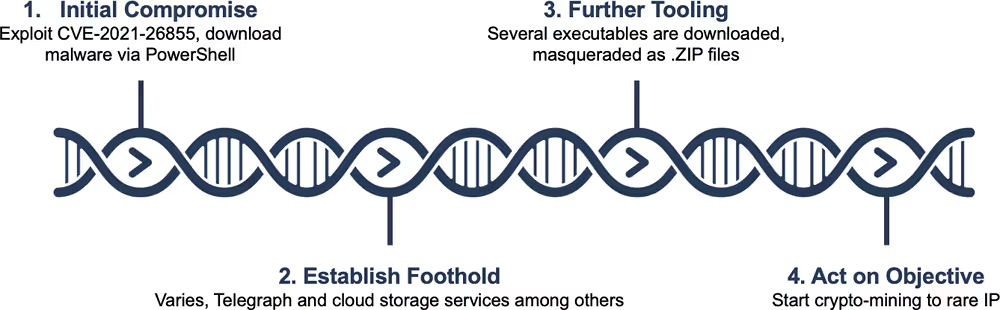
Figure 1: Timeline of a typical ProxyLogon exploit

After the ProxyLogon vulnerability was exploited, the Exchange servers reached out to the malicious domain microsoftsoftwaredownload[.]com, utilizing a PowerShell User Agent. Darktrace flagged this anomalous behavior as the particular User Agent had never been used before by the Exchange server, let alone to access a malicious domain which had never been observed in the network.
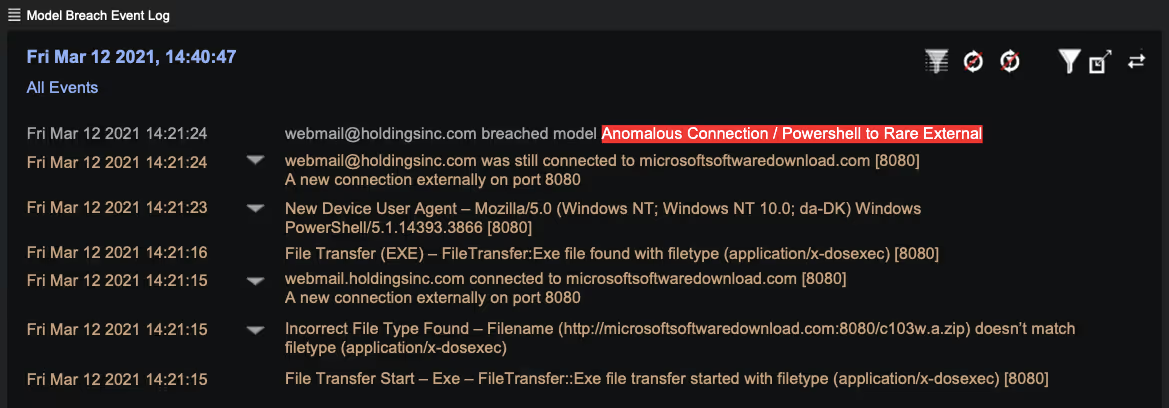
Figure 2: Darktrace revealing an anomalous PowerShell connection

The malware executable was masqueraded as a ZIP file, further trying to obfuscate the attack. Darktrace identified this highly anomalous file download and the masqueraded file.
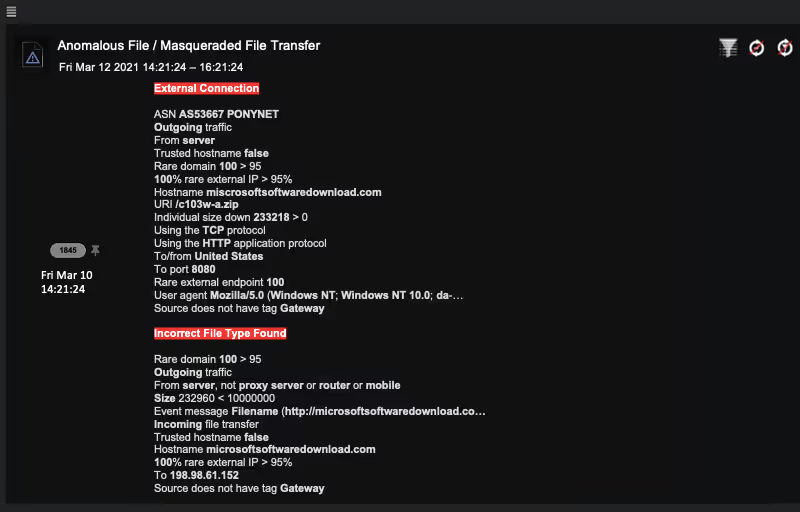
Figure 3: Darktrace revealing key information around the anomalous file download

In some cases, Darktrace AI also observed cryptocurrency mining seconds or minutes after the initial malware download.

Figure 4: Darktrace’s Crypto Currency Mining model is breached

In terms of C2 traffic, Darktrace has observed various potential channels. Around the time of the malware download, some of the Exchange servers began to beacon out to several external destinations using unusual SSL or TLS encrypted connections.

  • Telegra[.]ph — popular messenger application
  • dev.opendrive[.]com — cloud storage service
  • od[.]lk — cloud storage service

In this case, Darktrace recognized that none of these three external domains had ever been contacted before by anybody in the organization, let alone in a beaconing fashion. The fact that these communications started around the same time as the malware downloads strongly suggests a correlation. Darktrace’s Cyber AI Analyst automatically began an investigation into the incident, stitching together these events into one coherent narrative.

Investigating with AI

Cyber AI Analyst then automatically created a summary incident report about the activity, covering the malware download as well as the various C2 channels observed.
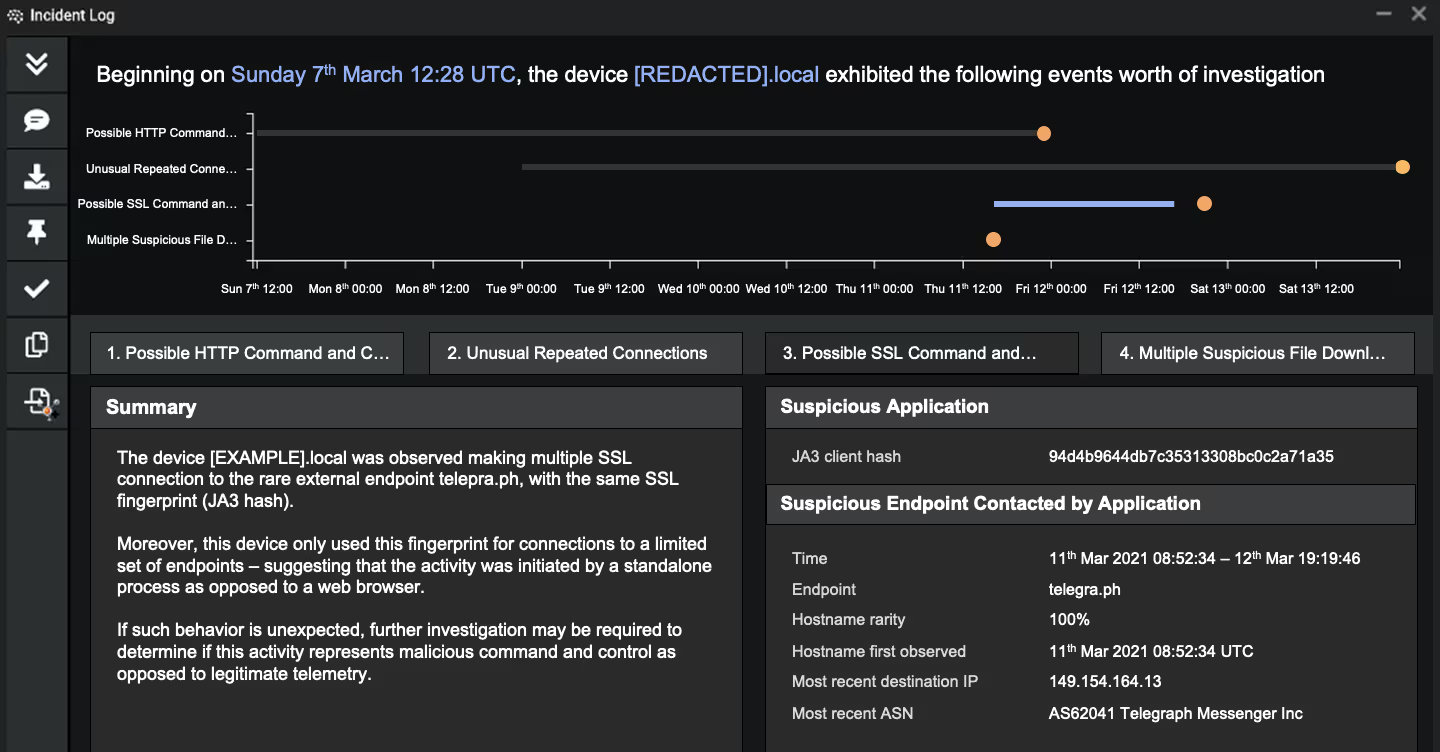
Figure 5: Cyber AI Analyst automatically generating a high-level incident summary

Looking at an infected Exchange server ([REDACTED].local) from a birds-eye perspective shows that Darktrace created various alerts when the attack hit. Every one of the colored dots in the graph below represents a major anomaly detected by Darktrace.
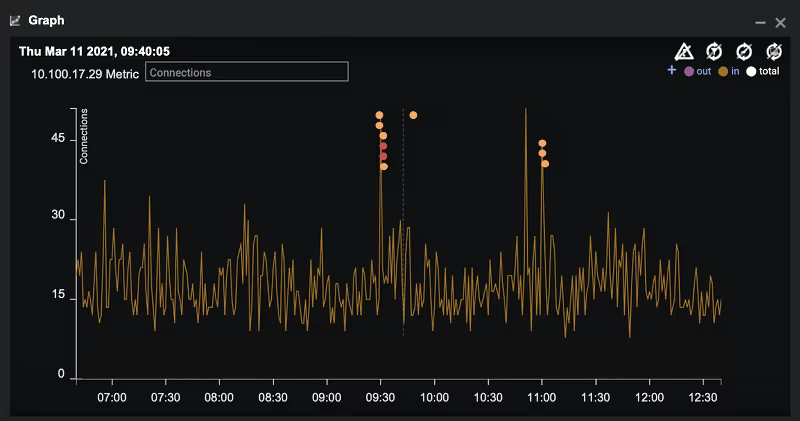
Figure 6: Darktrace reveals the anomalous number of connections and subsequent model breaches

This activity was prioritized as the most urgent incident in Cyber AI Analyst among a full week’s worth of data. In this particular organization, there were only four incidents for that week in total in Cyber AI Analyst. Such precise and clear alerting allows security teams to immediately understand the top threats facing their digital environment, without being overwhelmed by unnecessary alerts and false positives.

Machine-speed response

For customers with Darktrace Antigena, Antigena autonomously acted to block all outgoing traffic to malicious external endpoints on the relevant ports. This behavior is held for several hours to interrupt the threat actor from escalating the attack, while giving security teams time to react and remediate.

Antigena responded within seconds of the attack starting, effectively containing the attack in its earliest stage – without interrupting regular business activity (emails could still be sent and received), and despite this being a zero-day campaign.

Figure 7: Darktrace Antigena autonomously responds

Catching a zero-day exploit

This is not the first time Darktrace has stopped an attack leveraging a zero-day or a freshly released n-day vulnerability. Back in March 2020, Darktrace detected APT41 exploiting the Zoho ManageEngine vulnerability, two weeks before public attribution.

It is highly likely that there will be more cyber-criminals exploiting ProxyLogon in the wake of Hafnium. And while the recent Exchange server vulnerabilities were today’s threat, next time it might be a software or hardware supply chain attack, or a different zero-day. Novel threats are emerging every week. In this climate we now find ourselves in, where ‘known unknowns’ which are difficult or impossible to pre-define are the new norm, we need to be more adaptable and proactive than ever.

As soon as an attacker begins to exhibit unusual activity, Darktrace AI will detect it, even if there is no threat intelligence associated with the attack. This is where Darktrace works best, autonomously detecting, investigating and responding to advanced and never-before-seen threats in real time.

Learn more about the Darktrace Immune System

Example Darktrace model detections:

  • Antigena / Network / Compliance / Antigena Crypto Currency Mining Block
  • Compliance / Crypto Currency Mining Activity
  • Antigena / Network / Significant Anomaly / Antigena Breaches Over Time Block
  • Anomalous Connection / Suspicious Expired SSL
  • Antigena / Network / Significant Anomaly / Antigena Significant Anomaly from Client Block
  • Antigena / Network / Significant Anomaly / Antigena Enhanced Monitoring from Client Block
  • Device / Initial Breach Chain Compromise
  • Antigena / Network / Significant Anomaly / Antigena Breaches Over Time Block
  • Anomalous File / Masqueraded File Transfer
  • Anomalous File / EXE from Rare External Location
  • Antigena / Network / External Threat / Antigena Suspicious File Block
  • Antigena / Network / External Threat / Antigena File then New Outbound Block
  • Antigena / Network / Significant Anomaly / Antigena Controlled and Model Breach
  • Anomalous File / Internet Facing System File Download
  • Device / New PowerShell User Agent
  • Anomalous File / Multiple EXE from Rare External Locations
  • Anomalous Connection / Powershell to Rare External


Inside the SOC
Darktrace cyber analysts are world-class experts in threat intelligence, threat hunting and incident response, and provide 24/7 SOC support to thousands of Darktrace customers around the globe. Inside the SOC is exclusively authored by these experts, providing analysis of cyber incidents and threat trends, based on real-world experience in the field.
Written by
Max Heinemeyer
Global Field CISO

More in this series

No items found.

Blog

/

/

March 5, 2026

Inside Cloud Compromise: Investigating Attacker Activity with Darktrace / Forensic Acquisition & Investigation

Forensic Acquisition and investigationDefault blog imageDefault blog image

Investigating cloud attacks with Darktrace/ Forensic Acquisition & Investigation

Darktrace / Forensic Acquisition & Investigation™ is the industry’s first truly automated forensic solution purpose-built for the cloud. This blog will demonstrate how an investigation can be carried out against a compromised cloud server in minutes, rather than hours or days.

The compromised server investigated in this case originates from Darktrace’s Cloudypots system, a global honeypot network designed to observe adversary activity in real time across a wide range of cloud services. Whenever an attacker successfully compromises one of these honeypots, a forensic copy of the virtual server's disk is preserved for later analysis. Using Forensic Acquisition & Investigation, analysts can then investigate further and obtain detailed insights into the compromise including complete attacker timelines and root cause analysis.

Forensic Acquisition & Investigation supports importing artifacts from a variety of sources, including EC2 instances, ECS, S3 buckets, and more. The Cloudypots system produces a raw disk image whenever an attack is detected and stores it in an S3 bucket. This allows the image to be directly imported into Forensic Acquisition & Investigation using the S3 bucket import option.

As Forensic Acquisition & Investigation runs cloud-natively, no additional configuration is required to add a specific S3 bucket. Analysts can browse and acquire forensic assets from any bucket that the configured IAM role is permitted to access. Operators can also add additional IAM credentials, including those from other cloud providers, to extend access across multiple cloud accounts and environments.

Figure 1: Forensic Acquisition & Investigation import screen.

Forensic Acquisition & Investigation then retrieves a copy of the file and automatically begins running the analysis pipeline on the artifact. This pipeline performs a full forensic analysis of the disk and builds a timeline of the activity that took place on the compromised asset. By leveraging Forensic Acquisition & Investigation’s cloud-native analysis system, this process condenses hour of manual work into just minutes.

Successful import of a forensic artifact and initiation of the analysis pipeline.
Figure 2: Successful import of a forensic artifact and initiation of the analysis pipeline.

Once processing is complete, the preserved artifact is visible in the Evidence tab, along with a summary of key information obtained during analysis, such as the compromised asset’s hostname, operating system, cloud provider, and key event count.

The Evidence overview showing the acquired disk image.
Figure 3: The Evidence overview showing the acquired disk image.

Clicking on the “Key events” field in the listing opens the timeline view, automatically filtered to show system- generated alarms.

The timeline provides a chronological record of every event that occurred on the system, derived from multiple sources, including:

  • Parsed log files such as the systemd journal, audit logs, application specific logs, and others.
  • Parsed history files such as .bash_history, allowing executed commands to be shown on the timeline.
  • File-specific events, such as files being created, accessed, modified, or executables being run, etc.

This approach allows timestamped information and events from multiple sources to be aggregated and parsed into a single, concise view, greatly simplifying the data review process.

Alarms are created for specific timeline events that match either a built-in system rule, curated by Darktrace’s Threat Research team or an operator-defined rule  created at the project level. These alarms help quickly filter out noise and highlight on events of interest, such as the creation of a file containing known malware, access to sensitive files like Amazon Web Service (AWS) credentials, suspicious arguments or commands, and more.

 The timeline view filtered to alarm_severity: “1” OR alarm_severity: “3”, showing only events that matched an alarm rule.
Figure 4: The timeline view filtered to alarm_severity: “1” OR alarm_severity: “3”, showing only events that matched an alarm rule.

In this case, several alarms were generated for suspicious Base64 arguments being passed to Selenium. Examining the event data, it appears the attacker spawned a Selenium Grid session with the following payload:

"request.payload": "[Capabilities {browserName: chrome, goog:chromeOptions: {args: [-cimport base64;exec(base64...], binary: /usr/bin/python3, extensions: []}, pageLoadStrategy: normal}]"

This is a common attack vector for Selenium Grid. The chromeOptions object is intended to specify arguments for how Google Chrome should be launched; however, in this case the attacker has abused the binary field to execute the Python3 binary instead of Chrome. Combined with the option to specify command-line arguments, the attacker can use Python3’s -c option to execute arbitrary Python code, in this instance, decoding and executing a Base64 payload.

Selenium’s logs truncate the Arguments field automatically, so an alternate method is required to retrieve the full payload. To do this, the search bar can be used to find all events that occurred around the same time as this flagged event.

Pivoting off the previous event by filtering the timeline to events within the same window using timestamp: [“2026-02-18T09:09:00Z” TO “2026-02-18T09:12:00Z”].
Figure 5: Pivoting off the previous event by filtering the timeline to events within the same window using timestamp: [“2026-02-18T09:09:00Z” TO “2026-02-18T09:12:00Z”].

Scrolling through the search results, an entry from Java’s systemd journal can be identified. This log contains the full, unaltered payload. GCHQ’s CyberChef can then be used to decode the Base64 data into the attacker’s script, which will ultimately be executed.

Decoding the attacker’s payload in CyberChef.
Figure 6: Decoding the attacker’s payload in CyberChef.

In this instance, the malware was identified as a variant of a campaign that has been previously documented in depth by Darktrace.

Investigating Perfctl Malware

This campaign deploys a malware sample known as ‘perfctl to the compromised host. The script executed by the attacker downloads a Go binary named “promocioni.php” from 200[.]4.115.1. Its functionality is consistent with previously documented perfctl samples, with only minor changes such as updated filenames and a new command-and-control (C2) domain.

Perfctl is a stealthy malware that has several systems designed  to evade detection. The main binary is packed with UPX, with the header intentionally tampered with to prevent unpacking using regular tools. The binary also avoids executing any malicious code if it detects debugging or tracing activity, or if artifacts left by earlier stages are missing.

To further aid its evasive capabilities, perfctl features a usermode rootkit using an LD preload. This causes dynamically linked executables to load perfctl’s rootkit payload before other system modules, allowing it to override functions, such as intercepting calls to list files and hiding output from the returned list. Perfctl uses this to hide its own files, as well as other files like the ld.so.preload file, preventing users from identifying that a rootkit is present in the first place.

This also makes it difficult to dynamically analyze, as even analysts aware of the rootkit will struggle to get around it due to its aggressiveness in hiding its components. A useful trick is to use the busybox-static utilities, which are statically linked and therefore immune to LD preloading.

Perfctl will attempt to use sudo to escalate its permissions to root if the user it was executed as has the required privileges. Failing this, it will attempt to exploit the vulnerability CVE-2021-4034.

Ultimately, perfctl will attempt to establish a C2 link via Tor and spawn an XMRig miner to mine the Monero cryptocurrency. The traffic to the mining pool is encapsulated within Tor to limit network detection of the mining traffic.

Darktrace’s Cloudypots system has observed 1,959 infections of the perfctl campaign across its honeypot network in the past year, making it one of the most aggressive campaigns seen by Darktrace.

Key takeaways

This blog has shown how Darktrace / Forensic Acquisition & Investigation equips defenders in the face of a real-world attacker campaign. By using this solution, organizations can acquire forensic evidence and investigate intrusions across multiple cloud resources and providers, enabling defenders to see the full picture of an intrusion on day one. Forensic Acquisition & Investigation’s patented data-processing system takes advantage of the cloud’s scale to rapidly process large amounts of data, allowing triage to take minutes, not hours.

Darktrace / Forensic Acquisition & Investigation is available as Software-as-a-Service (SaaS) but can also be deployed on-premises as a virtual application or natively in the cloud, providing flexibility between convenience and data sovereignty to suit any use case.

Support for acquiring traditional compute instances like EC2, as well as more exotic and newly targeted platforms such as ECS and Lambda, ensures that attacks taking advantage of Living-off-the-Cloud (LOTC) strategies can be triaged quickly and easily as part of incident response. As attackers continue to develop new techniques, the ability to investigate how they use cloud services to persist and pivot throughout an environment is just as important to triage as a single compromised EC2 instance.

Credit to Nathaniel Bill (Malware Research Engineer)

Continue reading
About the author
Nathaniel Bill
Malware Research Engineer

Blog

/

Network

/

February 19, 2026

CVE-2026-1731: How Darktrace Sees the BeyondTrust Exploitation Wave Unfolding

Default blog imageDefault blog image

Note: Darktrace's Threat Research team is publishing now to help defenders. We will continue updating this blog as our investigations unfold.

Background

On February 6, 2026, the Identity & Access Management solution BeyondTrust announced patches for a vulnerability, CVE-2026-1731, which enables unauthenticated remote code execution using specially crafted requests.  This vulnerability affects BeyondTrust Remote Support (RS) and particular older versions of Privileged Remote Access (PRA) [1].

A Proof of Concept (PoC) exploit for this vulnerability was released publicly on February 10, and open-source intelligence (OSINT) reported exploitation attempts within 24 hours [2].

Previous intrusions against Beyond Trust technology have been cited as being affiliated with nation-state attacks, including a 2024 breach targeting the U.S. Treasury Department. This incident led to subsequent emergency directives from  the Cybersecurity and Infrastructure Security Agency (CISA) and later showed attackers had chained previously unknown vulnerabilities to achieve their goals [3].

Additionally, there appears to be infrastructure overlap with React2Shell mass exploitation previously observed by Darktrace, with command-and-control (C2) domain  avg.domaininfo[.]top seen in potential post-exploitation activity for BeyondTrust, as well as in a React2Shell exploitation case involving possible EtherRAT deployment.

Darktrace Detections

Darktrace’s Threat Research team has identified highly anomalous activity across several customers that may relate to exploitation of BeyondTrust since February 10, 2026. Observed activities include:

Outbound connections and DNS requests for endpoints associated with Out-of-Band Application Security Testing; these services are commonly abused by threat actors for exploit validation.  Associated Darktrace models include:

  • Compromise / Possible Tunnelling to Bin Services

Suspicious executable file downloads. Associated Darktrace models include:

  • Anomalous File / EXE from Rare External Location

Outbound beaconing to rare domains. Associated Darktrace models include:

  • Compromise / Agent Beacon (Medium Period)
  • Compromise / Agent Beacon (Long Period)
  • Compromise / Sustained TCP Beaconing Activity To Rare Endpoint
  • Compromise / Beacon to Young Endpoint
  • Anomalous Server Activity / Rare External from Server
  • Compromise / SSL Beaconing to Rare Destination

Unusual cryptocurrency mining activity. Associated Darktrace models include:

  • Compromise / Monero Mining
  • Compromise / High Priority Crypto Currency Mining

And model alerts for:

  • Compromise / Rare Domain Pointing to Internal IP

IT Defenders: As part of best practices, we highly recommend employing an automated containment solution in your environment. For Darktrace customers, please ensure that Autonomous Response is configured correctly. More guidance regarding this activity and suggested actions can be found in the Darktrace Customer Portal.  

Appendices

Potential indicators of post-exploitation behavior:

·      217.76.57[.]78 – IP address - Likely C2 server

·      hXXp://217.76.57[.]78:8009/index.js - URL -  Likely payload

·      b6a15e1f2f3e1f651a5ad4a18ce39d411d385ac7  - SHA1 - Likely payload

·      195.154.119[.]194 – IP address – Likely C2 server

·      hXXp://195.154.119[.]194/index.js - URL – Likely payload

·      avg.domaininfo[.]top – Hostname – Likely C2 server

·      104.234.174[.]5 – IP address - Possible C2 server

·      35da45aeca4701764eb49185b11ef23432f7162a – SHA1 – Possible payload

·      hXXp://134.122.13[.]34:8979/c - URL – Possible payload

·      134.122.13[.]34 – IP address – Possible C2 server

·      28df16894a6732919c650cc5a3de94e434a81d80 - SHA1 - Possible payload

References:

1.        https://nvd.nist.gov/vuln/detail/CVE-2026-1731

2.        https://www.securityweek.com/beyondtrust-vulnerability-targeted-by-hackers-within-24-hours-of-poc-release/

3.        https://www.rapid7.com/blog/post/etr-cve-2026-1731-critical-unauthenticated-remote-code-execution-rce-beyondtrust-remote-support-rs-privileged-remote-access-pra/

Continue reading
About the author
Emma Foulger
Global Threat Research Operations Lead
Your data. Our AI.
Elevate your network security with Darktrace AI